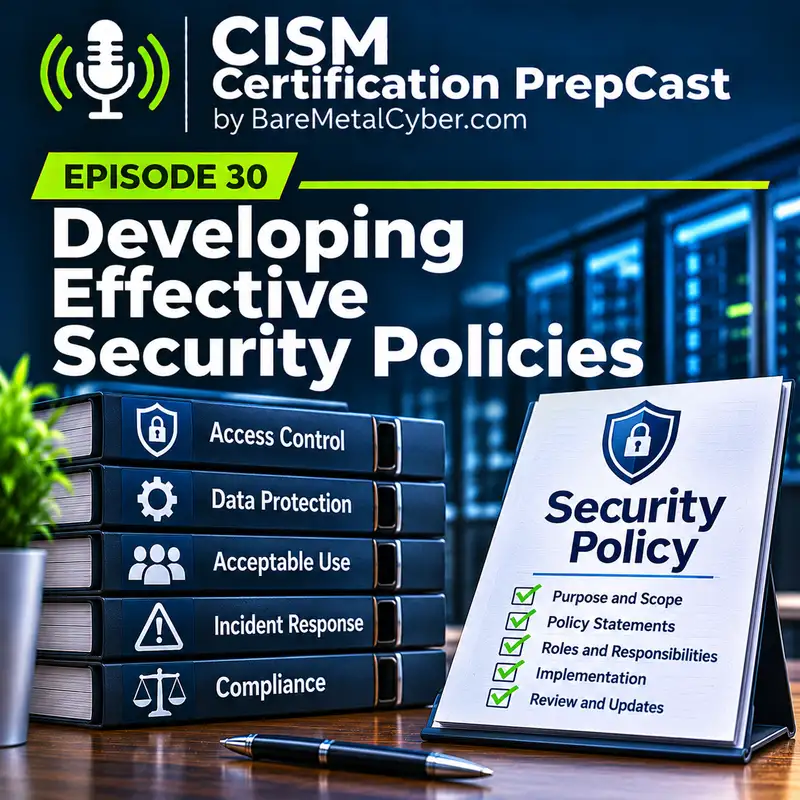
Developing Effective Security Policies
In this episode, we are developing effective security policies. A policy should establish authorized direction that people can understand and the organization can enforce. We will focus on the hierarchy from policy to standards and procedures, along with ownership, approval, exceptions, communication, and maintenance.
Consider a fictional research company called Northwind Research. Its remote-work policy says employees must protect confidential information, but it does not define approved storage, required authentication, exception authority, or what happens when a project depends on a specialized external platform. Employees make inconsistent decisions, managers approve informal workarounds, and the security team discovers the pattern during an audit. The policy sounds responsible, yet it does not create executable direction. A stronger approach would define the purpose and scope, identify accountable owners, connect mandatory statements to standards and controls, establish an exception process, and require review when technology or obligations change. The lesson is that policy quality is measured by the decisions and behavior it produces, not by polished language. This fictional teaching scenario also exposes an exam cue: when a policy is ignored, the best first response is often to examine clarity, feasibility, ownership, communication, and enforcement before assuming that additional punishment will solve the problem.
An effective policy begins with enforceable direction rather than vague aspiration. An enforceable policy starts by being unambiguous about what it governs, who it governs, and why the organization cares. If a reader cannot tell whether the policy applies to corporate laptops, contractor devices, cloud workloads, or all of the above, the policy will be “interpreted” into irrelevance. Enforceability also depends on the policy being tied to a business objective that survives leadership turnover, such as protecting customer data, meeting contractual requirements, or ensuring operational resilience. In exam terms, the policy is the “what and why,” not the “how,” and it should remain stable even when technologies change.
Scope is where most policies quietly fail, because scope is where people hide. A policy that says “all systems must be secure” is a wish, not a directive, because neither “all systems” nor “secure” has an operational meaning. An enforceable policy defines covered assets and covered populations using language that maps to how the organization already inventories and manages reality: business units, system classifications, data types, environments, and ownership roles. When scope is explicit, a disagreement becomes a compliance decision rather than a debate about vocabulary.
Policies become enforceable when they use testable verbs and avoid subjective adjectives. Words like “should,” “as appropriate,” and “where feasible” are useful in guidance, but they are the enemy of accountability because they create infinite escape hatches. Strong policy statements use “must” or “shall” and connect them to observable conditions, such as “must use organization-approved authentication mechanisms” rather than “must use strong authentication.” The best policies also reduce the number of interpretations by defining key terms once and using them consistently, especially for terms like “confidential data,” “production,” “privileged access,” and “third party.”
Roles and accountability are not administrative niceties; they are enforcement mechanisms. If a policy says “management is responsible,” enforcement will fail because nobody knows which management, and enforcement will become a political negotiation. An enforceable policy assigns responsibility to defined roles such as asset owner, system owner, data owner, control owner, and risk owner, and it distinguishes who approves, who implements, and who attests. This matters because a policy violation is rarely a technical mystery; it is usually a governance failure where responsibility was either vague or socially inconvenient.
A practical way to test enforceability is to imagine an auditor, an engineer, and a business executive reading the same paragraph and arriving at the same compliance outcome. If the engineer cannot translate it into a control expectation, the policy will never reach implementation. If the executive cannot see the business rationale, the policy will lose priority the first time it competes with revenue or delivery timelines. If the auditor cannot determine evidence that would confirm compliance, enforcement becomes arbitrary, which invites exceptions as a routine operating model rather than a governed decision.
Enforceable policies anticipate change without turning into vague platitudes. Technology changes quickly, but most governance failures are predictable: shadow IT, rushed deployments, inherited vendor risk, and workarounds created under deadline pressure. An enforceable policy stays durable by referencing organizational decision points rather than brand names, such as “all externally accessible services must undergo documented security review before production exposure.” This keeps the policy relevant when infrastructure shifts from on-premises to cloud or from virtual machines to containers, without rewriting the policy every quarter.
One exam-style scenario shows how enforceability fails in the real world: a business unit launches a customer-facing portal and argues that the access control policy does not apply because the portal is “hosted by a vendor,” and the vendor’s documentation says they are “secure by design.” The security team cannot point to a clear scope statement that includes vendor-hosted services, and the policy uses “should” language for review and testing. The launch proceeds, and later an incident review reveals that nobody performed a security assessment because “it wasn’t required.” The best answer logic is that enforceability comes from precise scope and mandatory language tied to a decision gate, not from faith in vendor assurances.
Enforcement also requires a credible mechanism for handling noncompliance that does not collapse into either chaos or tyranny. If every deviation triggers punitive action, people will route around security and stop reporting problems early. If deviations are routinely ignored, the policy becomes performative, and leadership learns that policy compliance is optional. Enforceable policy acknowledges that exceptions may be necessary, but it frames them as time-bound risk decisions that require documented approval by the appropriate risk owner, not as informal permissions granted by whoever complains the loudest.
Finally, an enforceable policy is written with the assumption that it will be read under stress, by someone who wants to finish a project today. That means shorter sentences, consistent terminology, and requirements that map to existing processes like procurement, change management, access provisioning, and incident response. Policies that require heroism to follow will be ignored by good people doing their best in imperfect conditions. The goal is not to create the most comprehensive statement of security ideals, but to create a durable governance instrument that can be applied consistently, evidenced objectively, and defended rationally when the organization is asked, “Why did you choose this level of control?”
Standards turn policy intent into measurable requirements that can be evaluated. Standards translate policy intent into requirements that can be checked, repeated, and defended. A policy might say the organization will protect sensitive information, but a standard specifies what “protect” means in measurable terms, such as approved encryption use, access control expectations, and baseline configuration requirements. In practice, standards are where governance becomes operational, because they give engineers and operators something they can implement without guessing what leadership “meant.” In exam logic, policies express direction, while standards define the minimum acceptable level of performance.
Connect the architecture decisions in an earlier program-development lesson to this hierarchy. A principle may call for access to reflect business purpose. A standard makes that expectation testable, for example by requiring supplier users to be individually identifiable and limited to approved records. An architecture pattern shows how identity, application permissions, and monitoring work together to meet the requirement. A procedure explains how an operator provisions or removes access. State which requirements are mandatory and which implementation choices remain delegated.
A measurable standard uses objective criteria that produce the same compliance decision regardless of who reads it. When a standard says “use strong passwords,” it invites arguments about what “strong” means and whether the requirement was met. When a standard specifies minimum password length, checks against compromised values, and conditions requiring a credential reset, it becomes testable. Those requirements should follow current guidance and the chosen authentication model, rather than preserving outdated complexity or routine rotation rules. Measurability also requires the standard to define the population it applies to, because “all accounts” means something different in workforce identity systems, service accounts, and consumer identity platforms.
Standards should be written with evidence in mind, because standards without evidence are aspirational. A measurable requirement is paired with an audit-friendly way to show compliance, such as configuration baselines, system inventory attributes, control attestations, logging data, or automated compliance checks.
Evidence does not need to be perfect, but it must be possible to produce it without extraordinary effort or manual heroics. If the only way to prove compliance is a custom script run by one expert who is always on vacation, the standard is not operationally viable.
A common failure mode is mixing standards with procedures, which makes both weaker. A standard should specify the “what” in testable form, such as approved protocols, minimum logging retention, or required review frequency. The procedure then describes the “how,” such as the steps to configure a system, submit a change, or complete an access review. When standards try to include detailed step-by-step instructions, they become brittle and outdated quickly, which creates a perverse incentive to ignore the standard rather than revise it.
Standards must also be written at the correct level of abstraction for the organization’s operating model. If the organization runs centralized infrastructure with consistent tooling, standards can be quite specific and still remain enforceable. If the organization is federated across business units, standards often need to define outcomes and constraints while allowing implementation flexibility, or they will be rejected as unrealistic. The measurable part is not the level of detail itself, but whether the requirement can be validated and whether a responsible party can be held accountable.
An exam-style scenario makes the point: an audit finds inconsistent encryption for customer data across different applications, and leaders respond by issuing a policy statement that “all customer data must be encrypted.” Engineering teams interpret this differently, one encrypts data at rest only, another relies on TLS, and a third assumes the database vendor covers it. The finding persists because the organization lacks a data protection standard that defines where encryption is required, what algorithms or mechanisms are approved, and what exceptions look like. The best answer is to develop a measurable standard that creates consistent, testable requirements rather than relying on policy language to do operational work.
Standards should explicitly account for risk-based variation without turning into a menu of personal preferences. One way standards accomplish this is by tying requirements to classifications, such as data sensitivity levels or system criticality tiers, with different minimums for each tier. This is still measurable because classification criteria can be defined and because each tier’s control expectations can be verified. The point is not to create complexity for its own sake, but to avoid the trap of imposing the highest-control requirements on low-risk systems, which encourages noncompliance across the board.
Lifecycle management is part of measurability, because a standard that cannot be kept current will quietly die. Standards should have an owner, a review cadence, and a change mechanism that aligns with how the organization manages updates, whether through a governance committee, a risk function, or architecture review. Measurable requirements should also be versioned so teams can prove which standard applied at a point in time, especially when dealing with long-running projects. Without version control and review discipline, standards become a set of conflicting documents that teams cite selectively to justify whatever they planned to do anyway.
Finally, standards work best when they are written for adoption, not merely for compliance theater. That means using clear “shall” or “must” language, minimizing exceptions, and ensuring the requirements align with how systems are actually built and operated. A measurable standard is not necessarily a strict standard; it is a standard that can be enforced consistently and evidenced reliably. When standards are measurable, they reduce ambiguity, accelerate decision-making, and make security expectations predictable, which is exactly what busy organizations need when they are trying to move fast without turning every release into a governance negotiation.
Exceptions must preserve governance rather than create an informal route around it. Exceptions are inevitable in real organizations because projects move faster than governance documents can be revised and because some systems have constraints that make a baseline requirement temporarily impractical. The problem is not that exceptions exist; the problem is when exceptions become the default operating model and quietly redefine the organization’s risk posture. A waiver is a formal, time-bound decision to accept a deviation from a policy or standard requirement, typically because compensating controls or business constraints make strict compliance unreasonable in the moment. When waivers are treated as governance, they preserve credibility; when waivers are treated as convenience, governance collapses into “security is negotiable.”
The foundation for exception handling is clarity about what can be waived and what cannot. Some requirements should be non-negotiable because they protect core safety boundaries, legal obligations, or systemic resilience, such as core access control principles, segregation of duties for high-risk functions, or mandatory incident reporting timelines. Other requirements may be waiver-eligible with conditions, such as timelines for remediation, deployment of compensating controls, or temporary use of legacy technology. Governance collapses when everything is waiver-eligible or when waiver eligibility is decided ad hoc based on who asks.
A controlled waiver process ensures the right decision-maker owns the risk, not the person experiencing the inconvenience. If the control owner approves their own noncompliance, the process is structurally biased toward “yes,” because the same party bears the operational friction and controls the approval. Effective governance separates request, analysis, and approval so that the risk owner can make an informed decision with input from security and operations. The core exam logic is that risk acceptance belongs to management, and the waiver mechanism is how that principle shows up in day-to-day operations.
The most important design feature of waivers is time-boundedness with explicit expiration. A waiver without an end date is not a waiver; it is a permanent policy rewrite done in the shadows. Expiration creates a forcing function to remediate, replace, or formally adjust the baseline if the requirement is no longer appropriate. Time-boundedness also allows governance to tolerate practical constraints without becoming cynical, because the exception is treated as a temporary risk posture, not a new normal.
An exam-style scenario shows how governance collapses when exceptions are unmanaged: a revenue-critical application cannot meet a logging retention standard due to storage constraints, so the team requests “temporary relief.” The request is approved informally via email, no compensating control is defined, and the waiver is never revisited because the system keeps generating revenue. Months later, an incident investigation fails to reconstruct actions because the relevant logs were overwritten, and leadership is surprised because they believed the standard was in place. The best answer is not simply “increase retention” but to implement a formal waiver process with a risk owner decision, compensating controls, and an expiration date.
A mature waiver process requires structured justification that is specific enough to be reviewed and challenged. The request should identify the exact requirement being waived, the scope of affected systems, and the operational constraint preventing compliance. It should include a risk statement describing what could happen because of the deviation, not just why the team dislikes the requirement. It should also specify compensating controls or interim safeguards, along with a remediation plan that explains how compliance will be achieved or how the baseline will be updated through governance.
Waivers must be measurable and auditable, because undocumented exceptions create invisible risk. Governance collapses when waiver tracking is scattered across inboxes, when evidence of approvals cannot be produced, or when nobody can report how many waivers exist and which ones are overdue. The organization should be able to answer basic questions without improvisation, such as which standards generate the most waivers, which business units rely on exceptions, and which waivers are approaching expiration. This is not bureaucracy for its own sake; it is basic risk visibility and control integrity.
Exception handling should also include escalation paths and consequences that are predictable, not punitive. If the waiver is denied, there should be a clear route for reconsideration based on new information, alternative compensating controls, or revised scope. If a waiver expires without remediation, the organization should have a defined response, such as forcing a risk acceptance renewal at a higher authority level, restricting exposure, or prioritizing remediation funding. Governance collapses when expired waivers are silently extended by default or when teams learn that deadlines do not matter.
Finally, the waiver process should produce learning, not just paperwork. If the same requirement generates frequent waivers, the organization may have a standards problem, a tooling problem, or a capability gap that needs investment. Repeated waivers can indicate that the baseline is misaligned with the operating environment or that implementation support is insufficient for teams to comply. When governance uses exception trends to improve standards, align procedures, and fund control enablement, waivers become a mechanism for resilience rather than an escape hatch that slowly erodes the entire control program.
Now apply the idea to the management decision at hand. Policy is the organization’s authoritative statement of intent, written at a level that executives can approve and that the enterprise can be held accountable to follow. It answers “what must be true” and “why it matters,” not “how to click the buttons.” A well-formed policy names the scope, the objective, the ownership, and the enforcement expectation, and it ties directly to risk appetite and legal or contractual obligations. In governance terms, policy is the mandate that gives security the right to require behavior, not merely recommend it.
an earlier lesson develops the drafting, ownership and maintenance workflow for this hierarchy. Standards translate policy into measurable requirements that can be implemented consistently across teams and technologies. Where policy says data must be protected, a standard specifies the acceptable methods and minimum thresholds, such as required encryption types, key management expectations, logging minimums, or identity assurance levels. Standards are designed to be testable, because they become the basis for audits, assessments, and compliance reporting. If a requirement cannot be assessed consistently, it probably belongs in a guideline rather than a standard.
Guidelines are recommended practices that support good decisions when rigid requirements would be counterproductive or too context-dependent. They provide guardrails and examples without creating a compliance obligation that must be enforced universally. Guidelines are particularly useful in areas where the threat landscape changes quickly or where teams need flexibility to innovate while still staying within acceptable risk boundaries. In exam terms, guidelines are “strongly advised,” but they do not carry the same enforcement weight as standards tied to policy mandates.
A common failure mode is writing policies that read like procedures and then wondering why nobody follows them. When policy includes tool-specific instructions or detailed technical configurations, it becomes brittle and requires constant rewrites for operational change that should not require executive approval. Conversely, when standards read like motivational posters, they fail because they do not define what “good” looks like in a way that can be verified. The hierarchy exists to keep each artifact at the right altitude, so governance can remain stable while operations can evolve.
This structure matters most during audit and incident response, when questions shift from “what did you intend” to “what did you require” and “what did you do.” If an incident exposes that a control was inconsistently applied, the organization needs to show that policy set the expectation, standards defined testable requirements, and procedures operationalized them in a repeatable way. If any layer is missing, the organization is forced to defend itself with ad hoc rationale rather than documented governance. Strong hierarchy does not prevent incidents by itself, but it prevents governance from improvising after the fact.
An exam-style scenario illustrates the difference: a business unit claims it is “following the policy” because staff received awareness training, yet the audit finds inconsistent multi-factor authentication enforcement and incomplete privileged access logging. Training might satisfy a guideline or a procedural step, but it does not substitute for a standard that defines authentication requirements and logging baselines. The best governance answer is to ensure the policy mandates strong access control, the standard specifies measurable access requirements, and the procedure defines exactly how enforcement and evidence collection occur. That hierarchy creates a chain from executive intent to operational proof, which is what auditors, regulators, and leadership ultimately expect.
Now apply the idea to the management decision at hand. A fast-growing software company proudly points to a comprehensive set of security policies during an audit, yet the incident response review shows teams routinely bypassed access procedures and stored secrets in shared documents. Nobody can identify which policy version applied at the time, and exceptions were granted verbally without traceable rationale. The gap is not “lack of documentation,” because there is plenty of it, but lack of documentation that shapes real decisions and can be enforced. In exam terms, governance documentation is effective only when it is authoritative, current, communicated, and tied to accountability and evidence. Paper that cannot be used to make or defend decisions is not governance; it is a library.
Governance documentation begins with a hierarchy, because not every document carries the same authority or intended audience. A policy states non-negotiable organizational intent and expectations, and it should be stable enough that it does not change every quarter. A standard translates policy into specific mandatory requirements, such as minimum logging, encryption expectations, or identity assurance levels, and it should be precise enough to assess compliance. Procedures and work instructions describe how to execute the standards in the organization’s operating model, including who does what and what evidence is produced. Guidelines and reference material can be optional and situational, but they must be clearly labeled as such to avoid confusion. The exam logic favors clear separation, because ambiguous document types let teams argue that “it was only guidance” after the fact.
Documentation drives behavior when it is written as a decision tool rather than as a narrative about good intentions. Effective policy language is concrete about scope, applicability, and enforcement, including what happens when requirements cannot be met. Effective standards use measurable statements that can be tested, such as required control outcomes, approval thresholds, and evidence artifacts, without embedding product-specific implementation details. Effective procedures align to how work actually flows, including ticketing systems, change management steps, and operational handoffs, so following them is the path of least resistance. When documentation is aspirational and detached from workflow, teams default to the workflow, not the PDF. For exam scenarios, the best answer often emphasizes operational integration over “write a new policy.”
Ownership and lifecycle management are the control points that keep documentation from drifting into irrelevance. Every policy and standard should have a named owner who is responsible for content accuracy, periodic review, and alignment with enterprise risk appetite. Reviews should be triggered by material changes such as new regulations, major architecture shifts, acquisitions, or significant incidents, not only by an arbitrary annual date. Version control should be disciplined so the organization can prove what was in effect at a given time and why it changed. Approval authority should match impact, with higher-impact policies approved at higher levels, because governance documents are an extension of decision rights. If ownership is unclear, documentation becomes stale, and stale governance becomes a liability.
Communication is not a broadcast; it is ensuring the right roles can find, understand, and apply the content at the moment of need. Documentation should be accessible in a single authoritative repository with clear navigation, rather than scattered across drives, wikis, and email attachments. The content should be written for the intended reader, which means executives get principles and accountability expectations, while practitioners get actionable requirements and steps. Terminology should be consistent across documents so teams are not forced to interpret mismatched definitions of “critical system,” “high risk,” or “privileged access.” When policies use vague language like “appropriate” without defining criteria, enforcement becomes subjective and inconsistent. In exam terms, clarity reduces interpretive risk and strengthens auditability.
Enforcement mechanisms are what convert documentation from advice into governance, and they must be designed into processes and technology where possible. If a standard requires approvals, the approval path should be implemented in the access management or ticketing system, not left to memory. If a standard requires logging, the logging pipeline and retention settings should be centrally managed or continuously monitored, not dependent on each team’s best effort. If a procedure requires evidence, evidence collection should be part of the workflow, such as automated change records, access reviews, and configuration baselines. The more governance relies on voluntary compliance, the more it will degrade under time pressure, staffing shortages, and competing incentives. The exam-friendly view is that governance documentation is strongest when controls make compliance easy and noncompliance visible.
Exceptions are where documentation proves whether it is real, because every organization encounters situations where requirements cannot be met on schedule. Effective governance documents define how exceptions are requested, who can approve them, what information must be included, and how long they can last. They also define compensating controls and monitoring expectations, because an exception without compensating action is often unmanaged risk disguised as pragmatism. Exception records should be traceable, time-bound, and periodically reviewed, because “temporary” exceptions are prone to becoming permanent through inertia. When exception handling is absent, teams invent their own methods, and governance becomes uneven across the enterprise. On exams, a defined exception process is frequently the differentiator between mature governance and performative policy.
Documentation should also map explicitly to the organization’s control environment so it can be assessed and improved. Policies and standards should be linked to control objectives, and those control objectives should be evaluated through assurance activities such as internal audits, control testing, and monitoring. Findings should feed back into document updates, training, and process redesign, creating a loop where governance evolves based on evidence rather than opinion. When a control fails, the question is whether the requirement was unclear, infeasible, or poorly implemented, and documentation should be updated accordingly. This makes governance documentation a living system rather than a one-time deliverable. The exam expects you to prioritize this feedback loop because it aligns with continuous improvement and accountability.
Finally, governance documentation drives behavior when it is aligned with incentives and performance expectations for leaders and teams. If leaders are measured only on delivery speed and cost reduction, security standards will be treated as obstacles regardless of how well written they are. If leaders are also measured on risk outcomes, resilience, and control performance, standards become part of how success is defined. Documentation should therefore be reflected in roles and responsibilities, decision gates, and acceptance criteria for projects and operations. When governance is embedded in how work is planned, approved, and reviewed, compliance becomes normal rather than exceptional. That is the operational reality the exam is testing: documentation that is usable, enforceable, and tied to accountability.
Return to the fictional scenario from the beginning of this lesson on developing effective security policies. The strongest management response is not a slogan or an isolated tool purchase. It is a documented decision that connects business impact, authority, evidence, operating responsibility, and follow-through. Ask what must be true before the organization can proceed, who is accountable for making or accepting the decision, and how the result will be verified over time. That reasoning pattern helps on the CISM exam because it prevents a technically plausible action from being mistaken for the best management action.
For practice, review a policy statement such as employees must protect confidential information. Rewrite it so the purpose, scope, mandatory direction, owner, supporting standard, exception authority, enforcement approach, and review trigger are clear. Then test whether the statement can be applied to a realistic situation without relying on unwritten assumptions. If reasonable people would reach incompatible decisions, the policy hierarchy still needs work.