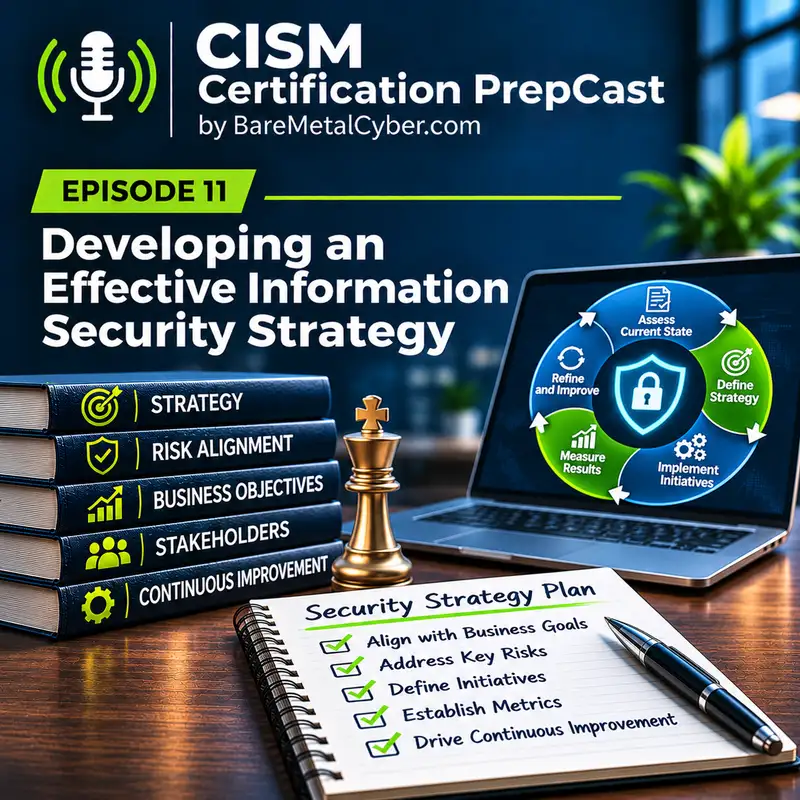
Developing an Effective Information Security Strategy
In this episode, we are examining developing an effective information security strategy. A security strategy is a set of choices about how the organization will manage information risk in support of enterprise objectives. It is not a list of technologies, a compliance checklist, or a collection of projects that happen to be funded in the same year.
Imagine a fictional manufacturer expanding into connected products and international services. The company needs growth, dependable operations, customer trust, and legal compliance. The security strategy must connect those goals to architecture, capabilities, priorities, resources, and evidence over several planning horizons.
Strategy development starts with an uncomfortable truth: security strategy is not a wish list, it is a response to the environment the enterprise actually operates in. The threat landscape is one input, but it is never "the" input in isolation because threats only matter when they can affect something the organization values. A practical strategy begins by mapping what the organization depends on (revenue paths, critical services, regulated data, and operational processes) then asking how those dependencies are exposed. When security leaders skip this grounding step, they tend to over-invest in controls that look impressive but do not materially change risk.
A useful threat landscape input is specific, time-bound, and tied to plausible attack paths, not generic headlines. Threat intelligence should be treated as decision support, not entertainment, and it should be filtered to the organization's sector, geography, technology stack, and business model. On first use, define what matters: a key risk indicator (KRI) is a measurable signal that risk is increasing, and a key performance indicator (KPI) is a measurable signal that a control or process is performing as intended. If threat reporting cannot drive a change in KRI's, KPI's, priorities, or control design, it is noise that will crowd out better inputs.
Consider an exam-style scenario: a mid-market manufacturer sees a spike in ransomware coverage and proposes "zero trust everywhere" as the strategy. In the same quarter, the company is rolling out remote access for third-party maintenance on production systems, and their patching window is limited by uptime commitments. The best answer is not to argue about slogans, but to translate the threat into concrete exposure: externally reachable services, credential pathways, backup integrity, and recovery readiness. In that moment, strategy inputs are the remote access architecture, the operational tolerance for downtime, and the ransomware tactics most likely to target that industry, not a broad philosophy statement.
Business plans are the second major input, and they are often the one security teams underweight until it is too late. Strategy should incorporate growth goals, new channels, product launches, data monetization plans, mergers and acquisitions, outsourcing, and cloud adoption because each one changes the risk surface and the control baseline. If the enterprise plans include entering a regulated market, integrating acquired identity systems, or building an application programming interface (API) ecosystem, security strategy must anticipate those transitions rather than react after the fact. A security leader who cannot speak in the language of business plans will struggle to justify sequencing, staffing, and investment decisions.
The highest-value business-plan artifacts are the ones that expose dependencies and timing. A business impact analysis (BIA) identifies which processes are most critical and the consequences of disruption, and it usually provides recovery time objectives (RTO targets) and recovery point objectives (RPO targets) that shape resilience requirements. A product roadmap reveals where data will be collected, processed, and shared, which determines privacy obligations and third-party risk. Strategic partnerships and vendor reliance introduce concentration risk, where a single external failure can cascade across multiple business services. When these inputs are treated as first-class strategy drivers, security becomes a constraint-aware enabler rather than an after-the-fact reviewer.
Constraints are the third category of strategy inputs, and they are not just budget lines. Constraints include staffing capacity, skill mix, procurement cycles, architectural reality, legacy technology, technical debt, and the operational cost of control ownership. They also include governance constraints such as risk appetite, which is the amount and type of risk the enterprise is willing to accept in pursuit of objectives, and risk tolerance, which is the acceptable variation around specific performance or risk thresholds. A strategy that assumes unlimited engineering time, perfect asset inventories, or instant segmentation is a strategy that will fail at execution.
Regulatory and contractual constraints also shape the feasible strategy space, sometimes more than the threat landscape does. Requirements tied to privacy, payment data, critical infrastructure, or customer security addenda can mandate specific capabilities like audit logging, encryption, access reviews, and incident reporting timelines. Service level agreements (SLA's) may limit downtime for maintenance, which affects patching strategy and drives compensating controls such as virtual patching, isolation, or enhanced monitoring. In complex environments, the constraint is not "we can't do security," it is "we must do security within uptime, cost, and compliance boundaries that are not negotiable." Mature strategy work makes those boundaries explicit so prioritization decisions are defensible.
A practical way to validate inputs is to check whether they agree across governance layers rather than contradict each other. Enterprise risk management (ERM) sets risk framing and reporting expectations, while governance, risk, and compliance (GRC) processes define how policies, exceptions, and evidence are managed. If business leadership expects rapid digital expansion but also expects zero operational disruption, the constraint conflict must be surfaced and resolved as a strategic decision, not hidden inside project-level debates. When inputs are aligned, strategy can focus on tradeoffs like "reduce likelihood" versus "reduce impact," and "prevent" versus "detect and respond," based on what the enterprise actually needs.
The quality of strategy inputs ultimately depends on how well they are translated into a common risk language that executives can act on. Threat data should be expressed as credible scenarios against real assets, business plans should be expressed as changes to the operating model and data flows, and constraints should be expressed as limits that drive sequencing and control selection. When those three inputs are gathered with discipline, security strategy becomes a set of deliberate choices rather than a list of controls.
Strategy becomes executable when it is connected to enterprise architecture. Current, target, and transition views reveal dependencies and prevent the roadmap from becoming a collection of disconnected aspirations.
Enterprise architecture is a maintained view of how the enterprise's business capabilities, information, applications, and supporting technology work together. It helps leaders judge whether a proposed change supports the mission and what else must change with it. The security manager uses this view to connect business impact to design choices, shared dependencies, and investment. A network diagram alone cannot explain those relationships.
The business view describes what the organization must be able to do, such as fulfill an order or resolve a customer complaint, and who is accountable for that outcome. The data view describes the information required, its ownership and sensitivity, and where it moves. The application view identifies the services and integrations that process the information. The technology view identifies the infrastructure and platforms those applications depend on. Read across these views: a change to customer data may affect service delivery, application interfaces, access decisions, and recovery arrangements at the same time.
A current-state view describes what actually operates today. Validate it with business and technical owners because an approved diagram may omit a manual workaround or a newly connected provider. A target-state view describes the capabilities and relationships needed to meet the chosen business direction. The gap between them identifies work, but does not by itself establish priority. Compare each gap with business impact, obligations, available resources, and the consequences of the transition.
Consider a retailer integrating an acquired business into one customer-service portal before seasonal demand increases. Today, the businesses keep separate customer records and identity stores, and an external support provider reaches both environments. The proposed target offers a consistent customer experience with controlled information sharing, accountable access, useful monitoring, and tested continuity. These are business and protection outcomes. Buying a portal platform addresses only part of the change.
The enterprise view exposes decisions that a project inventory can miss. Who determines which customer record is authoritative? Which support activities require access to both businesses' information? Can order fulfillment continue if the shared identity service is unavailable? Which existing connections must be retired after migration? A shared service can improve consistency and reduce duplicated work while concentrating failure impact. The manager should assess both effects instead of assuming that consolidation automatically reduces risk.
Keep decision rights visible. Business leaders own service outcomes and priorities; enterprise architects coordinate the overall design; security specialists define and assess protection needs; operational owners confirm that the result can be supported. The security manager brings risk scenarios, applicable obligations, resilience requirements, and evidence of control dependencies to the discussion. The person who approves an architecture pattern may not be authorized to accept the business consequences of departing from it.
Transition states describe workable steps between today and the target. The retailer might first establish reliable customer and access ownership, then pilot the shared portal with a limited support group, and expand only after its controls and continuity arrangements are demonstrated. Each step needs an owner, entry conditions, a definition of success, and a response if assumptions fail. Keep the current view updated as changes go live, so the next decision starts from observed reality.
Enterprise architecture provides this enterprise-wide context. Information security architecture develops the protection requirements, boundaries, and control interactions within it, which later program-development lessons explore. The security program's operating model supplies the people, authority, workflows, and resources that keep those arrangements working. Distinguishing these purposes helps leaders fund a coherent change rather than treating three different needs as one architecture document.
Security objectives are only "strategic" when they are clearly derived from what the enterprise is trying to accomplish, not from what the security team would like to buy. Enterprise objectives are usually expressed in outcomes like revenue growth, customer retention, operational resilience, regulatory compliance, time-to-market, and cost efficiency. Security objectives translate those outcomes into protectable conditions, such as preserving confidentiality for customer data, maintaining integrity for financial reporting, and sustaining availability for critical services. When the trace is explicit, decision-makers can evaluate security work using the same logic they use for other investments.
A good trace starts by identifying the enterprise objective and then stating what "bad" looks like in business terms, not security jargon. For example, if the enterprise objective is "expand digital sales," the business failure modes include customer account takeover, fraud losses, reputational damage, and regulatory exposure from mishandled personal data. The security objective then becomes concrete: reduce the likelihood and impact of account compromise by strengthening identity assurance, limiting session abuse, and improving detection and response for anomalous transactions. That objective can be measured with outcomes-oriented indicators like fraud rates, credential abuse detection time, and reduction in privileged access misuse.
The exam-reality mistake is treating security objectives as a synonym for control catalogs or compliance checklists. Controls are mechanisms; objectives are the conditions those mechanisms must create or preserve. A policy requiring multifactor authentication (MFA) is not an objective, and "implement MFA everywhere" is not a well-formed objective unless it is tied to a defined risk and a defined enterprise need. A more defensible objective is "raise assurance for high-risk transactions and privileged actions to reduce unauthorized access that could disrupt revenue operations," which allows for scope, exceptions, and sequencing based on risk. This distinction matters because objectives are stable across technology refreshes, while controls change as architectures change.
Traceability also requires a clear mapping from assets and processes to the enterprise outcomes they support. If a service supports customer revenue, then its availability requirements should reflect that, and the security objectives should align to resilience as much as to prevention. If a data set supports regulatory reporting, then integrity becomes a primary security objective, and controls like change management, segregation of duties, and audit logging become strategically justified. If a system supports internal collaboration, the objectives might prioritize confidentiality and acceptable use over strict uptime guarantees. The point is not that every system gets equal treatment, but that every objective is defensible based on business dependency.
In the retailer's portal case, a consistent customer experience depends on agreed customer records and controlled sharing across the acquired business. That dependency turns an abstract security objective into specific ownership, access, and integration requirements that architecture reviews can evaluate.
A short scenario makes the "best answer" logic visible: a healthcare provider plans to roll out telehealth to increase access and reduce costs, and leadership sets an aggressive launch date. The security team proposes a large program to "implement zero trust," but the immediate enterprise objective is speed-to-market with patient safety and privacy intact. A traced security objective would focus on protecting patient information in transit and at rest, ensuring strong authentication for clinicians and patients, and establishing monitoring for abuse without introducing excessive friction that blocks adoption. The strategy decision is then about measurable outcomes (reduced unauthorized access and rapid incident detection) rather than about adopting a buzzword as a goal.
Well-traced objectives are also prioritized by risk appetite and risk tolerance, because not every risk can be treated to the same level. Risk appetite sets the overall posture (how much uncertainty the enterprise will accept to pursue opportunity) while risk tolerance sets specific thresholds, such as maximum acceptable downtime, maximum acceptable fraud loss, or minimum acceptable control coverage for regulated data. Security objectives should reflect those thresholds in operational terms, like "achieve recovery capabilities that meet RTO and RPO commitments for revenue-critical services" or "maintain audit evidence sufficient to support regulatory inquiries within required timelines." This gives leadership a way to accept, transfer, mitigate, or avoid risk with clarity, rather than with vague comfort statements.
A traceable objective must be actionable, which means it has an owner, a scope boundary, and a measurable target that can be evaluated over time. Ownership matters because objectives that belong to "security" alone often fail when they require business process change, engineering capacity, or operational discipline from other teams. Scope matters because an objective that attempts to cover "everything" becomes meaningless and unmeasurable, while a scoped objective can drive a roadmap and enforce tradeoffs. Measurability matters because objectives that cannot be measured tend to become permanent projects, and permanent projects tend to lose funding.
Security objectives should also be written to survive organizational change, technology migrations, and vendor churn. An objective like "ensure only authorized users can access sensitive data, and that access is logged and reviewed" remains valid whether the organization uses on-premises directories, cloud identity providers, or a new application platform. A control-specific objective like "deploy product X" does not survive procurement changes and invites lock-in, which can become its own constraint. Durable objectives stay anchored to confidentiality, integrity, availability, and accountability outcomes, and they specify the business context that makes those outcomes important. That durability is what keeps strategy from being rewritten every time the tooling changes.
Finally, traced objectives support governance by making security decisions auditable and explainable to stakeholders who are not security specialists. When an executive asks why a project is delayed for security reasons, the answer should connect directly to an enterprise objective and a defined risk threshold, not to a vague sense of caution. When auditors ask why certain controls were selected or why an exception exists, the objective provides the rationale and the documented tradeoff. This is how security strategy becomes a coherent system of decisions rather than a collection of isolated projects.
A roadmap is the strategy made executable: it turns security objectives into a time-ordered set of outcomes that can be delivered with the people, budget, and operational tolerance the enterprise actually has. Prioritization is not a moral ranking of which risks are "scarier," but a disciplined choice about what to reduce first based on business impact, likelihood, and dependency. Sequencing is where many strategies quietly fail, because the order of work determines whether later initiatives can succeed. A roadmap that ignores prerequisites (like identity foundations before privileged access management) creates projects that look busy but do not materially improve risk.
Prioritization starts by comparing risks in a way that business leaders recognize, using consistent criteria rather than the volume of findings in a vulnerability scanner. The practical inputs are impact to enterprise objectives, exposure of critical assets, feasibility of exploitation, and the organization's ability to detect, respond, and recover. This is where the concept of risk treatment becomes concrete: mitigate reduces likelihood or impact, transfer shifts consequences contractually or via insurance, accept acknowledges residual risk, and avoid changes the plan to remove the risky activity. A good roadmap reflects explicit treatment choices, not accidental ones made by neglect. On exams, the "best answer" is typically the option that reduces enterprise risk in the most defensible, measurable way while respecting constraints.
Return to the retailer's shared portal. A useful transition roadmap first establishes ownership of customer records, identities, and critical integrations. It then funds a limited pilot with the external support provider, including access controls, monitoring, support procedures, and continuity testing. Wider rollout follows demonstrated readiness, with legacy connections retired when their business use ends. If the identity service or operational support is not ready, buying a second portal feature does not remove that dependency. The roadmap should show the risk during coexistence, not only the benefits promised for the target state. A later funding lesson follows this case into the investment decision.
Roadmaps also need to account for architectural choke points where a small change has outsized effect. Identity and access management often sits at the center of multiple objectives because it reduces the blast radius of credential compromise, limits lateral movement, and supports accountability through logging and review. Asset inventory and configuration management are similarly foundational, because you cannot protect what you cannot locate, classify, or patch in a repeatable way. Network segmentation and egress control can be high-impact, but they require operational maturity to avoid outages, so sequencing must incorporate testing and rollback capability. The roadmap's job is to pick the few foundational enablers that unlock many objectives, then build from there.
Prioritization should separate "risk-reducing work" from "evidence-producing work" without treating them as competing goals. In many organizations, compliance is a real constraint, and auditability is a required outcome that must be planned, not bolted on. Evidence-producing activities include access reviews, control testing, configuration baselines, and documented exception handling, all of which support governance and reduce the risk of unmanaged drift. Risk-reducing activities include hardening, patching, segmentation, and response capability improvements that change real-world outcomes. A mature roadmap treats these as mutually reinforcing, because evidence without risk reduction becomes paperwork, and risk reduction without evidence becomes fragile and hard to sustain.
Sequencing decisions should also account for "time-to-risk-reduction," not just the size of the end-state program. Some initiatives deliver early wins that materially reduce exposure, such as tightening external remote access, disabling legacy authentication paths, or improving backup immutability for ransomware resilience. Other initiatives are necessary but slower, such as replacing legacy platforms, refactoring applications, or building a centralized identity governance process. A well-built roadmap mixes quick risk reductions with longer foundational investments, so leadership sees measurable progress while the organization builds durable capability. This balance prevents the common failure mode where security is perceived as permanently "in transformation" with little visible benefit.
Another common sequencing trap is launching sophisticated governance mechanisms before the operational teams can realistically execute them. For example, requiring perfect vulnerability remediation service-level agreements (SLA's) before establishing patch windows, ownership, and deployment automation tends to produce dashboards full of red indicators and widespread exception requests. The better sequence is to establish ownership, define tiers based on asset criticality, set attainable targets, and then ratchet expectations upward as capability improves. Governance should create pressure toward improvement, not create an impossible standard that incentivizes hiding risk or gaming metrics. When metrics drive behavior, sequencing determines whether that behavior is constructive.
A roadmap also has to acknowledge interdependencies across teams, because security outcomes rarely sit inside a single department's boundary. Engineering may own application security improvements, infrastructure may own hardening and identity integration, operations may own monitoring and incident response runbooks, and procurement may own third-party risk controls and contract language. Sequencing work without confirming these dependencies is a recipe for stalled initiatives and ambiguous accountability. In exam terms, the best governance-aligned answer is the one that assigns clear ownership and ensures prerequisites are met before committing to delivery dates. Roadmaps are not just lists of projects; they are agreements about who will do what, when, and with what definition of "done."
For each transition, record the gap being closed, the accountable owner, the enabling investment, the dependency that could delay it, and the evidence required to move forward. A pilot can reveal that a shared identity change raises availability risk for other services. That finding should change scope, safeguards, or sequencing before the investment committee releases the next tranche of funding.
Finally, prioritization and sequencing decisions must be revisited as conditions change, but that does not mean constantly rewriting the roadmap. Trigger events (like a new acquisition, a major product launch, a material incident, or a regulatory change) justify reassessing priorities and rebalancing investment. However, the underlying security objectives should remain stable, and the roadmap should adapt by accelerating, pausing, or reshaping initiatives while preserving traceability. This is how security strategy stays resilient under real-world pressure: stable objectives, flexible execution, and a roadmap that can explain every major change in terms leadership recognizes.
This simplified retailer example shows two representative dependencies: order management relies on a shipping partner, and the payment gateway relies on a payment processor. Shared technology supports the service as a whole. Business, architecture, and security participants review the combined picture before selecting an authorized investment or risk response.
A strategy that lacks durable leadership commitment will fail during the first serious conflict over cost, schedule, or authority. Support must therefore be visible in decisions, funding, and accountability.
Durable leadership commitment is not a speech, a budget line, or a one-time approval; it is sustained executive behavior that consistently prioritizes security outcomes when tradeoffs get uncomfortable. In practice, commitment shows up when leaders fund foundational work that is not glamorous, accept measured friction in the name of risk reduction, and hold peers accountable for security responsibilities that sit outside the security function. Security leaders often mistake initial enthusiasm for commitment, especially after a breach or audit finding, but durability is proven in the quiet quarters when nothing dramatic happens. The most reliable indicator is whether security objectives remain intact when competing priorities demand time, staffing, and attention.
Commitment begins with a shared risk narrative that ties security outcomes to enterprise objectives in a way leaders can repeat accurately. Leaders do not need deep technical detail, but they do need a coherent explanation of what could go wrong, what it would cost in business terms, and what specific actions reduce the likelihood or impact. The narrative should avoid fear tactics and instead present credible scenarios, clear assumptions, and measurable outcomes. When leaders can describe the "why" without leaning on jargon, they are more likely to defend the "what" when the organization pushes back. This is where strategy becomes leadership language rather than security language.
An exam-style scenario illustrates the difference between superficial approval and durable commitment: a company authorizes an endpoint detection and response (EDR) deployment after a ransomware incident, but operational leaders refuse to schedule maintenance windows for patching because uptime metrics drive bonuses. The security program now has a shiny tool and the same underlying exposure, because leadership commitment did not extend to the incentives and constraints that created risk. A durable commitment would include aligning performance measures, approving scheduled downtime for critical fixes, and enforcing accountability for repeated exceptions. In other words, durable commitment changes the system that produces risk, not just the control inventory.
Governance mechanisms are how commitment becomes routine rather than personality-driven. A security steering committee with executive participation can work if it has decision authority, a consistent cadence, and a limited set of meaningful metrics tied to objectives. Metrics should be balanced so leaders see both risk reduction and operational impact, such as time to remediate critical vulnerabilities on high-value assets, mean time to detect and respond to incidents, and availability performance for resilience objectives. If metrics are too numerous or too technical, leadership will disengage; if metrics are too vague, the program becomes immune to accountability. Durable commitment requires a feedback loop that makes progress and slippage visible without turning governance into theater.
Funding and staffing decisions reveal whether leadership commitment is real, because strategy requires sustained capacity, not episodic spend. Leaders should understand the difference between capital expenditures for tooling and ongoing operating expenditures for people, process, and maintenance. Many security failures occur when an organization funds acquisition but not operations, leaving the team unable to tune detections, manage exceptions, or sustain control testing. Durable commitment includes investing in competencies like identity engineering, incident response, security architecture, and governance operations, even when those investments compete with revenue-generating projects. In decision terms, leadership commitment is choosing to pay for risk reduction before the bill arrives as an incident.
Another key element is willingness to sponsor cross-functional change, because many objectives require business process changes that security cannot mandate alone. If security objectives include stronger access control, then application owners and business managers must accept periodic access reviews and the removal of standing privileges. If objectives include better resilience, then business owners must define recovery priorities and accept testing that may temporarily disrupt operations. If objectives include third-party risk reduction, then procurement and legal must enforce security requirements in contracts and accept that some vendors will not qualify. Durable leadership commitment means leaders use their authority to remove barriers and resolve conflicts, rather than leaving security to negotiate from the sidelines.
Leaders also need a clear model for risk acceptance, because "we accept the risk" is not a decision unless it is documented, time-bound, and owned. Durable commitment includes establishing who can accept which risks, under what conditions, and with what compensating controls or monitoring. When risk acceptance is casual, it becomes a loophole that undermines strategy and shifts accountability onto security after the fact. When risk acceptance is formal, it becomes a governance tool that makes tradeoffs explicit and encourages remediation planning. On exams, the best answer usually favors formal governance, clear accountability, and documented decisions over informal assurances.
Communication cadence matters more than tone, because commitment fades when security is only discussed during crises. Regular, concise updates that show progress against objectives, explain material changes in risk posture, and propose specific decisions keep leadership engaged without overwhelming them. These updates should also surface constraints and dependencies honestly, because leaders cannot sponsor solutions to problems they never see. Durable commitment grows when leaders see that security is predictable, measurable, and aligned with enterprise priorities, rather than reactive and ambiguous. Consistency builds trust, and trust is the currency that buys difficult tradeoffs later.
Revisit the roadmap when acquisitions, outsourcing, major data use, or service priorities change. Leadership should confirm that the target architecture and funded operating capacity still support the enterprise direction, rather than allowing yesterday's approval to carry a different business forward.
Finally, durable leadership commitment requires aligning incentives so security outcomes are not perpetually sacrificed to short-term metrics. If leaders reward speed without quality, teams will bypass controls; if leaders reward uptime without resilience testing, recovery will fail when it is needed most. The most effective commitment signals are structural: integrating security objectives into performance plans, making security a standing requirement for major initiatives, and treating repeated control exceptions as a governance issue rather than a paperwork task. When the enterprise system rewards secure behavior, commitment becomes self-reinforcing rather than dependent on constant persuasion. That is what durability looks like in practice, and it is what exam questions are usually testing for when they ask how to sustain security strategy.
A strong strategy can be explained in a simple chain: enterprise objective, risk or dependency, security objective, capability or architectural change, owner, measure, and review decision. If one link is missing, execution and reporting become difficult.
For practice, select a fictional business expansion and describe the current state, target state, transition constraints, three prioritized security objectives, and the evidence leadership should review. This turns strategy from abstract language into a governable set of decisions.