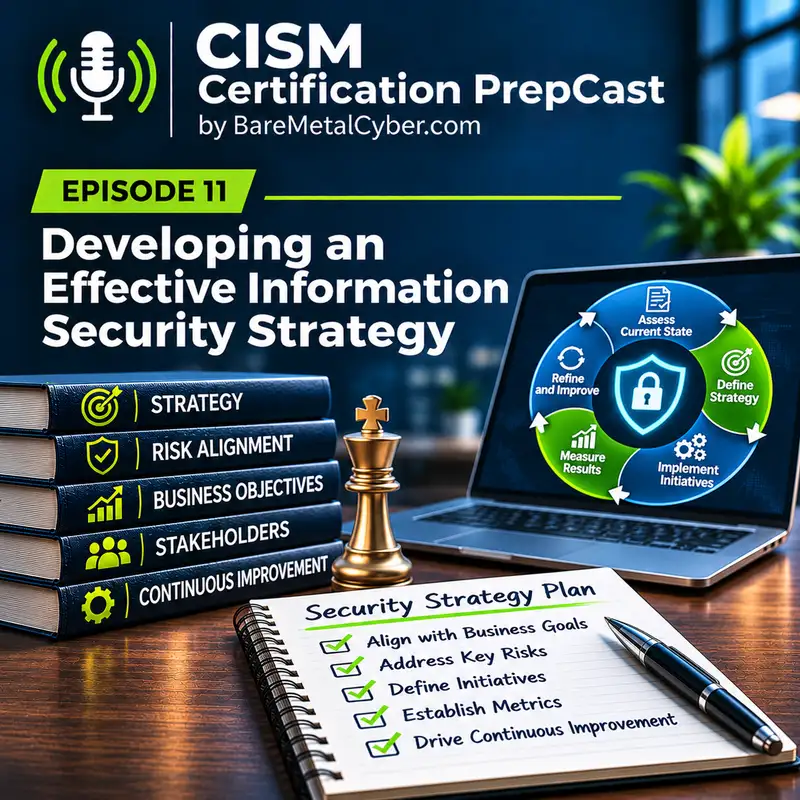
Developing an Effective Information Security Strategy
An information security strategy should connect long-term protection goals to business capabilities, enterprise architecture, investment, and measurable execution. This episode explains how internal and external drivers shape strategic priorities and how current-state, target-st…
CURRENT EDITION: CISM 2026. This episode is part of Season 2, the recommended course for the current certification exam.
An information security strategy should connect long-term protection goals to business capabilities, enterprise architecture, investment, and measurable execution. This episode explains how internal and external drivers shape strategic priorities and how current-state, target-state, and transition-state thinking turns broad goals into a practical roadmap. It examines dependencies among people, processes, information, applications, technology, suppliers, and governance structures. The discussion also covers stakeholder input, capability gaps, objectives, approval, communication, and periodic review. A strong strategy is presented not as a static document, but as a traceable set of choices that helps the organization move from its present risk posture toward a desired future state. Visit BareMetalCyber.com for more cybersecurity education, certification preparation, and practical security management guidance.