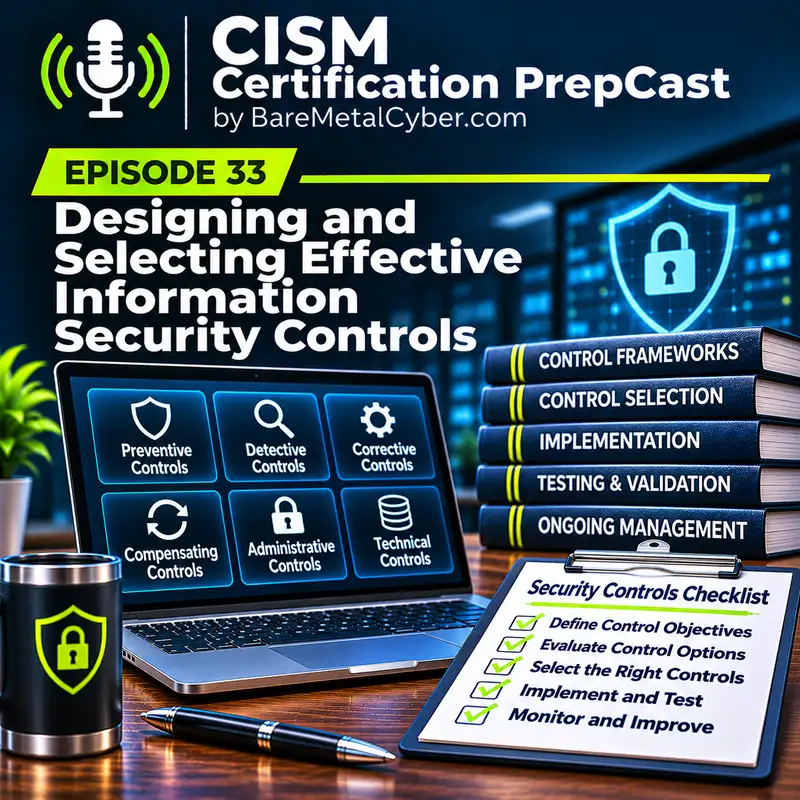
Designing and Selecting Effective Information Security Controls
In this episode, we are designing and selecting effective information security controls. The manager’s task is not to choose the most impressive mechanism. It is to define the control objective, understand risk and dependencies, select a feasible combination of safeguards, and decide what evidence will demonstrate that the intended protection exists.
Imagine a fictional medical-device company called Atlas Medical Devices. Several unauthorized configuration changes have reached a production environment, and the first proposal is to buy a new monitoring platform. The security manager asks the team to pause and define the control objective. The organization needs approved changes to be authorized, tested, traceable, and separable from the person who deploys them. Monitoring may be one mechanism, but it cannot by itself provide approval, segregation of duties, rollback, or accountability. The team designs a layered approach involving access restrictions, workflow approvals, automated checks, logging, review, and exception handling. It also defines the evidence that will show each element operates. This fictional scenario demonstrates the difference between a control objective and a mechanism. On the exam and in practice, selecting a tool before understanding the objective, dependencies, and operating environment often produces expensive coverage gaps.
Control selection should begin with the objective, not with a preferred product or mechanism. Effective control design begins with a clear control objective, not a shopping list of mechanisms. A control objective is the outcome the organization must achieve to manage a risk to an acceptable level, expressed in plain language that can be tested. In exam terms, the objective answers “what must be true” even when processes change, people rotate, and technologies get replaced. When practitioners jump straight to a specific tool or technical feature, they often hard-code assumptions that fail under audit and fail faster under pressure. The manager’s job is to keep the objective stable while allowing the mechanism to evolve.
A control objective should be anchored to a defined risk statement, because controls exist to reduce likelihood, reduce impact, or both. That anchoring forces precision about the asset, threat, vulnerability, and business impact being addressed, which is where exam questions usually hide their “best answer” logic. A well-formed objective also implies a measurement approach, even if the metric is simple, such as “only authorized users can approve payments over a threshold” or “production changes are traceable to an approved request.” If the objective cannot be validated, it will drift into policy poetry and become impossible to enforce consistently. The more ambiguous the objective, the more likely the mechanism becomes performative rather than effective.
Connect this objective to the architecture record from an earlier program-development lesson. For the retailer’s portal, limiting supplier access to approved customer records requires coordinated identity, application, and monitoring controls. Record which requirement each control satisfies and how it will be tested. If an alternative mechanism meets the requirement with lower operating burden, compare it through the design review. Conformance to a familiar product choice is less useful than evidence that the protection requirement is met.
Managers should describe objectives in terms of security properties and business behavior rather than implementation detail. Confidentiality, integrity, and availability often appear as the backdrop, but the better framing is operational: prevent unauthorized action, detect unacceptable conditions, correct deviations, and provide evidence. For example, “prevent unauthorized privilege escalation” is an objective that can be supported by multiple mechanisms over time, while “deploy product X” is an action that may or may not achieve the intent. This distinction matters because environments change, and the exam frequently tests whether you can separate intent from tactic. When you can articulate intent cleanly, you can compare multiple candidate mechanisms without bias toward a favorite solution.
A common scenario illustrates the difference: an organization experiences an incident where a terminated contractor’s account is used to access a customer database after hours. The control objective is not “turn on multi-factor authentication,” even if multi-factor authentication is part of the eventual answer. The objective is that access rights reflect current employment status and business need, and that access outside expected patterns is prevented or promptly detected. From that objective, multiple mechanisms become candidates, including identity lifecycle controls, time-based access restrictions, privileged access management, and monitoring tuned to off-hours behavior. The objective stays constant even if the identity provider, database platform, or monitoring stack changes.
Mechanisms should be selected only after the objective is agreed, because selection is a constrained optimization problem. The constraints include business process realities, user friction, cost, skills, regulatory expectations, and operational resiliency. Two mechanisms can satisfy the same objective but differ dramatically in failure modes, auditability, and total cost of ownership. Managers are expected to choose mechanisms that are sustainable, because an elegant control that no one follows is functionally absent. On the exam, answers that show explicit linkage between objective, constraint, and measurable outcome tend to be the “best” choices.
Control objectives also need clear scope boundaries, because controls that try to cover everything usually cover nothing well. Scope includes the systems, data classifications, roles, transactions, and time windows to which the objective applies. Without scope, testing becomes inconsistent and stakeholders argue about exceptions after the fact, typically right before an audit or right after an incident. A scoped objective can support consistent enforcement and meaningful evidence collection, which is a recurring theme in governance-focused questions. Precision about scope also helps prevent over-control, where the mechanism creates unnecessary friction beyond the risk it is meant to reduce.
The manager’s view must include evidence, because controls are not real until they can be demonstrated. Evidence is not just logs; it includes approvals, configurations, change records, access reviews, and reconciliations that collectively show the objective is being met. A mechanism that produces no reliable evidence forces auditors and leaders to infer effectiveness, which is a polite way of saying the control will be challenged. Evidence requirements should be considered during design so that data retention, log integrity, and reporting responsibilities are built in from the start. The exam often rewards answers that treat “prove it” as a first-class requirement, not an afterthought.
Finally, separating objective from mechanism supports continuous improvement without redefining success every quarter. Mature programs refine mechanisms as threats evolve, technologies age, and business models change, while keeping the objective stable enough to measure trendlines. When metrics drift because the objective was never clear, leaders cannot tell whether risk is decreasing or whether reporting is merely changing vocabulary. A stable objective also helps reconcile competing stakeholder demands, because it frames debates around outcomes rather than preferences. In practice and on the exam, the strongest control decisions are the ones that can be explained as “this objective, these constraints, this mechanism, and this evidence,” with no hand-waving.
A single safeguard rarely provides enough resilience, so managers must understand how controls reinforce one another. Layering controls is the practice of designing multiple, mutually reinforcing safeguards so that the failure of any single mechanism does not translate into an unacceptable business outcome. The point is not redundancy for its own sake, but resilience under realistic conditions: human error, partial outages, misconfigurations, and adversary adaptation. In exam terms, a layered approach reduces single points of failure and makes it harder for one breakdown in process or technology to become a material incident. Managers should think in terms of “how this fails” before thinking in terms of “how this works.” A control that only works in the happy path is not a control you can count on.
A layered design starts by acknowledging that controls have different functions: preventive controls aim to stop an event, detective controls aim to identify it, and corrective controls aim to restore acceptable conditions. Relying exclusively on prevention assumes the organization can anticipate every path of misuse and every configuration mistake, which is not realistic. Relying exclusively on detection assumes that the organization can respond fast enough to avoid impact, which may not be true given staffing and operational constraints. The resilient approach uses a mix so that prevention reduces volume, detection reduces dwell time, and correction reduces duration and blast radius. The manager’s value is in balancing those functions against the business’s tolerance for disruption and delay.
Layering also works because different controls fail differently, and those failure modes can offset each other. A technical access restriction might be bypassed through credential theft, but a separate anomaly detection control can still flag abnormal access patterns even when the credential is valid. A change approval process might be skirted by an urgent workaround, but an independent configuration monitoring control can detect drift and trigger remediation. When controls share the same dependency, they fail together, so resilience requires diversity of dependencies where possible. In practice, that means not stacking multiple controls that all depend on the same identity attribute, the same logging pipeline, or the same administrative group without compensating safeguards.
A short scenario makes the concept concrete: a business has a formal change management process for production systems, but a high-priority incident leads an engineer to apply an unreviewed configuration change late at night. If the only control is the approval workflow, the change happens anyway, and the organization discovers it after customers complain. A layered design would include least privilege on production access, a requirement for traceable changes tied to an identity, monitoring that detects configuration drift, and an operational process for emergency changes that still produces evidence. The “best answer” logic is that emergency conditions are predictable, so the control system must handle them without collapsing into exceptions. Layering reduces reliance on perfect behavior in the exact moment when behavior is most likely to be imperfect.
Layering must be intentional rather than accidental, because adding controls can also add complexity and risk. Every additional mechanism introduces operational load, maintenance requirements, and potential misalignment with real workflows. Complexity can become its own failure mode when teams cannot distinguish signal from noise, cannot keep procedures current, or cannot operate the environment during an outage. Managers should treat control layering as a design discipline: each layer should have a distinct purpose, a clear owner, and a measurable effect on likelihood or impact. If two controls do the same job with the same dependency, the second may be cost without resilience.
Resilience also depends on where controls are placed in the flow of a business process, not just which controls exist. Controls positioned only at the end of a workflow tend to discover problems after the organization has already accepted risk, incurred cost, or exposed data. Controls positioned earlier can prevent or constrain issues, while later controls can detect and limit residual risk that escapes earlier safeguards. A layered program often maps controls to decision points: onboarding, access request, deployment, transaction approval, data export, and incident response. Managers should favor designs that create multiple opportunities to stop a failure from propagating. The exam frequently tests this by presenting a late-stage control and asking what earlier control would have reduced risk more effectively.
Layering is also about sustaining outcomes during degraded conditions, because real-world incidents rarely respect system boundaries. Logging may be impaired during a denial-of-service event, identity systems may be stressed during remote-work surges, and teams may be operating with limited staff during holidays or emergencies. A resilient control design anticipates these constraints by ensuring that at least one layer remains reliable when another layer is degraded. That can include local enforcement when centralized services are down, or independent evidence sources when monitoring pipelines are disrupted. The manager’s role is to evaluate not just normal operations but also “fail open” and “fail closed” behaviors across layers. When a control fails, it should fail in a way that is acceptable to the business and consistent with the risk treatment decision.
Check shared dependencies across trust boundaries. If the same supplier administrator can expand portal permissions and suppress the only audit trail, two listed controls may still fail together. Ask what prevents that combination, who can detect it, and what evidence remains available. This is a design question about authority and control placement. Simply adding another product does not resolve it.
Finally, layered controls support governance because they produce corroborating evidence rather than a single fragile proof point. Evidence that comes from multiple independent sources (such as access logs, change records, and monitoring alerts) makes it harder for control effectiveness to be overstated by one system’s reporting gap. It also makes audits more efficient because the organization can demonstrate that key objectives are met even if one artifact is incomplete. Layering, when designed well, allows managers to say, “Even if this layer misses, that layer will catch, and this layer will limit impact,” which is the essence of resilience. The exam’s “best answer” is often the option that demonstrates this thinking without overcomplicating the environment. A layered design is not about having more controls; it is about having controls that fail gracefully and still protect the business.
Access and segregation decisions reveal whether accountability is designed into the control environment. Segregation of duties (segregation of duties) is the deliberate separation of responsibilities so that no single individual can complete a high-risk activity end-to-end without oversight or a second party. The managerial purpose is to reduce the likelihood of fraud, error, and unauthorized change by preventing a single point of human authority from becoming a single point of failure. On exams, segregation of duties shows up as a governance and control principle that is broader than “two people must approve,” because it includes how roles, permissions, and workflows are structured. The best answers usually treat segregation of duties as a risk-based design choice rather than a blanket rule applied everywhere. When segregation of duties is missing, the organization is often relying on trust as a control, which is not a control.
segregation of duties is easiest to understand through the “create, approve, execute, reconcile” lifecycle that exists in many business processes. If the same person can create a vendor, approve the vendor, initiate payment, and reconcile the account, the organization has effectively removed internal friction from a pathway that should be constrained. In security operations, the parallel risk is an administrator who can grant themselves access, deploy code, disable logging, and then attest that the change was appropriate. Managers do not need to memorize every permutation; they need to identify where concentrated authority creates unacceptable risk given the asset value and threat landscape. The exam typically rewards the response that separates initiation from approval and separates execution from verification.
Access logic is how identity and authorization rules enforce segregation of duties in practice, and it is often where well-written policy becomes poorly implemented reality. Authorization is not just about what a person can do, but also under what conditions they can do it, in which system, and with what traceability. A robust design considers role-based access control (RBAC), the least privilege principle, and privileged access management as mechanisms that support segregation of duties objectives. Managers should also be alert to “role explosion,” where poorly governed RBAC creates so many roles that segregation of duties becomes impossible to validate. The best access logic keeps roles understandable, testable, and aligned to business functions.
A common exam-style scenario is a small team where operational convenience pushes one person to hold multiple powerful roles. For example, a security engineer might administer the identity platform, approve access requests, and manage the audit evidence for those requests because “there’s no one else.” The segregation of duties objective is still valid, but the mechanism must adapt, such as requiring independent review by a manager outside the technical chain, implementing compensating controls like increased logging and frequent access reviews, or restricting privileged actions to time-bound sessions with strong accountability. The key is that segregation of duties does not disappear when staffing is tight; instead, risk treatment becomes explicit and evidence-driven. On the exam, answers that acknowledge constraints while still preserving independent oversight tend to be preferred.
segregation of duties should be applied where the combination of actions creates material risk, not where it simply adds process overhead. Separating low-risk tasks can slow delivery and encourage workarounds that undermine the entire control environment. Managers should focus segregation of duties on privileged access, financial transactions, sensitive data handling, and changes that affect security monitoring or policy enforcement. A well-designed segregation of duties model identifies toxic combinations, which are pairs or sets of permissions that should not be held together by one person. The ability to recognize toxic combinations is often more important than memorizing a list, because the exam frames them differently across scenarios. When the question asks what to fix first, the “best answer” is usually the toxic combination that enables concealment after misconduct.
Access logic must also account for the difference between entitlement and capability in real systems. A user may not be assigned an explicit permission to perform an action but can still accomplish it indirectly through group membership, inherited roles, or shared service accounts. Managers should be skeptical of designs that rely on shared credentials or generic administrator accounts, because these collapse accountability and render segregation of duties unenforceable. Strong identity practices support segregation of duties by ensuring actions are attributable to a specific individual and by limiting the spread of privilege. Even if the organization cannot fully separate duties, it should at least be able to prove who did what and when, which turns investigations from guesswork into evidence-based review.
Temporal aspects of access are a frequent hidden edge case in segregation of duties failures. A person might not hold conflicting permissions at the same moment, but could request them sequentially in a way that still enables end-to-end control over a process. For example, someone might approve a transaction while in one role, then later reconcile it after switching roles, defeating the intent of separation. Access logic that includes time-bound elevation, approval workflows tied to specific tasks, and monitoring for role changes can reduce this risk. Managers should think in terms of “can someone complete the chain over time,” not only “do they have both roles today.” Exam questions often reward this deeper view because it reflects how real misuse happens.
Evidence is the practical backbone of segregation of duties because it allows the organization to demonstrate that separation is enforced and exceptions are controlled. Evidence can include access provisioning records, approval trails, role assignment histories, privileged session logs, and periodic access reviews that explicitly check for toxic combinations. A mature approach treats segregation of duties exceptions as risk acceptances or risk mitigations with defined duration and compensating controls, not as permanent special cases. Managers should be able to explain how segregation of duties is validated, how exceptions are approved, and how violations are detected. When an exam asks for the best managerial action, selecting the option that includes governance plus testable enforcement is usually the right move.
Now apply the idea to the management decision at hand. Mitigation, the “treat” option in this episode, deliberately reduces likelihood, impact, or both through changes that are controllable and repeatable, not a vague promise to “improve security.” In exam terms, treatment is the option you select when the activity must continue, the risk exceeds tolerance, and feasible measures exist to bring the residual risk back within acceptable bounds. The key is that treatment produces a measurable change in the risk scenario, either by reducing how often an event can occur or by limiting the damage if it does. Treatment also assumes that leadership is willing to invest resources, accept friction, and enforce accountability to sustain the control over time. If the question hints at ongoing business need plus unacceptable exposure, you should think “treat” and then pick the control approach that best matches the risk driver.
Control selection starts with the specific risk statement, because controls are only “good” in relation to the threat, vulnerability, and business impact they address. A common exam pitfall is choosing a technically impressive control that does not materially change the scenario described, such as adding encryption when the primary risk is privileged misuse inside the environment. Good treatment decisions identify the dominant factor in the risk equation and target that factor first. If likelihood is driven by weak authentication, treatment favors stronger identity controls rather than downstream monitoring alone. If impact is driven by broad data exposure, treatment favors minimization, segmentation, or access restriction rather than only adding detection.
Controls can be preventive, detective, or corrective, and exam questions often reward you for selecting the type that most directly addresses the scenario’s timing and failure mode. Preventive controls reduce the chance of the event occurring, such as strong authentication, segmentation, secure configuration, or approval gates for high-risk actions. Detective controls increase the chance of finding the event quickly, which reduces dwell time and supports response, such as logging, monitoring, and alerting aligned to plausible misuse paths. Corrective controls reduce the duration or consequences after the event occurs, such as recovery processes, isolation mechanisms, or automated rollback of unauthorized changes. In treatment-heavy scenarios, the best answer frequently pairs a preventive control with supporting detection, because prevention without visibility can fail silently, and detection without containment can still leave high impact.
Treatment is also about choosing controls that are appropriate to the environment’s constraints and operational maturity. A control that requires constant manual review may be inappropriate in a lean organization with limited staffing, even if it looks rigorous on paper. Conversely, a highly automated control might be the best fit where consistency and scale matter, provided it can be implemented reliably. In exam logic, feasibility and sustainability matter because a control that cannot be operated is not a real reduction in risk. When you see constraints like legacy systems, limited budgets, or tight timelines, the “best answer” is often the control that yields the largest risk reduction per unit of complexity.
A useful way to think about selection is to treat controls as levers on attack paths and business impact paths. If the attack path depends on a single high-privilege account, treatment focuses on restricting privileged access, tightening authentication, and limiting where privilege can be exercised. If the impact path depends on broad lateral movement, treatment focuses on segmentation and restricting trust relationships so compromise cannot spread. If the impact path depends on data exposure, treatment focuses on access scoping, encryption at rest and in transit where relevant, and reducing retention or replication. The exam tends to favor controls that break the most critical link in the chain rather than controls that add general “security hygiene” everywhere.
Finally, treatment choices should reflect a layered mindset without turning into a shopping list of controls. Layering is about ensuring that failure of one control does not automatically produce full impact, but it should be proportionate to the stated risk. In exam scenarios, the best answer is rarely “implement everything,” and it is rarely “monitor only,” especially when the exposure is high. Instead, it is usually a targeted preventive control that addresses the primary driver, supported by detection that shortens time to discovery and corrective capability that limits impact. That combination most clearly reduces residual risk in a way that a risk owner can justify against appetite and constraints.
Control intent may be expressed through administrative, technical, and physical mechanisms that work together. Administrative controls exist to shape human behavior and organizational decision-making before a system ever processes a single packet. Policies, standards, procedures, and governance practices are often treated as “paperwork,” but their intent is to create consistent, repeatable outcomes across teams and time. When an exam scenario describes unclear decision rights, inconsistent approvals, or unmanaged exceptions, the missing control is frequently administrative rather than technical. Administrative controls also establish accountability by defining who can accept risk, who can grant access, and who must verify outcomes. In other words, they turn security from a collection of tools into a managed program with measurable expectations.
The intent of administrative controls is also to reduce ambiguity, because ambiguity is where control failures breed quietly. A well-written standard turns a vague goal like “encrypt sensitive data” into a specific expectation about where encryption is required, which algorithms are acceptable, and how keys are managed. Procedures translate those expectations into steps that can be followed by different operators with similar results, which matters when staff changes or workload spikes. Training and awareness controls are administrative for the same reason: they aim to make routine behavior safer without needing perfect technology. In audit language, administrative controls define criteria and create traceable decision paths, making it possible to evaluate whether actions were reasonable and authorized.
Technical controls implement enforcement through technology, but their intent is still business-driven rather than tool-driven. Firewalls, access control mechanisms, encryption, endpoint protections, and logging systems are not “good” or “bad” in isolation; they are responses to specific threats, exposures, and operational needs. In exam scenarios, technical controls are often the most visible, which tempts candidates to answer with the fanciest mechanism mentioned in the question. The better habit is to ask what the organization is trying to accomplish: limit access, protect confidentiality, ensure integrity, detect misuse, or preserve availability under stress. When the scenario includes rapid scaling, distributed users, or third-party integration, technical controls must also be designed for maintainability, because an unmaintainable control becomes a control that eventually stops working.
The intent of technical controls also includes consistency at machine speed, which is an advantage administrative controls cannot fully replicate. A properly configured access control system does not get tired, does not forget, and does not make exceptions because someone sounds urgent on the phone. That consistency is why technical controls are typically expected to enforce constraints that are hard to police manually, such as least privilege across thousands of identities or encryption-in-transit for every connection. However, technical controls can only enforce what they are configured to enforce, and misconfiguration is a form of control failure rather than a minor operational detail. Many exam questions quietly hinge on this reality: the presence of a tool is not evidence that the control objective is being met. The intent, therefore, is enforcement aligned to requirements, not the existence of technology.
Physical controls exist to protect people, facilities, and hardware, but their intent extends beyond locked doors and badge readers. Physical security controls aim to prevent unauthorized physical access, reduce the likelihood of theft or tampering, and maintain safety and operational continuity. In scenarios involving data centers, branch offices, or shared workspaces, physical controls may be the only realistic way to protect assets that cannot be fully secured through software alone. Environmental controls such as fire suppression, power conditioning, and HVAC monitoring are physical controls with an availability intent, even though they rarely feel like “cybersecurity” controls. Physical controls also support evidence generation, because access logs, camera footage, and visitor records can corroborate or refute claims about who had proximity to sensitive systems. The exam habit to build here is recognizing physical control intent even when the scenario is written in operational language rather than security language.
A practical way to distinguish control intent is to focus on what must happen for the control to succeed. Administrative controls succeed when people follow defined rules, decision-makers approve the right things, and exceptions are managed deliberately. Technical controls succeed when systems enforce policy, capture activity, and resist common failure modes like misconfiguration and privilege creep. Physical controls succeed when access is constrained to authorized individuals and the environment supports reliable operations. If a scenario mentions “we have a policy” but no one can show how it is followed, the control intent exists but the mechanism is incomplete. If a scenario mentions “we bought a tool” but no one can describe how it is configured, monitored, and maintained, the technical control intent is present but not realized. The best-answer logic is rarely “pick one category”; it is “pick the category that most directly addresses the described failure.”
Exam scenarios often mix categories on purpose, because real organizations do. Consider a case where an organization discovers that terminated employees still have access to cloud applications weeks after departure. The administrative intent is an access governance process defining joiner-mover-leaver responsibilities, approval points, and timelines for deprovisioning. The technical intent is identity lifecycle automation, centralized authentication, and periodic entitlement reviews that surface stale access. The physical intent may be badge deactivation and equipment collection, which prevents lingering access through retained devices and reduces the risk of credential reuse. When candidates miss this question, it is usually because they jump to a single control type without recognizing that the failure described is a breakdown of end-to-end control intent. The better approach is to identify the primary control objective and choose the control type that directly repairs the broken link in that objective.
Control intent also guides how to evaluate adequacy under constraints, which shows up in questions about limited budgets, legacy systems, or outsourced operations. Administrative controls are often the fastest to implement but can be the easiest to bypass if incentives and oversight are weak. Technical controls can provide strong enforcement but may be costly, complex, or infeasible in certain architectures without redesign. Physical controls can be highly effective for certain risks, yet they may not scale for remote workforces or cloud-first environments, where “facility perimeter” is less relevant. The exam does not reward idealized security; it rewards controls that fit the environment described and reduce risk in a measurable way. Intent-first thinking keeps the answer anchored to what the organization needs, rather than what the candidate personally prefers.
Finally, control intent is inseparable from ownership, because a control without an owner is a control that will drift. Administrative controls require governance owners who can update standards, resolve conflicts, and enforce consequences when procedures are ignored. Technical controls require operational owners who can patch, tune, monitor, and respond to alerts, because detection without response is only documentation of failure. Physical controls require facility and security owners who can manage access provisioning, monitor anomalies, and maintain systems that protect availability. In exam language, the “best” control is the one whose intent aligns to the risk and whose operation can be sustained with the roles and capabilities described. When you can articulate intent cleanly, control categories stop being a memorization exercise and become a reasoning tool.
Return to the fictional scenario from the beginning of this lesson on designing and selecting effective information security controls. The strongest management response is not a slogan or an isolated tool purchase. It is a documented decision that connects business impact, authority, evidence, operating responsibility, and follow-through. Ask what must be true before the organization can proceed, who is accountable for making or accepting the decision, and how the result will be verified over time. That reasoning pattern helps on the CISM exam because it prevents a technically plausible action from being mistaken for the best management action.
For practice, begin with a risk scenario and write the control objective in outcome language without naming a product. Identify preventive, detective, corrective, and compensating possibilities, along with dependencies and operational constraints. Select a layered design, assign owners, and define the evidence that would demonstrate design and operation. The exercise trains you to choose mechanisms only after the objective and context are clear.