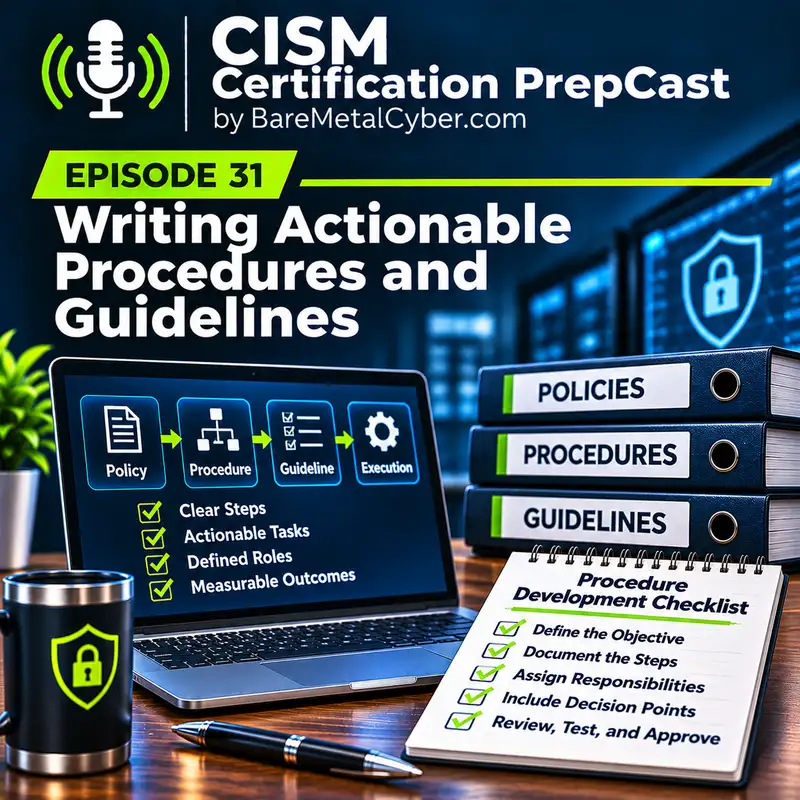
Writing Actionable Procedures and Guidelines
In this episode, we are writing actionable procedures and guidelines. Policies state direction, but procedures turn that direction into repeatable work, while guidelines help people exercise judgment where flexibility is appropriate. The management challenge is to make documentation usable, owned, current, and connected to real operational handoffs.
Imagine a fictional logistics company called Blue Harbor Logistics. Its access policy requires least privilege, but the procedure for emergency access was written for an older data center and does not address cloud administration. During an outage, an engineer follows an unofficial chat message from a former manager, gains broad access, restores service, and leaves the privilege active. The policy objective was reasonable, but the procedure did not define current steps, approvals, evidence, rollback, or the handoff after the emergency. A guideline could help engineers choose among approved troubleshooting options, but it should not replace mandatory steps for authorization and removal of elevated access. This fictional scenario demonstrates why procedures and guidelines occupy different places in the documentation hierarchy. Procedures must be usable under realistic conditions, and guidelines must identify the boundaries within which judgment is allowed. Both require owners, update triggers, and feedback from the people who perform the work.
Procedures require ownership and maintenance because operational reality changes. Procedures are where governance either becomes a repeatable habit or collapses into tribal knowledge. A policy states intent and a standard defines minimum requirements, but a procedure is the documented method for carrying out work in a consistent way. If the procedure is missing, outdated, or scattered across emails and chat threads, the organization cannot reliably execute controls, even when the right intentions exist. In practice, procedures protect the organization from the variability of individual judgment, staffing changes, and “we always do it this way” drift.
Ownership is the first prerequisite for procedures that actually get used. A procedure without an accountable owner becomes everyone’s responsibility, which means no one’s responsibility. The owner must be a role that can keep the procedure aligned with the actual workflow, such as the team responsible for the process outcome or the service being delivered. When ownership is assigned correctly, updates happen because they are operationally necessary, not because an auditor asked for documentation.
Procedure ownership also clarifies what changes are allowed and how deviations are handled. If a procedure is treated as a suggestion, teams will improvise under pressure and later claim the improv was “equivalent.” If a procedure is treated as immutable scripture, teams will avoid updating it and will work around it quietly. The effective middle ground is that procedures are binding for routine execution, but they are allowed to evolve through a defined change process, with documented rationale and controlled communication. This keeps procedures both enforceable and practical, which is the point.
Maintenance discipline is what prevents procedures from becoming historical artifacts. A disciplined procedure lifecycle includes routine review, clear versioning, and a trigger-based update model when upstream dependencies change, such as tooling migrations, organizational restructures, or new regulatory obligations. Procedures should be written so that the steps reflect reality as it is performed today, not as it was imagined during a policy rollout. When procedures are not maintained, people stop trusting them, and once trust is gone, the procedure becomes optional in practice regardless of what governance says.
An exam-style scenario illustrates how ownership failures become security failures: a privileged access provisioning procedure exists, but it was written years ago by a security analyst who left the company. Identity management has since changed, and teams now grant access using a different workflow, yet the old procedure remains the “documented” one. An access review finds that approvals are inconsistent and evidence is incomplete, because the procedure does not match reality and no one feels authorized to fix it. The best answer is to assign procedure ownership to the process owner and establish maintenance discipline, rather than rewriting policy language or adding more approvals.
Procedures must also be maintainable, which means they should avoid hard-coding details that change frequently unless the organization can keep up. A good procedure may reference controlled artifacts, such as configuration baselines, approved tool lists, or templates that can be updated independently. This reduces the frequency of procedure rewrites while still keeping execution accurate. The measure of quality is whether a new team member can follow the procedure successfully without needing a private briefing from the one person who “really knows how it works.”
Maintenance discipline includes how changes are communicated and adopted. Updating a procedure in a repository does not change behavior if the people who use it do not know it changed or do not understand why it changed. Effective organizations treat procedure updates like operational changes: they notify affected teams, update training and checklists, and align tooling and ticket workflows to the new steps. In other words, the procedure is not just documentation; it is a control instrument that must be integrated into the way work is requested, approved, and completed.
Procedure discipline also depends on aligning procedures with accountability for outcomes. If teams are evaluated only on speed and delivery, procedures will be perceived as obstacles and will be bypassed when deadlines tighten. If teams are evaluated on delivery plus control performance, procedure compliance becomes part of professional execution rather than a bureaucratic chore. This is not moralizing; it is recognizing that incentives determine behavior, and procedures must be supported by leadership expectations to survive real-world pressures.
Finally, procedure ownership and maintenance are governance topics, not merely documentation tasks. Strong ownership means there is a clear path for questions, exceptions, and continuous improvement, and it means procedures reflect current architecture and risk decisions. Strong maintenance discipline means procedures remain trustworthy, which is essential because people only follow documentation that consistently helps them succeed. When procedures are owned and maintained as living operational assets, they become a stabilizing force that supports security outcomes even as technology and teams change.
Documentation should enable coordinated execution rather than merely record that a meeting occurred. Documentation is where a security program proves it is more than institutional memory. The goal is not to create binders of policies that no one reads; the goal is to create durable, auditable artifacts that allow people to execute consistently, even when teams change, systems evolve, and pressure increases. On the exam, documentation is often the quiet differentiator between a program that can demonstrate governance and one that merely claims it. In practice, documentation reduces ambiguity, accelerates onboarding, and makes exceptions, risk decisions, and control expectations traceable. If it does not help someone do the work correctly, it is not enabling execution.
Effective documentation starts with a clear hierarchy of artifacts that align to how organizations operate. Policies state the “what” and the mandatory expectations, and they should be stable enough to survive technology shifts. Standards translate policy into specific requirements, such as minimum authentication strength, encryption expectations, or logging requirements, and they should be precise enough to be testable. Procedures and workflows describe the “how,” including who performs which steps, what evidence is produced, and what approvals are required. Guidelines provide recommended approaches, while architecture patterns document reusable designs and their conditions of use. Whether a pattern is required or optional should be explicit in the governing standard.
A common mistake is to write policy language as if it were a technical design, or to write technical standards as if they were aspirational principles. Policies that include deep implementation details become brittle and constantly out of date, which teaches teams to ignore them. Standards that are vague or optional invite inconsistent interpretations, which turns compliance into a debate rather than a measurable outcome. Procedures that are incomplete force teams to improvise, which produces different results depending on experience and time pressure. Documentation that enables execution is carefully scoped: each artifact says what it needs to say, at the right level, and no more.
A scenario illustrates the difference: an access review is required for privileged accounts, but the organization has multiple platforms and inconsistent ownership. If documentation is weak, every review cycle becomes a custom project, and missed accounts are discovered only after an incident or audit finding. If documentation enables execution, roles are defined for system owners and reviewers, the review cadence is stated, evidence requirements are explicit, and exception handling is documented when an account cannot be reviewed through normal mechanisms. The work becomes routine, which is exactly what you want for a control intended to reduce risk over time. Routine is not complacency; it is operational reliability.
Documentation must also support decision-making, not just control operation. Risk assessments, risk acceptance records, exception requests, and sign-offs should be documented with enough structure to be comparable across time and across business units. The content should capture the decision context: what asset or process is affected, what threat or exposure is driving the concern, what controls exist, what residual risk remains, and who accepted it with what conditions and expiration. When that structure is missing, the organization cannot answer basic questions later, such as why an exception was granted or whether the risk landscape has changed since the decision. Decision documentation is governance made visible.
Execution-friendly documentation anticipates integration points with other enterprise functions. Security requirements for procurement, vendor onboarding, and contract clauses should be documented so that procurement and legal can act without reinventing criteria each time. Security expectations for change management and release processes should be documented so that delivery teams know what gates exist, what evidence is needed, and how to request time-bound exceptions. Incident escalation paths and communication responsibilities should be documented so that people do not debate roles during an event. When interfaces are documented, security stops being a surprise dependency and becomes a predictable part of operations.
Another critical property is maintainability, because outdated documentation is worse than missing documentation. Enabling execution requires clear ownership for each artifact, a review cadence tied to risk and operational change, and a controlled method for updates and approvals. Documentation should be versioned and discoverable, with a single authoritative location to prevent “shadow policies” living in personal drives. It should also be written in a way that supports testing, because requirements that cannot be validated will not be enforced consistently. Maintainability is an operational control in its own right, protecting the program from drift.
Finally, documentation must be usable under stress, because that is when the program is most visible. During an incident, a regulatory inquiry, or an audit, teams need quick access to current requirements, prior decisions, and evidence that controls are operating. Documentation that enables execution is searchable, structured, and aligned to how the organization actually works, not to how it wishes it worked. It provides just enough detail to guide action, route decisions, and generate evidence without stalling teams in paperwork. When documentation meets that standard, it does not feel like compliance overhead; it feels like operational leverage.
Implementation succeeds when security becomes part of normal operational work. Security controls can fail when they are treated as something separate from day-to-day operations. In a mature environment, security is embedded into the same workflows that already run the business: service desk tickets, patch windows, onboarding and offboarding, backup jobs, and incident response. This is not about adding a second process layer; it is about putting security requirements into the existing layer where work actually happens. The exam-relevant takeaway is that “integration” means security objectives are achieved through operational execution, not through policy statements or standalone tooling.
Ticketing and work management systems are the backbone of operational control because they create accountability and evidence. If a control depends on humans doing the right thing, it should be represented as a required task with an owner, due date, and closure criteria. That includes patching exceptions, firewall rule changes, privileged access approvals, and even risk acceptances, which should never live only in email threads. From an exam perspective, the “best answer” often points to mechanisms that produce auditable records and repeatable execution, because those are sustainable under real-world workload. Integration turns security from an intention into a tracked deliverable.
A short scenario shows what “not integrated” looks like in practice. An operations team deploys a critical customer-facing application update during a normal release window, and a week later the security team discovers that logging is incomplete and administrative access is shared across multiple engineers. The root problem is not that the engineers are careless; it is that the deployment workflow never required log verification or individual privileged access as gate criteria. Integration would mean the release checklist and access process enforce those requirements automatically, so the team cannot “forget” them under deadline pressure. On the exam, the best corrective action typically centers on embedding control steps into the operational workflow rather than adding a separate review after the fact.
The most reliable integrations are the ones that reduce decision-making during execution. Standard builds and hardened baselines remove ambiguity by giving operations a known-good starting point, and configuration management keeps drift visible. Privileged access management (PAM) becomes operational when it is the default path for admin work, with session recording, approvals, and just-in-time elevation, instead of a tool used only when someone remembers. Endpoint detection and response (EDR) becomes operational when agents are deployed through standard provisioning and monitored for health like any other system component. The exam logic rewards controls that are “built in” and therefore consistently applied, rather than controls that depend on individual discipline.
Integration also requires that security signals map to operational actions, not just dashboards. Alerts that do not produce tickets, escalation paths, and owner accountability become noise, and noise becomes ignored. Conversely, well-integrated monitoring triggers defined runbooks, with severity aligned to business impact and clear criteria for paging, containment, and stakeholder notification. This is why integration often references incident management and problem management concepts, even when the control is “security” in name. In exam terms, a control is stronger when it drives timely, consistent operational response and produces evidence of that response.
At release, reconcile what was approved in an earlier program-development lesson with what was implemented. For the portal, confirm actual data flows, access boundaries, supplier responsibilities, and logging against the design record. Assign the operating owners, document remaining exceptions, and test the handoffs they must perform. Include recovery and rollback arrangements appropriate to the change. A passed design review is not evidence that every control survived deployment; the service needs an explicit readiness decision supported by implementation results.
Finally, integration should be evaluated through operational metrics that reflect control performance, not just tool coverage. Examples include patch compliance within defined timeframes for critical assets, percentage of privileged actions performed through approved mechanisms, mean time to detect and mean time to contain for high-severity events, and completeness of log sources for key systems. Metrics matter because they translate “security is important” into operational expectations that leaders can manage and teams can improve. When a control is integrated, it shows up in operational reporting, operational accountability, and operational planning cycles rather than only in security assessments. On the exam, that’s the practical definition of making security real: it runs with the business.
Change management is itself a security control because uncontrolled change can invalidate prior assurance. Change management is a security control because poorly assessed changes can introduce vulnerabilities, disrupt services, or weaken existing safeguards. A “change” is not just new code in production; it includes configuration edits, firewall rule updates, identity and access policy modifications, certificate renewals, and vendor-managed platform tweaks. When changes are governed, security risk is reduced by preventing unintended exposure and by ensuring changes are traceable to an approved business purpose. For exam purposes, the key idea is that change management is a preventive control that also strengthens detective and corrective capabilities through documentation and rollback readiness.
The security value of change management starts with classification, because not every change deserves the same rigor. Standard changes are pre-approved and low risk because they follow a proven procedure, while normal changes require review because they introduce variation. Emergency changes exist for business continuity, but they must still be documented and reviewed after the fact, because “urgent” is not a substitute for accountability. The best answer logic often favors a risk-based approach that aligns review depth to potential impact. Treating all changes identically creates operational resistance and, ironically, increases the likelihood of bypass behavior.
Approval is not the goal; informed approval is the goal, and that requires risk visibility in the change record. A well-formed change includes what will be altered, why it is needed, which assets and users are affected, and what could go wrong if the change fails. It should also specify prerequisites such as backups, maintenance windows, dependencies, and communications plans for impacted stakeholders. Security input belongs where it changes the decision, such as when a proposed firewall rule broadens exposure or a privilege change breaks segregation of duties. On the exam, controls that produce auditable evidence of review and decision-making tend to be stronger than informal peer checks.
The most exam-relevant mechanism inside change management is separation of duties between request, approval, and implementation. If the same individual can propose a change, approve it, and deploy it, the organization has created a single point of failure and a clear opportunity for abuse. That is especially risky for privileged changes like identity policy updates, production database permissions, and logging configuration adjustments. Stronger patterns require at least two roles, and often multiple, to move a change into production. This is not about mistrust; it is about designing controls that remain effective under pressure, turnover, and human error.
A short scenario makes the control concrete. An engineer is troubleshooting an outage and temporarily disables a web application firewall rule and reduces authentication requirements “just to get traffic flowing,” intending to restore them later. The outage is resolved, but the weakened settings remain in place for days because there is no change record, no owner accountability, and no post-implementation verification. The security lesson is that emergency actions must still route into the change system, even if approval is retrospective, because the organization needs a way to discover and unwind risky temporary decisions. On the exam, the best corrective response typically includes formalizing emergency changes with documentation, review, and validation.
Security testing and validation are part of change management because they reduce the chance that “approved” changes create new vulnerabilities. For software changes, validation might include verifying authentication flows, ensuring authorization checks still enforce least privilege, and confirming sensitive data handling did not regress. For infrastructure changes, validation often includes confirming logging coverage, verifying that monitoring agents still report, and ensuring network segmentation assumptions remain true. The goal is not to force every change through a heavyweight security assessment, but to define minimum checks based on risk. Exam questions frequently reward answers that place verification steps before and after deployment, because that is how organizations catch both design mistakes and implementation drift.
Rollback planning is a security control because it limits the duration and blast radius of a bad change. A change that cannot be reversed under pressure is a change that can force unsafe improvisation, such as disabling controls or expanding access to restore service. Good rollback planning includes identifying a known-good prior state, defining who is authorized to execute rollback, and ensuring the organization can restore without breaking evidence or audit trails. This matters for security controls like logging, identity systems, and key management, where “fixing fast” can accidentally destroy visibility or weaken protections. On the exam, rollback readiness is often the differentiator between a mature change process and a checkbox process.
Change management also protects monitoring and accountability by ensuring that detection controls do not silently degrade. Logging changes, alerting threshold edits, agent deployments, and time synchronization settings are all security-sensitive, even if the operational intent is performance tuning or cost reduction. If those changes are not reviewed with security impact in mind, the organization can end up blind precisely when an incident occurs. A mature process treats monitoring and identity as high-impact systems that require explicit scrutiny, because they influence many other controls. The exam-relevant principle is that security controls must be protected from accidental or malicious weakening through governed change.
Finally, the best change management programs integrate with operational tools in a way that makes compliance the path of least resistance. When deployments, configuration updates, and access modifications are naturally tied to change records, teams do not have to “remember” governance; governance happens as part of doing the work. That integration creates a reliable audit trail and enables trend analysis, such as repeated emergency changes indicating poor planning or frequent rollbacks indicating weak testing. Over time, change data becomes a security signal, highlighting risky teams, fragile systems, and control hotspots. In exam terms, change management is not paperwork; it is a control layer that keeps the environment stable, accountable, and resilient under real operational pressure.
Return to the fictional scenario from the beginning of this lesson on writing actionable procedures and guidelines. The strongest management response is not a slogan or an isolated tool purchase. It is a documented decision that connects business impact, authority, evidence, operating responsibility, and follow-through. Ask what must be true before the organization can proceed, who is accountable for making or accepting the decision, and how the result will be verified over time. That reasoning pattern helps on the CISM exam because it prevents a technically plausible action from being mistaken for the best management action.
For practice, select a recurring security activity and write the decision points before writing the steps. Identify the trigger, required inputs, responsible role, approval, sequence, evidence, exception path, handoff, rollback, and completion criteria. Then decide which parts must be a procedure and which can remain guidance. Ask a person unfamiliar with the process to walk through it, and treat every point of confusion as evidence for improvement.