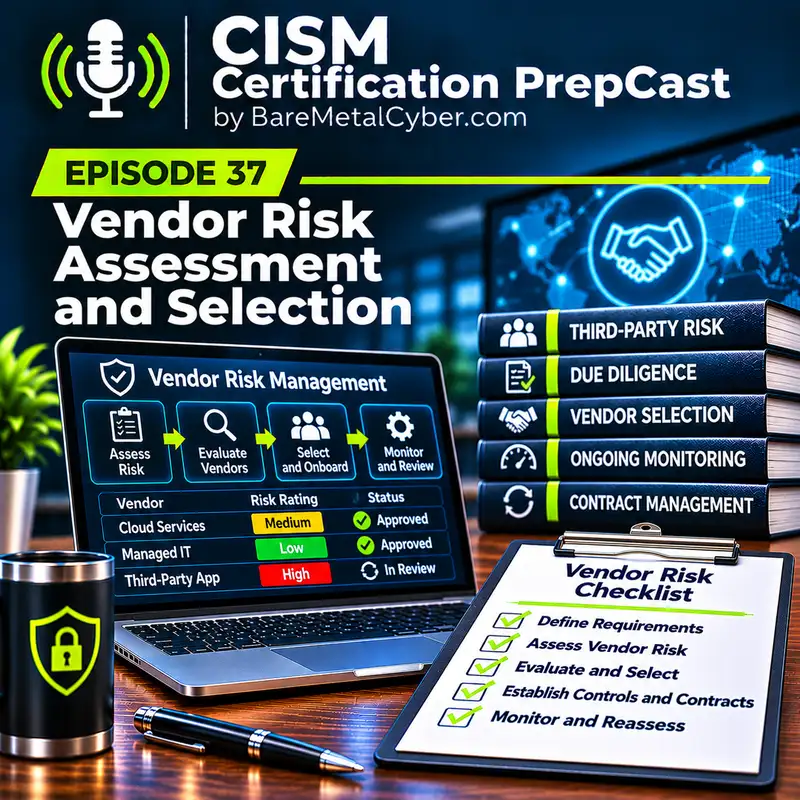
Vendor Risk Assessment and Selection
In this episode, we are conducting vendor risk assessment and selection. The decision begins with the service, information, dependencies, and business impact involved, not with a generic questionnaire. We will examine due diligence, shared responsibility, fourth-party exposure, relevant evidence, and the conditions that should exist before approval.
Imagine a fictional analytics firm called Evergreen Analytics selecting a cloud provider to process customer records. The provider offers a strong assurance report, a modern security presentation, and an attractive price. The security manager asks questions that the marketing package does not answer. Which exact service and locations are in scope? What responsibilities remain with Evergreen? Which subcontractors process or support the data? How are privileged actions controlled? What evidence is available for the controls that matter to the organization’s risk? What happens if the service architecture changes? Due diligence becomes a focused comparison between requirements and evidence rather than a contest to collect the most documents. This fictional scenario also shows why a reputable vendor can still be a poor fit. Selection should reflect service criticality, data handling, concentration risk, integration dependencies, exit feasibility, and the organization’s ability to monitor the relationship.
Vendor selection begins with risk-based due diligence and clear contractual expectations. Due diligence for third-party services starts with understanding what you are buying in operational terms, not marketing terms. The security team should insist on a clear service description that identifies where the service runs, what data types it will process, and which business processes will depend on it. That scope becomes the boundary for risk analysis, because you cannot evaluate control adequacy when the asset and data flows are ambiguous. A common exam trap is treating due diligence as a one-time checklist; in practice and on tests, it is a disciplined effort to reduce uncertainty before committing the organization to a dependency. The best answer usually prioritizes clarifying scope and risk ownership before negotiating features or price.
A practical starting point is to classify the data and map the service interaction points, because those two steps drive every control conversation that follows. If the vendor will handle regulated data, sensitive intellectual property, or authentication material, the security requirements should be measurably stronger and explicitly written into the agreement. Data flow mapping should capture ingress, storage, access paths, administrative interfaces, logging destinations, and egress to other providers, because those are where real incidents happen. When this mapping is skipped, contracts drift into generic language that looks reassuring but cannot be tested. In exam scenarios, the “best” control choice often ties back to protecting the highest-value data and enforcing accountability at the boundaries.
Vendor due diligence should evaluate both security posture and business resilience, because third-party failure is rarely courteous enough to limit itself to confidentiality. Security posture evidence commonly includes independent assurance reports, a documented security program, vulnerability management practices, and incident response capabilities that can be coordinated with your organization. Resilience evidence includes financial stability indicators, service continuity capabilities, and credible operational processes for capacity, backups, and disaster recovery. The point is not to demand perfection, but to understand which risks remain and whether the business is intentionally accepting them. When the question asks what to do “first,” selecting evidence that reduces the largest unknowns is usually the strongest choice.
Contract controls translate your risk assumptions into enforceable obligations, and enforceable means specific, measurable, and tied to consequences. Contracts should define security requirements in terms of outcomes and verification, such as required logging availability, encryption expectations, vulnerability remediation timelines, and restrictions on data use. Overly broad commitments like “industry standard security” are often unenforceable because they lack a test method and a clear baseline. A well-written agreement also clarifies what constitutes a security incident, what notifications are required, and how quickly the vendor must communicate. In exam logic, controls that are auditable and legally binding generally outrank controls that are merely “recommended” or left to vendor discretion.
Right-to-audit language is a frequent focus because it determines whether assurance is real or performative. Many vendors will not allow invasive audits, but contracts can still require alternative assurance mechanisms such as independent assessments, periodic reporting, and the delivery of relevant audit summaries under appropriate confidentiality protections. The key is ensuring your organization can obtain sufficient evidence to demonstrate due care and to validate that contractual controls are operating. Contracts should also specify how audit findings are handled, including remediation expectations and timelines, rather than treating assurance as a passive document exchange. When presented with options, the best answer typically secures practical auditability without demanding unrealistic access that would stall procurement.
Subcontractors and downstream providers are where third-party risk quietly becomes fourth-party risk, so contracts must address them explicitly. The agreement should require disclosure of material subcontractors involved in storing, processing, or accessing the organization’s data, and it should impose flow-down obligations so subcontractors are held to equivalent security requirements.
Notification expectations matter here as well, because an incident at a subcontractor can be just as damaging, and delayed disclosure can be worse than the incident itself. Without these clauses, the organization may discover too late that its data traveled through an unexpected chain of custody. In exam questions that mention subcontracting, the strongest answers usually emphasize flow-down controls and visibility into the supply chain.
Data ownership, use limitations, and retention terms are contract controls that frequently determine whether an organization can contain harm after an incident or a dispute. Agreements should state that the organization retains ownership of its data, define permitted processing purposes, and prohibit secondary use such as training models, marketing, or analytics beyond what is necessary to deliver the service unless explicitly approved. Retention language should specify how long data is kept, what happens to backups, and how deletion is confirmed, because “deleted” can mean “inaccessible” rather than “gone.” Access control expectations should include least privilege for vendor personnel, strong authentication for administrative access, and clear separation between customer environments when services are multi-tenant. The exam-reality wink here is that vague data clauses always look fine until the first uncomfortable question from legal, audit, or a regulator.
Finally, contract controls should include operational hooks that make security actionable during the relationship, not just at signing. This includes clear service level expectations that matter to security, such as log delivery timeliness, support responsiveness for security events, and defined escalation paths for urgent issues. It also includes liability-related terms, such as responsibilities for breach-related costs, cooperation requirements during investigations, and expectations for maintaining appropriate insurance, because those clauses influence behavior when stress is high. Contracts should align termination rights with security risk, allowing the organization to exit or suspend service for material security failures without being trapped by punitive terms. In exam questions, the “best” contract control is usually the one that creates enforceable accountability and measurable evidence, not the one that sounds most comprehensive.
Shared responsibility must identify who performs, verifies, and reports each important obligation. Shared responsibility models exist because modern services rarely map cleanly to a single control owner, even when one party pays the invoice. In most arrangements, the provider owns some combination of facilities, core infrastructure, and platform operations, while the customer owns identity decisions, data classification, and how the service is configured and used. The security risk emerges in the seams: the provider may secure the “thing,” but the customer can still misconfigure the “way it’s used” into an incident. A security leader should treat shared responsibility as a control allocation problem, not a slogan, and should insist on documenting who does what for each meaningful control objective. The exam-friendly move is to identify the gap created by ambiguous ownership and close it with explicit accountability.
Auditability is the practical test of whether shared responsibility is being managed or merely assumed. If the organization cannot obtain evidence that controls exist and operate, then any assurance is effectively faith-based, which is not a defensible risk position. Auditability is not limited to financial audits; it includes the ability to assess security controls, confirm data handling practices, and verify that incident response processes are usable. In third-party contexts, auditability must account for what can be verified directly versus what must be verified through independent assurance reporting. The best answer logic typically prefers controls that produce verifiable evidence over controls that only sound “strong.”
A common scenario is a cloud-hosted application where the provider secures the underlying platform, but the customer controls tenant configuration, access, and data governance. The provider may patch the hypervisor and maintain redundancy, yet the customer decides who can create admin accounts, how authentication is enforced, and what data is placed into the system. If the customer fails to enable logging or sets overly permissive access rules, the resulting exposure is still the customer’s risk, even if the service itself never “failed.” This is why shared responsibility must be expressed as responsibilities for specific control activities such as account provisioning, key management choices, and monitoring configuration. Exam questions often reward the answer that identifies configuration and access governance as the customer’s primary leverage point.
Auditability also depends on whether the provider’s logging, telemetry, and event reporting align with what the customer needs to detect and investigate issues. A service that is “secure” but opaque can still be a poor risk choice if it prevents timely detection of misuse or compromises. Contracts and service documentation should clarify what logs are available, how long they are retained, and whether they can be exported to the organization’s monitoring environment. The organization should also confirm whether logs include the necessary context, such as administrative actions, authentication events, and data access activity, rather than only high-level availability indicators. When an exam item contrasts “monitoring” versus “reporting,” auditability usually leans on the ability to obtain and preserve relevant evidence.
Independent assurance reports can support auditability, but only when the organization understands their scope and limitations. Assurance documentation typically describes which controls were evaluated, the time period covered, and whether exceptions were found, which matters because a narrow scope may exclude the very control you are relying on. A report that focuses on general controls may not validate service-specific configurations that are owned by the customer, so it cannot replace internal verification of customer-side responsibilities. Security leaders should be able to explain which risks are reduced by the provider’s assurance and which risks remain because they depend on customer behavior or optional service features. The best-answer move is to avoid overreliance on a single document and instead align assurance artifacts to the specific control objectives at stake.
Shared responsibility breaks down quickly when incident response and breach notification expectations are not aligned across parties. The provider may detect infrastructure events while the customer detects account misuse, and if escalation paths are unclear, both parties can assume the other is handling the problem until it becomes a headline. Auditability here means verifying that incident processes are coordinated: who declares an incident, who preserves evidence, how communications occur, and what timeframes apply. The organization should also understand what forensic support is available, what information the provider can legally share, and whether the provider will cooperate with regulators or law enforcement when appropriate. In exam scenarios, the strongest answers connect responsibility allocation to measurable response obligations and evidence preservation.
Fourth-party dependencies introduce an additional layer where shared responsibility can become diluted into “somebody else.” If the provider relies on sub-processors or downstream platforms for storage, messaging, identity, or content delivery, the customer’s auditability challenge becomes verifying that obligations flow through the chain. The customer may not have direct audit rights over the fourth party, so the practical control becomes requiring the primary provider to manage and attest to its subcontractor controls. This reinforces why shared responsibility must be mapped to control objectives rather than to organizational charts, because the control objective does not care how many companies are involved. In exam questions that mention “subcontractor” or “sub-processor,” the best logic usually emphasizes flow-down assurance and clear responsibility for oversight.
Effective shared responsibility management requires the organization to define what “done” looks like for controls that span both sides. For example, a provider may offer encryption at rest, but the customer still decides whether to use customer-managed keys, how key rotation is governed, and who can request key access. Similarly, a provider may support multi-factor authentication, but the customer must enforce it, manage exceptions, and monitor administrative changes. Auditability follows from these decisions: if the customer cannot demonstrate enforcement and monitoring, the control is not operating as intended regardless of the provider’s capability. The exam-reality wink is that “available” is not the same as “enabled,” and test questions often hinge on that difference.
Connect the responsibility model to the architecture assumptions in an earlier program-development lesson. If the portal depends on a provider’s identity, logging, or recovery capability, document the customer’s required configuration and the evidence expected from the provider. Confirm the scope before treating a provider control as protection the service can rely on. Changes to a provider or downstream dependency may require both architecture and risk review.
Ultimately, shared responsibility models and auditability converge on one practical outcome: the organization must be able to prove control coverage across the full service, including provider and customer activities, without hand-waving. That means mapping control objectives to owners, defining evidence sources, and confirming that evidence can be produced during audits, incidents, or executive review. When tradeoffs appear, the best answer usually prioritizes transparency and verifiability, because a control you cannot validate is difficult to defend and harder to improve. Shared responsibility is not a reason to outsource accountability; it is a reason to be explicit about it. The most defensible position is one where the organization can show who owns each control activity and how it is evidenced over time.
Now apply the idea to the management decision at hand. Third-party risk is not a separate category of risk so much as a different delivery mechanism for the same exposures the enterprise already owns. When a vendor stores your data, runs your workloads, processes your payments, or supports your operations, the business impact of failure still lands on you. The common mistake is treating third-party risk as a procurement checkbox, completed at onboarding and then filed away. A risk-integrated organization treats third parties as part of the extended enterprise, meaning the same risk concepts (asset value, threat exposure, control strength, and residual risk) apply with the same discipline. On the exam, the best answer usually reflects that accountability cannot be outsourced even when the service is.
an earlier lesson develops the full supplier lifecycle. Here, use that evidence when procurement, change or project decisions alter enterprise exposure.
A practical risk lens starts with dependency mapping: what business outcomes rely on the third party, and what would break if the provider failed or behaved unexpectedly. This includes obvious dependencies such as critical software as a service platforms, cloud infrastructure, and managed security services, but also less visible ones such as niche data feeds, integration middleware, and outsourced development pipelines. The risk conversation should be framed in business terms like revenue interruption, regulatory exposure, safety impact, reputational damage, and strategic disruption. That framing prevents a common governance failure where vendor reviews focus on technical artifacts while ignoring business criticality. In certification logic, risk decisions are stronger when tied to enterprise objectives and impact tolerance, not to a vendor’s marketing claims.
Third-party risk also differs because the organization has limited visibility and limited control over how safeguards are implemented. You can require certain outcomes, request assurance evidence, and define contractual obligations, but you typically cannot redesign the provider’s environment to meet your preferences. That constraint makes assurance and monitoring central controls, not optional extras. Assurance is the mechanism for establishing confidence at a point in time, while monitoring is the mechanism for detecting drift, degradation, or new exposure over time. A mature program acknowledges that vendors change: they acquire companies, shift data centers, alter subprocessors, introduce new features, and occasionally suffer incidents. The “extension of enterprise risk” concept is operationalized by treating those changes as risk events that require governance attention.
A common exam-style scenario is a business unit rapidly adopting a new software as a service tool to accelerate delivery, with a contract signed before security has defined data handling requirements. After rollout, the organization discovers the tool lacks sufficient audit logging, uses weak administrative controls, and stores sensitive data in an unacceptable jurisdiction. The security team is then asked to “fix it” without breaking the business process, which often means expensive compensating controls or disruptive migration. The lesson is that third-party risk control points must happen before commitment, when leverage exists. On the exam, preventative governance (requirements, due diligence, and risk-based approval authority) beats reactive remediation in most “best answer” situations.
Third-party risk management is strongest when it is tiered, because not every vendor warrants the same depth of assessment. Tiering should be based on potential impact and exposure, such as the sensitivity of data handled, the criticality of the service, the level of privileged access granted, and the degree of integration into core processes. A marketing email platform and a cloud identity provider do not belong in the same treatment category, even if both are “software as a service.” Tiering drives proportional controls, including what evidence is required, how often reassessments occur, and what monitoring expectations apply. This approach aligns with governance principles because it reserves intensive review for high-impact relationships and avoids wasting effort on low-risk suppliers.
Vendor assurance should be treated as evidence for risk decisions rather than a hunt for perfect security. Evidence might include independent audit reports, security testing summaries, incident response commitments, and operational transparency about subprocessors and data flows. The risk manager’s job is to translate that evidence into a view of control coverage, control gaps, and the residual risk the enterprise must accept or mitigate. A vendor with strong controls can still represent unacceptable risk if the service model conflicts with enterprise requirements, such as data residency, segregation needs, or logging obligations. Conversely, a vendor with minor gaps may be acceptable if the business impact is low and compensating controls are feasible. The exam will often test whether you can weigh control evidence against business context rather than treating a missing artifact as an automatic rejection.
Contracts and service agreements are governance controls because they define the levers available when risk becomes real. Security-relevant terms typically include breach notification timelines, cooperation obligations during investigations, limitations on subcontracting, data ownership and deletion requirements, and audit or assurance rights. The goal is not to win a legal debate; it is to ensure the enterprise can detect issues, respond effectively, and enforce expectations when a vendor’s performance threatens enterprise objectives. Weak contractual language can convert a manageable technical incident into a prolonged business crisis by delaying notification or limiting access to evidence. In exam logic, contractual mechanisms are often the “best answer” when the question asks how to institutionalize accountability for a provider.
Third-party risk is also cumulative, because the enterprise may depend on dozens or hundreds of providers, each with its own failure modes and attack surface. This creates concentration risk when multiple critical processes rely on the same provider category, region, identity system, or network backbone. It also creates systemic exposure when a widely used supplier suffers a breach that cascades across many customers, even if each individual relationship was assessed as acceptable in isolation. An enterprise risk view requires looking across the portfolio to identify common dependencies, shared subprocessors, and single points of failure. When the exam hints at “enterprise impact” or “strategic risk,” the strongest response typically elevates the view from one vendor to the aggregated risk landscape.
Ongoing monitoring is the difference between third-party risk management and third-party risk paperwork. Monitoring includes periodic reassessments based on tier, review of significant vendor changes, and governance triggers tied to incidents, performance degradation, or emerging threats. It also includes internal monitoring of how the organization is using the service, because risk often increases when teams expand scope, connect new integrations, or grant broader privileges than originally intended. The control objective is to maintain an accurate, current understanding of exposure and to ensure risk decisions stay valid as conditions change. From an exam perspective, continuous oversight and documented risk ownership are the clearest signs that third-party risk is being treated as an extension of enterprise risk rather than as a procurement event.
Now apply the idea to the management decision at hand. Asset value only becomes useful in risk assessment when it is expressed in terms the business already uses to make decisions. A server, application, database, or third-party service is not valuable because it exists, but because it enables revenue, operations, trust, safety, or compliance. In exam scenarios, the fastest way to “translate” asset value is to name the dependent business process and the consequence of that process failing. When the question stem gives you a business context, treat it as a clue about what the organization truly values, not as narrative decoration.
Use the architecture view to set scenario boundaries. Include the information flow, shared identity service and external provider on which the business depends. A failure in one shared component may affect several services and change the assessed impact.
A common mistake is treating asset value as a fixed dollar amount, as if the organization has a universal price tag for every system. In practice, value is situational and changes based on timing, dependencies, and stakeholders, and the exam rewards answers that recognize this. A payroll system may be “routine” most days, but it becomes mission critical near payroll cutoff, during a merger, or when regulatory scrutiny is heightened. Value is also shaped by concentration of sensitive data, especially where aggregation increases the blast radius of a single compromise. Thinking in terms of “what business capability is lost” will almost always outperform thinking in terms of “what technology is affected.”
Impact types are the bridge between asset value and the reason a risk is managed at all. Many organizations use the confidentiality, integrity, and availability (CIA) triad as a mental model, but executive decision-making often lands on financial, operational, legal and regulatory, safety, and reputational outcomes. Those are not competing perspectives; they are different ways of describing the same harm in the language of different audiences. A data integrity failure might be described technically as unauthorized modification, but the business impact is defective reporting, wrong decisions, or incorrect customer billing. In exam logic, the “best answer” usually connects the technical event to a business impact category with minimal leaps.
Confidentiality impact is easiest to oversimplify because it often gets reduced to “data was stolen” without identifying why that matters. The business language of confidentiality is typically framed as loss of customer trust, loss of competitive advantage, breach notification obligations, contractual penalties, or increased fraud. Executives also understand confidentiality in terms of who else can make money from your information, or how a disclosure changes negotiating position in a market. When the scenario mentions intellectual property, strategic plans, or product roadmaps, confidentiality is often the primary impact even if systems remain fully available. When the scenario mentions regulated personal data, confidentiality tends to pull legal and reputational impacts into the foreground.
Integrity impact is frequently underweighted because it does not always produce a visible “incident” in the way an outage does. In business terms, integrity failures create decisions made on bad information, financial misstatements, defective products, safety incidents, and operational rework that quietly drains capacity. A manipulated configuration baseline, altered access control rule, or poisoned dataset is an integrity risk even if nothing is exfiltrated. Executives care about integrity when the organization must stand behind accuracy, such as financial reporting, clinical results, industrial controls, or audit evidence. For exam questions, integrity is often the best answer when the stem emphasizes correctness, trustworthiness, or assurance rather than secrecy.
Availability impact maps cleanly to business continuity, but it should not be treated as “downtime equals bad” without context. The business language here is missed revenue, halted operations, service level agreement penalties, customer churn, and safety exposure when systems support life or critical processes. Availability is also about the organization’s ability to deliver at the required time, which is why peak periods and deadlines matter. A four-hour outage might be tolerable for a back-office tool, yet catastrophic for an online ordering platform during a holiday surge. In exam scenarios, look for hints about time sensitivity and operational dependency to calibrate the true impact.
Financial impact is not limited to immediate incident response expenses and should not be treated as synonymous with “the cost of a breach.” In risk assessment, financial impact includes lost revenue, productivity loss, legal fees, regulatory fines where applicable, settlement costs, and longer-term investments required to restore control confidence. It can also include opportunity cost, such as delaying product launches or abandoning markets because risk tolerance is exceeded. Many organizations think in ranges rather than single numbers because the point is comparability, not accounting precision. On the exam, the financially grounded answer is usually the one that links a technical event to a business outcome the organization would recognize on a dashboard.
Legal and regulatory impact is best expressed as obligations and constraints rather than fear of punishment. In business language, this impact type includes breach notification duties, audit findings, license restrictions, contractual noncompliance, and enforcement actions that change how the organization can operate. The key is that legal exposure often persists after systems are restored, creating a long tail that executives will prioritize. A risk assessment that ignores legal requirements tends to underestimate impact, especially where data residency, critical infrastructure rules, or sector regulations are involved. In exam reasoning, legal and regulatory impact often outweighs technical convenience because it affects the organization’s permission to do business.
The management skill in risk assessment is choosing the language that enables action without distorting the underlying reality. Technical teams need specificity about what failed and how, while leaders need clarity about what is at stake and what tradeoff is being proposed. A well-framed statement of impact can be evaluated, funded, and tracked, whereas jargon-heavy descriptions often turn risk into a debate about terminology instead of a decision about exposure. The best practice, and the exam-friendly approach, is to express asset value through the business process it supports and to describe impacts in categories that match executive priorities. When you can move cleanly from “asset and dependency” to “impact type and business consequence,” you are doing risk assessment as a management process rather than as a paperwork exercise.
Now apply the idea to the management decision at hand. Sourcing decisions are risk decisions disguised as procurement choices, because they determine who can deliver a capability reliably and who is accountable when it fails. Building in-house offers control and customization, but it also creates obligations for staffing, maintenance, and continuity that many organizations underestimate. Buying a product can accelerate delivery, but it introduces vendor dependency, integration effort, and lifecycle risk when the tool evolves or is discontinued. Partnering through managed services or consultants can provide expertise and coverage, but it can also create fragility if the organization cannot operate without them. The exam pattern is to choose the option that best matches required outcomes, internal capability, and risk tolerance, not the option that sounds most technologically impressive.
A useful way to evaluate sourcing is to separate “capability ownership” from “capability operation.” An organization may choose to own the governance and decision-making while outsourcing portions of execution, such as monitoring, routine triage, or vulnerability scanning. This often works well because the enterprise retains control over priorities, risk acceptance, and escalation decisions, while leveraging external scale for repeatable tasks. The opposite arrangement, where a partner effectively owns decisions because internal leadership lacks the knowledge or time, is high risk because accountability becomes blurry. For exam questions, the best answer usually preserves internal accountability for risk decisions even when execution is outsourced. Outsourcing should not become a mechanism to outsource responsibility.
Building is most defensible when the capability is core to the business, requires deep integration with proprietary systems, or represents a competitive differentiator. In security terms, this might include custom detections tied tightly to unique business processes, specialized threat modeling for proprietary technology, or security architecture patterns that are central to the organization’s operating model. The risk with building is not only initial delivery, but sustaining the solution through turnover, changing requirements, and evolving threat scenarios. If success depends on one engineer’s knowledge, the organization has built a single point of failure rather than a capability. A mature “build” decision includes plans for documentation, testing, operational handoff, and resourcing for ongoing improvement.
Buying is often the right answer when the capability is broadly standardized, when speed matters, or when the organization lacks the specialized expertise required to build and sustain it. Identity platforms, endpoint protection, centralized logging, and governance tooling frequently fall into this category because vendors can spread development cost across many customers. The most common failure in “buy” decisions is assuming the product will fit the environment without substantial integration and process change. Product success depends on configuration, tuning, and operational ownership, which are not automatically included in a license. For exam logic, buying is preferred when it reduces time to outcome and aligns with the organization’s ability to operate it effectively.
Partnering is most appropriate when the organization needs immediate expertise, around the clock coverage, surge capacity, or specialized functions that are difficult to staff permanently. Managed detection and response, incident response retainers, and targeted assessments can provide value when internal teams cannot sustain those capabilities alone. The primary risk is dependency: if the partner holds the knowledge, tools, or access paths, the organization may be unable to respond effectively when the partner is unavailable or when the relationship changes. Clear service definitions, escalation paths, and evidence expectations reduce this risk by making the partnership operationally concrete. From an exam perspective, partnering is strongest when it augments internal capability while building internal readiness over time.
Contracts and service level agreements are part of control design, not merely legal paperwork, because they specify what will actually happen under stress. Security-relevant terms include response times, escalation thresholds, access controls for provider personnel, logging and evidence retention, data handling requirements, and audit rights. Ambiguous language such as “best effort” is a warning sign when the service supports critical controls. The organization should also consider exit strategy and transition support, because vendor lock-in is a predictable failure mode. A sourcing decision is incomplete if it cannot describe how the organization will change providers or bring the function in-house without a control collapse.
Third-party risk is not limited to suppliers of security services, because many core business vendors become part of the security control plane. Cloud service providers, payroll platforms, customer relationship management systems, and software development tooling can each create security dependencies and shared responsibility boundaries. Sourcing decisions must account for what the organization can verify and what it must trust, including evidence of control operation, transparency into incidents, and the provider’s ability to support investigations. When a provider is involved, the organization should maintain clear internal ownership for vendor oversight, risk acceptance, and remediation follow-up. The exam “best answer” typically emphasizes governance over third parties rather than blind reliance on their assurances.
Finally, sourcing should be approached as a portfolio rather than a single choice, because most organizations sensibly mix build, buy, and partner approaches across different functions. The objective is coherent capability delivery, where responsibilities are clear, interfaces between teams and vendors are defined, and outcomes are measured consistently. Over time, the sourcing mix should evolve as the organization’s maturity changes, shifting from dependence on external execution to stronger internal ownership where appropriate. The strongest sourcing decisions are those that can explain tradeoffs plainly, maintain accountability for risk decisions, and keep the program resilient to change. In exam terms, the right sourcing choice is the one that most reliably produces required security outcomes within the organization’s real constraints.
Return to the fictional scenario from the beginning of this lesson on vendor risk assessment and selection. The strongest management response is not a slogan or an isolated tool purchase. It is a documented decision that connects business impact, authority, evidence, operating responsibility, and follow-through. Ask what must be true before the organization can proceed, who is accountable for making or accepting the decision, and how the result will be verified over time. That reasoning pattern helps on the CISM exam because it prevents a technically plausible action from being mistaken for the best management action.
For practice, create a vendor decision brief for a critical service. Describe the service, data, dependencies, fourth parties, shared responsibilities, required evidence, unresolved gaps, compensating controls, exit concerns, and the authority that can approve residual risk. The exercise is not to collect every possible document. It is to determine whether the available evidence supports the specific decision the organization must make.