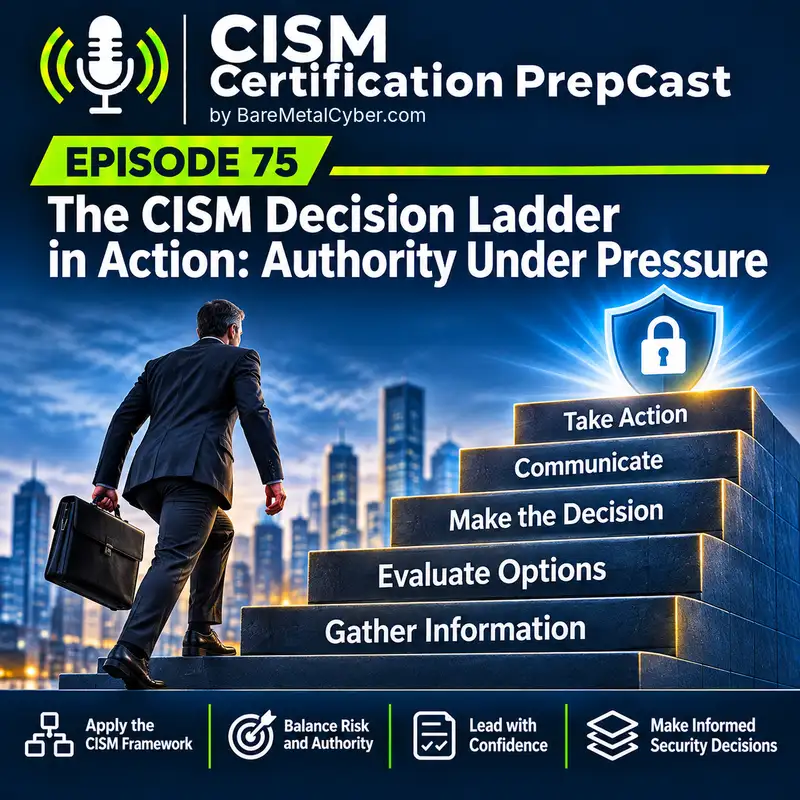
The CISM Decision Ladder in Action: Authority Under Pressure
In this episode, we are applying the CISM decision ladder under pressure without treating it as a rigid sequence. The objective is to connect the topic to business impact, decision authority, operating responsibility, and evidence rather than treating it as a slogan or isolated technical task.
Consider Pioneer Commerce, a fictional teaching organization. This workshop uses three fictional situations. In the first, an incident team has delegated authority to disable a compromised account. In the second, disconnecting a shared platform would interrupt multiple business services and exceeds the team’s authority. In the third, the facts are uncertain but evidence can be preserved while a bounded containment action proceeds. The technical details are similar, but authority, reversibility, and business impact change the preferred decision. This scenario is not an official examination question. It gives us a practical setting in which to examine the management choices and the reasons behind them.
The first task is to identify the decision verb, role, and material constraint. The manager must then prioritize immediate harm and business consequence. Next, the responsible teams should use existing authority while escalating decisions beyond it. Before the decision is closed, the organization must communicate facts, assumptions, actions, and decisions needed. Finally, it should verify the effect and revise when evidence changes. These actions may occur in parallel when authority and urgency permit, but none should disappear from the management record.
To deepen the lesson on the cism decision ladder in action: authority under pressure, begin with the management principle behind the decision. Governance decisions are about direction and control: who decides, based on what criteria, with what accountability, and with what documentation. Technical fixes are about execution: how to configure, patch, block, detect, or recover in a specific environment. On the exam, if the stem includes leadership-level triggers (board attention, regulatory exposure, cross-department impact, budget implications, or risk thresholds) you are being invited to answer like a manager. The best option will often feel slightly indirect because it sets conditions for success rather than swinging a wrench. That “manager’s move” is not delay; it is reducing the chance of doing the wrong work quickly and permanently.
The next part of the analysis concerns the evidence and accountability behind the decision. Consider a scenario where customer records in cloud storage are publicly accessible and the incident team has authority to remove unintended public access. The manager should ensure that this bounded containment action proceeds promptly while the team preserves relevant evidence, assesses severity, and coordinates with legal and privacy colleagues. Waiting for a committee to repeat an existing authorization would prolong exposure. A different choice may be needed if the proposed action would interrupt a critical service beyond the team’s authority. Read the stated facts: technical containment and management coordination can proceed together, and neither substitutes for the other.
Viewed through this episode’s purpose, the practical implication is important. One reliable tell is the presence of competing priorities in the narrative: uptime versus containment, customer experience versus stronger authentication, speed versus evidence preservation. A weak answer may optimize a single dimension while ignoring business impact or tradeoffs, whether it proposes a technical change or a governance activity. Governance decisions recognize that security is one objective among several and that risk must be managed, not merely reduced. When an answer choice includes language about risk appetite, risk acceptance, policy alignment, stakeholder accountability, or formal authorization, it is often signaling the governance layer the question is actually testing.
A manager should connect this point to ownership, operating reality, and the business consequence. This distinction also matters when you see attractive answers that sound like “more security.” Governance is not measured by the number of controls deployed; it is measured by whether controls are selected, implemented, and monitored in a way that supports business objectives and defined risk tolerance. A technical fix can be correct yet unmanaged, unapproved, and unmeasured, which makes it a weak answer in a management exam context. The exam repeatedly rewards choices that establish accountability, align to policy, and create evidence of due diligence, because those are the artifacts leaders must defend to executives, auditors, and regulators. Technical excellence without governance discipline is a common real-world failure mode, and it is exactly the kind of failure the questions are designed to expose.
This distinction becomes especially useful when several plausible actions compete for attention. Choose the best option by explicitly accounting for implied constraints. For each question, identify at least one constraint signaled by the stem (time pressure, business continuity, regulatory exposure, stakeholder impact, or limited resources) and evaluate answers against that reality. Favor options that are feasible, sequenced correctly, and defensible rather than those that promise sweeping fixes or assume unlimited budget and time. Apply this in your work by documenting tradeoffs and prioritization logic so decisions can be defended after the fact. This discipline mirrors the exam’s “best answer” logic, where balance and accountability matter as much as control strength.
The governance question is not whether the idea sounds secure, but whether it is authorized, workable, and verifiable. Treat uncertainty as real and avoid answers that assume facts not in evidence. When the stem is vague about scope, root cause, or impact, eliminate choices that jump to irreversible actions like broad resets, wiping systems, or disruptive changes without validation and decision authority. Prefer answers that classify, triage, preserve evidence, and escalate through defined decision rights before committing to high-impact moves. In operational practice, adopt the same posture by ensuring that early actions reduce risk without destroying options, evidence, or accountability. This helps you recognize that disciplined sequencing is a management control, not “delay.”
The operational consequence also matters because a plan that cannot be sustained will not manage risk for long. Check both technical correctness and management fit when testing possible distractors. During review, flag choices that exceed the stated authority, promise a silver-bullet overhaul, bundle one good action with one governance violation, or rely on absolutist language that ignores tradeoffs. Practice explaining why those options are wrong using management criteria: role alignment, sequencing, authorization, and defensibility. In policy and team practices, reinforce this thinking by clarifying who makes which decisions, how escalation works, and what must be documented when risk is accepted or treated. Over time, you’ll stop being pulled toward “more security” answers and start selecting the answer that matches accountable leadership under constraints.
Use this point to challenge assumptions and to identify what must be demonstrated before the next decision. Security leadership is rarely about finding a perfect answer; it is about making a defensible decision at the right level, at the right time, with the right evidence. The work oscillates between building policy that creates consistency and taking action that limits harm when time is short, and the difference between maturity and improvisation is whether those moves are governed and traceable. Clear escalation pathways and decision ownership keep urgent situations from turning into chaos, while purposeful documentation turns intent into proof for auditors, incident reviews, and regulators. The goal is practical judgment that holds up under pressure: prioritizing impact, authorizing within defined authority, communicating with discipline, and verifying outcomes without slowing the organization to a crawl.
The exam lens here is to separate the activity from the outcome that leadership actually needs. Decision ownership becomes clearest when it is stated in terms of “risk acceptance authority.” A security manager can recommend, quantify, and document risk, but an executive or delegated business owner typically accepts it. The difference shows up when a control gap is known and remediation competes with revenue, deadlines, or operational constraints. If a leader declines remediation, the risk is still real, but the governance requirement is that the acceptance is explicit, documented, and tied to the right owner. Exam questions often hide this in wording like “who should approve,” “who is accountable,” or “who should be informed,” and the best answer is the role with the authority to accept the consequence.
A defensible approach keeps the scope, owner, evidence, and remaining uncertainty visible. Escalation also protects the organization from unilateral actions that create avoidable harm. For example, shutting down a production environment, blocking a critical vendor connection, or forcing emergency credential rotations can be necessary, but these actions have measurable business impact and reputational implications. The person executing the change might be a senior engineer, but ownership for the decision should sit with the leader accountable for service availability and customer commitments, informed by security and legal guidance. This is why pre-approved emergency change authority exists: it allows speed while keeping decisions within a defined authorization model. On the exam, look for language that implies “enterprise impact,” because that usually shifts ownership upward.
Apply this principle directly to the management decision in this episode. Communication is part of escalation, but it is not the same as ownership. Many incidents require fast operational updates to keep teams aligned, yet only a small set of roles should make binding commitments about disclosure, customer notification, or public statements. Legal counsel, executive leadership, and communications functions often own those calls because they carry liability and reputational consequences. Security provides facts, timelines, and impact analysis, but should avoid speculative claims that later become inconsistent with evidence. In exam terms, this means separating factual incident reporting from executive decision-making and from external messaging authority.
The next part of the analysis concerns the evidence and accountability behind the decision. Short sessions work because they force prioritization, and prioritization is exactly what the exam measures. A twenty-minute block is long enough to rehearse decision ladders, but too short to get lost in research or rabbit holes. The constraint pushes you toward repeatable mental prompts like “Who owns this risk?” and “What is the next best managerial action?” Over time, those prompts become automatic, and automatic is what you need when you are staring at a timed question and four plausible choices. The exam is less about memorizing perfect definitions and more about consistently selecting actions that reflect mature security management.
Viewed through this episode’s purpose, the practical implication is important. The fastest way to build this skill is to practice micro-scenarios that end with a decision, not a discussion. For example, imagine a critical vendor announces a security incident and your team has limited details, but leadership wants assurance by end of day. Your technical brain may want indicators, logs, and forensics, but the managerial decision path starts with governance: validate facts, assess exposure, invoke third-party response requirements, and assign an accountable owner. A short session would focus on deciding who must be engaged and what documentation or evidence is needed to support decisions. This approach trains you to answer what is being asked rather than what you would personally investigate first.
A manager should connect this point to ownership, operating reality, and the business consequence. Exam-speed judgment improves when you learn to rank answer choices by scope and authority. Many questions include distractors that are technically correct but mis-scoped, like jumping to implement new controls when the scenario is about governance, or escalating to executives when the action is already pre-authorized at the operational level. In a short session, you can rehearse spotting those mismatches by asking whether the choice is setting direction, managing risk, executing a procedure, or gathering evidence. The “best answer” frequently sits at the governance layer for CISM-style questions, especially when the scenario mentions policy, risk acceptance, or business impact. The practice is not about memorizing that rule, but about learning to justify it quickly and consistently.
This distinction becomes especially useful when several plausible actions compete for attention. Architecture adds another interface to clarify. The architect proposes and evaluates designs; asset owners define protection needs; service owners confirm operational dependencies and support. A control owner implements and maintains the assigned protection. These roles may share meetings, but the charter should still identify who approves the design and who can accept the resulting risk.
The governance question is not whether the idea sounds secure, but whether it is authorized, workable, and verifiable. Roles are the “who,” responsibilities are the “what,” and authority is the “can,” and those three must line up for governance to work. A role definition without authority creates performative accountability, where someone is blamed for outcomes they could not influence. Authority without responsibility creates uncontrolled power, where actions are taken without a clear obligation to meet control objectives. Responsibility without defined boundaries leads to overlap, which seems collaborative until two teams assume the other team handled the critical step. In exam scenarios, the best answer typically favors clarifying role boundaries and decision rights before adding new tools or processes, because ambiguity is the root cause of persistent control breakdowns.
The operational consequence also matters because a plan that cannot be sustained will not manage risk for long. Security governance relies on a few recurring role archetypes that must be distinguished even when the same person wears multiple hats. The business owner is accountable for the asset or process meeting its objectives and for accepting residual risk within tolerance. The system owner is responsible for lifecycle management, including ensuring controls are designed into the system and maintained over time. The data owner is responsible for classification decisions, authorized uses, and access requirements for information, which often differs from who operates the system holding that data. The control owner is responsible for a specific control’s design and operating effectiveness, and the control performer executes the control activities, which should not automatically be the same role. When these archetypes are collapsed into a single title, governance loses the ability to ask targeted questions and to hold the right party to the right obligation.
Use this point to challenge assumptions and to identify what must be demonstrated before the next decision. When resource constraints prevent clean separation, governance should deliberately choose compensating controls rather than pretending the conflict does not exist. Increased logging and immutable audit trails can reduce concealment by making actions harder to hide. Peer review and managerial review can introduce independence when separate teams are not available, especially if reviews are sampled, tracked, and tied to performance expectations. Automated policy enforcement can reduce reliance on individual discretion by making certain actions impossible without required approvals. Periodic access recertification by business owners can counterbalance centralized administrators who must perform both provisioning and support. On the exam, compensating controls are credible when they address the specific conflict and are capable of producing evidence.
The exam lens here is to separate the activity from the outcome that leadership actually needs. Role clarity also depends on how responsibilities are communicated and enforced across the organization’s operating model. When a shared services team provides identity or cloud platform operations, governance must define where the shared team’s responsibility ends and the product team’s responsibility begins. When outsourcing is involved, roles must explicitly cover vendor management, including who validates controls, who reviews attestations, and who can authorize deviations. When agile delivery is used, product owners and engineering leaders need role definitions that include security outcomes, not only feature delivery. When multiple lines of defense are used, responsibilities should distinguish between owning controls, monitoring controls, and independently validating controls, even if those functions are lean. Ambiguity across these interfaces is a frequent source of audit findings because evidence shows “everyone touched it” but no one owned it.
A defensible approach keeps the scope, owner, evidence, and remaining uncertainty visible. Segregation of duties is ultimately a governance signal because it reflects an organization’s willingness to constrain itself in service of integrity. If leaders accept that “we trust our people” as a substitute for SoD, they are confusing cultural trust with control design. A healthy governance posture assumes good intent while still designing systems that reduce temptation, reduce error likelihood, and increase detectability. The exam’s “best answer” logic usually rewards designs that make misuse difficult and accountability provable, while still enabling the business to operate at speed. In practice, the strongest organizations treat role clarity and SoD as foundational design constraints, not as after-the-fact compliance tasks.
Apply this principle directly to the management decision in this episode. Effective governance makes security outcomes predictable by ensuring that authority, oversight, and accountability are explicit before risk materializes. When boards and executives understand their retained accountability, when roles and segregation of duties reduce conflicts, when steering committees clarify decision rights, and when documentation drives real behavior, security becomes a managed business function rather than a reactive control exercise. These mechanisms do not eliminate risk, but they ensure risk is consciously addressed at the right level and supported by evidence. In practice and on the exam, strong governance is visible through consistent decisions, traceable accountability, and controls that hold up under scrutiny. The distinguishing factor is not intent, but whether the organization’s structures reliably convert intent into action.
The next part of the analysis concerns the evidence and accountability behind the decision. A practical approach separates the authority to classify from the authority to commit organizational resources. Classification is the act of labeling an event as an incident and assigning severity based on predefined criteria, which should be delegated to trained responders who are closest to the evidence. Resource commitment is the act of mobilizing business-wide support, approving disruptive containment steps, and invoking crisis management structures, which often requires leadership involvement. If the same person must do both, incidents tend to be under-declared until impact is undeniable, which is the opposite of effective management. The plan should therefore define multiple “decision rights” rather than a single binary authority, because response decisions occur continuously, not once. This distinction also helps prevent the common anti-pattern where “incident” is treated as a politically loaded word instead of an operational status.
Viewed through this episode’s purpose, the practical implication is important. Authority should be mapped to action types, likely business impact, and severity thresholds, so responders do not invent governance in the moment. The plan should identify urgent containment that an incident commander or response team may perform under authority delegated in advance, even during a high-severity incident. It should also identify actions outside that mandate, such as a shutdown affecting several critical services, that require escalation to a named decision-maker or alternate. Severity alone does not mean every action must wait for fresh business-owner approval. Define who can authorize emergency changes and spending, including external response support, and require prompt notification and a decision record. Clear boundaries make fast action accountable.
A manager should connect this point to ownership, operating reality, and the business consequence. The incident commander role is central to authority design because it creates a single point of coordination without centralizing every technical decision. The incident commander should have authority to direct response activities across teams, assign tasks, and set the tempo of communications, even if they are not the most senior person involved. That authority must be granted in advance and reinforced by leadership, otherwise functional managers will revert to their normal reporting lines and the response will fragment. The plan should also define who can appoint or replace the incident commander, since leadership changes mid-incident can create confusion if not handled deliberately. In mature organizations, the incident commander is empowered to act within defined boundaries while escalating decisions that exceed those boundaries, which keeps response fast and governed.
This distinction becomes especially useful when several plausible actions compete for attention. A common exam-relevant scenario is a responder who sees indicators of compromise and wants to isolate systems, but operations resists due to uptime commitments. The plan should address this by defining “containment authority” for time-critical actions, including emergency powers under specific conditions. A limited emergency authority might permit temporary isolation of a suspected endpoint, revocation of a compromised credential, or blocking of known malicious indicators without waiting for a meeting. That authority should come with requirements for rapid notification and documentation, so actions are transparent and reviewable. The goal is not to bypass governance, but to design governance that acknowledges the physics of incidents, where minutes can matter more than perfect consensus.
The governance question is not whether the idea sounds secure, but whether it is authorized, workable, and verifiable. For example, a playbook may authorize the duty incident commander to isolate a compromised workstation and revoke its active sessions while notifying the service owner. Disconnecting the shared identity platform could affect several business services and may exceed that delegation. The plan must say who decides, how quickly an alternate takes over, and which emergency authority applies if delay would allow serious harm. An authority matrix is an organization-specific agreement, not a rule that business owners must personally approve every containment action. Business accountability remains in place when trained responders act within an approved mandate.
The operational consequence also matters because a plan that cannot be sustained will not manage risk for long. Authority design should also include communications authority, because messaging is part of incident control. Internally, the plan should specify who can send organization-wide alerts, who can instruct employees to take protective actions, and who can communicate with executives during the incident. Externally, the plan should designate authorized spokespeople and define who can communicate with customers, regulators, law enforcement, and the media. The designated external spokesperson should work within the communications plan, with security providing verified technical facts and legal or compliance input where needed. The role may be held by an appropriately authorized security leader; the deciding factor is the assigned mandate, not the person’s job title. When communication authority is defined, teams avoid the twin risks of silence that fuels rumors and uncontrolled statements that create legal exposure.
Use this point to challenge assumptions and to identify what must be demonstrated before the next decision. To function under stress, the pathway must specify which channels are used, when they are used, and what minimum content is required. Email alone is fragile during identity compromise, and chat systems can become evidence mines if participants speculate in writing. Many organizations designate an out-of-band method for initial activation, such as a phone tree or paging service, and then move to a controlled collaboration space once participants are confirmed. The message content should be structured to communicate what is known, what is unknown, what has been done, and what is needed next, without adding unverified attribution. This discipline reduces the risk that early, uncertain statements become “facts” that later constrain legal and communications options.
The exam lens here is to separate the activity from the outcome that leadership actually needs. Consider an exam-style scenario: a security analyst observes anomalous authentication patterns and a spike in data egress from a cloud storage bucket, and a containment action would disrupt a revenue-critical customer workflow. If the analyst notifies only the security team, containment may be delayed while business leaders later object to the disruption, and the delay can increase loss. If the analyst notifies everyone broadly, internal rumor and contradictory instructions can create operational chaos before facts are validated. The best pathway activates the incident commander and appropriate service owner early. Responders act within predelegated emergency authority to stop credible active harm while seeking a decision for measures outside that mandate. Notification and consultation support the decision; they do not create a universal requirement to wait for fresh approval before every containment action. When notification and escalation are pre-wired, the organization spends its time choosing actions, not choosing participants.
A defensible approach keeps the scope, owner, evidence, and remaining uncertainty visible. Pathways must account for time sensitivity and the reality that organizations operate across shifts, geographies, and third parties. Escalation rules should include coverage expectations, such as who is on call, what the response time is, and who becomes the delegate when the primary role is unreachable. This is where many programs fail in practice: a policy names a role, but the role is not staffed after hours, turning “notify within one hour” into wishful thinking. The pathway should also include vendor and managed service provider engagement points, because control evidence and containment actions often require coordinated changes across organizational boundaries. When the incident involves outsourced infrastructure or SaaS, escalation may need to include contract management or vendor risk to ensure support is activated under the correct terms.
Apply this principle directly to the management decision in this episode. Partner communications are often overlooked, but they can be the difference between isolated recovery and cascading failure. Partners include upstream providers, downstream integrators, payment processors, logistics providers, and any organization connected through business processes or technical integrations. A partner may need to rotate API keys, adjust network allowlists, disable integrations, or increase monitoring, and those actions require timely notification with the right technical context. At the same time, partner relationships are contractual, and disclosures can create reputational and liability consequences if not handled carefully. Effective programs route partner outreach through a combined technical and contractual lens, ensuring that the recipient gets what they need to act without receiving speculation or unnecessary internal detail.
The next part of the analysis concerns the evidence and accountability behind the decision. Consider an exam-style scenario: a SaaS provider discovers suspicious access patterns affecting a subset of tenants, but investigation has not yet confirmed data exfiltration. A customer’s procurement office demands a written statement within twenty-four hours, while a strategic integration partner asks whether to revoke shared credentials immediately. If the provider responds with a blanket claim that “no data was accessed,” and later finds evidence of access, the credibility cost can exceed the technical impact. If the provider refuses to communicate until certainty exists, customers may assume the worst and partners may take uncoordinated actions that break services or destroy evidence. The best approach is a controlled statement: what is observed, what is being investigated, immediate precautions, and when the next update will occur, coupled with targeted technical coordination for partners who must take near-term actions.
Viewed through this episode’s purpose, the practical implication is important. A key control for external communications is aligning the message with evidence handling and privilege considerations. External statements, even informal ones, can become part of contractual disputes, regulatory investigations, or litigation, so the organization should ensure that communications are reviewed through the appropriate governance path. This does not mean over-lawyering every operational update, but it does mean avoiding unnecessary admissions, inaccurate attribution, or broad statements that exceed available facts. Many incidents also involve law enforcement engagement, and disclosures should not compromise investigative efforts or operational security. From an exam standpoint, coordinating with legal counsel and communications leadership is a standard “best answer” because it balances speed with defensibility.
Return to the fictional Pioneer Commerce scenario. The ladder is a reasoning aid. Depending on the facts, prioritizing, authorizing, communicating, and verifying may occur together or in a different visible order, but each responsibility must be addressed. The strongest management response makes the underlying choice visible, names the accountable owner, and states how the result will be verified. It also preserves the distinction between an authorized technical action and the governance decision that gives that action direction, limits, and follow-through.
For practice, write a concise decision record for all three Pioneer situations. For each one, identify the fact that changes the decision, the action that can proceed now, the approval that is required, the audience that must be informed, and the evidence used to verify the outcome. Then challenge your own answer by identifying one plausible alternative that appears reasonable but fails because of authority, timing, scope, evidence, or business impact. This exercise develops the habit of explaining not only what should happen, but why that action is the best management decision under the stated conditions.