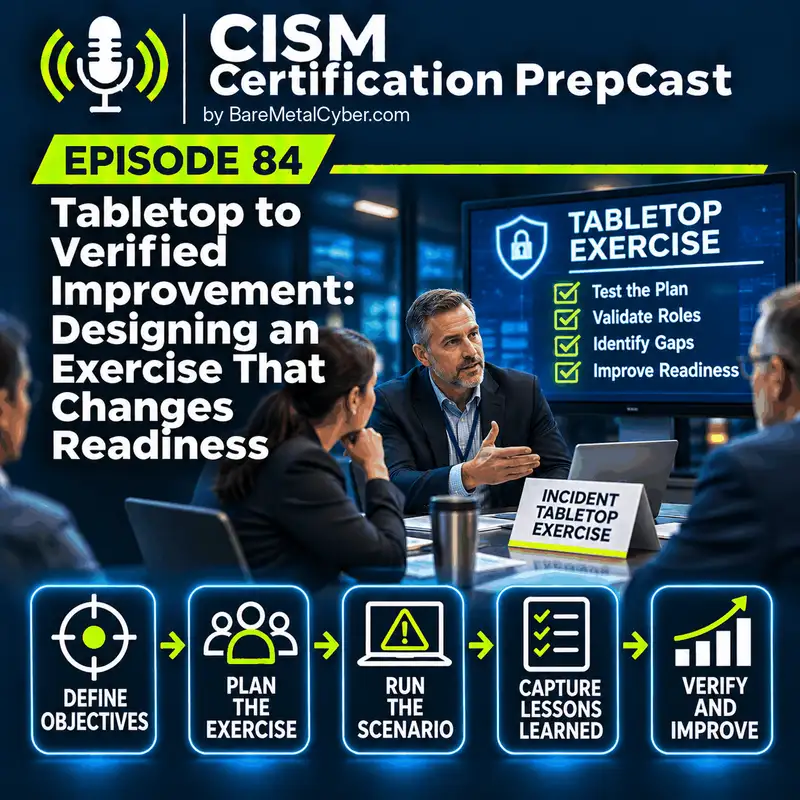
Tabletop to Verified Improvement: Designing an Exercise That Changes Readiness
In this episode, we are following an incident exercise from design through verified improvement. The value of a tabletop is not that participants can read a plan aloud or demonstrate confidence in a meeting. It is that the organization can observe decisions, handoffs, authority, communication, and recovery assumptions, then convert what it learns into corrective action that is tested and closed.
Imagine a fictional organization called Prairie Municipal Services. It provides billing, permit, and public-information services for several local governments. Its customer portal depends on a managed hosting provider, an identity service, a payment processor, and internal records systems. The organization wants to test a scenario involving a supplier outage and suspected exposure of customer information. Previous exercises ended with a lessons-learned meeting, but many actions remained open and no one verified whether readiness actually improved.
The first step is to define the exercise objective. Saying that the organization will test incident response is too broad. Prairie Municipal Services might choose to test whether leaders can classify the event, determine containment authority, coordinate with suppliers, make notification decisions, and restore a critical service within approved conditions. The objective should identify the capability being evaluated and the evidence expected. A focused objective allows observers to distinguish useful performance from energetic discussion.
The exercise method should match that objective. A checklist review can confirm that plans, contacts, contracts, and procedures exist and are current. A tabletop can test decision flow, role clarity, escalation, communication, and coordination through structured discussion. A simulation can add time pressure, artifacts, and operational actions. A technical exercise can validate specific tools, access, or restoration procedures. Calling every method a test without distinguishing what it proves creates false assurance.
Prairie Municipal Services begins with a checklist review because the tabletop will depend on current information. The review finds that one supplier contact has changed, the recovery plan references an old identity process, and a notification template uses an outdated approval route. Correcting these items is useful, but the organization should not claim that response readiness has been tested. Documentation currency is one layer of readiness. Decision and execution capability require additional evidence.
The tabletop scope should describe the service, participants, time period, assumptions, and exclusions. If the exercise includes the customer portal but excludes payroll and emergency services, that boundary should be explicit. If supplier personnel will participate only during certain stages, planners should note the limitation. Scope prevents later claims that the exercise validated capabilities it never addressed. It also helps keep the session deep enough to produce meaningful observations.
Participants should represent the decisions and handoffs in the scenario. Technical responders, incident leadership, business owners, legal, privacy, communications, supplier management, continuity, and executive representation may all be needed. Not every observer must be an active player. The planner should distinguish participants who make decisions from observers who record behavior. Including many people without defined roles can turn the exercise into an audience rather than a test.
The facilitator should know the objective but remain neutral about the preferred outcome. The role is to introduce scenario information, clarify rules, maintain pace, and ensure that decisions are made by the appropriate participants. The facilitator should not rescue the team by supplying missing procedures or authority. If participants cannot identify who can shut down the service, that is an observation. The exercise should reveal the current state, not demonstrate what the facilitator knows.
Observers need structured criteria. They should record what decision was required, who acted, what information was used, how long the discussion took, which authority was cited, what communication occurred, and what evidence was missing. General comments such as communication needs improvement are too vague. Useful observations identify the handoff, consequence, and condition. For example, the team could not confirm whether the supplier had preserved access logs because the contract owner was not included and the after-hours contact was unknown.
The scenario should be realistic enough to engage participants but controlled enough to test the chosen objective. Prairie Municipal Services begins with a report that the hosting provider is experiencing instability and that unusual administrative access occurred shortly before the outage. The portal becomes unavailable, and a local government customer asks whether personal information may have been exposed. The facts are incomplete. This uncertainty forces participants to distinguish confirmed events from inference and to decide what they need next.
Injects should create decision points rather than simply add drama. The facilitator may reveal that the provider can restore service quickly but cannot yet confirm log integrity. Another inject may show that payment processing is working while identity access remains inconsistent. A customer may request a public statement, or a regulator may ask for preliminary information under a hypothetical obligation. Each inject should connect to the exercise objective and create observable choices about authority, evidence, communication, or recovery.
The exercise should test classification and categorization early. Participants need to determine whether the event is an incident, how severe it is, and what factors drive that judgment. If the organization uses a severity scheme, the team should apply it to business impact, data sensitivity, availability, and possible obligations. The facilitator should observe whether the label produces the expected escalation and resources. A classification system is effective only when it drives correct action.
Containment decisions should include business consequences. The team may consider suspending supplier access, isolating the portal, disabling administrative functions, or stopping related integrations. Participants should explain what harm each action limits and what service impact it creates. The exercise should reveal whether delegated authority is clear and whether business owners understand the tradeoff. A response plan that lists containment options but does not identify who can authorize them is incomplete.
Supplier coordination is a critical part of the scenario. Prairie Municipal Services should test whether the provider can be reached through the documented route, what evidence can be requested, who owns the relationship, and how disagreements are escalated. The supplier should not be treated as an external character who magically supplies answers. Contractual cooperation, technical access, and communication cadence should be exercised. This can expose gaps that internal-only discussions miss.
Communication injects should test message discipline. The team may need to brief executives, inform affected customers, coordinate with partner governments, and prepare for public questions. Participants should distinguish confirmed facts from unverified claims and identify approval authority. The exercise can reveal whether technical status is translated into business impact and whether messages remain consistent across audiences. A communications plan is not validated by reading a template. It is validated by producing timely, accurate, appropriately authorized information under scenario pressure.
Recovery objectives should be part of the discussion. The business owner should state what service capability must return, how quickly, how much data loss is acceptable, and what dependencies matter. The exercise should test whether participants understand the difference among the recovery time objective, recovery point objective, and maximum tolerable downtime. If the hosting provider offers infrastructure restoration within a certain period, the team should still evaluate end-to-end business recovery. Supplier restoration is an input, not the entire outcome.
Return-to-service decisions should be explicit. The facilitator might state that the provider has restored the portal, but identity logs remain incomplete and several records require reconciliation. The team must decide whether to authorize full service, stage a limited release, operate in degraded mode, or delay. Observers should record the criteria used, evidence requested, authority involved, and monitoring conditions. This tests whether recovery is treated as an accountable decision rather than a technical restart.
The exercise should also test continuity alternatives. Can customer requests be handled through a manual process? How much demand can that process sustain? Who communicates the alternative to customers? How are transactions reconciled later? A workaround described in a plan may fail when participants consider staffing, data, privacy, and capacity. Tabletop discussion can expose those assumptions before a real outage.
Time pressure should be deliberate, not theatrical. The facilitator can limit discussion windows, introduce competing demands, or simulate executive unavailability. The purpose is to observe prioritization and escalation, not to make participants fail through confusion. If the exercise moves too quickly for the objective, it may produce noise rather than insight. If it moves too slowly, participants may solve problems through research that would not be available during an incident. The pace should reflect the capability being tested.
Success criteria should be defined before the exercise. Prairie Municipal Services may expect participants to identify the incident commander, classify the event within a reasonable period, contact the supplier through the approved path, produce an executive update, choose a containment action within authority, and define evidence-based return criteria. Success does not require every decision to match the facilitator's preference. It requires decisions to be timely, authorized, reasoned, and aligned with the organization's plans and objectives.
The exercise should capture strengths as well as gaps. Perhaps the communications team produces a clear status update, supplier management reaches the provider quickly, and the business owner defines recovery priorities well. Recognizing strengths helps preserve effective practices and maintains credibility. It also prevents the review from becoming a list of failures detached from actual performance. Improvement builds on what worked while addressing what did not.
The debrief should occur while observations are fresh. Participants can explain what information they lacked, where procedures helped, and where they improvised. Observers can present evidence rather than conclusions alone. The discussion should remain non-blaming. The goal is to improve the system of roles, plans, tools, relationships, and decisions. Blame encourages defensiveness and hides the conditions that made errors likely.
Findings should be specific and linked to impact. An observation that supplier communication was slow becomes a finding when the organization explains that the outdated contact delayed confirmation of log preservation and increased uncertainty about notification. A statement that roles were unclear becomes useful when it identifies which authority was disputed and what decision was delayed. Clear findings support prioritization and treatment. Vague criticism produces vague actions.
Root-cause analysis should be proportionate. If participants did not know who could authorize a portal shutdown, the cause may be missing delegation, conflicting plans, inadequate training, or an outdated organizational structure. Simply adding the answer to one checklist may not solve the underlying issue. The review should examine why the information was unavailable and how the governance process should change. Improvement should address the system, not only the exercise symptom.
Corrective actions need owners, deadlines, resources, and required evidence. An action to update the supplier contact list should identify who owns the list, how changes are validated, and when the update is complete. An action to clarify shutdown authority may require plan revision, executive approval, training, and a future exercise. An action to improve log access may require contract, architecture, and technical changes. Completion criteria should describe the outcome, not merely the task.
Prioritization should consider risk and dependency. A missing contact for a critical supplier may require immediate correction. A confusing template may be lower priority if accurate communication can still occur. Some actions may block others, such as clarifying service ownership before finalizing recovery authority. The improvement backlog should make these relationships visible. Treating every finding as equal can delay the changes that matter most.
Governance bodies should receive the findings appropriate to their authority. Operational teams can manage procedure corrections, while leadership may need to resolve funding, supplier, policy, or risk-acceptance issues. The report should explain the exercise scope and limitations so leaders understand what was and was not tested. It should also identify any residual risk while actions remain open. Exercise reporting is part of risk governance, not a ceremonial closeout.
Tracking should continue beyond the meeting. A governance, risk, and compliance platform or ordinary project system can record actions, owners, evidence, due dates, and status. The tool matters less than disciplined follow-through. Overdue actions should be escalated based on risk. If findings repeatedly remain open, the organization has learned about its governance process, not just its incident plan.
Verification distinguishes real improvement from administrative closure. A revised document can prove that wording changed. Training records can prove that people attended. A technical test can prove that access or integration works. A follow-up tabletop can demonstrate that participants now use the clarified authority. The evidence should match the original finding. Closing an action with the wrong evidence can preserve the gap while making the dashboard look better.
Prairie Municipal Services should retest the specific capabilities that failed. If supplier contact and log preservation were weak, a focused exercise can begin after hours and require the team to reach the provider, request evidence, and document the response. If return-to-service authority was unclear, a later tabletop can present conflicting recovery evidence and require an authorized decision. Retesting need not repeat the entire original scenario. It should produce evidence about the corrected capability.
The risk register and plans should be updated based on verified findings. If the exercise reveals that supplier response is slower than assumed, recovery and incident risks may change. If the manual workaround cannot handle expected volume, the business impact analysis may need revision. If authority is unclear, governance documentation should be corrected. Continuous improvement connects observations to the systems that guide future decisions.
Exercise metrics should focus on readiness and closure, not participation alone. Useful measures may include time to make key decisions, proportion of required roles represented, number of material findings, age of open actions, proportion of actions verified, and recurrence of previously identified gaps. Attendance and exercise count can provide context, but they do not prove improvement. A mature program measures whether capability changed.
Repeated findings require escalation. If every exercise reveals the same supplier-contact problem or the same uncertainty about service ownership, another reminder may not be enough. Leadership may need to change accountability, funding, or oversight. Persistent gaps indicate that the improvement process is not working. The program should identify why actions fail to close and adjust governance accordingly.
Exercise design should evolve with the business and threat environment. New suppliers, cloud services, product launches, legal obligations, and incidents can change what readiness means. Scenarios should reflect credible organizational exposure rather than the most dramatic external story. The exercise calendar should include different objectives over time, such as classification, containment, communications, recovery, or executive decision-making. Variety improves coverage while preserving depth.
The organization should avoid using exercises to prove a predetermined positive conclusion. Participants may feel pressure to demonstrate readiness to executives or auditors. That pressure can cause facilitators to guide answers, exclude difficult dependencies, or close findings prematurely. Honest exercises create value precisely because they expose uncertainty and friction. Leadership should reward discovery and remediation, not only smooth performance.
Exercise safety and rules of engagement should be defined before the session. Participants need to know which systems, communications, and external contacts are simulated and which remain real. A message sent accidentally to a customer or provider can create an actual incident. The planner should identify stop authority, confidentiality expectations, and how sensitive observations will be handled. Realism is valuable only when the exercise remains controlled and does not introduce unmanaged harm.
The scenario control team should manage injects consistently. If participants make a sound decision, the facilitator should not change the facts merely to force failure. If the team asks for information that would reasonably be available, the exercise should provide it or record that the source is unavailable. Fair scenario control makes findings credible. Participants are more likely to accept difficult lessons when they believe the exercise tested the process rather than manipulated them toward a predetermined result.
Role preparation should balance familiarity and surprise. Participants should understand their normal responsibilities and the exercise rules, but they should not receive every scenario detail in advance. Too much advance knowledge allows rehearsal of answers rather than demonstration of readiness. Too little preparation can cause confusion about the exercise itself. The planner should train people on roles and procedures while preserving uncertainty about the event they will face.
External-provider participation can add significant value when governed carefully. The hosting provider may practice notification, evidence preservation, recovery estimates, and executive escalation. Prairie Municipal Services can observe whether contractual commitments translate into actual behavior. If the supplier cannot participate, the organization should simulate its expected responses and record the limitation. A tabletop without the real dependency can still teach, but it should not be presented as proof of supplier coordination.
The exercise record should protect sensitive information while preserving useful evidence. Notes may contain control weaknesses, contact details, legal concerns, or observations about individual performance. Access, retention, and distribution should be defined. Summaries for leadership can focus on material findings and actions, while detailed records remain available to owners and reviewers. Poor handling of exercise evidence can discourage honest participation or expose the organization unnecessarily.
Program maturity can be seen in how the organization treats unexpected strengths and weaknesses. A mature team does not hide a failure because the plan looked good on paper, and it does not overreact to one mistake without understanding context. It compares observed behavior with requirements, prioritizes by risk, and tests the correction. Over time, this creates a body of evidence showing which capabilities are reliable, which are improving, and which require strategic investment.
Executive sponsorship matters after the exercise. Leaders should remove obstacles, fund material corrections, and hold owners accountable without turning the session into a blame event. They should also accept that some findings may require changes to objectives, supplier relationships, or architecture rather than simple training. When executives ask only whether the exercise passed, they encourage superficial reporting. When they ask what decision failed, what evidence changed, and how improvement will be verified, they reinforce a learning culture.
The organization should maintain an exercise roadmap rather than selecting scenarios randomly. The roadmap can rotate among critical services, decision authorities, supplier dependencies, communications, and recovery capabilities. It should reflect unresolved findings and major business changes. This prevents the program from repeatedly testing comfortable topics while leaving difficult assumptions untouched.
A later exercise can deliberately combine capabilities that were previously tested separately. Once classification, supplier contact, and recovery authorization have each improved, a more complex scenario can evaluate the full chain. Integration testing reveals whether individually sound processes work together under pressure. The progression from focused exercises to integrated exercises creates stronger evidence than jumping immediately to a large event that produces too many findings to interpret. It also helps leadership see whether investments are improving the specific capabilities that earlier exercises found weak. That visibility supports better prioritization and more credible oversight. It also strengthens confidence in future exercise conclusions.
On the exam, identify what the organization is trying to validate. If the goal is to confirm that plans are current, a checklist review may be appropriate. If the goal is to rehearse cross-functional decisions, a tabletop is stronger. If the goal is to validate technical execution and tooling, a simulation or operational test may be required. Choosing a method that cannot produce the needed evidence is a common wrong answer.
Also distinguish lessons learned from improvement. A post-exercise report can identify a gap, but the organization has not improved until an action changes the relevant capability and verification shows the change works. The best answer may involve assigning ownership, updating plans, implementing controls, and retesting. CISM reasoning follows the loop through closure rather than stopping when a meeting ends.
For a learner exercise, design a short tabletop for Prairie Municipal Services. State one objective, the scope, participants, three injects, success criteria, and the evidence observers should collect. Then write two findings, each with an owner, corrective action, deadline, and verification method. This practice turns exercise planning into a management process rather than a creative-writing task.
For a second exercise, compare three statements: the plan was reviewed, the team discussed the scenario, and the team demonstrated the capability. Identify what evidence supports each statement and what remains unproven. Then decide which method would answer the next important question. This trains you to resist broad readiness claims based on shallow testing.
Prairie Municipal Services should treat the supplier outage and suspected exposure exercise as the beginning of an improvement cycle. It should observe decisions and handoffs, produce evidence-based findings, assign accountable actions, and retest the affected capabilities. The exercise is successful when it creates honest visibility and verified change, not when participants complete the agenda without discomfort. Readiness improves through challenge, correction, and validation.
The central lesson is that exercise value is created after the scenario as much as during it. Good design reveals the decisions that matter. Good observation captures what actually happened. Good governance turns findings into owned work. Good verification proves that the work changed capability. When all four are present, a tabletop becomes a mechanism for resilience rather than a meeting that produces temporary awareness.
An exercise creates lasting value only when observations become owned corrective actions and those actions are later tested for effectiveness. Scheduling the next validation step before closing the exercise prevents lessons from becoming meeting notes and gives governance bodies evidence that readiness improved rather than merely being discussed.