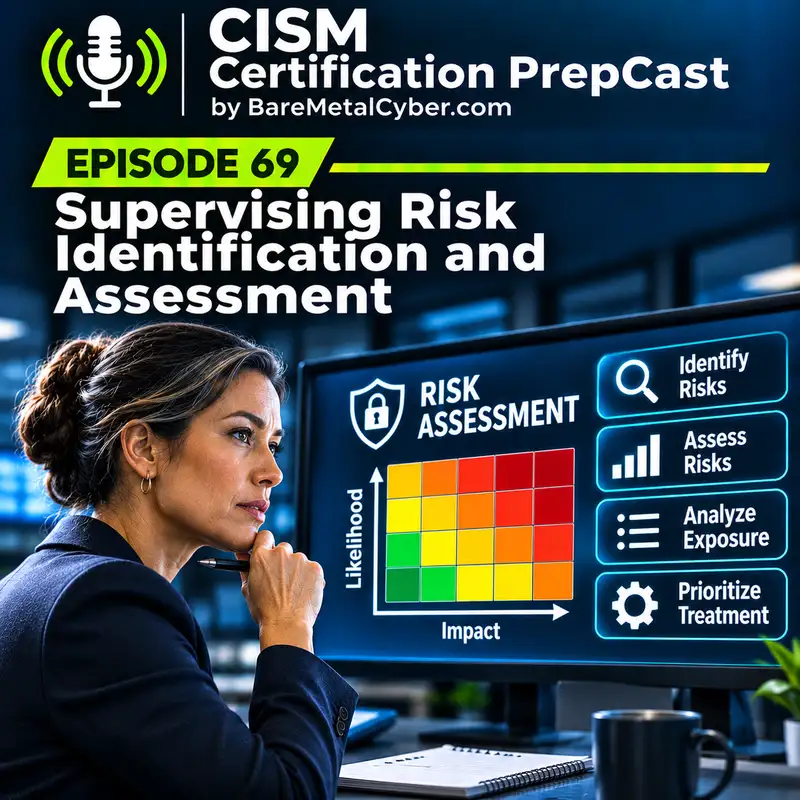
Supervising Risk Identification and Assessment
In this episode, we are supervising risk identification and assessment so methods, scope, assumptions, ownership, and outputs support real decisions. The objective is to connect the topic to business impact, decision authority, operating responsibility, and evidence rather than treating it as a slogan or isolated technical task.
Consider Lakeview Insurance, a fictional teaching organization. It asks every business unit to complete a risk worksheet. The results use different definitions, omit important service dependencies, and assign nearly every risk to the security department. Senior leaders receive a colorful heat map but cannot tell which assumptions were used or what decisions are required. The security manager must supervise the process without personally inventing every score. This scenario is not an official examination question. It gives us a practical setting in which to examine the management choices and the reasons behind them.
The first task is to define scope, method, criteria, and intended decision. The manager must then build credible risk scenarios around assets and business consequences. Next, the responsible teams should make assumptions, uncertainty, and existing controls visible. Before the decision is closed, the organization must assign risk ownership to accountable business leaders. Finally, it should review quality, challenge inconsistency, and connect results to treatment. These actions may occur in parallel when authority and urgency permit, but none should disappear from the management record.
The success of any information security program depends heavily on how well it identifies and assesses risk. For security leaders, this means not only participating in risk processes, but actively supervising them to ensure that they are accurate, aligned, and useful. The role of the CISM in risk supervision is to provide oversight and direction so that risk management activities support enterprise strategy and business priorities. Security leaders must ensure that risk identification is comprehensive, repeatable, and based on current information. Risk assessment must go beyond surface-level scoring to reflect the actual business impact of threats and vulnerabilities. This oversight helps align technical findings with governance-level decision-making, ensuring that material risks are communicated to those responsible for setting policy, allocating resources, or accepting risk. The CISM's supervisory role also reinforces accountability, making sure that risks are owned, tracked, and evaluated consistently across departments and over time.
Effective risk management begins with strong identification practices. At its core, risk identification involves recognizing and documenting the threats, vulnerabilities, and exposures that exist across systems, processes, and data. Risks must be identified across all dimensions, internal operations, technology platforms, personnel, and external partnerships. Structured tools such as checklists, questionnaires, interviews, and threat intelligence feeds can help uncover risks that might otherwise be missed. Data from control testing, audit reports, incident logs, and vulnerability scans provide a rich source of real-world risk indicators. Risks should be classified into categories such as strategic, operational, compliance, and reputational to provide context and help with prioritization. Proper classification supports oversight, accountability, and alignment with enterprise risk registers and governance reviews. Without thorough identification, the entire risk process loses credibility, because unrecognized risks cannot be mitigated or monitored.
Supervising the identification process means making sure it is inclusive, up-to-date, and aligned with enterprise needs. This starts by ensuring that input is gathered from across the organization, not just IT or security. Business units, legal teams, compliance officers, and operational managers all have valuable insight into where risks reside. Risks related to new technologies, third-party services, and digital initiatives must be considered as they emerge. Risk inputs must be refreshed regularly, especially following incidents, system upgrades, or process changes. The scope of risk identification should reflect the organization's business model, regulatory landscape, and stated risk appetite. Reviews should include an evaluation of completeness and quality, checking that risk registers are current, that descriptions are specific, and that duplication is avoided. Gaps in scope, documentation, or ownership must be addressed to preserve the value of the identification process.
Once risks are identified, they must be assessed in a way that informs decision-making. There are multiple techniques available, and the best choice depends on the organization’s maturity, available data, and risk culture. Qualitative assessment is the most common, using likelihood and impact scales such as high, medium, or low. This method relies heavily on expert judgment but can be effective when data is limited. Quantitative assessments use numeric scoring models such as Annualized Loss Expectancy or probabilistic methods to estimate financial exposure. These models require more data but support stronger investment justification. Hybrid approaches combine structured scoring with supporting data and narrative context. Scenario-based assessments are another option, especially useful for evaluating complex or emerging threats. These involve analyzing “what-if” cases and their potential impact on operations. Regardless of the method used, the approach must be consistent, explainable, and tailored to the organization's capacity and strategic needs.
Supervising the execution of risk assessments ensures consistency, reliability, and relevance. Criteria for scoring, documentation, and comparison must be defined and followed. Security leaders must review the inputs used in assessments, such as data sources, assumptions, and interview notes, to validate their credibility. Assessments must reflect not only technical risks, but business impact. A vulnerability on a critical system carries more weight than one on a low-priority test server. Severity ratings must include a clear rationale, and risk treatment suggestions must be linked to practical options such as mitigation, transfer, avoidance, or acceptance. All material risks must be routed to the appropriate decision-makers. That means ensuring that governance committees, system owners, or business sponsors are aware of their responsibilities. Risk assessments are only valuable when their outputs inform action.
Assigning ownership is key to sustaining accountability. Every identified risk should have a clearly documented owner, whether that is a business leader, system administrator, or project manager. These owners are responsible for evaluating the risk, deciding how it should be treated, and executing mitigation plans. Stakeholders should be actively involved in risk scoring and treatment planning. Ownership also includes the obligation to update status, monitor controls, and reassess periodically. Risk owners must be provided with the tools and training needed to fulfill their responsibilities. This may include access to risk platforms, policy guidance, or support from risk and compliance teams. During periodic reviews, ownership should be validated, ensuring that no risks are left unassigned or forgotten. The goal is to foster a culture where risk is shared, understood, and acted upon, not centralized in the security office alone.
The risk register is the foundation of risk communication and tracking. It must be centralized, version-controlled, and updated as new information becomes available. Each entry should include a risk title, description, assigned owner, risk score, treatment status, and related controls or documentation. The register should also record any relevant business units, system ID's, data classifications, or dependencies. It must be reviewed and updated regularly, either on a fixed cadence or after major changes, such as system migrations or process redesigns. The risk register should be linked to internal audits, control testing, and project governance workflows to ensure that identified risks influence decision-making. Most importantly, the risk register must be a living document, not a one-time report or compliance artifact. It should be used actively in governance meetings, project planning, and investment reviews to ensure that risk insights inform the broader organization.
Governance reporting and escalation pathways help translate risk data into action. Risks should be aggregated by category, system, business unit, or owner for review by governance boards and risk committees. Top risks, those with the highest impact, widest exposure, or most strategic relevance, should be highlighted during executive updates. Changes in risk exposure since the last review must be flagged, particularly if new risks have emerged, mitigation has stalled, or risk scores have increased. High-risk or unowned items must be escalated. Escalation pathways should be defined in policy and supported by reporting platforms. Risk data should be integrated into executive dashboards and strategic presentations, showing how risk posture is evolving and what decisions are needed. These reports support not only transparency but also resource planning and accountability tracking. Escalation helps ensure that risk is not buried, but instead, addressed at the level where it can be resolved.
Evaluating the effectiveness of risk assessments is a supervisory function. Reviews should check for consistency in how risks are scored, how treatment decisions are justified, and whether similar risks are assessed similarly across the organization. Reassessments must be triggered by meaningful events, such as an incident, policy change, or new business initiative. Security leaders should audit how risk data is used in decision-making, funding proposals, and policy development. Stakeholder feedback is also valuable, if business users don’t understand the reports or can’t act on them, the process may need to change. Finally, leaders must look for blind spots. Are certain departments underrepresented? Are risks being reported too late? Are cultural or organizational barriers preventing certain issues from being surfaced? These evaluations help ensure that the process remains relevant and effective.
To sustain maturity, risk practices must evolve. This begins with providing refresher training for risk owners, assessors, and reviewers. Over time, staff may forget how to use scoring tools, document treatment plans, or follow governance workflows. Maturity assessments and benchmarking can help organizations compare their processes to frameworks like ISO twenty-seven thousand five or the NIST Risk Management Framework. These assessments identify gaps, opportunities, and areas for investment. Risk practices must also be integrated into project management, procurement, vendor evaluation, and IT operations to ensure that risk is considered proactively. Lessons from incidents, near misses, and audits should feed back into the risk program. New threats, business shifts, or strategic pivots should trigger reviews and revisions. Above all, risk identification and assessment must be treated as dynamic, not static, practices. The environment is constantly changing. The organization’s ability to identify and assess risk must keep pace.
To deepen the lesson on supervising risk identification and assessment, begin with the management principle behind the decision. Risk assessment in effective security programs is less about filling in templates and more about enabling informed management decisions under uncertainty. Leaders are not asking for perfect predictions; they are asking for clear insight into what could materially harm the organization and why it deserves attention now. This requires translating technical conditions into business-relevant impacts, reasoning about likelihood without pretending to control randomness, and maintaining a disciplined view of risk as conditions evolve. When done well, risk assessment becomes a shared language between security, technology, and executive leadership rather than a static compliance exercise. The sections that follow treat risk assessment as an ongoing management process designed to support prioritization, accountability, and strategic choice.
The next part of the analysis concerns the evidence and accountability behind the decision. Asset value only becomes useful in risk assessment when it is expressed in terms the business already uses to make decisions. A server, application, database, or third-party service is not valuable because it exists, but because it enables revenue, operations, trust, safety, or compliance. In exam scenarios, the fastest way to “translate” asset value is to name the dependent business process and the consequence of that process failing. When the question stem gives you a business context, treat it as a clue about what the organization truly values, not as narrative decoration.
Viewed through this episode’s purpose, the practical implication is important. A common mistake is treating asset value as a fixed dollar amount, as if the organization has a universal price tag for every system. In practice, value is situational and changes based on timing, dependencies, and stakeholders, and the exam rewards answers that recognize this. A payroll system may be “routine” most days, but it becomes mission critical near payroll cutoff, during a merger, or when regulatory scrutiny is heightened. Value is also shaped by concentration of sensitive data, especially where aggregation increases the blast radius of a single compromise. Thinking in terms of “what business capability is lost” will almost always outperform thinking in terms of “what technology is affected.”
A manager should connect this point to ownership, operating reality, and the business consequence. Impact types are the bridge between asset value and the reason a risk is managed at all. Many organizations use the confidentiality, integrity, and availability (CIA) triad as a mental model, but executive decision-making often lands on financial, operational, legal and regulatory, safety, and reputational outcomes. Those are not competing perspectives; they are different ways of describing the same harm in the language of different audiences. A data integrity failure might be described technically as unauthorized modification, but the business impact is defective reporting, wrong decisions, or incorrect customer billing. In exam logic, the “best answer” usually connects the technical event to a business impact category with minimal leaps.
This distinction becomes especially useful when several plausible actions compete for attention. Confidentiality impact is easiest to oversimplify because it often gets reduced to “data was stolen” without identifying why that matters. The business language of confidentiality is typically framed as loss of customer trust, loss of competitive advantage, breach notification obligations, contractual penalties, or increased fraud. Executives also understand confidentiality in terms of who else can make money from your information, or how a disclosure changes negotiating position in a market. When the scenario mentions intellectual property, strategic plans, or product roadmaps, confidentiality is often the primary impact even if systems remain fully available. When the scenario mentions regulated personal data, confidentiality tends to pull legal and reputational impacts into the foreground.
The governance question is not whether the idea sounds secure, but whether it is authorized, workable, and verifiable. Availability impact maps cleanly to business continuity, but it should not be treated as “downtime equals bad” without context. The business language here is missed revenue, halted operations, service level agreement penalties, customer churn, and safety exposure when systems support life or critical processes. Availability is also about the organization’s ability to deliver at the required time, which is why peak periods and deadlines matter. A four-hour outage might be tolerable for a back-office tool, yet catastrophic for an online ordering platform during a holiday surge. In exam scenarios, look for hints about time sensitivity and operational dependency to calibrate the true impact.
The operational consequence also matters because a plan that cannot be sustained will not manage risk for long. Reputational impact deserves careful handling because it is real but often poorly defined, and the exam typically prefers answers grounded in measurable consequences. Reputation matters because it drives customer behavior, partner confidence, investor reaction, and regulator posture, but it is easiest to misuse as a vague catch-all. Strong risk assessment language ties reputational harm to a specific stakeholder reaction, such as lost renewals, increased acquisition costs, or diminished willingness of partners to share data. Reputational impact also compounds other impacts by increasing the cost and duration of recovery efforts. When a scenario includes public visibility, brand promises, or trust-based services, reputational impact becomes a first-class factor rather than an afterthought.
Use this point to challenge assumptions and to identify what must be demonstrated before the next decision. Financial impact is not limited to immediate incident response expenses and should not be treated as synonymous with “the cost of a breach.” In risk assessment, financial impact includes lost revenue, productivity loss, legal fees, regulatory fines where applicable, settlement costs, and longer-term investments required to restore control confidence. It can also include opportunity cost, such as delaying product launches or abandoning markets because risk tolerance is exceeded. Many organizations think in ranges rather than single numbers because the point is comparability, not accounting precision. On the exam, the financially grounded answer is usually the one that links a technical event to a business outcome the organization would recognize on a dashboard.
The exam lens here is to separate the activity from the outcome that leadership actually needs. Legal and regulatory impact is best expressed as obligations and constraints rather than fear of punishment. In business language, this impact type includes breach notification duties, audit findings, license restrictions, contractual noncompliance, and enforcement actions that change how the organization can operate. The key is that legal exposure often persists after systems are restored, creating a long tail that executives will prioritize. A risk assessment that ignores legal requirements tends to underestimate impact, especially where data residency, critical infrastructure rules, or sector regulations are involved. In exam reasoning, legal and regulatory impact often outweighs technical convenience because it affects the organization’s permission to do business.
A defensible approach keeps the scope, owner, evidence, and remaining uncertainty visible. The management skill in risk assessment is choosing the language that enables action without distorting the underlying reality. Technical teams need specificity about what failed and how, while leaders need clarity about what is at stake and what tradeoff is being proposed. A well-framed statement of impact can be evaluated, funded, and tracked, whereas jargon-heavy descriptions often turn risk into a debate about terminology instead of a decision about exposure. The best practice, and the exam-friendly approach, is to express asset value through the business process it supports and to describe impacts in categories that match executive priorities. When you can move cleanly from “asset and dependency” to “impact type and business consequence,” you are doing risk assessment as a management process rather than as a paperwork exercise.
Apply this principle directly to the management decision in this episode. Likelihood estimates should match the evidence and the decision. Both qualitative and quantitative approaches can be useful when the scenario, timeframe, assumptions and uncertainty are explicit. A precise-looking percentage is weak if nobody can explain its basis; a numerical estimate supported by relevant data can improve comparison and investment decisions. The same discipline applies to labels such as “high” or “unlikely.” The goal is to make a reasoned estimate that supports action and can be reviewed as evidence changes.
The next part of the analysis concerns the evidence and accountability behind the decision. A practical way to reason about likelihood is to separate “how exposed are we” from “how capable is the threat” and then ask what has to go wrong for loss to occur. Exposure is shaped by how the asset is connected, who can access it, what control gaps exist, and how quickly those gaps are detected. Threat capability is shaped by motivation, resources, and opportunity, which vary dramatically across scenarios and attacker types. When the stem describes an internet-facing system with weak authentication and no monitoring, likelihood should rise even if the organization has never had a documented incident. When the stem describes a segmented system with strong access controls and tight change management, likelihood can reasonably be lower even if the impact would be severe.
Viewed through this episode’s purpose, the practical implication is important. Time is an underused lens for likelihood, and it is often the subtle clue that separates a good answer from the best answer. A vulnerability with a publicly available exploit, active scanning, and no compensating control increases likelihood sharply over a short horizon. A dependency on a third-party service with unclear change notification practices may create a slower-moving likelihood profile, but one that grows as integrations expand. Likelihood also shifts after major events like acquisitions, rapid cloud migrations, or restructuring, because changes create temporary windows where controls and asset inventories lag reality. When a scenario emphasizes rapid change, treat it as a likelihood amplifier unless the organization has demonstrated mature change control and validation.
A manager should connect this point to ownership, operating reality, and the business consequence. Avoiding false precision does not mean avoiding structure. A qualitative approach uses defined descriptive levels, such as low, medium and high. A semi-quantitative approach uses scoring scales or bands to compare risk, but those scores are not automatically monetary values or probabilities. A quantitative approach uses numerical estimates with a meaningful scale, such as expected loss frequency or financial impact. Choose the approach that fits the available evidence and decision. In every case, document assumptions, use consistent criteria and explain uncertainty so another assessor can follow the reasoning.
This distinction becomes especially useful when several plausible actions compete for attention. For a simplified example, assume an estimated loss-event frequency of zero point two per year and an average loss of dollars five hundred thousand per event. Multiplying them gives expected annual loss of dollars one hundred thousand. These illustrative estimates support comparison; they do not predict a dollars one hundred thousand loss next year. Test how the result changes with different frequency and impact assumptions, and consider whether a plausible severe event would exceed tolerance even when its expected annual loss looks affordable.
The governance question is not whether the idea sounds secure, but whether it is authorized, workable, and verifiable. Another quality signal is consistency in how likelihood and impact are described across entries. When one risk uses precise financial figures, another uses vague adjectives, and a third uses technical severity ratings, comparison becomes impossible. Mature registers use a common vocabulary and scale so that leadership can prioritize without decoding each entry. This does not require false precision, but it does require discipline and shared definitions. In exam scenarios, inconsistent scoring and language are often subtle clues that a risk process is immature.
The operational consequence also matters because a plan that cannot be sustained will not manage risk for long. Ownership and accountability are also critical indicators of register effectiveness. Every meaningful risk should have a named owner who is accountable for monitoring conditions and advancing treatment decisions, not just a team that is vaguely “responsible.” Ownership should align with authority, meaning the owner can influence controls, funding, or acceptance decisions related to the risk. When risks are unowned or owned by people without decision power, they tend to stagnate. The exam often tests this principle indirectly by contrasting operational task ownership with true risk ownership at the management level.
Use this point to challenge assumptions and to identify what must be demonstrated before the next decision. Actionability separates living risk registers from static inventories. High-quality entries document current treatment status, planned actions, and residual risk in language that reflects real progress rather than aspirational control lists. They also make clear whether a risk is being reduced, accepted, transferred, or avoided, and why that choice aligns with risk appetite. Registers that simply restate recommended controls without indicating decisions or outcomes signal process theater rather than governance. In exam logic, the better answer is the one that emphasizes informed choice over control accumulation.
The exam lens here is to separate the activity from the outcome that leadership actually needs. Security control changes should also prompt reassessment, whether the change is an improvement, a degradation, or a shift in how the control is operated. Implementing stronger authentication, improving logging and alerting, or tightening privileged access can legitimately reduce likelihood, but only if the controls are operating effectively in practice. Conversely, staffing reductions, tool decommissioning, or widening exceptions can increase likelihood by reducing detection and response capability. Control drift is particularly important because it happens quietly, and a register can remain optimistic long after control effectiveness has degraded. The exam often frames this as “operating effectiveness” versus “design adequacy,” rewarding answers that reassess when control performance changes.
A defensible approach keeps the scope, owner, evidence, and remaining uncertainty visible. Incidents and near misses are high-value reassessment triggers because they provide real evidence about threat pathways and organizational resilience. A successful attack, a significant outage, or a major policy exception reveals where assumptions about controls and exposure were incomplete. Near misses, such as a blocked intrusion that required manual heroics or a third-party disruption that almost halted operations, are equally informative. These events frequently expose hidden dependencies and single points of failure that were not captured in earlier assessments. In exam reasoning, the best answer typically treats incidents as feedback loops that should refine likelihood, impact, and treatment priorities.
Apply this principle directly to the management decision in this episode. Changes in the external environment can trigger reassessment even when the internal environment looks unchanged. New exploitation trends, public proof-of-concept releases, or increased targeting of a specific sector can raise the likelihood of certain threat events. Regulatory updates, enforcement patterns, or new contractual expectations from major customers can alter impact and tolerance. Market shifts can also change reputational stakes, especially if the organization moves into more trust-sensitive services. The key management skill is to avoid chasing headlines while still recognizing when external signals materially change risk conditions.
The next part of the analysis concerns the evidence and accountability behind the decision. Time-based reassessment still matters, but it should be calibrated to volatility and criticality rather than applied as a one-size-fits-all annual ritual. High-change environments and high-impact assets warrant more frequent review because assumptions expire faster. Stable environments can use longer cycles, but even then, periodic validation is needed to detect slow drift and creeping scope changes. A mature program combines scheduled reviews with event-driven triggers so reassessment happens when it matters most. The exam usually favors approaches that are risk-based and responsive, not merely calendar-driven.
Viewed through this episode’s purpose, the practical implication is important. The “why” of reassessment is ultimately about maintaining decision integrity. Leaders make funding, prioritization, and acceptance decisions based on the register, and those decisions become flawed when the underlying inputs are stale. Reassessment ensures that residual risk reflects current controls and that treatment plans remain appropriate to the organization’s priorities. It also supports accountability by confirming whether promised mitigations actually changed exposure and likelihood as intended. In exam terms, reassessment protects governance by keeping risk management credible, actionable, and aligned with the environment it is supposed to represent.
A manager should connect this point to ownership, operating reality, and the business consequence. Effective risk assessment succeeds when it produces clarity rather than complexity and supports decisions rather than documentation. By grounding asset value in business context, expressing impact in language leaders recognize, and reasoning about likelihood without false precision, risk discussions become actionable and credible. A well-maintained risk register and timely reassessment ensure that those discussions remain aligned with changing conditions instead of reflecting outdated assumptions. Together, these practices reinforce risk management as a living governance function that evolves with the organization. The result is not perfect foresight, but disciplined judgment that consistently improves how security risks are understood and managed.
Return to the fictional Lakeview Insurance scenario. A supervised assessment produces comparable and decision-ready risk information. It is not complete merely because a worksheet has values; the scenarios, evidence, ownership, and limitations must withstand challenge. The strongest management response makes the underlying choice visible, names the accountable owner, and states how the result will be verified. It also preserves the distinction between an authorized technical action and the governance decision that gives that action direction, limits, and follow-through.
For practice, review one Lakeview risk entry and rewrite it as a complete scenario. Include the asset or service, threat event, enabling condition, business impact, existing controls, key assumption, risk owner, and the decision that the assessment should inform. Then challenge your own answer by identifying one plausible alternative that appears reasonable but fails because of authority, timing, scope, evidence, or business impact. This exercise develops the habit of explaining not only what should happen, but why that action is the best management decision under the stated conditions.