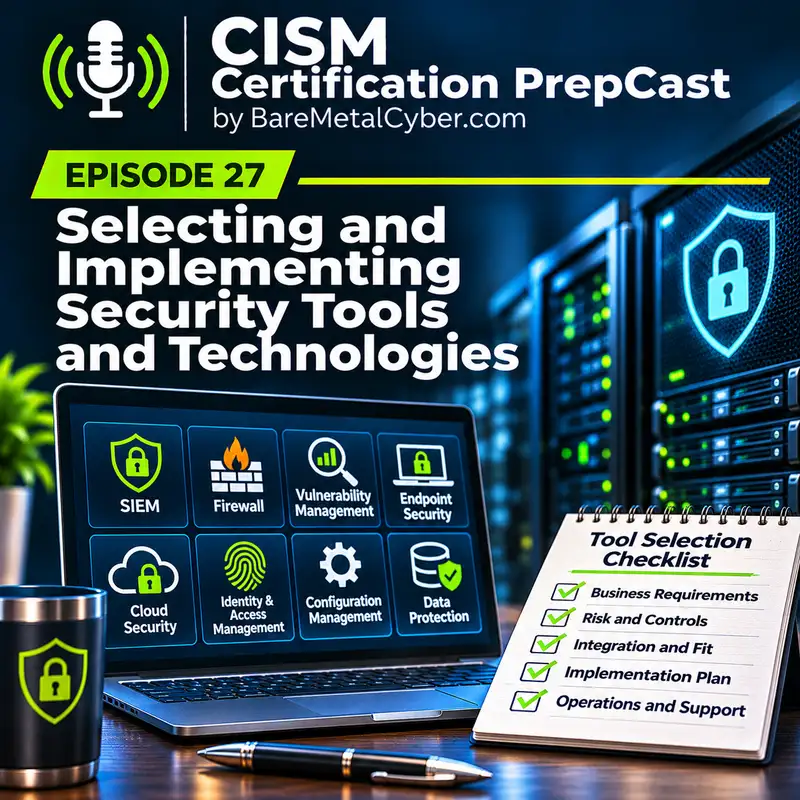
Selecting and Implementing Security Tools and Technologies
In this episode, we are examining selecting and implementing security tools and technologies. Tool selection begins with a control objective and operating requirement, not a demonstration or vendor promise. The organization must understand the risk, architecture, users, integrations, evidence, ownership, and lifecycle before deciding that technology is the right mechanism.
A fictional enterprise is considering a new monitoring platform. The current problem is incomplete visibility across cloud and on-premises services, but the team also lacks asset ownership and response procedures. Purchasing software without correcting those interfaces could create more data without better decisions.
Tooling decisions are easiest to get wrong because they feel tangible: a dashboard, a console, a vendor demo that looks like it can solve problems by itself. In practice, tools are amplifiers of process and staffing, not substitutes for them, and buying a tool before defining the outcome usually results in shelfware. The exam-friendly logic is to start with what must be achieved, then determine what capabilities are required, and only then select tooling that supports those capabilities. A tool choice is justified when it measurably improves risk reduction, detection fidelity, response speed, or assurance evidence, not when it simply increases the number of alerts or the volume of collected logs.
Outcomes should be expressed in operational terms that can be observed, such as reducing mean time to detect (MTTD) and mean time to respond (MTTR), improving patch compliance within an agreed window, increasing the percentage of privileged actions that are approved and recorded, or decreasing the number of high-risk exceptions. When the outcome is clear, the required features become clearer as well, including integrations, data quality, workflow support, and reporting requirements. Vague outcomes such as "better visibility" are a warning sign, because they encourage the organization to buy a data lake and then argue about what it is for. In a mature program, visibility is a means to a decision, and the decision is the point. Tooling decisions should be judged by whether they make the decision easier, faster, and more consistent.
A useful exam scenario is a team drowning in alerts from multiple point products while leadership demands improved incident response performance. The wrong answer is to buy another detection tool, because more signals do not automatically produce better response. The better answer is to rationalize detection and response as a system: define which events must produce actionable incidents, ensure those events are reliably collected, and implement triage workflows that route the right cases to the right people. In that context, tooling may shift toward correlation, case management, and automation rather than raw detection volume. The outcome is not "more alerts," it is "fewer missed incidents and faster containment with defensible evidence."
Tool selection should follow a capability map that separates prevention, detection, response, and governance needs, because these categories have different success criteria. Prevention tools are evaluated by their ability to reduce attack surface and enforce policy without creating unsustainable friction. Detection tools are evaluated by signal-to-noise ratio, coverage of prioritized threat scenarios, and the ability to support investigation with reliable context. Response tooling is evaluated by how well it coordinates actions, preserves evidence, and supports repeatable execution under pressure. Governance tooling is evaluated by how well it supports risk decisions, exception tracking, and audit-ready reporting without turning the team into spreadsheet administrators.
Integration is often the deciding factor, because tools that cannot share context force humans to perform manual correlation, which does not scale and increases error. A log platform that does not ingest critical identity events or cloud control-plane logs will not support timely detection for modern environments. An endpoint tool that cannot feed confirmed malicious activity into response workflows will produce "alerts" but not outcomes. A vulnerability platform that does not tie findings to asset inventory and ownership will generate backlog without remediation accountability. The best answer usually emphasizes interoperability, standardized data flows, and clear ownership of integration maintenance.
Tooling must also be sized to operational capacity, because an advanced tool deployed into an immature process often makes things worse. High configurability increases the risk of misconfiguration and the burden of ongoing tuning, especially when staffing is thin. A tool that requires daily rule engineering, data pipeline troubleshooting, or constant exception management can consume the same capacity that would have addressed the underlying control gaps. In a healthy environment, the complexity of tooling aligns with the maturity of the team and the stability of the supporting processes. The exam pattern here is that "right tool, wrong environment" is still the wrong answer.
Evidence and reporting are not secondary features; they are outcomes in environments where assurance matters. Tools should support trustworthy records of configuration state, changes, access approvals, incident timelines, and control operation, because these records demonstrate that controls are functioning and decisions are governed. The quality of evidence is influenced by how the tool logs events, preserves integrity, and supports retention and retrieval requirements. When a control fails, evidence should help determine whether the failure was design, implementation, or operation, not just provide a screenshot for an auditor. Tooling decisions that ignore evidence needs typically reintroduce manual documentation work later, which increases cost and decreases reliability.
Finally, tooling should be evaluated against total lifecycle cost and operational burden, not just licensing. Deployment time, integration work, training, ongoing tuning, data export, and exit assistance all affect lifecycle cost. The hidden costs of false positives and user friction also affect whether the tool can deliver the intended outcome. Organizations that buy overlapping tools to satisfy every stakeholder often create fragmented control ownership and inconsistent metrics, which weakens governance. A disciplined approach chooses fewer tools that are well-integrated, well-owned, and aligned to specific outcomes that leadership can track. The result is a toolset that supports decisions and action, rather than a toolset that merely produces activity.
Implementation succeeds when the tool is integrated into normal technology and business processes. Ownership, change management, support, and response workflows are part of the control.
Security controls can fail when they are treated as something separate from day-to-day operations. In a mature environment, security is embedded into the same workflows that already run the business: service desk tickets, patch windows, onboarding and offboarding, backup jobs, and incident response. This is not about adding a second process layer; it is about putting security requirements into the existing layer where work actually happens. The exam-relevant takeaway is that "integration" means security objectives are achieved through operational execution, not through policy statements or standalone tooling.
A practical way to recognize integration is to look for security decisions expressed as operational criteria. For example, access requests should route through the same identity lifecycle process as HR-driven onboarding, with approvals tied to job roles and time-bound entitlements. Vulnerability remediation should align to asset criticality and service-level expectations, not just scan severity, because operations teams work off prioritization and calendars. Backup and recovery controls should be expressed as recovery time objective (RTO) and recovery point objective (RPO) targets that operations can test and report against. When security is framed as operational requirements, it becomes measurable, schedulable, and enforceable.
Ticketing and work management systems are the backbone of operational control because they create accountability and evidence. If a control depends on humans doing the right thing, it should be represented as a required task with an owner, due date, and closure criteria. That includes patching exceptions, firewall rule changes, privileged access approvals, and even risk acceptances, which should never live only in email threads. From an exam perspective, the "best answer" often points to mechanisms that produce auditable records and repeatable execution, because those are sustainable under real-world workload. Integration turns security from an intention into a tracked deliverable.
Operational integration also depends on clean ownership boundaries, because controls often cross teams. Security can define policy, minimum standards, and risk thresholds, but IT operations typically owns execution: deploying patches, configuring monitoring agents, rotating keys, and enforcing baselines. This division matters because it determines who can be held accountable when a control is not performed and who has the authority to remediate. A common exam trap is choosing an answer that makes security responsible for operational tasks it cannot reliably execute at scale. The stronger answer is usually the one that aligns responsibility with the team that runs the process and has the tools to make it happen.
A short scenario shows what "not integrated" looks like in practice. An operations team deploys a critical customer-facing application update during a normal release window, and a week later the security team discovers that logging is incomplete and administrative access is shared across multiple engineers. The root problem is not that the engineers are careless; it is that the deployment workflow never required log verification or individual privileged access as gate criteria. Integration would mean the release checklist and access process enforce those requirements automatically, so the team cannot "forget" them under deadline pressure. On the exam, the best corrective action typically centers on embedding control steps into the operational workflow rather than adding a separate review after the fact.
The most reliable integrations are the ones that reduce decision-making during execution. Standard builds and hardened baselines remove ambiguity by giving operations a known-good starting point, and configuration management keeps drift visible. Privileged access management (PAM) becomes operational when it is the default path for admin work, with session recording, approvals, and just-in-time elevation, instead of a tool used only when someone remembers. Endpoint detection and response (EDR) becomes operational when agents are deployed through standard provisioning and monitored for health like any other system component. The exam logic rewards controls that are "built in" and therefore consistently applied, rather than controls that depend on individual discipline.
Integration also requires that security signals map to operational actions, not just dashboards. Alerts that do not produce tickets, escalation paths, and owner accountability become noise, and noise becomes ignored. Conversely, well-integrated monitoring triggers defined runbooks, with severity aligned to business impact and clear criteria for paging, containment, and stakeholder notification. This is why integration often references incident management and problem management concepts, even when the control is "security" in name. In exam terms, a control is stronger when it drives timely, consistent operational response and produces evidence of that response.
At release, reconcile what was approved during architecture and design review with what was implemented. For the portal, confirm actual data flows, access boundaries, supplier responsibilities, and logging against the design record. Assign the operating owners, document remaining exceptions, and test the handoffs they must perform. Include recovery and rollback arrangements appropriate to the change. A passed design review is not evidence that every control survived deployment; the service needs an explicit readiness decision supported by implementation results.
Finally, integration should be evaluated through operational metrics that reflect control performance, not just tool coverage. Examples include patch compliance within defined timeframes for critical assets, percentage of privileged actions performed through approved mechanisms, mean time to detect and mean time to contain for high-severity events, and completeness of log sources for key systems. Metrics matter because they translate "security is important" into operational expectations that leaders can manage and teams can improve. When a control is integrated, it shows up in operational reporting, operational accountability, and operational planning cycles rather than only in security assessments. On the exam, that's the practical definition of making security real: it runs with the business.
Logging and monitoring only work as security controls when they are integrated into accountability structures that can act on what the data reveals. Logs are records of events, while monitoring is the process of collecting, analyzing, and responding to those events in a timely way. Accountability is the operational layer that assigns ownership for both the systems producing logs and the teams expected to respond when something looks wrong. If any one of those three is missing, the control collapses into theater: data without analysis, alerts without response, or response without traceability. For the exam, the "best answer" usually connects all three by showing how evidence becomes action with named owners and measurable outcomes.
A useful way to think about logging is coverage, consistency, and context. Coverage means the right sources are logging, including identity systems, privileged access workflows, critical applications, network security devices, and core infrastructure components. Consistency means logs share reliable timestamps and common fields, so events can be correlated across systems without guesswork. Context means logs contain enough detail to support investigation and accountability, such as user identifiers, source and destination, action taken, and result codes. The exam-relevant point is that logs must be designed for investigation and audit, not just generated by default settings.
Identity is the backbone of accountability, because the most important question in most investigations is "who did what, when, and from where." Shared accounts and generic administrator credentials undermine nonrepudiation, which is the ability to prove an action was taken by a specific person or process. Strong logging programs prioritize unique user identification, privileged session traceability, and clear separation between human actions and service account activity. When privilege is involved, session-level evidence becomes more important than simple authentication records because it supports review of what was actually done. On exam questions, options that strengthen individual accountability and reduce ambiguity tend to be favored over options that merely increase log volume.
Monitoring is not the same as collecting logs, and the difference shows up the moment an alert fires at two o’clock a.m. Monitoring requires defined thresholds, correlation logic, triage procedures, and escalation paths that align to business impact. A mature approach uses severity definitions that map to operational response, so a low-confidence alert does not page executives while a high-confidence compromise does not sit in an inbox. The integration challenge is to keep monitoring aligned with how operations actually respond: tickets, on-call rotations, incident response roles, and clear handoffs between teams. Exam questions often probe this point by offering choices that "buy a tool" versus choices that define response ownership and processes.
A short scenario illustrates why integration matters. A security team deploys centralized logging, and dashboards show authentication failures and unusual admin activity across multiple systems, but no one is assigned to review them daily. Weeks later, an incident investigation reveals the signs were present, yet no alerts were generated and no tickets were opened because the monitoring rules were never tuned and the operations team did not know they were expected to act. The failure is not technical capability; it is missing accountability and operationalization. On the exam, the best corrective action typically ties alerts to a response workflow with owners, service-level expectations, and regular review.
Retention, integrity, and access control are essential because logs are evidence, and evidence must be trustworthy. Retention should reflect business needs, regulatory constraints where applicable, and the realities of detection and investigation timelines, since many compromises are discovered long after initial access. Integrity protection ensures logs cannot be altered or deleted without detection, which is particularly important when investigating privileged misuse or insider threats. Access control to logs prevents sensitive information exposure and reduces the risk that attackers use logs to understand detection logic or erase traces. Exam questions commonly reward answers that protect log integrity and chain of custody rather than focusing only on expanding collection.
Integration also means preventing "blind spots" created by operational change. New systems, cloud services, application updates, and network redesigns frequently break log pipelines, change event formats, or disable monitoring agents without anyone noticing. A mature control integrates logging requirements into provisioning and change management, so new assets are not considered operational until they are logging properly and alerting is verified. Continuous health checks for logging agents, ingestion rates, and source coverage turn observability into a managed service rather than a one-time project. From an exam standpoint, this is a classic example of designing controls that remain effective over time, not controls that only look good during initial deployment.
Accountability is strengthened when monitoring outputs are tied to governance expectations that leaders can measure. Metrics such as mean time to detect (MTTD) and mean time to respond (MTTR) translate technical monitoring into operational performance, while tracking false-positive rates drives tuning and sustainability. Ownership must be explicit: who owns the sensor health, who owns alert triage, who owns incident escalation, and who owns remediation for the affected system. Without those assignments, alerts become a blame game, and the system slowly degrades as noise increases. Exam answers that define roles and responsibilities tend to outperform answers that assume responsibility will "work itself out."
Use the architecture view to check monitoring dependencies as well as event coverage. If the portal's supplier connection stops forwarding events, the retailer should be able to recognize that loss of visibility and route it to an owner. Agree on required events, delivery expectations, and responses to missing data. A quiet dashboard should not be mistaken for evidence that the service is safe.
Finally, the most effective logging and monitoring programs support both security operations and audit needs without becoming a bottleneck. That balance requires thoughtful event selection, normalization, and prioritization, because collecting everything is expensive and analyzing everything is impossible. Integration means security and operations agree on what constitutes actionable events, what requires immediate escalation, and what can be handled through periodic review. It also means accountability is enforced through process, such as required closure notes for security tickets and documented rationale for dismissing alerts. On the exam, the strongest choices typically reflect this pragmatic integration: evidence that is usable, monitoring that is actionable, and accountability that is enforced.
Controls that create excessive friction will be bypassed or poorly operated. Managers must compare usability and business impact with the risk reduction and assurance the technology provides.
Operational friction is the "cost" a security control imposes on people and systems trying to get work done, and it shows up as extra steps, delays, constrained options, and occasional breakage. Risk is the probability and impact of loss if the control is absent, weak, or bypassed, and the exam expects you to reason about both at the same time. Controls that are too heavy tend to be worked around, while controls that are too light tend to fail quietly until an incident forces attention. The goal is not minimum friction or maximum control; it is a deliberate balance where the organization gets meaningful risk reduction without making normal operations unworkable. On the exam, the best answer usually reflects a risk-based decision that keeps controls sustainable under real conditions.
A common trap is confusing "more security" with "better security," especially when the added control increases complexity. Complexity is itself a source of risk because complicated processes create more failure modes, more misconfigurations, and more inconsistent execution across teams. For example, requiring multiple approvals for routine access changes can create backlogs and encourage shared credentials, which undermines accountability and increases exposure. Conversely, simplifying access through role-based access control (RBAC) can reduce friction while strengthening security by making least privilege easier to apply consistently. Exam questions often reward approaches that reduce unnecessary complexity while preserving core control objectives.
A short scenario makes the tradeoff concrete. A security team enforces aggressive password resets and frequent multi-factor authentication (MFA) prompts for all systems, including low-risk internal tools used constantly by operations staff. Productivity drops, people begin storing credentials insecurely, and teams start requesting broad exemptions to "get work done," which creates uneven enforcement and weak oversight. The mistake is not valuing strong authentication; it is applying a high-friction control uniformly without tailoring it to risk and use patterns. The better approach is to apply stronger controls where the risk is higher, such as privileged access and sensitive systems, while using lower-friction but still effective mechanisms for lower-risk workflows.
Controls should be designed so the secure path is the easy path, because humans follow the path of least resistance under time pressure. When security adds steps, the control must either be automated, integrated into existing workflows, or compensated with strong monitoring and enforcement to prevent bypass. For example, just-in-time privileged access can reduce standing privileges while keeping administrators effective, especially when approvals and session controls are streamlined. Similarly, secure configuration baselines reduce friction by eliminating ad hoc hardening decisions and giving teams a known-good starting point. On the exam, the strongest answers often involve integrating controls into operations so that compliance happens naturally as part of doing the job.
Tradeoffs also show up in availability and resilience decisions, where security controls can unintentionally increase downtime risk. Overly restrictive network segmentation can break dependencies if it is not designed with service flows in mind, and aggressive blocking rules can disrupt business if false positives are not managed. However, loosening controls to avoid outages can expose critical systems to lateral movement and compromise, especially when monitoring is weak. Mature environments mitigate this by testing changes, staging deployments, and using compensating controls like improved visibility and rapid rollback capabilities. Exam answers that acknowledge availability as part of risk, rather than treating it as a separate concern, tend to align with management-level reasoning.
The friction-risk balance is also about where decisions are made and how often they must be revisited. If every exception requires executive review, leaders become a bottleneck and exceptions may pile up without meaningful analysis. If exceptions are delegated without guardrails, risk acceptance becomes informal and untracked, which erodes governance. A better pattern assigns decision rights based on impact, documents rationale, and sets review dates so temporary exceptions do not become permanent weaknesses. The exam frequently tests this governance angle by presenting options that either centralize all decisions unrealistically or decentralize them without accountability.
Measurement is the practical tool that keeps friction and risk from becoming purely opinion-based arguments. Metrics like control adoption rates, exception volume, incident trends, and time-to-complete key workflows show whether controls are being followed or quietly bypassed. If a control is causing chronic delays, that friction is a signal to redesign the process, automate steps, or narrow the scope to the highest-risk use cases. If incidents cluster around a specific workflow, that risk signal may justify increased control even if friction rises. The exam expects you to favor decisions supported by evidence and governance rather than decisions based on fear or convenience.
Finally, the best tradeoff decisions recognize that controls work as a system, not as isolated requirements. A lower-friction preventive control might be acceptable when paired with stronger detective controls and faster response capabilities, while a high-friction preventive control may be justified when detection is weak or impact is severe. For instance, stringent approvals for high-risk production changes make sense when misconfiguration could cause major exposure, but the same rigor for low-risk changes can be replaced by automation and monitoring. In management terms, the aim is to shape behavior and reduce risk in ways the organization can sustain, because an ignored control provides zero protection. On the exam, that sustainability lens is often the difference between a technically impressive answer and the best answer.
Evaluate total cost of ownership, including licensing, implementation, integration, training, staffing, data, support, maintenance, tuning, and retirement. A less expensive purchase can become the more costly program when operational needs are ignored.
For practice, create requirements for a fictional security tool without naming a product. Define the objective, scope, architecture, integrations, data, users, evidence, success measures, and exit plan. Then compare two mechanisms against those requirements.