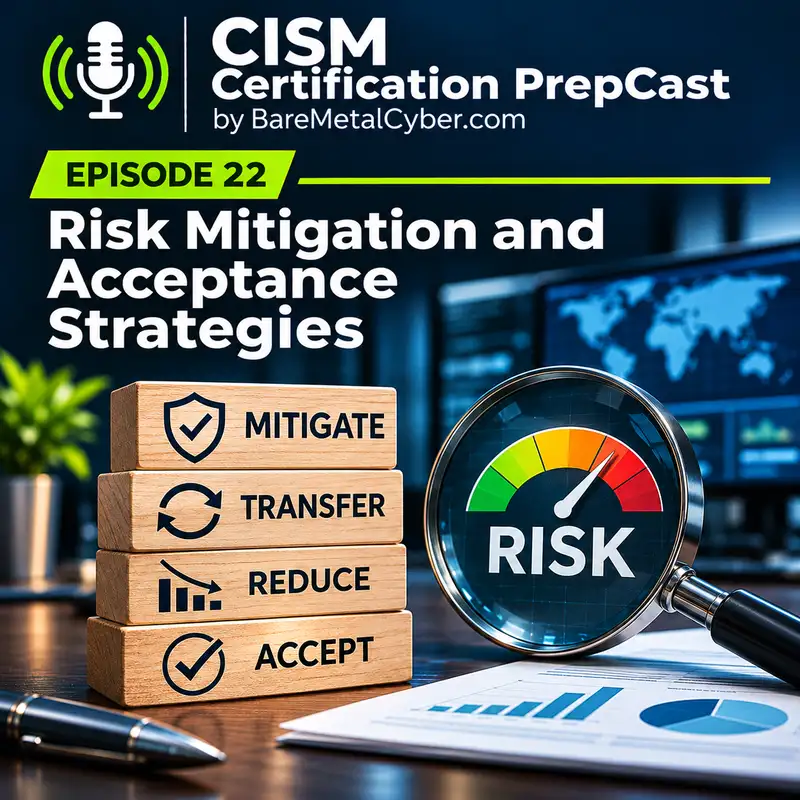
Risk Mitigation and Acceptance Strategies
In this episode, we are examining risk mitigation and acceptance strategies. Mitigation reduces likelihood or impact through controls. Acceptance, called tolerance in some frameworks, is an authorized decision to retain residual risk. Both require clear reasoning, ownership, evidence, and monitoring.
A fictional manufacturer cannot immediately replace a vulnerable production system. Shutting it down would stop essential output, while leaving it unchanged creates exposure. The organization must compare compensating controls, schedule remediation, identify residual risk, and obtain acceptance from the authorized business owner.
Risk response is fundamentally a decision about what the organization will do with a defined level of uncertainty, not a decision about how much security the team can "add" to a system. In exam scenarios, the trap is to treat response options as interchangeable labels when they are actually distinct management commitments with different accountability, cost structures, and residual risk outcomes. The most defensible choice starts with the organization's risk appetite, which describes the amount and type of risk leadership is willing to pursue or retain to achieve objectives. Appetite is then operationalized through risk tolerance, which puts practical boundaries around how much variance is acceptable in specific processes, systems, or metrics. When appetite and tolerance are unclear, the best answer is usually the one that explicitly drives clarification and governance, rather than improvising technical controls.
The four Ts are a memory aid: treat means mitigate, transfer moves specified consequences to another party, tolerate means accept, and terminate means avoid. "Risk treatment" can also be used more broadly for selecting and implementing responses, so read the term in context.
A correct response selection also depends on constraints, because constraints define what "feasible" looks like in a given environment. Common constraints include regulatory requirements, contractual obligations, safety considerations, and the realities of budget, staffing, and system design. A response that appears strong on paper can be invalid if it violates a non-negotiable constraint, such as a legal requirement to retain logs or to protect certain classes of data. Conversely, an option that seems weaker, such as tolerating residual risk, may be appropriate when the organization deliberately chooses to accept exposure in a low-impact area to focus resources on higher-value risk reduction. For exam purposes, you should treat constraints as guardrails that narrow the acceptable responses before you compare their benefits.
Treat, transfer, tolerate, and terminate are best understood as four different ways of aligning residual risk with appetite while respecting constraints. Treat means reducing likelihood, impact, or both through controls, redesign, or operational changes until the remaining risk fits within tolerance. Transfer means shifting financial consequences or operational responsibility to another party, but never eliminating accountability for outcomes that the organization still owns. Tolerate means accepting risk as-is, which is only defensible when the exposure is understood, within tolerance, and explicitly authorized. Terminate means stopping the activity that creates the risk, which can be the best answer when the risk is unacceptable and cannot be reduced to tolerance at reasonable cost.
Consider a scenario in which a business unit wants to roll out a customer-facing feature quickly, but the feature requires collecting additional personal data that increases breach impact and regulatory exposure. If leadership's appetite for regulatory and reputational risk is low, a "tolerate" response is difficult to justify unless the exposure is minimal and explicitly accepted by the right authority. If the delivery timeline is constrained, "treat" may still be the best response, but only if the treatment is targeted and realistically implementable within the deadline, such as reducing data collected, shortening retention, or segmenting access paths. If the organization can avoid collecting the data entirely and still meet the business objective, the best answer may be "terminate" in the narrow sense of terminating the risky component of the design rather than canceling the whole project. The exam logic favors the response that most directly reconciles the objective with stated risk limits, not the response that sounds most aggressive.
When matching response type to appetite, it helps to separate inherent risk from residual risk in your reasoning even if the question does not use those exact terms. Inherent risk is the exposure before controls; residual risk is what remains after the response is applied. Treat is selected when the gap between inherent risk and tolerance can be closed with controls that are reasonable and sustainable. Terminate is selected when the gap is too large, treatment is impractical, or constraints demand elimination of the risky activity. Tolerate is selected when residual risk already sits within tolerance, or when the cost and friction of further reduction outweigh the benefit in a way leadership has explicitly accepted.
Transfer is the option most frequently misunderstood because it is easy to overstate what it accomplishes. Transferring risk is typically about shifting financial impact or certain operational burdens, such as through insurance, warranties, or contractual indemnification, but the organization rarely transfers the mission impact, reputational harm, or regulatory responsibility. If a third party fails, the organization still experiences downtime, customer harm, and scrutiny, even if some costs are reimbursed. Exam questions often reward answers that acknowledge this nuance by treating transfer as a complement to treatment rather than a substitute for it. If the scenario involves legally protected data, critical services, or executive-level reputational stakes, transfer alone is almost never the best answer.
Decision rights matter as much as decision logic, because risk response is not merely a technical selection; it is governance in action. A response aligned to appetite must be made, approved, and recorded at the appropriate level of authority, especially for tolerate decisions that leave exposure in place. In exam terms, if the scenario indicates high impact, cross-functional implications, or deviation from standard policy, the best answer tends to involve escalation to the correct risk owner and formal approval. Treatment decisions may be delegated operationally, but they still need to map to policy and tolerance thresholds. Termination decisions often require business leadership buy-in because they can change scope, revenue, or strategy, even when driven by security realities.
Finally, strong response selection uses comparatives rather than absolutes, because every option has tradeoffs that must be reconciled to context. Treat can reduce risk but may introduce complexity, delay, or new operational failure modes that need management. Transfer can stabilize finances but can create complacency if stakeholders believe responsibility has moved elsewhere. Tolerate can preserve speed and cost efficiency but demands disciplined monitoring and clear ownership of the residual exposure. Terminate can eliminate a risk source but can also eliminate a business capability, which makes it appropriate only when the risk exceeds appetite and cannot be brought into tolerance by other means.
Mitigation should begin with the risk and control objective, not with a preferred product. The selected control must fit architecture, operations, resources, and evidence needs.
Mitigation, the "treat" option in this episode, deliberately reduces likelihood, impact, or both through changes that are controllable and repeatable, not a vague promise to "improve security." In exam terms, treatment is the option you select when the activity must continue, the risk exceeds tolerance, and feasible measures exist to bring the residual risk back within acceptable bounds. The key is that treatment produces a measurable change in the risk scenario, either by reducing how often an event can occur or by limiting the damage if it does. Treatment also assumes that leadership is willing to invest resources, accept friction, and enforce accountability to sustain the control over time. If the question hints at ongoing business need plus unacceptable exposure, you should think "treat" and then pick the control approach that best matches the risk driver.
Control selection starts with the specific risk statement, because controls are only "good" in relation to the threat, vulnerability, and business impact they address. A common exam pitfall is choosing a technically impressive control that does not materially change the scenario described, such as adding encryption when the primary risk is privileged misuse inside the environment. Good treatment decisions identify the dominant factor in the risk equation and target that factor first. If likelihood is driven by weak authentication, treatment favors stronger identity controls rather than downstream monitoring alone. If impact is driven by broad data exposure, treatment favors minimization, segmentation, or access restriction rather than only adding detection.
Controls can be preventive, detective, or corrective, and exam questions often reward you for selecting the type that most directly addresses the scenario's timing and failure mode. Preventive controls reduce the chance of the event occurring, such as strong authentication, segmentation, secure configuration, or approval gates for high-risk actions. Detective controls increase the chance of finding the event quickly, which reduces dwell time and supports response, such as logging, monitoring, and alerting aligned to plausible misuse paths. Corrective controls reduce the duration or consequences after the event occurs, such as recovery processes, isolation mechanisms, or automated rollback of unauthorized changes. In treatment-heavy scenarios, the best answer frequently pairs a preventive control with supporting detection, because prevention without visibility can fail silently, and detection without containment can still leave high impact.
Treatment is also about choosing controls that are appropriate to the environment's constraints and operational maturity. A control that requires constant manual review may be inappropriate in a lean organization with limited staffing, even if it looks rigorous on paper. Conversely, a highly automated control might be the best fit where consistency and scale matter, provided it can be implemented reliably. In exam logic, feasibility and sustainability matter because a control that cannot be operated is not a real reduction in risk. When you see constraints like legacy systems, limited budgets, or tight timelines, the "best answer" is often the control that yields the largest risk reduction per unit of complexity.
A useful way to think about selection is to treat controls as levers on attack paths and business impact paths. If the attack path depends on a single high-privilege account, treatment focuses on restricting privileged access, tightening authentication, and limiting where privilege can be exercised. If the impact path depends on broad lateral movement, treatment focuses on segmentation and restricting trust relationships so compromise cannot spread. If the impact path depends on data exposure, treatment focuses on access scoping, encryption at rest and in transit where relevant, and reducing retention or replication. The exam tends to favor controls that break the most critical link in the chain rather than controls that add general "security hygiene" everywhere.
Control selection must consider the difference between reducing risk and shifting it, because some controls relocate exposure instead of reducing it. Outsourcing an operational function might reduce internal workload but create dependency risk and visibility gaps if oversight is weak. Centralizing a security capability can improve consistency but introduce concentration risk if it becomes a single point of failure. Even strong controls can create new operational risks, such as outages caused by overly strict access policies or performance impact from deep inspection. Treatment choices that acknowledge operational tradeoffs and still produce meaningful risk reduction are typically better exam answers than choices that ignore side effects.
Evidence and measurement separate real treatment from aspirational treatment, and exam questions often hint at this with language about metrics, monitoring, or assurance. If leadership expects proof that risk has been reduced, the control strategy should include ways to verify effectiveness, such as audit logs, reviewable approvals, or repeatable configuration checks. Treatment is not complete when the control is deployed; it is complete when it is operating and producing expected outcomes under normal and abnormal conditions. If the scenario emphasizes governance or accountability, the best answer commonly includes documentation of the control objective, ownership, and periodic validation. Even when the question does not ask for measurement directly, selecting controls that can be evidenced tends to align with management-oriented exam logic.
Finally, treatment choices should reflect a layered mindset without turning into a shopping list of controls. Layering is about ensuring that failure of one control does not automatically produce full impact, but it should be proportionate to the stated risk. In exam scenarios, the best answer is rarely "implement everything," and it is rarely "monitor only," especially when the exposure is high. Instead, it is usually a targeted preventive control that addresses the primary driver, supported by detection that shortens time to discovery and corrective capability that limits impact. That combination most clearly reduces residual risk in a way that a risk owner can justify against appetite and constraints.
When residual risk remains, acceptance must be explicit and time-aware. Documentation creates accountability and prevents a temporary compromise from becoming invisible permanent exposure.
Risk acceptance is a formal management decision to tolerate residual risk, and its credibility depends on the quality of the documentation that supports it. In exam scenarios, acceptance is often the correct response when additional controls are disproportionate to the benefit, when constraints make treatment impractical, or when the exposure is already within tolerance. The documentation is what converts acceptance from an informal shrug into a governed choice that can be defended to leadership, auditors, and regulators. A common trap is to confuse acceptance with neglect, or to assume that stating "the business accepts the risk" is sufficient without specifying what risk, at what level, and for how long. The best answers treat acceptance as a controlled exception that is explicit, time-bound when appropriate, and owned by the correct risk owner.
A well-documented acceptance begins with a clear risk statement that names the asset or process, the threat scenario, the vulnerability or condition, and the business impact. It should also capture the assessment outcome in a way that makes the decision legible, including the likelihood and impact ratings used by the organization's method and the resulting risk level. The key exam concept is residual risk, meaning the risk remaining after existing controls are considered, because acceptance is almost always about residual risk rather than inherent risk. If existing controls are unknown or not documented, acceptance is not defensible because the organization cannot demonstrate what it is actually accepting. Good documentation therefore connects the acceptance to the current control environment and makes it clear that the decision was made with informed context.
Ownership and authority are central, because acceptance must be made by the party accountable for the business outcome, not by the security team acting alone. In exam logic, that usually means the system owner, process owner, or executive sponsor with the authority to accept the consequences if the risk materializes. The security function's role is to advise, articulate tradeoffs, and ensure the decision is recorded properly, but not to absorb the business's exposure by default. Documentation should name the risk owner, the approver, and any consulted stakeholders, especially when the risk spans multiple functions. If the scenario involves material impact, regulated data, or enterprise-wide exposure, the best answer tends to involve higher-level approval and governance committee visibility.
Exceptions are closely related to acceptance, but they are best treated as controlled deviations from policy or standard that require specific justification and compensating measures. An exception should state which requirement is being deviated from, why the deviation is necessary, and what alternative measures will be used to reduce exposure during the exception period. The exam trap is to treat an exception as a permanent waiver, which undermines governance and allows risk creep to become normal operations. A credible exception includes boundaries, such as limiting scope to a particular system, environment, or time window, rather than allowing the deviation to spread. Even when the organization chooses to tolerate the residual risk, exception documentation should show that the deviation was evaluated and that any feasible mitigations were considered.
Time horizons and review cycles make acceptance and exceptions operational rather than purely administrative. If the decision is based on temporary constraints, such as a pending system replacement or an incomplete project, the documentation should include an expiration date or a reauthorization requirement. If the risk is accepted because it is within tolerance, a periodic review is still appropriate to ensure conditions have not changed, such as new threats, new dependencies, or changes in business criticality. For exam purposes, including a revalidation or review requirement signals disciplined governance and aligns with the idea that risk is dynamic. A decision that is never revisited is likely to drift outside tolerance without anyone noticing.
Compensating controls are not always required for acceptance, but they are frequently relevant for exceptions, particularly when the deviation weakens a key safeguard. A compensating control is not a perfect substitute; it is a practical alternative that reduces risk in a different way, often through monitoring, restriction, or procedural checks. The exam emphasizes that compensating controls should be tied to the specific weakness created by the exception, not generic security improvements. For example, if an exception allows delayed patching due to operational constraints, compensating measures might focus on reducing exposure through access restrictions and heightened monitoring rather than unrelated controls. Documentation should connect the compensating measures to the risk statement so the decision remains coherent.
Good acceptance documentation also captures the rationale in business terms, because risk response is ultimately about objectives and tradeoffs. This does not mean vague statements like "cost is too high," but rather a reasoned explanation such as resource limits, competing priorities, or risk reduction options that are not proportionate to the impact reduction achieved. The rationale should acknowledge alternatives that were considered, including treatment and termination options, and why they were not selected under current constraints. In exam questions, the best answer often includes evidence of this evaluation process because it demonstrates that acceptance is informed, not accidental. This is also where you would note dependencies, such as vendor limitations or architectural constraints, that explain why full compliance is not feasible yet.
Finally, documentation should define how the organization will monitor the accepted risk so it does not become invisible. Monitoring can be as simple as tracking the conditions that drove the decision, such as system lifecycle milestones, vendor remediation timelines, or recurring metrics that indicate increased exposure. The core concept is that acceptance does not end risk management; it changes the management strategy from reduction to oversight. When conditions change, the response may need to shift from tolerate to treat or terminate, and the documentation should make that transition easy by stating triggers for reassessment. In exam terms, acceptance and exceptions are correct only when they are owned, bounded, reviewed, and traceable to appetite and tolerance.
Acceptance is not neglect. It should identify the risk, rationale, owner, conditions, expiration or review cadence, and any monitoring or compensating measures. If the risk exceeds authority or violates a mandatory obligation, the proposed acceptance is not valid.
For practice, create a fictional high-risk finding that cannot be fixed immediately. Compare two mitigation options and one time-limited acceptance, then identify who can decide and what evidence is needed at the review date.
Mitigation plans should include dependencies and failure modes. A new monitoring control may depend on complete asset coverage, reliable logs, trained analysts, and a response workflow. If those conditions are absent, the organization may believe risk has been reduced when the mechanism is not yet operating. Treatment status should distinguish planned, implemented, verified, and sustained controls.
Acceptance should also define what would invalidate the decision. A change in threat activity, business criticality, legal obligation, control performance, or incident experience may require immediate reassessment rather than waiting for the scheduled review. Decision triggers make acceptance active governance instead of passive delay.
When several risks compete for limited resources, mitigation sequencing should consider shared controls and dependencies. One capability may reduce multiple material scenarios, while another addresses only a narrow finding. The manager should compare expected risk reduction, feasibility, time, and operational impact, then document why the selected order best supports enterprise objectives.
The security manager should report treatment status in language that distinguishes activity from risk. Saying that a tool was purchased or a policy was published does not show that mitigation is effective. Report implementation coverage, control performance, remaining exposure, blocked dependencies, and the decision required from leadership. This keeps treatment connected to accountable outcomes.
Where treatment depends on another project or supplier, the plan should record that dependency and the consequence of delay. The risk owner needs visibility into whether milestones remain credible and whether interim protection is still sufficient. A mitigation plan that cannot be completed on schedule may require stronger compensating controls, revised acceptance, or escalation to a higher authority.
Treatment governance should therefore include a fallback decision. If the preferred mitigation fails, costs rise, or implementation becomes infeasible, the owner should know whether to select another control, extend a time-limited acceptance, transfer part of the exposure, or terminate the activity. Predefined options reduce delay when assumptions change.
The fallback decision and its authority should be documented before the original deadline is missed. This keeps changing conditions from turning into unmanaged delay.
The treatment decision should also specify what evidence will show that mitigation reduced exposure or that acceptance remains within tolerance. Without that follow through, the organization has documented an intention rather than governed a risk, and changing conditions can quietly invalidate the original approval.