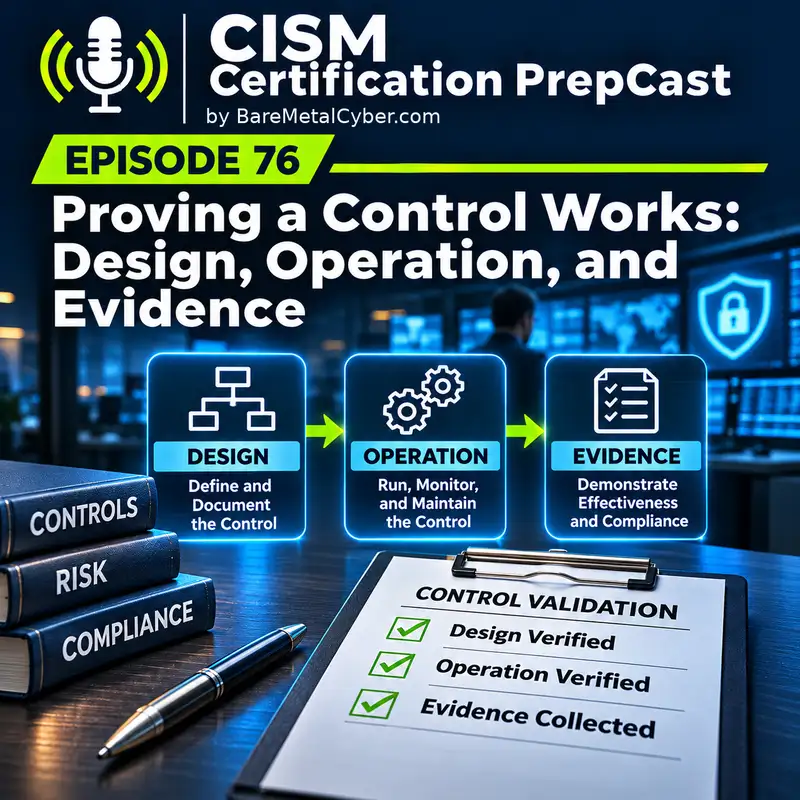
Proving a Control Works: Design, Operation, and Evidence
In this episode, we are proving whether a control works by separating design, operation, evidence quality, scope, and limitations. The objective is to connect the topic to business impact, decision authority, operating responsibility, and evidence rather than treating it as a slogan or isolated technical task.
Consider Silverline Finance, a fictional teaching organization. It demonstrates that privileged access requires approval during a scheduled audit. The demonstration passes, yet later evidence shows that emergency accounts are outside the workflow, approvals are not reviewed after organizational changes, and one integration stopped sending logs. Leaders still describe the control as fully effective because the auditor saw a successful test. This scenario is not an official examination question. It gives us a practical setting in which to examine the management choices and the reasons behind them.
The first task is to define the control objective and exact effectiveness claim. The manager must then evaluate whether the design addresses the risk. Next, the responsible teams should test operation across the relevant population and period. Before the decision is closed, the organization must assess evidence sufficiency, appropriateness, reliability, and dependencies. Finally, it should state limitations, corrective action, and verification required for closure. These actions may occur in parallel when authority and urgency permit, but none should disappear from the management record.
To deepen the lesson on proving a control works: design, operation, and evidence, begin with the management principle behind the decision. A cue for operating effectiveness problems is when the control statement is solid, but the environment’s outcomes contradict it. If the scenario describes frequent unauthorized changes, yet the organization has an approved change management process with documented segregation of duties, the likely issue is that changes are happening outside the process or approvals are rubber-stamped. If the scenario describes repeated access by former employees, yet the organization has a joiner-mover-leaver procedure, the likely failure is execution, such as HR notifications not triggering deprovisioning or identity systems not being integrated. Operating effectiveness issues also show up as inconsistent artifacts: some tickets have approvals, some do not, or logs exist for certain systems but not for others. Drift is a classic operating failure, where a control was implemented correctly at one time but is no longer effective due to system upgrades, new business units, acquisitions, or cloud migrations. In exam reasoning, operating effectiveness failures often lead to answers focused on monitoring, enforcement, training, and remediation rather than rewriting the control.
The next part of the analysis concerns the evidence and accountability behind the decision. Control design and operating effectiveness also differ in how they are tested, and scenario language often hints at the test being performed. Design evaluation is largely about inspection and reasonableness: reviewing policies, standards, control descriptions, and architecture to see whether the control could work in principle. Operating effectiveness evaluation is about observation and corroboration: sampling transactions, inspecting logs, re-performing control steps, and examining evidence that the control operated during the period in question. If a scenario describes that “procedures exist but have not been reviewed in years,” that is a design maintenance concern, because controls must evolve as the environment changes. If a scenario describes that “reviews are required monthly, but there is no proof they occurred,” that is an operating effectiveness concern rooted in missing evidence and inconsistent execution. The best-answer logic tends to follow the implied test: design findings lead to redesign or control enhancement, while operating findings lead to remediation of execution and improved oversight.
Viewed through this episode’s purpose, the practical implication is important. Many exam questions embed the phrase “adequately designed but not operating effectively” or the reverse, but more often the cues are subtle. Language like “policy exists,” “procedure documented,” and “standard requires” points toward design artifacts, while language like “not consistently performed,” “no evidence,” “exceptions not approved,” and “controls not monitored” points toward operation. Another subtle cue is whether failures are isolated or systemic: a single missed review might be an operational lapse, while repeated failures across teams may indicate the design is impractical, unclear, or misaligned with workflow. Practicality is a design attribute, because a control that cannot be executed under real conditions will predictably fail operationally. If a change approval process requires three committees for minor updates, teams will bypass it, and the resulting operating failures are symptoms of an unrealistic design. Exam scenarios love this pattern because it tests whether you see the human system as part of the control.
A manager should connect this point to ownership, operating reality, and the business consequence. Finally, control design versus operating effectiveness often determines what the “best next step” should be when risk is discovered. If the control is poorly designed, the best action is to adjust the control objective, scope, or mechanism so it addresses the risk realistically, then update documentation and roles accordingly. If the control is well-designed but not operating effectively, the best action is to remediate execution, strengthen oversight, improve accountability, and ensure evidence is produced reliably. If both are weak, the best answer frequently prioritizes stabilizing high-risk operations first while redesigning in parallel, because risk does not pause for paperwork. The exam’s best-answer logic tends to favor actions that reduce risk fastest while establishing a sustainable path, rather than actions that only improve documentation. Being able to separate design from operation lets you choose controls based on what will actually change outcomes, not what looks tidy on a policy shelf.
This distinction becomes especially useful when several plausible actions compete for attention. Evidence sufficiency is about quantity and coverage: whether you have enough evidence to support a conclusion about a control or an outcome. On exam scenarios, sufficiency is rarely “more documents,” and more often “enough of the right samples across the right population and time period.” If an organization claims that access reviews are performed quarterly, a single signed checklist proves almost nothing; sufficiency requires enough review instances to show the control operated as stated and across the relevant systems. Sufficiency also includes breadth, because a control that works in one department but fails in another is not effective at the organizational level implied by the policy. When a question hints at limited sampling, missing periods, or evidence collected only from low-risk systems, the issue is commonly insufficient evidence rather than an inherently bad control. The best-answer logic is to expand evidence to cover the scope of the claim and the risk.
The governance question is not whether the idea sounds secure, but whether it is authorized, workable, and verifiable. Evidence appropriateness is about relevance and fit-for-purpose: whether the evidence actually supports the specific assertion being evaluated. Appropriateness is why “policy exists” is not appropriate evidence that a process is followed, and why a configuration screenshot may be inappropriate evidence of a control’s operation over time. Appropriate evidence matches the control objective, the period under review, and the attribute being tested, such as design versus operating effectiveness. For example, to evaluate whether privileged access is restricted, an appropriate evidence set might include current role definitions, system access lists, recent provisioning and deprovisioning records, and a sample of approvals tied to access grants. If the scenario describes a control failure and the provided evidence consists only of training slides or meeting notes, the evidence may be real but not appropriate to prove the control operated. On the exam, the best answer often favors evidence that directly ties actions to authorization and outcomes, not evidence that merely shows intention.
The operational consequence also matters because a plan that cannot be sustained will not manage risk for long. Vulnerability scanners operate with assumptions that matter when interpreting outputs as evidence. They depend on accurate discovery, credentialed access where applicable, correct network paths, and reliable signatures, and any weakness there can inflate false positives or hide true exposure. A scanner reporting “host unreachable” is not a benign technical footnote; it is potentially evidence of a control gap in asset management, monitoring, or segmentation visibility. Similarly, scanner categorization like “critical” is often vendor-defined, while organizational risk ratings should reflect business context and exposure. A mature deficiency analysis treats scan results as inputs that require validation and context, not as final conclusions.
Use this point to challenge assumptions and to identify what must be demonstrated before the next decision. Deficiency identification frequently starts outside the scanner, using outcomes that indicate control intent is not being met. Repeated emergency changes, inconsistent logging, privileged access exceptions, or unresolved audit issues can all signal deficiencies even when vulnerability metrics look stable. In those cases, scanning outputs may be used to corroborate patterns, but the deficiency is anchored in process performance, governance, and accountability. The exam-friendly mental model is that vulnerabilities are discovered weaknesses in assets, while deficiencies are discovered weaknesses in controls. If you can articulate the “control should do X, but evidence shows it does not,” you are doing deficiency identification rather than listing technical findings.
The exam lens here is to separate the activity from the outcome that leadership actually needs. Another useful distinction is that vulnerabilities tend to be itemized and technical, while deficiencies tend to be systemic and causal. A scan might list “TLS weak cipher” across twenty systems, but deficiency analysis asks why standards are not enforced at build time, why configuration baselines are not applied, and why detection did not prevent drift. The deficiency could be “secure configuration management is not consistently implemented,” with the scan findings serving as representative evidence. This matters because remediation plans differ: patching and reconfiguring addresses individual vulnerabilities, while fixing a deficiency often requires changes to control design, workflow, ownership, and monitoring. Exam questions often reward answers that target the control level when the problem is persistent and recurring.
A defensible approach keeps the scope, owner, evidence, and remaining uncertainty visible. It is also important to separate detection capability from the control itself, because many controls are preventive or directive and may not show up as scanner findings. For example, an organization may have a strong secure development lifecycle control that reduces exploitable flaws, yet scanning will still detect third-party component issues that require governance over dependency management. Conversely, an organization might run scans faithfully while lacking an effective vulnerability management control, evidenced by unclear remediation timelines, inconsistent exception handling, and lack of risk-based prioritization. In that case, scanning is happening, but the control objective (reducing exposure to acceptable levels) is not being achieved. The exam framing emphasizes that tools support controls, but tools are not controls by themselves.
Apply this principle directly to the management decision in this episode. When translating scanning outputs into deficiency language, the highest-quality statements include scope, criteria, and consequence in a single coherent claim. Scope clarifies which environments, systems, or processes are affected and whether the issue is isolated or systemic. Criteria links the gap to a defined expectation, such as a patch timeline, configuration standard, or access control requirement. Consequence explains the risk in terms of likelihood and impact, especially where exposure exists to external threat paths or sensitive assets. This translation is what turns technical data into something an assurance function can act on, and it is often what exam questions are actually testing.
The next part of the analysis concerns the evidence and accountability behind the decision. For the purpose of certification-style reasoning, remember that scanning outputs are one stream of evidence among many, and deficiency identification is the act of concluding that a control is missing, poorly designed, or not operating as intended. The most defensible conclusions combine scanner evidence with validation, such as configuration review, ticketing and change records, interviews, and sampling across the control lifecycle. A scanner finding might be resolved quickly but still reveal a deficiency if it indicates a recurring breakdown in preventive measures. Conversely, a large set of findings might not equal a major deficiency if they are low exposure, within agreed timelines, and trending down under an operating control. The best answers consistently separate “what the tool observed” from “what the control should achieve,” and then connect them with criteria-based logic.
Viewed through this episode’s purpose, the practical implication is important. Control failures rarely occur because people “forgot” security; they occur because the control’s design, placement, or operating model does not match how work actually happens. When a control is routinely bypassed, delayed, or inconsistently applied, that is a signal that the control is misaligned with incentives, capacity, or workflow. A CISM-minded analysis treats a control as a system: defined objective, clear ownership, repeatable execution, measurable performance, and evidence generation. If any of those pieces are weak, the control can exist on paper while failing in practice. The exam-relevant skill is recognizing the pattern behind the failure, not just the symptom.
A manager should connect this point to ownership, operating reality, and the business consequence. One common pattern is unclear control intent, where teams do not share the same definition of what “compliant” looks like. Policies that state “apply patches promptly” or “log security events” without a measurable timeline, scope, and responsibility invite inconsistent interpretations. In that environment, different teams will optimize for local goals, and the control will appear to “work” until an incident or audit forces a precise reading. This is a design failure, not an execution failure, because the control cannot be reliably operated as written. The best corrective action is to make the control objective testable and unambiguous, so operating evidence becomes straightforward.
This distinction becomes especially useful when several plausible actions compete for attention. Another frequent root cause is ownership ambiguity, especially for controls that span multiple functions such as identity lifecycle, vulnerability remediation, or logging coverage. When no single role is accountable end-to-end, gaps appear at handoffs: tickets are created but not closed, exceptions are granted but not reviewed, and monitoring exists but is not tuned. The system may contain many responsible parties, but responsibility without accountability produces drift. On exams, the strongest answers often assign control ownership clearly and require measurable reporting, because that is how controls become dependable. A control that everyone supports but nobody owns is usually a control that fails.
The governance question is not whether the idea sounds secure, but whether it is authorized, workable, and verifiable. Control objectives also need clear scope boundaries, because controls that try to cover everything usually cover nothing well. Scope includes the systems, data classifications, roles, transactions, and time windows to which the objective applies. Without scope, testing becomes inconsistent and stakeholders argue about exceptions after the fact, typically right before an audit or right after an incident. A scoped objective can support consistent enforcement and meaningful evidence collection, which is a recurring theme in governance-focused questions. Precision about scope also helps prevent over-control, where the mechanism creates unnecessary friction beyond the risk it is meant to reduce.
The operational consequence also matters because a plan that cannot be sustained will not manage risk for long. The manager’s view must include evidence, because controls are not real until they can be demonstrated. Evidence is not just logs; it includes approvals, configurations, change records, access reviews, and reconciliations that collectively show the objective is being met. A mechanism that produces no reliable evidence forces auditors and leaders to infer effectiveness, which is a polite way of saying the control will be challenged. Evidence requirements should be considered during design so that data retention, log integrity, and reporting responsibilities are built in from the start. The exam often rewards answers that treat “prove it” as a first-class requirement, not an afterthought.
Use this point to challenge assumptions and to identify what must be demonstrated before the next decision. Finally, separating objective from mechanism supports continuous improvement without redefining success every quarter. Mature programs refine mechanisms as threats evolve, technologies age, and business models change, while keeping the objective stable enough to measure trendlines. When metrics drift because the objective was never clear, leaders cannot tell whether risk is decreasing or whether reporting is merely changing vocabulary. A stable objective also helps reconcile competing stakeholder demands, because it frames debates around outcomes rather than preferences. In practice and on the exam, the strongest control decisions are the ones that can be explained as “this objective, these constraints, this mechanism, and this evidence,” with no hand-waving.
The exam lens here is to separate the activity from the outcome that leadership actually needs. Layering also works because different controls fail differently, and those failure modes can offset each other. A technical access restriction might be bypassed through credential theft, but a separate anomaly detection control can still flag abnormal access patterns even when the credential is valid. A change approval process might be skirted by an urgent workaround, but an independent configuration monitoring control can detect drift and trigger remediation. When controls share the same dependency, they fail together, so resilience requires diversity of dependencies where possible. In practice, that means not stacking multiple controls that all depend on the same identity attribute, the same logging pipeline, or the same administrative group without compensating safeguards.
A defensible approach keeps the scope, owner, evidence, and remaining uncertainty visible. A short scenario makes the concept concrete: a business has a formal change management process for production systems, but a high-priority incident leads an engineer to apply an unreviewed configuration change late at night. If the only control is the approval workflow, the change happens anyway, and the organization discovers it after customers complain. A layered design would include least privilege on production access, a requirement for traceable changes tied to an identity, monitoring that detects configuration drift, and an operational process for emergency changes that still produces evidence. The “best answer” logic is that emergency conditions are predictable, so the control system must handle them without collapsing into exceptions. Layering reduces reliance on perfect behavior in the exact moment when behavior is most likely to be imperfect.
Apply this principle directly to the management decision in this episode. Layering must be intentional rather than accidental, because adding controls can also add complexity and risk. Every additional mechanism introduces operational load, maintenance requirements, and potential misalignment with real workflows. Complexity can become its own failure mode when teams cannot distinguish signal from noise, cannot keep procedures current, or cannot operate the environment during an outage. Managers should treat control layering as a design discipline: each layer should have a distinct purpose, a clear owner, and a measurable effect on likelihood or impact. If two controls do the same job with the same dependency, the second may be cost without resilience.
The next part of the analysis concerns the evidence and accountability behind the decision. Check shared dependencies across trust boundaries. If the same supplier administrator can expand portal permissions and suppress the only audit trail, two listed controls may still fail together. Ask what prevents that combination, who can detect it, and what evidence remains available. This is a design question about authority and control placement. Simply adding another product does not resolve it.
Viewed through this episode’s purpose, the practical implication is important. Finally, layered controls support governance because they produce corroborating evidence rather than a single fragile proof point. Evidence that comes from multiple independent sources (such as access logs, change records, and monitoring alerts) makes it harder for control effectiveness to be overstated by one system’s reporting gap. It also makes audits more efficient because the organization can demonstrate that key objectives are met even if one artifact is incomplete. Layering, when designed well, allows managers to say, “Even if this layer misses, that layer will catch, and this layer will limit impact,” which is the essence of resilience. The exam’s “best answer” is often the option that demonstrates this thinking without overcomplicating the environment. A layered design is not about having more controls; it is about having controls that fail gracefully and still protect the business.
A manager should connect this point to ownership, operating reality, and the business consequence. Segregation of duties (SoD) is the deliberate separation of responsibilities so that no single individual can complete a high-risk activity end-to-end without oversight or a second party. The managerial purpose is to reduce the likelihood of fraud, error, and unauthorized change by preventing a single point of human authority from becoming a single point of failure. On exams, SoD shows up as a governance and control principle that is broader than “two people must approve,” because it includes how roles, permissions, and workflows are structured. The best answers usually treat SoD as a risk-based design choice rather than a blanket rule applied everywhere. When SoD is missing, the organization is often relying on trust as a control, which is not a control.
This distinction becomes especially useful when several plausible actions compete for attention. Design effectiveness is about suitability and completeness in context, not effort or complexity. A well-designed access control might require a unique user identity, strong authentication, role-based authorization, and timely revocation, because those elements map directly to common access risks. If the design ignores a realistic threat path (like privileged access that bypasses the standard workflow) then the design is ineffective even if the team executes it perfectly. Design effectiveness also depends on clarity: if the procedure cannot be followed consistently by different people, the design is too ambiguous to be dependable. When you see policy language that is aspirational but non-operational, treat it as a design weakness, not a training opportunity.
The governance question is not whether the idea sounds secure, but whether it is authorized, workable, and verifiable. Operating effectiveness is about execution over a defined period, and it is where “we intended to” stops counting. A control can be beautifully designed and still fail because it was not performed, not performed on time, performed by the wrong role, or performed using incomplete inputs. Operating effectiveness also includes whether the control leaves reliable traces that show it happened, because controls that cannot be evidenced are indistinguishable from controls that were skipped. If approvals are required but routinely granted after work is completed, the control may exist but it is not operating as a preventive control. In exam logic, operating effectiveness is tied to observed behavior and artifacts, not to policy statements.
The operational consequence also matters because a plan that cannot be sustained will not manage risk for long. A short scenario makes the split obvious: a company requires manager approval for access to the production environment, and the request system enforces that workflow. The design is likely effective because it creates a gate that aligns with the risk of unauthorized change, and it assigns accountability to a defined role. During testing, however, you find multiple emergency access grants that were approved days later, and some were approved by peers rather than managers. That evidence points to weak operating effectiveness even though the workflow, in theory, is sound. The best answer is not “rewrite the policy,” but “fix execution and enforcement,” because the defect is in operation, not in design.
Use this point to challenge assumptions and to identify what must be demonstrated before the next decision. The exam frequently tests your ability to infer which type of effectiveness is being questioned from the type of evidence presented. If you are given walkthroughs, policy reviews, system configurations, and control descriptions, you are mostly in design territory. If you are given ticket samples, logs, screenshots of completed steps, and timestamps across months, you are mostly in operating territory. If you are given both, the question may be asking for an overall conclusion, which requires you to treat failure in either area as a failure of effectiveness. A control that is poorly designed cannot be rescued by perfect execution, and a well-designed control that is not executed is still not effective in practice. That “either side can fail the claim” rule is a safe exam anchor.
The exam lens here is to separate the activity from the outcome that leadership actually needs. The most useful way to think about design effectiveness is mapping the control to a risk statement and asking whether the control interrupts the risk path. If the risk is “unauthorized modification of financial reporting systems,” a detective control that reviews changes quarterly may be poorly designed if the business needs rapid detection. If the risk is “data exfiltration from sensitive repositories,” a control that only limits user access but ignores service accounts may be incomplete by design. Design effectiveness also considers whether the control is scalable and enforceable given the organization’s structure and tooling. In exam scenarios, the “best” control design tends to be the one that is specific, enforceable, and directly tied to the risk, not the one that is most comprehensive on paper.
A defensible approach keeps the scope, owner, evidence, and remaining uncertainty visible. Operating effectiveness also depends on how the control handles exceptions, because real environments run on exceptions. Emergency changes, break-glass access, vendor activity, and operational outages create pressure to bypass controls, so operating effectiveness requires that exceptions are controlled, time-bound, and reviewed. If exceptions are frequent, undocumented, or not retrospectively validated, the control may be operating in name only. Conversely, if the exception process is defined, consistently used, and evidenced with timely approvals and post-event reviews, the control can still be operating effectively even under stress. Exam questions often reward answers that recognize controlled exceptions as part of operation rather than treating every exception as a failure.
Apply this principle directly to the management decision in this episode. Apply this distinction to the portal architecture in another lesson in this course. Before release, examine the control allocation and test whether permitted work succeeds while unauthorized record requests fail. After release, examine evidence from the relevant operating period, including access changes, exceptions, supplier interfaces, and important service failures. Passing an acceptance test does not prove that a control operated throughout the following quarter. When findings reveal an incorrect design assumption, send them back to the architecture owner; when execution failed, assign corrective action to the responsible control owner and validate closure.
The next part of the analysis concerns the evidence and accountability behind the decision. When you are forced to pick the next action, choose the move that matches the type of effectiveness failure. If the control is poorly designed, the next action is to redesign it so it aligns with the risk, clarifies responsibility, and is measurable in performance. If the control is well designed but not operating, the next action is to address execution: improve enforcement, fix workflow steps, ensure the right population is covered, and strengthen evidence capture. If you lack enough evidence to decide, the best answer is often to expand testing or obtain additional artifacts rather than declaring the control effective. That is the exam-reality wink: “effective” is a conclusion you earn, not a label you apply.
Return to the fictional Silverline Finance scenario. A control claim is supported only to the extent that reliable evidence covers the intended design, population, period, and dependencies. A successful demonstration cannot prove conditions that were not tested. The strongest management response makes the underlying choice visible, names the accountable owner, and states how the result will be verified. It also preserves the distinction between an authorized technical action and the governance decision that gives that action direction, limits, and follow-through.
For practice, build a claim-to-evidence review for Silverline. State the control objective, design conclusion, operating conclusion, missing population, failed dependency, evidence limitation, risk implication, corrective action, and retest needed before management can claim effectiveness. Then challenge your own answer by identifying one plausible alternative that appears reasonable but fails because of authority, timing, scope, evidence, or business impact. This exercise develops the habit of explaining not only what should happen, but why that action is the best management decision under the stated conditions.