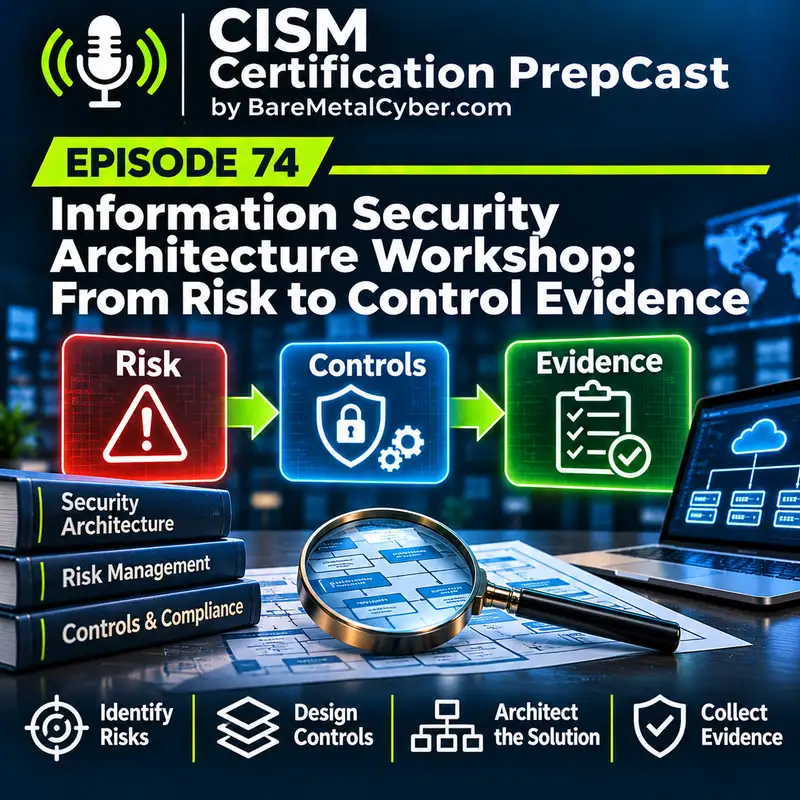
Information Security Architecture Workshop: From Risk to Control Evidence
In this episode, we are conducting an information security architecture workshop that converts a risk into requirements, trust boundaries, interacting controls, and evidence. The objective is to connect the topic to business impact, decision authority, operating responsibility, and evidence rather than treating it as a slogan or isolated technical task.
Consider Keystone Customer Care, a fictional teaching organization. It is giving an external support team limited access to customer records through a shared portal. Authentication works, but business and technical teams disagree about which records the supplier should see, who approves access, what activity must be monitored, and how access will be removed. The workshop must create a defensible protection argument rather than a product configuration list. This scenario is not an official examination question. It gives us a practical setting in which to examine the management choices and the reasons behind them.
The first task is to follow information and authority across trust boundaries. The manager must then state requirements for authentication, authorization, monitoring, and recovery. Next, the responsible teams should compare feasible designs and their dependencies. Before the decision is closed, the organization must separate design approval, operational readiness, release authorization, and risk acceptance. Finally, it should define verification and validation evidence before handover. These actions may occur in parallel when authority and urgency permit, but none should disappear from the management record.
To deepen the lesson on information security architecture workshop: from risk to control evidence, begin with the management principle behind the decision. A useful way to think about scope is as a bounded system with inputs, outputs, and constraints. Inputs include business objectives, risk appetite, legal and regulatory obligations, and the current operating environment. Outputs include risk decisions, security requirements, control objectives, metrics, and assurance evidence that leadership can rely on. Constraints include budget, staffing, technical debt, architecture choices, and the organization’s tolerance for disruption. If you cannot name the inputs and constraints, you will not be able to defend the outputs when stakeholders ask why security is “slowing things down.”
The next part of the analysis concerns the evidence and accountability behind the decision. Scope boundaries should be expressed in terms of what the program governs versus what it merely influences. Within its delegated scope, the program applies approved policy, establishes standards, and routes decisions through defined authority. Acceptance of residual business risk belongs to the designated risk owner or higher approving authority; it does not automatically belong to the security team. Influence means the program provides guidance, patterns, and expertise, but the final decision sits elsewhere, such as in product management or a business unit leadership team. Confusing these two leads to predictable failure modes: the security team is blamed for outcomes it cannot control, or it tries to control outcomes without legitimate authority. Clear boundaries make accountability possible, which is the prerequisite for maturity.
Viewed through this episode’s purpose, the practical implication is important. Interfaces are the structured handoffs and shared responsibilities between the security program and other parts of the enterprise. Every interface needs two things: a defined decision right and a defined communication path. For example, an interface with enterprise architecture should clarify who sets security architecture standards, who grants exceptions, and what evidence is required to justify deviation. An interface with legal should clarify when security escalates an incident for breach analysis and what facts must be documented to support notification decisions. A program without explicit interfaces will still have them, but they will be improvised under pressure, which is exactly when inconsistency becomes expensive.
A manager should connect this point to ownership, operating reality, and the business consequence. Three connected views help a manager turn strategy into working protection. Enterprise architecture describes how business capabilities, information, applications, and technology fit together, including current arrangements and the intended future state. another lesson in this course develops that business view. Information security architecture describes how protection is built into those arrangements through security requirements, control responsibilities, boundaries, and interactions. The program operating model explains how people, processes, resources, and decision rights keep that protection working. A staffing chart cannot show whether a supplier can read customer records, and a network diagram cannot identify who may approve a risk exception.
This distinction becomes especially useful when several plausible actions compete for attention. Return to the retailer integrating an acquired business into a shared customer-service portal before seasonal demand. The service owner wants customers served across both businesses while records remain accurate, access stays appropriate, and disruption remains within agreed limits. Security helps turn those needs into requirements. Which staff may see which records? Can the external support provider export customer data? How will inappropriate changes be identified? What service must remain available if an integration fails? Those answers give architects and delivery teams a business purpose for each protection decision.
The governance question is not whether the idea sounds secure, but whether it is authorized, workable, and verifiable. Follow a customer request through the portal, identity service, customer records, external support team, and monitoring service. Describe what information moves, why it moves, and who controls each step. A trust boundary marks a point where security assumptions or authority change, such as the boundary between a supplier's environment and the retailer's records. Boundaries can also exist within a shared cloud environment. Being on the same network does not establish permission to access a record. Each crossing needs explicit expectations for identity, authorization, data handling, and evidence.
The operational consequence also matters because a plan that cannot be sustained will not manage risk for long. Suppose the assessed risk is that a supplier account could retrieve records unrelated to its assigned work. A useful requirement is that support staff can access only the records needed for authorized cases, with actions attributable to individual users. The architecture allocates responsibilities: the identity service establishes who is connecting, the application enforces permitted access, and monitoring supports detection and investigation of misuse. Strong authentication alone does not decide which customer record a valid user may open. The manager asks whether the combined design addresses the risk across the whole flow.
Use this point to challenge assumptions and to identify what must be demonstrated before the next decision. Compare feasible designs against those requirements and their lifecycle costs. Reusing the retailer's identity and monitoring services may improve consistency, but the portal then depends on their capacity, availability, and ownership. Document those dependencies and agree on acceptable behavior when they are unavailable. An approved limited service mode might preserve essential work; a sensitive function might need to stop safely. The appropriate choice depends on business impact and the risk decision. More components or more suppliers do not automatically produce a more resilient service.
The exam lens here is to separate the activity from the outcome that leadership actually needs. In the retailer scenario, suppose the acquired application cannot yet enforce the required supplier access limits. The manager presents alternatives: defer that integration, restrict the initial service to an approved subset of data, or fund the missing capability. If a limited interim design is authorized, document exactly what data and users it covers, how misuse will be detected, and when the decision expires. The business deadline does not supply approval by itself. Required safeguards remain conditions of the decision, and their owners need resources to operate them.
A defensible approach keeps the scope, owner, evidence, and remaining uncertainty visible. Assurance begins with agreement on what acceptable evidence will look like. Verification asks whether the specified requirements have been met. Validation asks whether the resulting service meets its intended business and protection needs in its operating environment. For the portal, test that permitted users can complete legitimate work, unauthorized record requests are denied, revoked access is removed as required, and useful events reach the responsible monitoring team. Exercise important dependency failures and the agreed recovery or limited service arrangements. A successful demonstration of one feature does not establish that the entire service is ready.
Apply this principle directly to the management decision in this episode. A control objective should be anchored to a defined risk statement, because controls exist to reduce likelihood, reduce impact, or both. That anchoring forces precision about the asset, threat, vulnerability, and business impact being addressed, which is where exam questions usually hide their “best answer” logic. A well-formed objective also implies a measurement approach, even if the metric is simple, such as “only authorized users can approve payments over a threshold” or “production changes are traceable to an approved request.” If the objective cannot be validated, it will drift into policy poetry and become impossible to enforce consistently. The more ambiguous the objective, the more likely the mechanism becomes performative rather than effective.
The next part of the analysis concerns the evidence and accountability behind the decision. Connect this objective to the architecture record from another lesson in this course. For the retailer’s portal, limiting supplier access to approved customer records requires coordinated identity, application, and monitoring controls. Record which requirement each control satisfies and how it will be tested. If an alternative mechanism meets the requirement with lower operating burden, compare it through the design review. Conformance to a familiar product choice is less useful than evidence that the protection requirement is met.
Viewed through this episode’s purpose, the practical implication is important. Managers should describe objectives in terms of security properties and business behavior rather than implementation detail. Confidentiality, integrity, and availability often appear as the backdrop, but the better framing is operational: prevent unauthorized action, detect unacceptable conditions, correct deviations, and provide evidence. For example, “prevent unauthorized privilege escalation” is an objective that can be supported by multiple mechanisms over time, while “deploy product X” is an action that may or may not achieve the intent. This distinction matters because environments change, and the exam frequently tests whether you can separate intent from tactic. When you can articulate intent cleanly, you can compare multiple candidate mechanisms without bias toward a favorite solution.
A manager should connect this point to ownership, operating reality, and the business consequence. Layering is also about sustaining outcomes during degraded conditions, because real-world incidents rarely respect system boundaries. Logging may be impaired during a denial-of-service event, identity systems may be stressed during remote-work surges, and teams may be operating with limited staff during holidays or emergencies. A resilient control design anticipates these constraints by ensuring that at least one layer remains reliable when another layer is degraded. That can include local enforcement when centralized services are down, or independent evidence sources when monitoring pipelines are disrupted. The manager’s role is to evaluate not just normal operations but also “fail open” and “fail closed” behaviors across layers. When a control fails, it should fail in a way that is acceptable to the business and consistent with the risk treatment decision.
This distinction becomes especially useful when several plausible actions compete for attention. Check shared dependencies across trust boundaries. If the same supplier administrator can expand portal permissions and suppress the only audit trail, two listed controls may still fail together. Ask what prevents that combination, who can detect it, and what evidence remains available. This is a design question about authority and control placement. Simply adding another product does not resolve it.
The governance question is not whether the idea sounds secure, but whether it is authorized, workable, and verifiable. Finally, layered controls support governance because they produce corroborating evidence rather than a single fragile proof point. Evidence that comes from multiple independent sources (such as access logs, change records, and monitoring alerts) makes it harder for control effectiveness to be overstated by one system’s reporting gap. It also makes audits more efficient because the organization can demonstrate that key objectives are met even if one artifact is incomplete. Layering, when designed well, allows managers to say, “Even if this layer misses, that layer will catch, and this layer will limit impact,” which is the essence of resilience. The exam’s “best answer” is often the option that demonstrates this thinking without overcomplicating the environment. A layered design is not about having more controls; it is about having controls that fail gracefully and still protect the business.
The operational consequence also matters because a plan that cannot be sustained will not manage risk for long. Risk transfer is frequently misunderstood as “someone else is responsible,” but the manager’s view treats transfer as shifting financial impact or operational responsibility while retaining accountability for outcomes. Controls that align with transfer include vendor due diligence, contract clauses, service level requirements, right-to-audit provisions, and monitoring of third-party performance. Even when risk is transferred, the organization still needs controls to manage residual risk, such as integration security, access governance, and incident coordination expectations. The exam often tests this nuance by offering an option that outsources responsibility completely, which is usually not the best answer. A well-aligned approach acknowledges that transfer changes the control boundary but does not eliminate the need for governance and verification.
Use this point to challenge assumptions and to identify what must be demonstrated before the next decision. Risk acceptance requires the most disciplined control thinking because the temptation is to either do nothing or quietly mitigate anyway. Acceptance is an authorized decision to retain a defined amount of risk, with its scope, duration, and conditions documented. It normally sits within approved tolerance; a decision beyond delegated limits requires the appropriate higher authority. Controls aligned with acceptance focus on transparency and evidence: monitoring to ensure the risk stays within bounds, periodic reassessment, and clear triggers for revisiting the decision if conditions change. Acceptance does not cancel existing controls or an agreed improvement plan. Confirm which safeguards are conditions of the acceptance and what remaining risk is being retained before deciding whether additional treatment is needed. On the exam, the best acceptance-related answer usually involves documentation, appropriate approval, and monitoring rather than immediate implementation of new controls.
The exam lens here is to separate the activity from the outcome that leadership actually needs. Aligning controls with treatment decisions also depends on understanding inherent risk versus residual risk, because controls exist to move the organization from one to the other. Inherent risk describes exposure before controls, while residual risk describes exposure after controls, including the reality of control effectiveness and control failure. Managers should be careful not to describe risk treatment in terms that assume perfect control performance, because no control is absolute and many have operational dependencies. When a control fails, residual risk can drift upward, and alignment requires detecting that drift rather than continuing to report outdated assumptions. Exam questions often probe this by presenting an environment where controls exist but are not operating consistently, and the best answer addresses validation and effectiveness rather than adding more controls.
A defensible approach keeps the scope, owner, evidence, and remaining uncertainty visible. Operational integration also depends on clean ownership boundaries, because controls often cross teams. Security can define policy, minimum standards, and risk thresholds, but IT operations typically owns execution: deploying patches, configuring monitoring agents, rotating keys, and enforcing baselines. This division matters because it determines who can be held accountable when a control is not performed and who has the authority to remediate. A common exam trap is choosing an answer that makes security responsible for operational tasks it cannot reliably execute at scale. The stronger answer is usually the one that aligns responsibility with the team that runs the process and has the tools to make it happen. In this lesson on information security architecture workshop: from risk to control evidence, apply the principle to the stated decision, authority boundary, and evidence requirement rather than treating it as a universal shortcut.
Apply this principle directly to the management decision in this episode. A short scenario shows what “not integrated” looks like in practice. An operations team deploys a critical customer-facing application update during a normal release window, and a week later the security team discovers that logging is incomplete and administrative access is shared across multiple engineers. The root problem is not that the engineers are careless; it is that the deployment workflow never required log verification or individual privileged access as gate criteria. Integration would mean the release checklist and access process enforce those requirements automatically, so the team cannot “forget” them under deadline pressure. On the exam, the best corrective action typically centers on embedding control steps into the operational workflow rather than adding a separate review after the fact. In this lesson on information security architecture workshop: from risk to control evidence, apply the principle to the stated decision, authority boundary, and evidence requirement rather than treating it as a universal shortcut.
The next part of the analysis concerns the evidence and accountability behind the decision. The most reliable integrations are the ones that reduce decision-making during execution. Standard builds and hardened baselines remove ambiguity by giving operations a known-good starting point, and configuration management keeps drift visible. Privileged access management (PAM) becomes operational when it is the default path for admin work, with session recording, approvals, and just-in-time elevation, instead of a tool used only when someone remembers. Endpoint detection and response (EDR) becomes operational when agents are deployed through standard provisioning and monitored for health like any other system component. The exam logic rewards controls that are “built in” and therefore consistently applied, rather than controls that depend on individual discipline. In this lesson on information security architecture workshop: from risk to control evidence, apply the principle to the stated decision, authority boundary, and evidence requirement rather than treating it as a universal shortcut.
Viewed through this episode’s purpose, the practical implication is important. Integration also requires that security signals map to operational actions, not just dashboards. Alerts that do not produce tickets, escalation paths, and owner accountability become noise, and noise becomes ignored. Conversely, well-integrated monitoring triggers defined runbooks, with severity aligned to business impact and clear criteria for paging, containment, and stakeholder notification. This is why integration often references incident management and problem management concepts, even when the control is “security” in name. In exam terms, a control is stronger when it drives timely, consistent operational response and produces evidence of that response. In this lesson on information security architecture workshop: from risk to control evidence, apply the principle to the stated decision, authority boundary, and evidence requirement rather than treating it as a universal shortcut.
A manager should connect this point to ownership, operating reality, and the business consequence. At release, reconcile what was approved in another lesson in this course with what was implemented. For the portal, confirm actual data flows, access boundaries, supplier responsibilities, and logging against the design record. Assign the operating owners, document remaining exceptions, and test the handoffs they must perform. Include recovery and rollback arrangements appropriate to the change. A passed design review is not evidence that every control survived deployment; the service needs an explicit readiness decision supported by implementation results. In this lesson on information security architecture workshop: from risk to control evidence, apply the principle to the stated decision, authority boundary, and evidence requirement rather than treating it as a universal shortcut.
This distinction becomes especially useful when several plausible actions compete for attention. Finally, integration should be evaluated through operational metrics that reflect control performance, not just tool coverage. Examples include patch compliance within defined timeframes for critical assets, percentage of privileged actions performed through approved mechanisms, mean time to detect and mean time to contain for high-severity events, and completeness of log sources for key systems. Metrics matter because they translate “security is important” into operational expectations that leaders can manage and teams can improve. When a control is integrated, it shows up in operational reporting, operational accountability, and operational planning cycles rather than only in security assessments. On the exam, that’s the practical definition of making security real: it runs with the business. In this lesson on information security architecture workshop: from risk to control evidence, apply the principle to the stated decision, authority boundary, and evidence requirement rather than treating it as a universal shortcut.
The governance question is not whether the idea sounds secure, but whether it is authorized, workable, and verifiable. A short scenario makes the control concrete. An engineer is troubleshooting an outage and temporarily disables a web application firewall rule and reduces authentication requirements “just to get traffic flowing,” intending to restore them later. The outage is resolved, but the weakened settings remain in place for days because there is no change record, no owner accountability, and no post-implementation verification. The security lesson is that emergency actions must still route into the change system, even if approval is retrospective, because the organization needs a way to discover and unwind risky temporary decisions. On the exam, the best corrective response typically includes formalizing emergency changes with documentation, review, and validation.
The operational consequence also matters because a plan that cannot be sustained will not manage risk for long. Security testing and validation are part of change management because they reduce the chance that “approved” changes create new vulnerabilities. For software changes, validation might include verifying authentication flows, ensuring authorization checks still enforce least privilege, and confirming sensitive data handling did not regress. For infrastructure changes, validation often includes confirming logging coverage, verifying that monitoring agents still report, and ensuring network segmentation assumptions remain true. The goal is not to force every change through a heavyweight security assessment, but to define minimum checks based on risk. Exam questions frequently reward answers that place verification steps before and after deployment, because that is how organizations catch both design mistakes and implementation drift.
Use this point to challenge assumptions and to identify what must be demonstrated before the next decision. Rollback planning is a security control because it limits the duration and blast radius of a bad change. A change that cannot be reversed under pressure is a change that can force unsafe improvisation, such as disabling controls or expanding access to restore service. Good rollback planning includes identifying a known-good prior state, defining who is authorized to execute rollback, and ensuring the organization can restore without breaking evidence or audit trails. This matters for security controls like logging, identity systems, and key management, where “fixing fast” can accidentally destroy visibility or weaken protections. On the exam, rollback readiness is often the differentiator between a mature change process and a checkbox process.
The exam lens here is to separate the activity from the outcome that leadership actually needs. In control testing, “effective” is never a vibes-based compliment; it is a claim you can defend with logic and evidence. The first part of that claim is design effectiveness, which asks whether the control, as written and architected, would prevent or detect the risk it is supposed to address. The second part is operating effectiveness, which asks whether that control actually ran as intended during the period that matters. Many exam questions hide the trick in plain sight by using the word “effective” without specifying which half of the claim is being tested. The best-answer move is to separate “could work” from “did work,” then choose the option that matches the question’s evidence and timeframe.
A defensible approach keeps the scope, owner, evidence, and remaining uncertainty visible. Design effectiveness is about suitability and completeness in context, not effort or complexity. A well-designed access control might require a unique user identity, strong authentication, role-based authorization, and timely revocation, because those elements map directly to common access risks. If the design ignores a realistic threat path (like privileged access that bypasses the standard workflow) then the design is ineffective even if the team executes it perfectly. Design effectiveness also depends on clarity: if the procedure cannot be followed consistently by different people, the design is too ambiguous to be dependable. When you see policy language that is aspirational but non-operational, treat it as a design weakness, not a training opportunity.
Apply this principle directly to the management decision in this episode. Operating effectiveness is about execution over a defined period, and it is where “we intended to” stops counting. A control can be beautifully designed and still fail because it was not performed, not performed on time, performed by the wrong role, or performed using incomplete inputs. Operating effectiveness also includes whether the control leaves reliable traces that show it happened, because controls that cannot be evidenced are indistinguishable from controls that were skipped. If approvals are required but routinely granted after work is completed, the control may exist but it is not operating as a preventive control. In exam logic, operating effectiveness is tied to observed behavior and artifacts, not to policy statements.
The next part of the analysis concerns the evidence and accountability behind the decision. Tracking becomes meaningful when it includes status that is evidence-based rather than narrative-based. “In progress” should tie to concrete milestones such as design approval, implementation completion, validation testing, and rollout to the full population. Without milestones, remediation status tends to become optimistic reporting, especially when there is pressure to show improvement. A disciplined process also prevents “paper remediation,” where a policy is updated but the operational behavior remains unchanged. Exam items commonly test whether you recognize that documentation updates alone rarely prove operating effectiveness improvement.
Viewed through this episode’s purpose, the practical implication is important. Closure criteria are where many teams fail, because they confuse activity with outcome. Closure should require validation that the remediation actually addressed the finding and reduced risk, which often means re-testing the control after the change is implemented. Validation should match the nature of the original gap: if the gap was operational, you need evidence of sustained operation over a period, not a single successful example. If the gap was design, you need evidence that the redesigned control maps correctly to the risk and is implementable in the real workflow. For the exam, closing a finding without re-testing or equivalent validation is usually the wrong answer, because it substitutes trust for assurance.
A manager should connect this point to ownership, operating reality, and the business consequence. A practical scenario makes the logic visible: access reviews are required quarterly, and testing finds that reviews were performed but not documented for two quarters. A remediation plan that updates the procedure to “document reviews” addresses a symptom, but it may not address the cause if the review system has no place to store evidence or if reviewers lack time and tooling. A stronger remediation includes a mechanism that forces evidence capture, assigns accountability, and provides a review trail that can be sampled later. Closure would require showing that the next cycle completed on time with complete evidence across the intended population. The exam “best answer” typically favors fixing the mechanism and validating outcomes, not just sending reminders.
This distinction becomes especially useful when several plausible actions compete for attention. one. Separate design effectiveness from operating effectiveness in every practice scenario you run. Take any control statement you encounter and write two short test prompts: one that asks whether the control, as designed, would address the risk, and another that asks whether it actually operated over a defined period. In your day job, apply the same split when reviewing policies or procedures so you can distinguish “could work” gaps from “did work” gaps. This habit trains you to spot exam questions that misuse “effective” as a catch-all and to pick the best answer based on the type of evidence described. In this lesson on information security architecture workshop: from risk to control evidence, apply the principle to the stated decision, authority boundary, and evidence requirement rather than treating it as a universal shortcut.
The governance question is not whether the idea sounds secure, but whether it is authorized, workable, and verifiable. two. Train yourself to translate artifacts into claims, not comfort. When you see an artifact like a policy, a ticket, a log excerpt, or an approval record, state explicitly what it proves, what it does not prove, and what scope or timeframe it covers. In project planning, use that same method to define evidence expectations up front so control owners know what “good” looks like before testing begins. This reduces the common failure mode where teams produce plenty of documents but cannot demonstrate control operation. Practicing this mapping makes you faster at eliminating distractor answers that present impressive-looking but irrelevant evidence.
The operational consequence also matters because a plan that cannot be sustained will not manage risk for long. three. Build sampling intuition by tying sample choices to risk, variability, and the human factor. In your study sessions, take a manual control and an automated control and describe how your confidence threshold would change based on who performs the control, how often it runs, and how exceptions are handled. In operational work, reflect that logic by sampling across time, including edge cases and exceptions, instead of pulling only the “clean” instances that make the control look good. Use early sample results to guide your next step: a single verified failure should trigger scoping and deeper testing rather than premature closure. This prepares you for exam questions where the best answer is to expand testing or refine scope before concluding effectiveness.
Return to the fictional Keystone Customer Care scenario. A sound architecture record links the business need and risk to measurable requirements, interacting controls, accountable owners, operating dependencies, and evidence that the design works in the intended environment. The strongest management response makes the underlying choice visible, names the accountable owner, and states how the result will be verified. It also preserves the distinction between an authorized technical action and the governance decision that gives that action direction, limits, and follow-through.
For practice, create a spoken architecture decision record for Keystone. Include the business need, protected information, trust boundaries, authorization rule, monitoring owner, recovery dependency, design alternative, release evidence, and unresolved risk that requires an accountable decision. Then challenge your own answer by identifying one plausible alternative that appears reasonable but fails because of authority, timing, scope, evidence, or business impact. This exercise develops the habit of explaining not only what should happen, but why that action is the best management decision under the stated conditions.