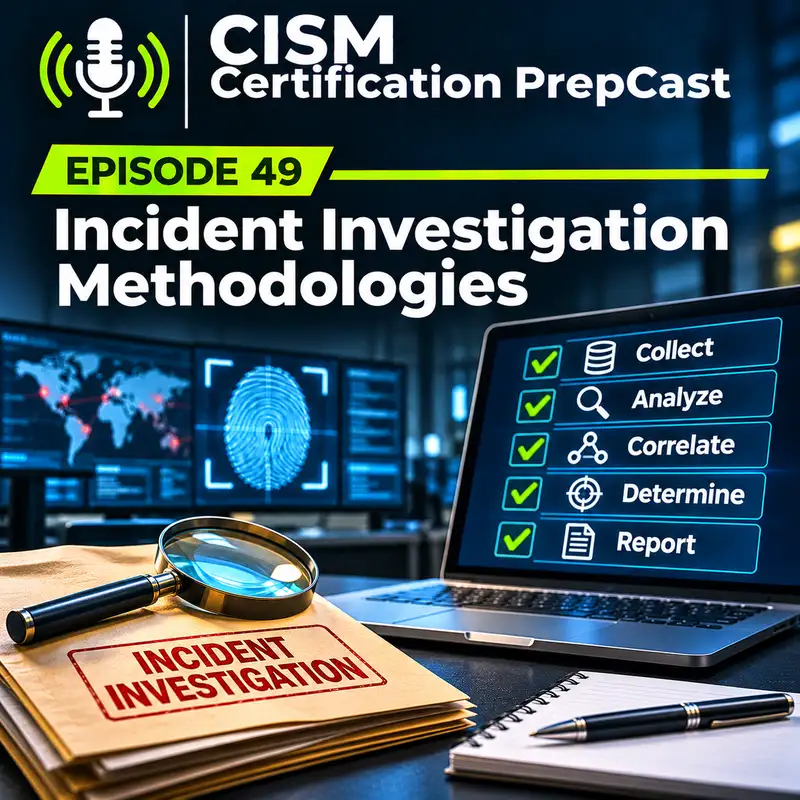
Incident Investigation Methodologies
In this episode, we are examining incident investigation methodologies. A defensible investigation defines scope, develops and tests hypotheses, preserves relevant evidence, coordinates with the right stakeholders, and adjusts as facts change. The goal is timely understanding that supports proportionate action without compromising integrity or creating unnecessary disruption.
Imagine a fictional design company called Orion Design. A privileged account logs in from an unusual location and accesses several repositories. The investigation team could immediately assume account compromise, but a defensible methodology begins with hypotheses and evidence. Possibilities include legitimate travel, stolen credentials, a misconfigured integration, an insider action, or inaccurate location data. Investigators define scope, preserve relevant records, establish a timeline, compare expected behavior, and coordinate with the account owner, human resources, legal counsel, and system owners as appropriate. Containment is adjusted as confidence changes. This fictional scenario demonstrates that investigation is not a search for evidence supporting the first theory. It is a controlled process for reducing uncertainty while protecting the organization, respecting authority, and preserving information that may be needed later.
Investigation should follow a defensible process that preserves evidence integrity while testing hypotheses. An investigation is a controlled learning process: you start with an observation, form a hypothesis about what it could mean, and then collect facts that can confirm or disprove it. The first discipline is triage, which separates “interesting” from “urgent” and prevents analysts from burning time on noise while missing active harm. Triage also establishes the initial incident classification, potential business impact, and the minimum set of stakeholders who need awareness. In exam terms, the best answer is usually the one that stabilizes decision-making early without overcommitting to a single narrative.
Scope control is the next practical step, because investigations fail when they sprawl faster than evidence can be collected and preserved. A defensible scope identifies the affected assets, the likely attack surface, and the time window of interest, then expands only when new facts justify it. This is where baseline knowledge matters, such as normal authentication patterns, standard administrative workflows, and expected network paths for key services. When the environment is complex, the best approach is to prioritize the systems that can answer attribution and impact questions first, rather than chasing every secondary anomaly. A disciplined scope also keeps containment and recovery decisions grounded in evidence instead of speculation.
Evidence integrity begins with an assumption: the most valuable information is also the most fragile. Volatile data such as memory contents, running processes, network connections, and active sessions can disappear with a reboot, a containment action, or a simple timeout. Non-volatile artifacts such as logs, file metadata, and configuration state are more persistent but can still be overwritten by retention limits or altered by normal operations. When time and risk permit, capture volatile evidence before actions that would destroy it, then preserve more durable artifacts and document what changed. This is not a universal requirement to finish collection before containment. Active exfiltration, destructive activity, or safety consequences may require authorized action immediately, with feasible collection in parallel and the evidence tradeoff recorded.
Chain of custody is the administrative backbone that makes collected evidence usable beyond the immediate technical team. It is a documented history of who collected the evidence, when and where it was collected, how it was handled, and who had access to it afterward. The intent is not bureaucracy for its own sake, but to demonstrate that the evidence is what it claims to be and was not altered or substituted. Even when an organization never expects a courtroom, chain of custody improves internal credibility by reducing arguments about whether findings are “real.” On exams, any scenario involving potential legal action, insider misconduct, or regulatory scrutiny should trigger stronger chain of custody discipline.
Technical integrity controls support that documentation by proving that digital artifacts have not changed since collection. Hashing (using a cryptographic hash function such as SHA two hundred fifty six) creates a compact fingerprint that will change if the underlying data changes, allowing analysts to validate integrity later. Secure storage practices, including access control, write protection, and segregation of evidence repositories from general-purpose file shares, reduce the risk of accidental or malicious modification. Timestamp accuracy matters as well, because inconsistent clocks can make a true sequence of events look impossible, which weakens conclusions and complicates correlation. The best-answer mindset treats evidence as a controlled asset, not just a folder of files.
Investigations are also harmed by well-intended responders who “fix” systems before facts are captured. If an administrator deletes a suspicious account, reimages a host, rotates credentials, or blocks an IP address without coordination, the environment may become safer but the ability to determine root cause and scope can collapse. That tradeoff is sometimes acceptable, but it should be an explicit decision with documented rationale, not an accident of urgency. A disciplined team separates containment actions from evidence-collection actions, sequences them consciously, and records what was changed and why. On the exam, actions that preserve optionality (capturing artifacts first, then containing) tend to be the safer choice when time allows.
A practical scenario illustrates the distinction: an analyst sees a privileged login from an unfamiliar location followed by a surge of database reads. If credible evidence indicates active data theft, use the approved authority to restrict the attacker’s access promptly while preserving available identity and database logs. Capture volatile session context in parallel when feasible; do not leave the theft running solely to finish a system snapshot. If active harm is not established and a short collection window is justified, capture fragile artifacts before disruptive changes. In either case, coordinate the actions, record the basis for the decision, and account for evidence lost through necessary containment.
Throughout the process, investigators must distinguish between facts, inferences, and assumptions, because reports that blur those lines become fragile under scrutiny. Facts are direct observations with sources, such as a log entry showing a privilege escalation event at a specific time. Inferences connect facts into a narrative, such as concluding that a credential was misused based on impossible travel and abnormal access patterns. Assumptions fill gaps, such as presuming a system is uncompromised because no alerts fired, which is rarely defensible. The exam-friendly approach is to document what is known, what is likely, and what remains unknown, then pursue the unknowns with targeted evidence collection.
Finally, evidence integrity is inseparable from investigation governance, because the most common failure is not a missing forensic tool but unclear authority. Roles must be explicit: who can authorize invasive collection, who can access sensitive logs, who can approve system snapshots, and who owns communication with legal counsel and leadership. Evidence repositories should have restricted access, and investigative actions should be logged so that the organization can later show due care and disciplined handling. When the situation involves potential employee misconduct, the investigation must also respect human resources procedures to avoid contaminating disciplinary outcomes. In exam terms, the best answer is the one that protects integrity through documented process, controlled access, and clear decision rights while still enabling timely technical work.
Containment decisions require speed, authority, proportionality, and awareness of collateral impact. Containment is where incident response becomes management, because you are choosing which risks to accept for the next few hours so you can reduce larger risks over the next few days. The core constraint is uncertainty: early indicators rarely tell you the full scope, the attacker’s objective, or whether access is still active. A defensible containment decision balances speed, reversibility, and business impact, while preserving the ability to learn what happened. On the exam, the “best answer” usually reflects deliberate tradeoffs and clear authority rather than aggressive action taken on incomplete information.
The first decision is whether to contain immediately or to observe briefly to gain clarity, and the right choice depends on potential impact. If there is credible evidence of active data exfiltration, destructive behavior, safety risk, or privileged compromise, rapid containment generally outweighs the benefits of continued observation. If the signal is weak, the suspected impact is limited, and containment could cause major disruption, a short period of controlled monitoring may be justified to confirm the hypothesis. That observation window must be bounded in time and governed by explicit criteria for escalation, because “wait and see” becomes denial if it is not structured. A defensible responder documents why the team chose immediate action or deliberate observation, including the triggers that would change that choice.
Containment options are not binary; they range from surgical changes to broad isolation, and reversibility matters when facts are incomplete. Blocking a single indicator, disabling one account, or quarantining a host can be low-disruption and quickly reversible, but may fail if the compromise is wider. Network segmentation, service shutdowns, or emergency access control changes can be highly effective, but they can also interrupt business operations and complicate recovery if they are applied indiscriminately. A strong containment posture prioritizes actions that reduce attacker capability while preserving core business functions and evidence. In exam logic, the best answer typically starts with targeted containment aligned to the highest-risk pathway, then expands based on validated scope.
Authority and coordination are part of containment logic because containment often changes production behavior and can violate normal change control. Emergency changes should still be governed, meaning there is a clear decision-maker, a documented rationale, and a record of what was changed and when. That governance is not a paperwork exercise; it enables rapid rollback when a containment action causes unexpected outage, and it protects the organization when stakeholders ask why service availability was traded for risk reduction. Containment should also be synchronized across teams, because inconsistent actions (like rotating credentials in one system while leaving related sessions active elsewhere) can create gaps and false confidence. The best-answer choice is the one that demonstrates clear ownership, authorization, and coordinated execution.
Identity containment deserves special attention because modern attacks frequently pivot through legitimate authentication rather than overt malware. Disabling accounts, forcing password resets, revoking refresh tokens, and reducing excessive privileges can cut off attacker access without touching infrastructure. However, identity actions can also lock out legitimate users, break automated services, and create support load, so they must be planned and targeted. When privileged credentials are suspected, the priority is to contain the privilege pathway first, then address broader user populations based on evidence. A defensible approach treats identity as both a containment lever and a potential incident vector that must be stabilized early.
Infrastructure containment must account for attacker persistence and the risk of tipping off an adversary. Quarantining a single endpoint may stop immediate lateral movement, but if the attacker has additional footholds, it may only shift activity elsewhere. Conversely, isolating large network segments can prevent spread but can also disrupt monitoring visibility if telemetry is routed through affected networks. Responders must also consider whether containment will destroy volatile evidence, such as killing processes or rebooting systems before collecting memory artifacts. The best-answer logic prefers containment that limits attacker freedom of movement while keeping the environment observable and preserving investigative options.
A common scenario under uncertainty is suspected ransomware staging: unusual privilege use, remote administration tool activity, and signs of mass file enumeration, but no encryption yet. The containment decision is time-sensitive because waiting can turn a manageable intrusion into a business outage, yet overreacting can shut down revenue-generating systems unnecessarily. A defensible approach may include isolating affected segments, disabling suspicious administrative accounts, blocking known command-and-control indicators, and protecting backups by tightening access and network paths. The decision rationale is based on potential impact and the attacker’s likely objective, not on perfect confirmation. For exam purposes, when credible pre-encryption behaviors are present, containment and backup protection are generally the stronger answers than extended monitoring.
Another uncertainty-driven scenario is suspected data theft through approved channels, such as an attacker using valid API keys or privileged sessions to extract sensitive records. Containment here is less about malware and more about controlling access paths: revoking keys, tightening conditional access, and limiting high-risk actions until the identity story is clear. The business risk is that aggressive access restrictions can interrupt integrations and customer workflows, but the alternative may be continued silent exfiltration. A defensible response applies compensating controls such as step-up authentication, additional logging, and throttling for unusually large data transfers while investigators validate scope. The exam-friendly mindset is to constrain the attacker’s capability using identity and access controls while maintaining essential services as much as possible.
Containment decisions also require a plan for what comes next, because containment without eradication and recovery can trap the organization in a fragile state. Actions taken during containment should be tracked so eradication teams know which systems were isolated, which credentials were rotated, and which controls were temporarily tightened. Temporary measures should have explicit expiration criteria, because emergency restrictions tend to become permanent “forever fixes” that are neither optimized nor governed. A defensible logic includes rollback plans, monitoring for attacker reaction, and criteria for expanding or relaxing containment as evidence improves. On the exam, the best answer is the one that treats containment as a controlled, iterative process under uncertainty: fast enough to reduce harm, structured enough to stay defensible, and coordinated enough to support recovery.
Now apply the idea to the management decision at hand. Threat modeling, as tested, is less about drawing perfect diagrams and more about recognizing what information matters when you are forced to choose the “best answer.” The exam uses threat modeling cues to see whether you can connect a business scenario to an attacker’s likely path and your organization’s weakest leverage points. You are expected to think in terms of assets, entry points, trust boundaries, and what an attacker gains at each step. When an item gives you just enough detail to imagine a path, it is inviting a threat modeling mindset even if it never uses that phrase.
A common cue is the presence of a critical asset paired with a change event, because change creates opportunity. Mergers, cloud migrations, new third-party integrations, rapid remote work expansion, and new customer-facing applications all reshape trust boundaries and control coverage. In those scenarios, the exam expects you to identify how the change alters exposure and where assumptions may no longer hold. The “best answer” usually acknowledges that new paths exist and that controls must be validated in the new context. If you treat change as purely a project milestone rather than a risk reshaping event, you will miss what the question is actually testing.
Another cue is specificity around identity and privilege, because identity is the shortest path to impact in modern environments. When a scenario mentions administrators, service accounts, federated sign-on, API keys, or “break-glass” access, you should immediately think about privilege escalation, credential theft, and abuse of trusted tokens. The exam often rewards answers that reduce attack success by limiting privilege, tightening authentication, or adding compensating monitoring around high-impact identities. That does not mean “add MFA” is always correct; it means identity is a primary threat surface and should be treated as such. The cue is not the control name, but the presence of an identity path that bypasses other defenses.
Network placement and trust boundaries show up as cues even in executive-friendly phrasing. Mentions of “internet-facing,” “partner connectivity,” “flat network,” “segmented environments,” or “shared services” signal that the question is about lateral movement and containment. If an application spans zones, if administrators manage multiple environments from a single workstation, or if production and development are loosely separated, the exam is prompting you to model movement and blast radius. The best answers typically reduce unnecessary trust, constrain movement, or make boundary crossings observable. Vague assurances like “secure the network” tend to underperform compared to choices that reflect explicit boundary thinking.
Data characteristics are another recurring cue, especially around confidentiality and regulatory exposure. If the scenario emphasizes customer records, payment data, intellectual property, health information, or “sensitive logs,” the exam expects you to consider what happens if the data is exfiltrated, altered, or made unavailable. Threat modeling here focuses on where data is stored, where it moves, and who can access it under what conditions. The strongest answers often address data handling and access paths rather than only perimeter defenses. When the question frames the business impact in legal, financial, or reputational terms, treat data loss and integrity failures as central.
The exam also uses cues around operational constraints because attackers exploit weak seams in process, not just technology. Statements like “the team is understaffed,” “changes are frequent,” “legacy systems cannot be patched quickly,” or “availability is critical” are there to shape your threat model. These details are not excuses; they are boundaries within which you must choose a workable risk response. In such cases, the best answer often involves layered controls, compensating measures, or prioritization of the highest-risk exposure points. Threat modeling becomes the tool that helps you decide where limited effort reduces the most risk.
Look for cues that the question wants you to separate threat from vulnerability from risk, because that distinction drives correct choices. A threat is an actor and intent, a vulnerability is a weakness, and risk is the expected loss given likelihood and impact in your context. When the item provides an active adversary pattern, a known weakness, and a meaningful business impact, it is handing you the components of a risk narrative. The exam tends to reward answers that validate exposure, confirm exploitability, and then select an appropriate treatment option aligned to business tolerance. If you jump straight from “bad thing exists” to “buy tool,” you are skipping the modeling step the question is probing.
Finally, threat modeling cues are often embedded in the answer options themselves, and your job is to recognize which option matches the most plausible attack path. One option will usually address symptoms, another will address a control that does not intersect the path, and one will interrupt the path at a high-leverage point. The “best answer” frequently reduces attacker options early, protects high-value targets, and improves detection where prevention is imperfect. In other words, it reflects an understanding of how compromise happens, not just what good security “should” look like.
Now apply the idea to the management decision at hand. Likelihood estimates should match the evidence and the decision. Both qualitative and quantitative approaches can be useful when the scenario, timeframe, assumptions and uncertainty are explicit. A precise-looking percentage is weak if nobody can explain its basis; a numerical estimate supported by relevant data can improve comparison and investment decisions. The same discipline applies to labels such as “high” or “unlikely.” The goal is to make a reasoned estimate that supports action and can be reviewed as evidence changes.
A practical way to reason about likelihood is to separate “how exposed are we” from “how capable is the threat” and then ask what has to go wrong for loss to occur. Exposure is shaped by how the asset is connected, who can access it, what control gaps exist, and how quickly those gaps are detected. Threat capability is shaped by motivation, resources, and opportunity, which vary dramatically across scenarios and attacker types. When the stem describes an internet-facing system with weak authentication and no monitoring, likelihood should rise even if the organization has never had a documented incident. When the stem describes a segmented system with strong access controls and tight change management, likelihood can reasonably be lower even if the impact would be severe.
Evidence for likelihood does not have to be perfect to be useful, but it does need to be honest about its limits. Incident history is relevant, yet it is also biased by detection capability, reporting culture, and how long the environment has been stable. Vulnerability and configuration data provides concrete indicators of exposure, but it can mislead if it ignores compensating controls or actual exploitability. Threat intelligence can improve context, but it should be applied as “this actor targets environments like ours” rather than as a promise that an attack will happen next week. The strongest likelihood rationale blends multiple indicators and remains explicit about uncertainty instead of hiding it behind a precise-looking score.
The managerial outcome of good likelihood reasoning is a prioritized set of risks that leaders can actually act on, with clarity about what would lower likelihood in the next cycle. When likelihood is framed as a reasoned estimate, it becomes easier to justify investments in prevention, detection, and response because you can explain which conditions are being improved. This approach also supports reassessment because you can revisit the same indicators after a control change and see whether the rationale still holds. The exam’s “best answer” logic consistently favors this transparency: acknowledge uncertainty, ground likelihood in observable conditions, and describe how management decisions can change the odds. That is how likelihood becomes a tool for governance rather than a ritual of precision.
Return to the fictional scenario from the beginning of this lesson on incident investigation methodologies. The strongest management response is not a slogan or an isolated tool purchase. It is a documented decision that connects business impact, authority, evidence, operating responsibility, and follow-through. Ask what must be true before the organization can proceed, who is accountable for making or accepting the decision, and how the result will be verified over time. That reasoning pattern helps on the CISM exam because it prevents a technically plausible action from being mistaken for the best management action.
For practice, begin with one suspicious event and write at least three plausible hypotheses. Define the evidence that would support or weaken each one, the scope boundaries, preservation needs, stakeholders, containment options, and decision points. Update the hypotheses as new facts appear. The exercise should demonstrate disciplined uncertainty rather than a rush to confirm the first explanation.