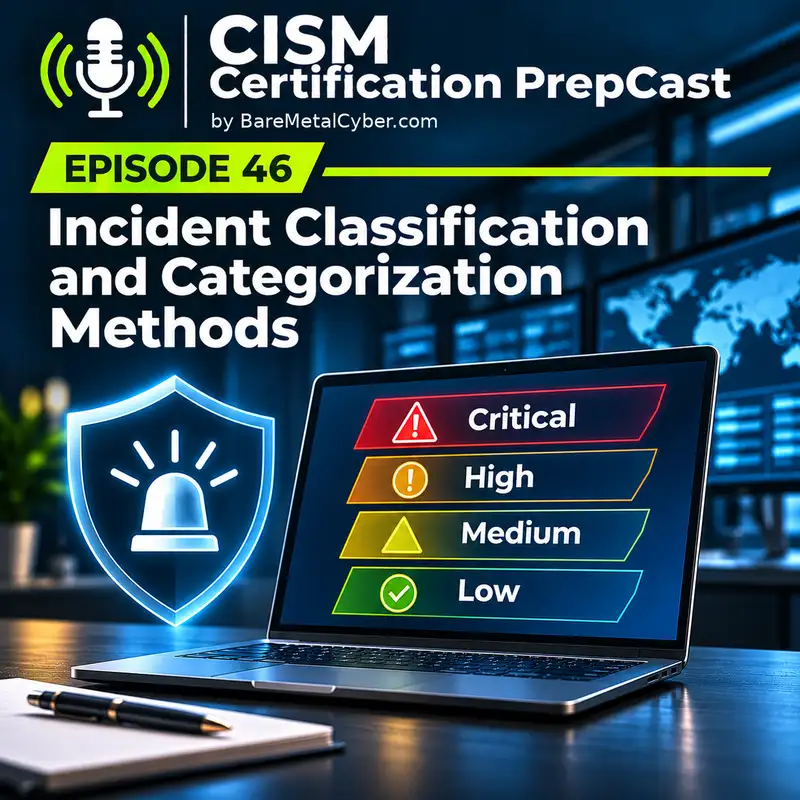
Incident Classification and Categorization Methods
In this episode, we are examining incident classification and categorization methods. Classification should guide urgency, ownership, escalation, notification, containment, and recovery, not merely place a label on a ticket. We will use business impact, evidence, thresholds, and reassessment to produce consistent action as an incident evolves.
Consider a fictional manufacturer called Apex Manufacturing. Monitoring detects unusual authentication activity on an engineering account. The first analyst labels the event critical because the account can reach sensitive designs, while another calls it medium because no data loss is confirmed. The incident manager separates classification from speculation. The team evaluates affected services and information, current evidence, potential impact, scope, urgency, control status, and notification triggers. It assigns an initial classification with explicit assumptions and a scheduled reassessment as evidence develops. This fictional scenario demonstrates that classification is a decision tool, not a prediction of the final outcome. Consistent criteria support escalation and action, while the ability to reclassify prevents the initial label from becoming an obstacle when the situation changes.
Classification starts with business impact and urgency rather than technical excitement. Severity is a decision tool, not a mood ring. The point of assigning a level is to drive consistent action under time pressure: who engages, what work stops, what gets monitored, and what can wait. A mature program treats severity as a controlled vocabulary that connects operational symptoms to business impact. If severity is used as a proxy for how embarrassed someone feels, it becomes noisy and loses predictive value. The best severity models stay stable over time, even as technology stacks change.
Business impact signals are the inputs that keep severity anchored to reality. The highest-quality signals describe harm in business terms: revenue interruption, safety or life risk, legal exposure, customer trust, and mission degradation. Operational indicators like “CPU is high” or “a server is down” are not business impact by themselves, because redundancy, maintenance windows, and architectural design can make them irrelevant. Security impact indicators like “a credential was used” also need context, because not every credential leads to meaningful access. Severity improves when you use signals that are observable, time-bounded, and directly linked to business outcomes.
Consider a scenario that shows why signals matter more than technical drama. A cloud access security broker alert flags a “mass download” from a file repository, and an analyst marks it as critical because the number looks large. In review, it turns out to be a sanctioned backup job running under a service account, during a scheduled migration window, with no sensitive data involved. The alert was real, but the business impact signal was absent: there was no unauthorized access, no data sensitivity, and no policy breach. A consistent severity model would downgrade the event quickly based on validated signals rather than the initial spike in activity.
Now flip the scenario to a quieter event with higher consequence. A single sign-on (SSO) log shows one successful authentication from an unusual location followed by a single privileged group change, and nothing else looks “loud.” The signal is not the location alone; it is the combination of privilege change, deviation from the user’s normal admin workflow, and the blast radius of that role. When severity is tied to business impact, that small pattern can outrank a thousand commodity malware detections on isolated endpoints. The “best answer” mentality on exams often rewards this logic: prioritize events with high potential impact and low reversibility.
Time is itself a business impact signal, and severity should encode urgency explicitly. Two events can be technically identical but differ in impact because of timing: quarter close, product launch, clinical operations, or public-facing peak usage all increase consequence and reduce tolerance for disruption. That is why severity models frequently incorporate service level agreement (SLA) commitments and recovery objectives like recovery time objective (RTO) and recovery point objective (RPO). If an incident threatens an RTO for a revenue-critical service, that is a business signal even before customer complaints arrive. Conversely, if a non-production system fails without downstream dependencies, the urgency and severity may legitimately be lower.
Data sensitivity signals deserve special handling because they often determine regulatory and contractual exposure. Severity should rise when confirmed or likely involvement includes personally identifiable information (PII), payment card data, protected health information (PHI), trade secrets, or regulated records, but only when the exposure pathway is plausible. “Sensitive data exists somewhere in the environment” is not a signal; “sensitive dataset was accessed by an unauthorized principal and exfiltration is likely” is a signal. Classification labels help, but you still need to validate scope: which records, which systems, and which identities. The goal is to avoid both underreaction that creates harm and overreaction that burns credibility.
User and identity signals are often the fastest way to estimate impact, especially in modern, identity-centric environments. Privileged identities, service accounts, and shared credentials carry disproportionate blast radius because they can cross boundaries, change configurations, and disable controls. Severity should increase when the affected identity has administrative rights, when token theft is suspected, or when authentication anomalies correlate with changes to security posture such as disabling logging. At the same time, not every privileged event is malicious, so consistency comes from requiring corroboration: source of the change, change ticket alignment, and peer review evidence. Strong programs treat identity telemetry as business-relevant because identity is how work gets done and how systems are controlled.
Dependency and customer impact signals keep severity aligned with what leaders actually care about. If the event affects a customer-facing path, a shared platform, or an integration that multiple business units rely on, impact rises rapidly due to cascading failure risk. External exposure also changes the calculus: public exploitability, active scanning, or evidence of adversary persistence increases likelihood, which is part of impact estimation. Third-party obligations can be a signal as well, because contracts may require notification within specific time windows even when operational disruption is minimal. Severity models that ignore these obligations tend to create last-minute escalations when legal and communications get involved.
Finally, the most reliable severity models are designed to remain consistent when information is incomplete. Early in an event, you rarely know everything, so the model should allow a provisional level based on current validated signals, with an explicit expectation of reassessment as new facts arrive. Consistency does not mean rigidity; it means using the same decision logic every time, so two analysts looking at the same signals arrive at the same severity. That is also why the best severity approaches separate “technical scope” from “business impact,” then recombine them into a single decision that drives action. When severity is disciplined in this way, triage becomes less about debate and more about executing the right response at the right speed.
Consistent criteria help different responders reach comparable decisions under pressure. Classification is the act of placing an event into a defined category so the organization can respond with the right playbook, the right expertise, and the right reporting path. Good classifications are mutually understood, operationally useful, and stable enough that metrics mean something from month to month. When categories drift based on who is on call, you cannot trend, you cannot compare, and you cannot justify investment decisions with credibility. Consistency is not an aesthetic preference; it is how triage becomes a repeatable management system instead of a series of one-off debates. A certification mindset will treat classification as governance that enables action, not as paperwork for its own sake.
Classification criteria should be observable, testable, and tied to decision points the organization actually makes. A category like “malware” is often too broad to be meaningful, while a category like “ransomware with confirmed encryption activity” is narrow enough to drive a distinct response. Criteria work best when they rely on evidence types you can reliably collect, such as endpoint telemetry, authentication logs, network flow data, cloud audit logs, or change management records. Vague criteria like “suspicious activity” are tempting in the moment but create a junk drawer that hides real patterns. The goal is to reduce interpretation and increase repeatability, especially when the first responder is tired and the evidence is incomplete.
A short scenario shows how inconsistency quietly breaks an incident program. An analyst tags a credential-stuffing attempt as “DDOS” because the authentication service slowed down and users reported login failures. Another analyst tags the same pattern next week as “application outage” because the service recovered quickly after rate limits were tuned. Neither choice is disastrous in isolation, but the organization now has three different trend lines for the same threat pattern, and leadership gets conflicting stories about what is happening. Consistent criteria would recognize the primary nature of the event as “identity attack” with an operational impact on availability, not a network flood and not a generic outage.
A practical way to build criteria is to separate the “what happened” category from the “how it happened” and “what it affected.” In many environments, the “what” might be unauthorized access, data exposure, service disruption, fraud, or policy violation. The “how” might be phishing, exploitation, misconfiguration, insider misuse, vendor compromise, or lost device, and the “affected” dimension might be identity, endpoint, cloud control plane, database, or third-party service. This approach allows you to classify consistently even when the root cause is uncertain, because you can place the event based on the best evidence available and refine later. It also prevents a common anti-pattern where every incident becomes “phishing” simply because a user reported an email, even when the impact is actually privilege escalation or financial fraud.
Consistency depends on precise definitions, not just category names. If “data breach” means “confirmed unauthorized acquisition of regulated data” to one team and “any suspected data access” to another, severity and notification decisions will oscillate wildly. Definitions should specify what counts as confirmation, what counts as reasonable suspicion, and what artifacts support each state. This is where exam logic often points: decisions should be based on defined criteria and documented thresholds, not on the loudest stakeholder or the most anxious responder. The more you can turn definitions into yes-or-no questions, the less you rely on individual judgment at two a.m.
Evidence quality should be part of the classification criteria, because early telemetry can mislead. Cloud logs might show an API call that looks like deletion but is actually a failed attempt, or endpoint alerts might attribute behavior to “trojan” when it is a legitimate administrative tool. Classification should support provisional states such as “suspected,” “likely,” and “confirmed,” even if your tooling uses different words, because those states drive very different actions. A consistent program uses the same evidence requirements to move between states, and it records the basis for the change. This reduces hindsight bias and makes post-incident review focused on process improvement rather than blame.
Consistency also requires handling multi-vector incidents without creating category chaos. A real incident may begin as a phishing email, pivot to credential theft, result in privilege escalation, and end with data exfiltration or business email compromise. If teams keep reclassifying the incident to the latest observed technique, reporting becomes fragmented and stakeholders lose the narrative. A stronger practice is to classify by primary business impact while also recording contributing factors, so the event stays intelligible from start to finish. That approach supports both operational response and meaningful metrics, because you can count “data exposure” incidents while still analyzing phishing as a dominant entry vector.
People and process controls are what make classification consistent across shifts, regions, and service teams. A single, shared taxonomy needs a single owner, typically a security governance function in partnership with incident response leadership, with authority to define terms and resolve disputes. Analysts need short decision guidance embedded in the workflow, not a policy document that lives in a forgotten folder. Consistency improves when you calibrate: periodic case reviews where multiple responders classify the same past event and reconcile differences using the written criteria. That kind of calibration is not busywork; it is how you build inter-rater reliability so the program behaves like a system rather than a collection of individuals.
Finally, consistency must survive organizational stress, because that is when classification is most likely to be distorted. When executives are watching, teams can feel pressure to downgrade language to avoid alarms, or to upgrade language to justify emergency change windows and vendor escalation. A well-designed taxonomy resists this by linking categories to objective criteria and preserving an audit trail of why a classification changed. The practical win is that stakeholders can debate response options without rewriting history through labels. In exam terms, the best answer is usually the one that protects decision integrity: classify based on defined criteria, document the rationale, and keep your metrics honest enough to manage.
Escalation and notification thresholds must be linked to authority and obligations. Escalation is the controlled act of bringing in more authority, more expertise, or more organizational attention based on predefined conditions. It exists because incident response is not just technical work; it is coordinated risk management under uncertainty, time pressure, and competing priorities. Triggers translate observed facts into predictable behavior, such as engaging legal counsel, contacting a vendor, convening crisis management, or initiating containment that may disrupt business operations. Without triggers, escalation becomes personality-driven, where the same event produces different outcomes depending on who is on call. With triggers, escalation becomes defensible, repeatable, and auditable.
Notification thresholds are the rules for when to inform specific stakeholders, and they should be written as decision criteria rather than as “best effort.” A threshold might be based on data sensitivity, privilege level involved, customer-facing impact, suspected external compromise, or a risk of regulatory reporting obligations. The most useful thresholds are early-warning thresholds, not post-mortem thresholds, because leaders need time to shape decisions and messaging before external pressure arrives. Thresholds should explicitly account for what is known versus suspected, because the organization often must act while facts are still emerging. This is where many teams stumble: they treat “notification” as synonymous with “certainty,” which delays engagement until options are narrower and risk is higher.
A scenario makes the escalation logic concrete. An engineer reports that a cloud storage bucket appears publicly accessible, but there is no proof of access and no confirmed sensitive data in the bucket. If the trigger is “any public exposure of storage containing sensitive data,” the first step is to validate data classification and access logs, not to page every executive. If the bucket is confirmed to include regulated records and public access is confirmed, that crosses a threshold for security leadership notification and legal engagement, even if exfiltration is not yet proven. The trigger is the condition that changes the organization’s obligations and risk posture, not the emotional temperature of the incident chat.
Escalation triggers should distinguish between operational escalation and governance escalation. Operational escalation pulls in responders who can execute containment, forensics, identity remediation, or platform-level configuration changes. Governance escalation pulls in decision-makers who can accept downtime, approve emergency changes, authorize external communications, and manage legal and regulatory exposure. When these are mixed, the incident response team can become stuck waiting for permission to act, or leaders can become overloaded with technical detail that does not support decisions. A consistent program defines what the security operations center (SOC) can do autonomously and what requires business authorization, then ties those boundaries to triggers.
Time-based triggers matter because uncertainty has a cost. If an incident remains unresolved beyond a defined window, the risk of uncontrolled impact increases, and stakeholders need to know the situation is not stabilizing. A common threshold is a sustained outage or degraded service that threatens an RTO, but time triggers can also apply to suspected compromise with incomplete telemetry, such as missing logs or unavailable endpoint data. The point is not to punish responders; it is to prevent silent failure where an incident lingers without the right resources. In certification terms, time triggers reflect governance maturity: they demonstrate that leadership expects visibility when risk remains unmanaged.
Privilege and scope triggers are often the fastest path to the “notify now” category. If a privileged identity is compromised, if security controls are disabled, or if a management plane is affected, the blast radius can expand quickly and containment options can narrow fast. Triggers might include creation of new administrative principals, changes to identity provider configurations, modifications to audit logging settings, or unusual use of break-glass accounts. These conditions justify escalation even before user-facing impact is observed, because they represent a material change in the organization’s control environment. This is especially true in cloud and software as a service environments, where a single administrative action can alter access across multiple services.
Data-related triggers need to be written carefully to avoid two equally damaging extremes: over-notification that creates fatigue and under-notification that creates legal and reputational harm. A useful approach is to define thresholds based on sensitivity and exposure pathway, such as “confirmed unauthorized access to regulated data,” “credible evidence of exfiltration,” or “loss of control over encryption keys protecting sensitive datasets.” Another set of triggers might cover ambiguity: “sensitive data likely involved but logging insufficient to determine access,” which drives early engagement with legal and privacy teams. Notification does not require definitive breach confirmation; it requires that the risk has crossed a level where stakeholders must shape response choices. The key is to treat notification as decision support, not as a public admission.
External dependency triggers are increasingly important because third parties can dictate timelines and actions. If a managed service provider is involved, escalation may be required to coordinate containment across boundaries and to preserve evidence under contractual terms. If a vulnerability is actively exploited in the wild and the organization has exposed instances, a trigger might require engaging patch management leadership, activating emergency change processes, and notifying service owners with clear action deadlines. If law enforcement engagement is part of the organization’s playbook, triggers should specify the conditions and authority required to initiate contact. These triggers keep incident response aligned with reality: modern environments are ecosystems, and containment rarely stays within one team.
Notification thresholds should define recipients by role, not by name, to maintain continuity through organizational change. Security leadership, legal counsel, privacy, communications, human resources, fraud, and business owners each have distinct responsibilities and should be engaged based on defined conditions. The threshold language should also specify what information is required in the notification: what happened, what is impacted, what is being done, what is unknown, and what decisions are needed. This prevents unhelpful notifications that say “we have an incident” without actionable context, which can provoke panic rather than support. A calm, structured threshold-driven notification is one of the most effective ways to maintain trust during incidents.
Finally, escalation and notification should be designed to preserve decision integrity under pressure. When triggers are clear, responders can focus on evidence gathering and containment instead of negotiating who gets paged. When thresholds are well-defined, leaders receive timely visibility without being dragged into every minor event. The best programs treat these mechanisms as part of control design: they are how the organization ensures that material risks are surfaced to the right level of authority. On exams, the strongest answers usually favor predefined criteria, timely escalation based on risk and obligation, and role-based notification that supports business decisions without inflaming uncertainty.
Uncertainty should be managed explicitly because ambiguity can delay action or create overreaction. Ambiguity is unavoidable in the early stages of security incidents, but unmanaged ambiguity can become a material risk in its own right. When evidence is incomplete, logs are missing, or signals conflict, decision-making slows while impact may continue to grow. In these moments, the absence of clarity does not mean the absence of harm; it means the organization does not yet know how much harm is occurring. Treating ambiguity as neutral is a mistake, because it often masks worst-case exposure rather than best-case reassurance. Mature triage models explicitly recognize uncertainty as a factor that can increase risk and justify action.
A common source of ambiguity is insufficient visibility at critical control points. Cloud services may have logging disabled or retained for too short a period, endpoints may be offline or reimaged, and third-party platforms may restrict access to raw telemetry. In such cases, the question is not whether compromise occurred, but whether the organization can prove that it did not. When you cannot establish a negative with reasonable confidence, the risk profile changes, because obligations and recovery choices must be made without full assurance. Certification logic often favors this framing: lack of evidence is not evidence of lack, especially when controls intended to generate evidence have failed.
Consider an incident where an administrative account token is suspected to be exposed, but audit logs covering the relevant time window are unavailable due to a misconfiguration. No obvious damage is detected, and systems appear stable. The ambiguity lies in the unknown scope of potential actions taken with that token, including configuration changes that may not have immediate effects. Waiting for “proof of harm” may allow persistence or delayed impact to materialize later. In this situation, the risk is driven by uncertainty itself, not by confirmed damage, and prudent action treats the ambiguity as a reason to escalate and contain.
Ambiguity also arises when signals point in different directions. An endpoint detection tool may show suspicious process execution, while network telemetry shows no corresponding data movement, and identity logs show no unusual authentication. Each signal alone is inconclusive, but together they create a fog where neither benign explanation nor malicious activity can be confidently asserted. If the affected system supports a critical business process, the cost of being wrong increases. The disciplined response is to weigh the potential impact of inaction against the cost of controlled disruption, rather than waiting for perfect alignment of indicators that may never arrive.
From a governance perspective, ambiguity challenges accountability because it blurs ownership of decisions. If no one is empowered to act until certainty is achieved, responsibility diffuses and response stalls. Well-designed classification and escalation frameworks anticipate this by defining thresholds for “credible uncertainty,” such as loss of logging on a sensitive system or unexplained administrative changes. These thresholds legitimize action even when evidence is partial, protecting responders from hindsight criticism. On exams, this often appears as the “best answer” that prioritizes risk management over technical completeness.
Communication is especially important when ambiguity drives action, because stakeholders may question why disruptive steps are taken without definitive proof. Clear articulation of what is known, what is unknown, and why the unknown matters turns ambiguity from a weakness into a rationale. For example, explaining that containment is being performed because the organization cannot verify the absence of data access reframes the decision as responsible governance rather than overreaction. This transparency helps maintain trust with leadership and avoids the perception that security is acting on fear rather than analysis. It also creates a documented record that decisions were made based on defined risk criteria.
Ambiguity should influence severity and escalation in a controlled, temporary way. As additional evidence is gathered, uncertainty should narrow, and severity can be adjusted up or down accordingly. Treating ambiguity as static is as dangerous as ignoring it, because it can lock the organization into an elevated posture long after it is justified. The key is to tie uncertainty to specific investigative objectives, such as restoring logging, validating configuration baselines, or obtaining third-party attestations. When those objectives are met, the ambiguity resolves, and risk can be reassessed with greater confidence.
There is also a strategic lesson in repeated ambiguity: it often signals a control gap rather than an isolated incident. If the organization frequently cannot determine what happened, that points to weaknesses in logging, monitoring, asset inventory, or identity governance. While the immediate response must manage the current risk, leadership should recognize the pattern as a systemic issue that increases future exposure. In certification terms, this is where incident response intersects with risk management and control improvement. Ambiguity is not just a situational challenge; over time, it becomes evidence that the control environment is insufficient.
Ultimately, treating ambiguity as a risk aligns incident triage with the realities of modern, distributed environments. Perfect information is rare, but decisions still must be made in time to matter. A mature organization accepts that uncertainty has a cost and designs its processes to surface, manage, and reduce that cost deliberately. The strongest responses are those that neither freeze in the absence of proof nor overreact without structure, but instead use predefined criteria to act responsibly under uncertainty. This balance is central to effective classification and categorization, and it is a recurring theme in how exams test judgment under imperfect conditions.
Return to the fictional scenario from the beginning of this lesson on incident classification and categorization methods. The strongest management response is not a slogan or an isolated tool purchase. It is a documented decision that connects business impact, authority, evidence, operating responsibility, and follow-through. Ask what must be true before the organization can proceed, who is accountable for making or accepting the decision, and how the result will be verified over time. That reasoning pattern helps on the CISM exam because it prevents a technically plausible action from being mistaken for the best management action.
For practice, classify a fictional incident using impact, scope, urgency, critical services, information sensitivity, obligations, and current evidence. State the assumptions and unknowns, choose escalation and notification actions, and define when the classification will be reassessed. Then change one fact and explain whether the classification or response should change. This builds consistency without pretending that early information is complete.