Implementing Information Security Governance Frameworks
In this episode, we are implementing a governance framework so authority, oversight, policy, exceptions, and accountability operate in practice. The objective is to connect the topic to business impact, decision authority, operating responsibility, and evidence rather than treating it as a slogan or isolated technical task.
Consider Redwood University, a fictional teaching organization. It has adopted a respected governance framework, but different colleges still approve security exceptions independently, risk reports use incompatible scales, and no committee can compel remediation. Leaders point to the framework as proof of maturity, while operational teams experience ambiguity. The security manager must turn the selected framework into an operating model rather than a collection of references. This scenario is not an official examination question. It gives us a practical setting in which to examine the management choices and the reasons behind them.
The first task is to define governance objectives and decision rights. The manager must then assign accountable owners and escalation paths. Next, the responsible teams should connect policy, standards, procedures, and exceptions. Before the decision is closed, the organization must establish forums with real authority and reliable information. Finally, it should measure whether decisions and corrective actions occur as designed. These actions may occur in parallel when authority and urgency permit, but none should disappear from the management record.
Implementing an effective information security governance framework is essential for managing risk, demonstrating accountability, and sustaining long-term program success. The purpose of information security governance is to establish a structured system of oversight and decision-making authority that guides how security is planned, managed, and measured across the organization. Governance provides the framework for aligning security objectives with broader business goals and enterprise risk management. It defines who is accountable for specific controls, how performance is measured, and where approvals and exceptions are tracked. Security governance supports compliance with legal, regulatory, and contractual requirements by creating defensible documentation and structured reporting. Most importantly, it enhances transparency between technical teams, business stakeholders, and executive leadership. Through clearly defined structures and documented responsibilities, governance ensures that security is not managed in isolation, but as an integral part of enterprise operations and strategic decision-making.
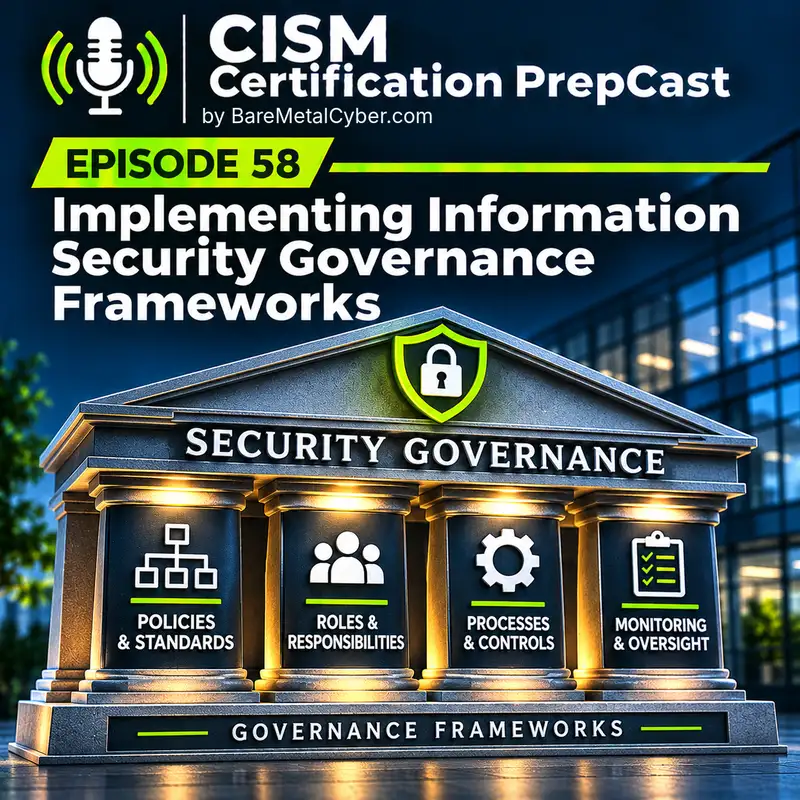
Every governance framework contains a set of foundational components. These include policies and standards that outline acceptable behavior, required controls, and organizational expectations. Governance structures also define roles, responsibilities, and reporting relationships, specifying who owns which risks, who approves which decisions, and who is responsible for enforcing compliance. Metrics and dashboards are used to monitor performance and provide visibility into areas like control effectiveness, risk exposure, or policy violations. Formal committees or decision-making forums may be established to review policies, approve changes, evaluate exceptions, or oversee strategic initiatives. Finally, governance must be integrated into enterprise-wide governance, risk, and compliance functions. This integration ensures that information security governance is aligned with financial controls, legal compliance, human resources oversight, and audit programs. These components work together to ensure that security management is consistent, accountable, and embedded in the fabric of enterprise operations.
Choosing a governance framework approach requires evaluating several external and internal factors. Established frameworks like COBIT, ISO and IEC twenty-seven thousand fourteen, or the NIST Cybersecurity Framework provide widely accepted structures for defining governance responsibilities and processes. Selection should be based on the organization’s regulatory obligations, industry practices, and internal maturity level. For example, a heavily regulated company may adopt ISO-based governance for audit defensibility, while a public sector entity may align with NIST for compliance. The framework must be tailored to the size and complexity of the organization. A small business may implement a lightweight model, while a global enterprise may need layers of governance to match its complexity. Compatibility with existing enterprise governance structures is another essential factor. The selected approach must support integration with strategic planning, investment management, risk committees, and project oversight. The goal is to avoid duplication and ensure that security governance reinforces, not competes with, other areas of organizational control.
Defining governance roles and structures is a foundational step in implementation. Governance begins at the top, with executive sponsors such as the Chief Information Security Officer, the Chief Risk Officer, or a designated member of the leadership team. These individuals provide authority, funding, and visibility for the governance framework. A steering committee or oversight board should be established to set priorities, review risks, and oversee strategic decisions. Operational control ownership should be assigned across IT, security, business units, and compliance teams. Reporting relationships must be defined for incidents, risks, exceptions, and audit findings. In many cases, cross-functional working groups are formed to address specific topics such as third-party risk, cloud security, or regulatory readiness. A RACI matrix, standing for Responsible, Accountable, Consulted, and Informed, can be used to clarify exactly who does what at each level of decision-making. This level of role clarity helps reduce confusion, streamline escalation, and ensure that no critical tasks fall through the cracks during governance activities.
Governance documentation is the vehicle that supports consistency, traceability, and defensibility. Every organization should establish and maintain a clear policy hierarchy, beginning with top-level policies, then cascading into standards, procedures, and guidelines. Each document should follow a structured format and include ownership, version history, and review schedules. Governance processes must also be documented, for example, how controls are reviewed, how exceptions are handled, and how escalations are approved. These documents must be stored in accessible but secure locations and updated regularly to reflect changes in systems, regulations, or business priorities. Review cycles and approval workflows must be tracked and enforced to maintain version control. Retention schedules must be applied to ensure that obsolete documents are archived or retired in accordance with internal policy and legal standards. Well-managed documentation not only supports day-to-day governance, it serves as critical evidence for regulators, auditors, and internal reviews.
Information security governance must be woven into the operational fabric of the organization. This means integrating governance checkpoints into change management processes, new system deployments, procurement cycles, and project lifecycles. When new technologies are introduced, governance bodies must evaluate their alignment with policy and risk tolerance before they go live. Coordination with departments like Human Resources, Legal, and Procurement is essential for ensuring that policy enforcement, vendor contracts, and workforce accountability are addressed consistently. Security governance forums should be used to approve not only new systems but also vendor onboarding and policy exceptions. Governance must also be linked to broader enterprise functions such as enterprise risk management, internal audit, and regulatory compliance. These integrations ensure that security decisions are coordinated with financial controls, business continuity planning, and legal reporting. Involving business representation in security governance ensures that decisions reflect operational realities and avoid unintended disruption or friction.
Governance frameworks must be equipped with monitoring and reporting mechanisms to ensure effectiveness and accountability. This begins by defining key performance indicators that track how well controls are performing and how consistently policies are followed. Key risk indicators may also be used to track threat trends, control failures, or systemic vulnerabilities. Dashboards should be created that visualize governance metrics for executive leadership and oversight bodies. These dashboards allow leadership to monitor trends, evaluate risk posture, and make informed decisions. Reporting must include trend analysis that highlights areas of improvement or concern, as well as progress on remediation plans, audit findings, and compliance metrics. These insights feed directly into governance decision-making processes. Tracking remediation progress helps demonstrate a closed-loop approach to risk management, where issues are not only identified but also addressed and validated. These monitoring efforts elevate governance from a static structure to a dynamic, data-informed capability.
Governance must also include mechanisms for enforcing accountability and compliance. Noncompliance with policies or repeated control failures must be tracked and reported through governance structures. Escalation paths should be established for unresolved issues, especially those that impact strategic objectives, customer trust, or regulatory obligations. Governance teams must be empowered to intervene when violations occur. Policy adherence should be linked to performance evaluations, access rights, or project funding to ensure that compliance is treated seriously across the organization. For high-risk or repeated violations, disciplinary processes should be enforced in coordination with Human Resources and Legal. Governance logs must be maintained to record actions taken, justification for exceptions, and resolution of disputes. These records support audit transparency and may be required for legal or regulatory inquiries. Enforcement must be applied consistently to maintain credibility and demonstrate that governance is not simply advisory, it is authoritative and operationally effective.
No governance model remains effective without ongoing maintenance. The governance framework must be reviewed periodically, annually at a minimum, to assess its continued relevance and effectiveness. As the organization grows, restructures, or adopts new technologies, roles and processes must be adjusted. Feedback from governance participants, control owners, and business stakeholders should be collected regularly to identify pain points or improvement opportunities. Lessons learned from security incidents, internal audits, and risk reviews must be incorporated to strengthen oversight. Education on governance principles, responsibilities, and expectations must be ongoing, through training, onboarding, and documentation updates. Governance maturity grows not through static adherence but through adaptability. By actively reviewing and refining governance processes, organizations ensure that governance remains a source of strength, not friction or stagnation.
To measure governance maturity and drive improvement, organizations can apply formal models such as the Capability Maturity Model Integration or COBIT maturity assessments. These models provide structured benchmarks across domains like policy management, stakeholder engagement, documentation, performance measurement, and enforcement. Maturity assessments help organizations identify where their governance program stands today, where gaps exist, and what improvements are needed to reach the next level. Benchmarking against peers or industry standards adds context and supports goal-setting. Assessment results should be used to prioritize roadmap milestones for governance enhancement. These milestones might include improving executive engagement, automating reporting, tightening exception handling, or refining documentation workflows. Governance must be treated as a strategic asset, not merely a compliance requirement. It enables sustainable security operations, improves coordination across the enterprise, and enhances the organization’s ability to manage risk intelligently, transparently, and consistently.
To deepen the lesson on implementing information security governance frameworks, begin with the management principle behind the decision. Organizations rarely fail at security because they lack technology; they fail because authority, oversight, and accountability are unclear when decisions matter. Governance is the system that determines who decides, who is accountable, how conflicts are resolved, and how risk is consciously accepted or reduced in pursuit of business objectives. When governance works, security decisions are consistent, defensible, and aligned with enterprise priorities even under pressure. When it fails, risk accumulates quietly through informal workarounds, ambiguous roles, and undocumented tradeoffs. This material examines how effective governance structures translate intent into action and how exam-relevant signals distinguish mature oversight from governance in name only.
The next part of the analysis concerns the evidence and accountability behind the decision. An effective pattern starts with clear lines between governance, management, and execution, because blurred lines create gaps that show up as unowned risks. The board sets expectations for risk posture by approving risk appetite and tolerances, then expects management to implement controls consistent with that posture. Executives, in turn, assign responsibility to leaders who can influence outcomes (such as a CIO, CISO, or product owner) while keeping a visible mechanism for escalation when risk exceeds tolerance. When escalation is informal, decision-making devolves into consensus-seeking and nobody can be held to a decision. When escalation is formal, the “best answer” is the role with authority to accept risk at the right level and the evidence that acceptance occurred.
Viewed through this episode’s purpose, the practical implication is important. Accountability becomes operational when it is mapped to decision types, because different decisions require different oversight depth. Strategy-level decisions (entering a new market, acquiring a company, adopting a new delivery model) should have board visibility because they shift the organization’s risk profile. Program-level decisions (prioritizing security investments, setting enterprise standards, accepting major architectural exceptions) are typically executive-accountable with structured reporting upward. Tactical decisions (patch scheduling, configuration choices, and day-to-day access requests) are manager-accountable, but only within guardrails. A mature organization can point to who approves which class of decision, under what conditions, and how disputes are resolved.
A manager should connect this point to ownership, operating reality, and the business consequence. Risk acceptance is the accountability pressure test because it exposes whether authority and oversight exist in more than name. A strong pattern defines who can accept residual risk, how risk is described (likelihood, impact, and affected objectives), and what compensating actions are required when acceptance is time-bound. Weak patterns treat acceptance as an email thread, a ticket comment, or a meeting memory, which fails both auditability and governance intent. On exams, the best governance answer almost always favors explicit, documented acceptance at the appropriate level over informal sign-offs. The purpose is not paperwork; it is ensuring the decision-maker understands the business consequence and has the mandate to make the tradeoff.
This distinction becomes especially useful when several plausible actions compete for attention. A steering committee is not a meeting; it is a governance mechanism that formalizes how the organization makes certain classes of decisions. Its purpose is to coordinate across stakeholders who control different resources and incentives, including security, IT, legal, privacy, risk management, finance, and business leadership. When designed well, it converts competing priorities into explicit tradeoffs that can be decided at the right level and then executed without constant re-litigation. When designed poorly, it becomes a status-update ritual that slows delivery without improving outcomes. The exam expects you to recognize that the “best answer” is not more attendance, but clearer authority, scope, and decision criteria.
The governance question is not whether the idea sounds secure, but whether it is authorized, workable, and verifiable. Decision rights are the mapped permissions to decide, approve, veto, or escalate, and they should be defined for recurring decisions rather than debated case by case. Some decisions must be centralized to ensure consistency, such as enterprise security policy, identity standards, cryptographic requirements, and baseline logging. Other decisions can be delegated to product or platform teams within guardrails, such as implementation choices that meet the standard but vary by architecture. A common governance anti-pattern is treating all decisions as local, which produces fragmentation and uneven risk, or treating all decisions as centralized, which produces bottlenecks and shadow IT. The right balance depends on risk appetite, regulatory environment, and operational maturity, but the exam logic generally favors centralizing standards and delegating execution.
The operational consequence also matters because a plan that cannot be sustained will not manage risk for long. Steering committees should have an explicit charter that defines membership, scope, authority, and escalation paths, because ambiguity is what turns meetings into debates. Membership should reflect decision-making power, not just subject-matter expertise, because expertise without authority cannot resolve conflicts. Scope should include what the committee can decide and what it merely recommends, because a committee that “advises on everything” decides nothing. Authority should be tied to thresholds, such as material risk, budget impact, regulatory exposure, or cross-business dependencies, so routine work is not dragged into governance. Escalation paths should be defined for deadlocks, including when to move issues to executives or the board, so stalled decisions do not become de facto risk acceptance.
Use this point to challenge assumptions and to identify what must be demonstrated before the next decision. Effective steering committees make decisions using pre-agreed criteria that connect to enterprise objectives and risk tolerances. That usually includes alignment to business strategy, impact on confidentiality, integrity, and availability, compliance obligations, cost and operational complexity, and resilience and recovery considerations. Committees that decide based on personalities or the loudest stakeholder create inconsistent outcomes that cannot be defended during audit or incident review. Committees that decide based on criteria can explain why one project received an exception while another did not, and can show how exceptions are time-bound and monitored. In exam scenarios, a defensible governance mechanism is one that can produce evidence of “why” decisions were made, not just “what” was decided.
The exam lens here is to separate the activity from the outcome that leadership actually needs. Security steering committees often fail when they are positioned as “security approving IT,” which frames governance as gatekeeping rather than risk-based enablement. A healthier model is to make security one of several stakeholders balancing enterprise outcomes, while still preserving security’s authority to escalate when risk exceeds tolerance. This is where decision rights matter: security may not own product priorities, but it should have a defined role in setting minimum control requirements and in flagging unacceptable residual risk. The committee’s job is to decide whether to change scope, change timing, add compensating controls, or accept risk at an authorized level, not to endlessly debate the existence of risk. The exam-friendly framing is that the committee enables informed decisions rather than substituting for executive accountability.
A defensible approach keeps the scope, owner, evidence, and remaining uncertainty visible. Cadence and artifacts are governance signals because they show whether decisions are repeatable and auditable. A steering committee should meet often enough to keep decisions timely, but not so often that it becomes a distraction from execution, and the cadence should match the tempo of the organization’s delivery model. The meeting output should include a decision log that captures what was decided, who decided it, the conditions or constraints, and any follow-up actions with owners. Without a decision log, governance collapses into “tribal knowledge,” which fails both accountability and continuity when personnel change. The exam often rewards answers that emphasize recorded decisions and assigned owners because those are control-friendly and operationally realistic.
Apply this principle directly to the management decision in this episode. A key role of steering committees is managing exceptions and ensuring they do not quietly become the norm. Exceptions should be granted based on explicit criteria, documented with the risk statement and compensating controls, and bounded by time or milestone. The committee should also ensure exceptions are revisited, because temporary deviations frequently outlive the urgency that created them. If exceptions are plentiful, the committee should treat that as feedback on the standard itself: either the standard is impractical, or the organization lacks the capability to meet it. In governance terms, exception volume is a metric that indicates misalignment between policy and operating reality. The best governance response is to adjust standards, funding, or timelines rather than normalizing noncompliance.
The next part of the analysis concerns the evidence and accountability behind the decision. Steering committees also act as a coordination hub for dependencies that individual teams cannot resolve alone. Identity modernization, logging platforms, vulnerability management, and incident response capabilities often require shared services, consistent telemetry, and cross-team adoption. Without a central forum, teams optimize locally, leaving enterprise gaps that surface during incidents when data is missing or controls behave inconsistently. A committee with clear decision rights can prioritize enterprise enablers and align budgets, which is frequently more impactful than trying to enforce compliance one project at a time. On exams, this appears as the difference between tactical remediation and structural governance improvement, with the latter typically being the better answer.
Viewed through this episode’s purpose, the practical implication is important. The most mature steering committees understand that their value is measured by decision quality and execution follow-through, not by meeting completion. If decisions are repeatedly revisited, it suggests decision rights were unclear or criteria were not agreed in advance. If actions are not completed, it suggests accountability was not assigned or authority was insufficient to drive execution. If projects route around the committee, it suggests governance is too slow or too unpredictable to be trusted, which is a risk in itself. Strong committees build credibility by being consistent, timely, and transparent about tradeoffs, which encourages teams to engage early rather than escalate late. That credibility is the governance outcome the exam is testing: a decision system that makes risk management a normal business function.
A manager should connect this point to ownership, operating reality, and the business consequence. A fast-growing software company proudly points to a comprehensive set of security policies during an audit, yet the incident response review shows teams routinely bypassed access procedures and stored secrets in shared documents. Nobody can identify which policy version applied at the time, and exceptions were granted verbally without traceable rationale. The gap is not “lack of documentation,” because there is plenty of it, but lack of documentation that shapes real decisions and can be enforced. In exam terms, governance documentation is effective only when it is authoritative, current, communicated, and tied to accountability and evidence. Paper that cannot be used to make or defend decisions is not governance; it is a library.
This distinction becomes especially useful when several plausible actions compete for attention. Governance documentation begins with a hierarchy, because not every document carries the same authority or intended audience. A policy states non-negotiable organizational intent and expectations, and it should be stable enough that it does not change every quarter. A standard translates policy into specific mandatory requirements, such as minimum logging, encryption expectations, or identity assurance levels, and it should be precise enough to assess compliance. Procedures and work instructions describe how to execute the standards in the organization’s operating model, including who does what and what evidence is produced. Guidelines and reference material can be optional and situational, but they must be clearly labeled as such to avoid confusion. The exam logic favors clear separation, because ambiguous document types let teams argue that “it was only guidance” after the fact.
The governance question is not whether the idea sounds secure, but whether it is authorized, workable, and verifiable. Documentation drives behavior when it is written as a decision tool rather than as a narrative about good intentions. Effective policy language is concrete about scope, applicability, and enforcement, including what happens when requirements cannot be met. Effective standards use measurable statements that can be tested, such as required control outcomes, approval thresholds, and evidence artifacts, without embedding product-specific implementation details. Effective procedures align to how work actually flows, including ticketing systems, change management steps, and operational handoffs, so following them is the path of least resistance. When documentation is aspirational and detached from workflow, teams default to the workflow, not the PDF. For exam scenarios, the best answer often emphasizes operational integration over “write a new policy.”
The operational consequence also matters because a plan that cannot be sustained will not manage risk for long. Ownership and lifecycle management are the control points that keep documentation from drifting into irrelevance. Every policy and standard should have a named owner who is responsible for content accuracy, periodic review, and alignment with enterprise risk appetite. Reviews should be triggered by material changes such as new regulations, major architecture shifts, acquisitions, or significant incidents, not only by an arbitrary annual date. Version control should be disciplined so the organization can prove what was in effect at a given time and why it changed. Approval authority should match impact, with higher-impact policies approved at higher levels, because governance documents are an extension of decision rights. If ownership is unclear, documentation becomes stale, and stale governance becomes a liability.
Use this point to challenge assumptions and to identify what must be demonstrated before the next decision. Communication is not a broadcast; it is ensuring the right roles can find, understand, and apply the content at the moment of need. Documentation should be accessible in a single authoritative repository with clear navigation, rather than scattered across drives, wikis, and email attachments. The content should be written for the intended reader, which means executives get principles and accountability expectations, while practitioners get actionable requirements and steps. Terminology should be consistent across documents so teams are not forced to interpret mismatched definitions of “critical system,” “high risk,” or “privileged access.” When policies use vague language like “appropriate” without defining criteria, enforcement becomes subjective and inconsistent. In exam terms, clarity reduces interpretive risk and strengthens auditability.
The exam lens here is to separate the activity from the outcome that leadership actually needs. Enforcement mechanisms are what convert documentation from advice into governance, and they must be designed into processes and technology where possible. If a standard requires approvals, the approval path should be implemented in the access management or ticketing system, not left to memory. If a standard requires logging, the logging pipeline and retention settings should be centrally managed or continuously monitored, not dependent on each team’s best effort. If a procedure requires evidence, evidence collection should be part of the workflow, such as automated change records, access reviews, and configuration baselines. The more governance relies on voluntary compliance, the more it will degrade under time pressure, staffing shortages, and competing incentives. The exam-friendly view is that governance documentation is strongest when controls make compliance easy and noncompliance visible.
A defensible approach keeps the scope, owner, evidence, and remaining uncertainty visible. Exceptions are where documentation proves whether it is real, because every organization encounters situations where requirements cannot be met on schedule. Effective governance documents define how exceptions are requested, who can approve them, what information must be included, and how long they can last. They also define compensating controls and monitoring expectations, because an exception without compensating action is often unmanaged risk disguised as pragmatism. Exception records should be traceable, time-bound, and periodically reviewed, because “temporary” exceptions are prone to becoming permanent through inertia. When exception handling is absent, teams invent their own methods, and governance becomes uneven across the enterprise. On exams, a defined exception process is frequently the differentiator between mature governance and performative policy.
Apply this principle directly to the management decision in this episode. Documentation should also map explicitly to the organization’s control environment so it can be assessed and improved. Policies and standards should be linked to control objectives, and those control objectives should be evaluated through assurance activities such as internal audits, control testing, and monitoring. Findings should feed back into document updates, training, and process redesign, creating a loop where governance evolves based on evidence rather than opinion. When a control fails, the question is whether the requirement was unclear, infeasible, or poorly implemented, and documentation should be updated accordingly. This makes governance documentation a living system rather than a one-time deliverable. The exam expects you to prioritize this feedback loop because it aligns with continuous improvement and accountability.
The next part of the analysis concerns the evidence and accountability behind the decision. Effective governance makes security outcomes predictable by ensuring that authority, oversight, and accountability are explicit before risk materializes. When boards and executives understand their retained accountability, when roles and segregation of duties reduce conflicts, when steering committees clarify decision rights, and when documentation drives real behavior, security becomes a managed business function rather than a reactive control exercise. These mechanisms do not eliminate risk, but they ensure risk is consciously addressed at the right level and supported by evidence. In practice and on the exam, strong governance is visible through consistent decisions, traceable accountability, and controls that hold up under scrutiny. The distinguishing factor is not intent, but whether the organization’s structures reliably convert intent into action.
Viewed through this episode’s purpose, the practical implication is important. Evaluate steering committees by their decision rights, not their attendance. When you see a committee scenario, ask what it is authorized to decide, what thresholds trigger escalation, and what criteria are used to balance risk against objectives. Practice spotting the anti-pattern of “status meetings” that do not produce decisions, and favor the model that records decisions, owners, constraints, and follow-up actions. In your own projects, insist that cross-functional forums produce a decision log so issues stop being re-litigated every time priorities collide.
A manager should connect this point to ownership, operating reality, and the business consequence. Rewrite governance documentation in your head as a decision tool with enforcement hooks. On exam questions, separate policy (intent), standards (mandatory requirements), and procedures (how work gets done), and look for measurable language that can be tested and audited. Prefer documents that align to real workflows, create the right evidence naturally, and define exception handling with time bounds and compensating actions.
Return to the fictional Redwood University scenario. Framework implementation succeeds when people can show who decides, how issues escalate, how exceptions are governed, and what evidence demonstrates that oversight changes outcomes. The strongest management response makes the underlying choice visible, names the accountable owner, and states how the result will be verified. It also preserves the distinction between an authorized technical action and the governance decision that gives that action direction, limits, and follow-through.
For practice, use the Redwood scenario to define one governance decision, one accountable role, one committee responsibility, one required record, and one metric that would prove the framework is functioning rather than merely documented. Then challenge your own answer by identifying one plausible alternative that appears reasonable but fails because of authority, timing, scope, evidence, or business impact. This exercise develops the habit of explaining not only what should happen, but why that action is the best management decision under the stated conditions.