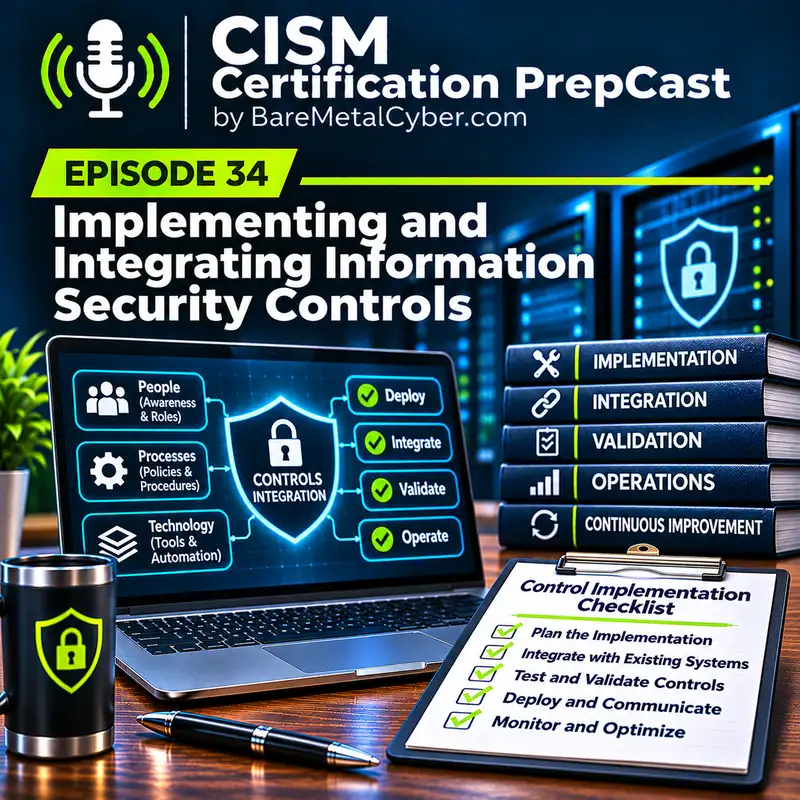
Implementing and Integrating Information Security Controls
In this episode, we are implementing and integrating information security controls. A control is not successful merely because a product was installed or a policy was published. It must fit operating workflows, connect to other safeguards, survive change, produce usable evidence, and have clear ownership from deployment through retirement.
Consider a fictional retailer called Granite Retail. It purchases an identity governance platform to reduce excessive access. The implementation team connects the largest application, demonstrates that the software can produce reports, and declares success. Months later, access remains in smaller systems, employee transfers are not reaching the platform reliably, managers approve requests without understanding the entitlements, and terminated contractor accounts persist in a supplier portal. The product works, but the control system does not. A successful implementation would connect human resources events, role definitions, application integrations, owner approvals, exception workflows, monitoring, and removal. It would verify that the technology was configured as intended and validate that the end-to-end access outcome was achieved. This fictional teaching scenario shows why integration and operating handoffs matter more than installation. The manager must govern the entire control lifecycle, including change, evidence, support, tuning, and retirement.
Logging and monitoring create value only when their outputs connect to accountable action. Logging and monitoring only work as security controls when they are integrated into accountability structures that can act on what the data reveals. Logs are records of events, while monitoring is the process of collecting, analyzing, and responding to those events in a timely way. Accountability is the operational layer that assigns ownership for both the systems producing logs and the teams expected to respond when something looks wrong. If any one of those three is missing, the control collapses into theater: data without analysis, alerts without response, or response without traceability. For the exam, the “best answer” usually connects all three by showing how evidence becomes action with named owners and measurable outcomes.
Identity is the backbone of accountability, because the most important question in most investigations is “who did what, when, and from where.” Shared accounts and generic administrator credentials undermine nonrepudiation, which is the ability to prove an action was taken by a specific person or process. Strong logging programs prioritize unique user identification, privileged session traceability, and clear separation between human actions and service account activity. When privilege is involved, session-level evidence becomes more important than simple authentication records because it supports review of what was actually done. On exam questions, options that strengthen individual accountability and reduce ambiguity tend to be favored over options that merely increase log volume.
Monitoring is not the same as collecting logs, and the difference shows up the moment an alert fires at two o’clock a.m. Monitoring requires defined thresholds, correlation logic, triage procedures, and escalation paths that align to business impact. A mature approach uses severity definitions that map to operational response, so a low-confidence alert does not page executives while a high-confidence compromise does not sit in an inbox. The integration challenge is to keep monitoring aligned with how operations actually respond: tickets, on-call rotations, incident response roles, and clear handoffs between teams. Exam questions often probe this point by offering choices that “buy a tool” versus choices that define response ownership and processes.
Integration also means preventing “blind spots” created by operational change. New systems, cloud services, application updates, and network redesigns frequently break log pipelines, change event formats, or disable monitoring agents without anyone noticing. A mature control integrates logging requirements into provisioning and change management, so new assets are not considered operational until they are logging properly and alerting is verified. Continuous health checks for logging agents, ingestion rates, and source coverage turn observability into a managed service rather than a one-time project. From an exam standpoint, this is a classic example of designing controls that remain effective over time, not controls that only look good during initial deployment.
Accountability is strengthened when monitoring outputs are tied to governance expectations that leaders can measure. Metrics such as mean time to detect (MTTD) and mean time to respond (MTTR) translate technical monitoring into operational performance, while tracking false-positive rates drives tuning and sustainability. Ownership must be explicit: who owns the sensor health, who owns alert triage, who owns incident escalation, and who owns remediation for the affected system. Without those assignments, alerts become a blame game, and the system slowly degrades as noise increases. Exam answers that define roles and responsibilities tend to outperform answers that assume responsibility will “work itself out.”
Use the architecture view to check monitoring dependencies as well as event coverage. If the portal’s supplier connection stops forwarding events, the retailer should be able to recognize that loss of visibility and route it to an owner. Agree on required events, delivery expectations, and responses to missing data. A quiet dashboard should not be mistaken for evidence that the service is safe.
Managers must also balance operational friction against the risk reduction a control provides. Operational friction is the “cost” a security control imposes on people and systems trying to get work done, and it shows up as extra steps, delays, constrained options, and occasional breakage. Risk is the probability and impact of loss if the control is absent, weak, or bypassed, and the exam expects you to reason about both at the same time. Controls that are too heavy tend to be worked around, while controls that are too light tend to fail quietly until an incident forces attention. The goal is not minimum friction or maximum control; it is a deliberate balance where the organization gets meaningful risk reduction without making normal operations unworkable. On the exam, the best answer usually reflects a risk-based decision that keeps controls sustainable under real conditions.
A common trap is confusing “more security” with “better security,” especially when the added control increases complexity. Complexity is itself a source of risk because complicated processes create more failure modes, more misconfigurations, and more inconsistent execution across teams. For example, requiring multiple approvals for routine access changes can create backlogs and encourage shared credentials, which undermines accountability and increases exposure. Conversely, simplifying access through role-based access control (RBAC) can reduce friction while strengthening security by making least privilege easier to apply consistently. Exam questions often reward approaches that reduce unnecessary complexity while preserving core control objectives.
A short scenario makes the tradeoff concrete. A security team enforces aggressive password resets and frequent multi-factor authentication (MFA) prompts for all systems, including low-risk internal tools used constantly by operations staff. Productivity drops, people begin storing credentials insecurely, and teams start requesting broad exemptions to “get work done,” which creates uneven enforcement and weak oversight. The mistake is not valuing strong authentication; it is applying a high-friction control uniformly without tailoring it to risk and use patterns. The better approach is to apply stronger controls where the risk is higher, such as privileged access and sensitive systems, while using lower-friction but still effective mechanisms for lower-risk workflows.
Controls should be traceable to approved risk treatment decisions and defined outcomes. Controls are not chosen in a vacuum; they are selected to execute a specific risk treatment decision that leadership has accepted as appropriate for the business. Risk treatment generally falls into a small set of options: avoid the risk by stopping the activity, mitigate the risk by reducing likelihood or impact, transfer the risk through contractual or financial means, or accept the risk when it is within tolerance. The manager’s responsibility is to ensure the control environment reflects that decision rather than defaulting to “mitigate everything” out of habit. In exam terms, the “best answer” aligns governance intent with operational reality and produces evidence that the decision is being carried out. When controls do not match the chosen treatment, the organization either wastes effort or carries risk it did not intend to carry.
Mitigation is where controls are most visible, but even mitigation requires precision about what is being reduced and how success will be measured. A mitigation decision should identify whether the organization is trying to reduce likelihood, reduce impact, shorten recovery time, or improve detection and response, because those goals point to different control types. If leadership is concerned about high-frequency errors, preventive controls and workflow constraints may be the best fit, while low-frequency high-impact events often justify strong detection, containment, and recovery controls. Managers should avoid control sprawl by insisting that each control has a clear linkage to the risk statement and the intended reduction. On the exam, mitigation answers that explicitly address the risk’s drivers typically outperform answers that simply add technology.
Risk avoidance has a different control profile, because the goal is to stop the risky condition rather than manage it. Controls that support avoidance often look like policy restrictions, architectural decisions, or process prohibitions, such as refusing to store a particular data type in a given environment or disallowing a high-risk integration pattern. Managers should recognize that avoidance is sometimes the most efficient decision when the business benefit is small and the potential impact is large. The control objective in avoidance is enforceability and verification, because “we don’t do that” must be true in practice, not just on paper. Exam questions may frame avoidance as a governance choice, where the best answer is to change the activity rather than layer controls around it. If a scenario indicates the risk is outside tolerance, avoidance is often the cleanest alignment.
Risk transfer is frequently misunderstood as “someone else is responsible,” but the manager’s view treats transfer as shifting financial impact or operational responsibility while retaining accountability for outcomes. Controls that align with transfer include vendor due diligence, contract clauses, service level requirements, right-to-audit provisions, and monitoring of third-party performance. Even when risk is transferred, the organization still needs controls to manage residual risk, such as integration security, access governance, and incident coordination expectations. The exam often tests this nuance by offering an option that outsources responsibility completely, which is usually not the best answer. A well-aligned approach acknowledges that transfer changes the control boundary but does not eliminate the need for governance and verification.
Risk acceptance requires the most disciplined control thinking because the temptation is to either do nothing or quietly mitigate anyway. Acceptance is an authorized decision to retain a defined amount of risk, with its scope, duration, and conditions documented. It normally sits within approved tolerance; a decision beyond delegated limits requires the appropriate higher authority. Controls aligned with acceptance focus on transparency and evidence: monitoring to ensure the risk stays within bounds, periodic reassessment, and clear triggers for revisiting the decision if conditions change. Acceptance does not cancel existing controls or an agreed improvement plan. Confirm which safeguards are conditions of the acceptance and what remaining risk is being retained before deciding whether additional treatment is needed. On the exam, the best acceptance-related answer usually involves documentation, appropriate approval, and monitoring rather than immediate implementation of new controls.
Aligning controls with treatment decisions also depends on understanding inherent risk versus residual risk, because controls exist to move the organization from one to the other. Inherent risk describes exposure before controls, while residual risk describes exposure after controls, including the reality of control effectiveness and control failure. Managers should be careful not to describe risk treatment in terms that assume perfect control performance, because no control is absolute and many have operational dependencies. When a control fails, residual risk can drift upward, and alignment requires detecting that drift rather than continuing to report outdated assumptions. Exam questions often probe this by presenting an environment where controls exist but are not operating consistently, and the best answer addresses validation and effectiveness rather than adding more controls.
A practical alignment check is to look for contradictions between what leadership claims to have decided and what teams are being asked to do. If risk is accepted while teams are still implementing preventive controls, first determine whether those controls are conditions of acceptance, part of an approved treatment plan, or required for another obligation. Their presence alone is not a contradiction. If risk is mitigated, but controls are purely detective with no response capability, mitigation may be aspirational rather than real. If risk is transferred, but there is no ongoing oversight of the third party, transfer is incomplete because performance and security assumptions cannot be verified. Managers should treat these contradictions as governance issues, because they create confusion and degrade control discipline. The exam’s “best answer” typically resolves the contradiction by reestablishing clarity between treatment, objective, and evidence.
Finally, control selection should match not only the treatment decision but also the organization’s capacity to operate the controls reliably over time. A sophisticated mechanism that the organization cannot maintain often produces worse residual risk than a simpler control that is consistently executed and evidenced. Managers should consider ownership, monitoring, testing, and exception handling as part of the control’s operational design, because a control without a functioning lifecycle becomes shelfware. Aligning controls with risk treatment means making the decision actionable, measurable, and sustainable, not merely approved in a register. When exam questions ask what a manager should do first, the strongest choices tend to establish or confirm the risk treatment decision, then ensure controls and evidence align to it. That logic is the bridge between governance language and day-to-day control reality.
Now apply the idea to the management decision at hand. Change management is where security intentions either become operational reality or quietly evaporate. In many organizations, “change” is treated as an IT workflow: open a ticket, implement, close the ticket, move on. From a governance perspective, the security objective is different: ensure the organization understands what is being altered, what could break, what new exposure is being introduced, and what compensating controls are required before the change becomes the new normal. The most mature programs treat security as a required input to the change decision, not a post-change investigation tool. That mindset matters on the exam because the best answer usually prioritizes embedding risk evaluation into the process where decisions are made.
Include architecture review at concept, design and major change decisions. Compare the proposed business and data flows with agreed requirements, identify effects on shared services, and update the maintained architecture view as the approved change becomes operational.
A practical way to think about change is that every change modifies one or more of confidentiality, integrity, availability, or accountability. Even “routine” changes like patching, firewall rule updates, and configuration tuning can create new access paths or disable existing protections if they are executed without risk awareness. Security’s role is not to veto change by default, but to ensure the right questions are asked at the right time, using a consistent standard. That standard should address the asset or service impacted, the business criticality, the threat exposure, and the control dependencies such as logging, identity, and segmentation. When these elements are absent, the organization is forced to rely on tribal knowledge and heroics, which is not a control.
Consider a scenario that is exam-realistic because it is so common: an operations team submits an “urgent” change to allow inbound access to a management interface for troubleshooting. The approver sees the urgency, rubber-stamps it, and the team implements a broad firewall rule to “get things working.” Two weeks later, the rule is still in place, no one owns it, and monitoring is inconsistent because the change did not trigger any control updates. The risk is not simply that a port was opened; the risk is that the organization created an untracked, unreviewed exception that bypasses normal accountability. The control lesson is that the process must force time bounds, ownership, and verification steps for security-relevant changes, especially urgent ones.
Security embedded into change management means categorizing changes in a way that drives proportional control, not endless bureaucracy. Low-risk, repeatable changes can be pre-authorized through standard change models, with defined guardrails and automated checks that confirm they stayed within bounds. Higher-risk changes require stronger review, clearer rollback planning, and explicit verification that security controls will remain effective after the change. Emergency changes are not exempt from governance; they are governed differently, with accelerated approval and mandatory after-the-fact review to validate necessity and remove temporary exposure. For exam purposes, the “best answer” typically recognizes risk-based tailoring while still preserving accountability and evidence.
Procurement is the other half of the same story because buying technology and services is a form of change with long-term consequences. A purchase decision commits the organization to an architecture, a vendor’s security posture, and a lifecycle of maintenance, patching, renewals, and eventual decommissioning. If security requirements show up after a contract is signed, the organization is negotiating from weakness and paying for remediation in both dollars and time. Embedding security into procurement means translating risk into requirements that vendors must meet before onboarding, not after an incident. Done well, procurement becomes a preventive control that reduces downstream operational risk and improves auditability.
Security requirements in procurement must be written as verifiable expectations rather than aspirational language. “Vendor will use industry-standard security” is not enforceable, testable, or meaningful, and it creates false confidence for stakeholders who assume it offers protection. Requirements should instead be tied to outcomes the organization can validate, such as identity integration capabilities, logging and audit trail availability, data handling constraints, encryption expectations, incident notification timelines, and the right to assess or receive assurance evidence. The goal is not to build a legal monument; it is to ensure the organization can operate the service securely without constant exceptions. On the exam, choices that focus on measurable requirements and enforceable accountability are typically stronger than choices that rely on goodwill.
Procurement also needs a clear decision path for risk acceptance, because “security says no” is rarely a sustainable business posture. Sometimes the business will proceed with a solution that has known gaps because the opportunity cost of delay is greater than the expected loss, or because compensating controls can reduce exposure. The control point is who is authorized to accept that risk, what evidence supports the decision, and what conditions are attached to the exception. A risk acceptance that is not documented, time-bound, and assigned to a risk owner is not risk management; it is unmanaged liability. Exam questions often test whether you recognize the difference between documenting a risk and actually ensuring the right accountability for accepting it.
The most effective integration is achieved when change and procurement share a common risk language and a consistent set of control expectations. If procurement demands strong logging but change management allows deployments that disable log forwarding, the program is internally inconsistent and will fail in real operations and in audit evidence. Similarly, if change approvals consider availability impacts but ignore integrity controls like configuration management and access restrictions, incident response becomes reactive and expensive. Consistency comes from aligning change categories, risk criteria, and approval authority with enterprise risk appetite and business criticality. That alignment is what turns security from a parallel process into part of how the organization runs.
Operationally, embedded security is sustained through feedback loops that improve decisions over time. After changes, organizations learn from outages, near misses, and security events to refine what counts as “high risk” and what controls are non-negotiable. After procurements, lessons from vendor performance, incident handling, and integration effort should update requirements so future selections are better informed. These feedback loops are governance controls because they reduce repeat failure, increase predictability, and strengthen evidence that risk is being managed rather than merely discussed. In exam terms, the strongest programs are those that institutionalize learning and accountability, not those that rely on one-time reviews.
Now apply the idea to the management decision at hand. Tooling decisions are easiest to get wrong because they feel tangible: a dashboard, a console, a vendor demo that looks like it can solve problems by itself. In practice, tools are amplifiers of process and staffing, not substitutes for them, and buying a tool before defining the outcome usually results in shelfware. The exam-friendly logic is to start with what must be achieved, then determine what capabilities are required, and only then select tooling that supports those capabilities. A tool choice is justified when it measurably improves risk reduction, detection fidelity, response speed, or assurance evidence, not when it simply increases the number of alerts or the volume of collected logs.
Outcomes should be expressed in operational terms that can be observed, such as reducing mean time to detect (MTTD) and mean time to respond (MTTR), improving patch compliance within an agreed window, increasing the percentage of privileged actions that are approved and recorded, or decreasing the number of high-risk exceptions. When the outcome is clear, the required features become clearer as well, including integrations, data quality, workflow support, and reporting requirements. Vague outcomes such as “better visibility” are a warning sign, because they encourage the organization to buy a data lake and then argue about what it is for. In a mature program, visibility is a means to a decision, and the decision is the point. Tooling decisions should be judged by whether they make the decision easier, faster, and more consistent.
A useful exam scenario is a team drowning in alerts from multiple point products while leadership demands improved incident response performance. The wrong answer is to buy another detection tool, because more signals do not automatically produce better response. The better answer is to rationalize detection and response as a system: define which events must produce actionable incidents, ensure those events are reliably collected, and implement triage workflows that route the right cases to the right people. In that context, tooling may shift toward correlation, case management, and automation rather than raw detection volume. The outcome is not “more alerts,” it is “fewer missed incidents and faster containment with defensible evidence.”
Integration is often the deciding factor, because tools that cannot share context force humans to perform manual correlation, which does not scale and increases error. A log platform that does not ingest critical identity events or cloud control-plane logs will not support timely detection for modern environments. An endpoint tool that cannot feed confirmed malicious activity into response workflows will produce “alerts” but not outcomes. A vulnerability platform that does not tie findings to asset inventory and ownership will generate backlog without remediation accountability. The best answer usually emphasizes interoperability, standardized data flows, and clear ownership of integration maintenance.
Tooling must also be sized to operational capacity, because an advanced tool deployed into an immature process often makes things worse. High configurability increases the risk of misconfiguration and the burden of ongoing tuning, especially when staffing is thin. A tool that requires daily rule engineering, data pipeline troubleshooting, or constant exception management can consume the same capacity that would have addressed the underlying control gaps. In a healthy environment, the complexity of tooling aligns with the maturity of the team and the stability of the supporting processes. The exam pattern here is that “right tool, wrong environment” is still the wrong answer.
Return to the fictional scenario from the beginning of this lesson on implementing and integrating information security controls. The strongest management response is not a slogan or an isolated tool purchase. It is a documented decision that connects business impact, authority, evidence, operating responsibility, and follow-through. Ask what must be true before the organization can proceed, who is accountable for making or accepting the decision, and how the result will be verified over time. That reasoning pattern helps on the CISM exam because it prevents a technically plausible action from being mistaken for the best management action.
For practice, take a control that appears to be implemented and trace it from trigger to outcome. Identify every system integration, human handoff, approval, exception, monitoring point, support role, and change dependency. Then define verification that the components were configured correctly and validation that the intended risk outcome was achieved. Any unexplained gap is an integration risk that deserves an owner.