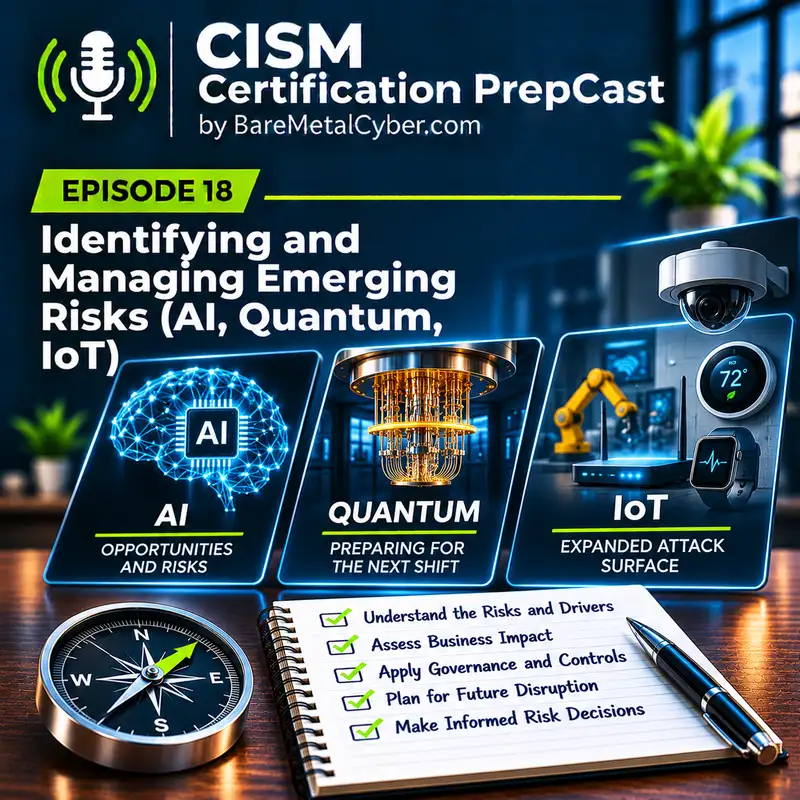
Identifying and Managing Emerging Risks (AI, Quantum, IoT)
In this episode, we are examining identifying and managing emerging risks involving artificial intelligence, quantum computing, and the Internet of Things. Emerging risk is uncertainty created or materially changed by new technology, business models, dependencies, threats, or regulation. The management challenge is to avoid two extremes: dismissing a risk because evidence is incomplete or exaggerating it because the technology receives attention. Leaders need a repeatable method for moving from trend to accountable decision.
Artificial intelligence can introduce risk through data, models, prompts, outputs, integrations, automated decisions, and third-party services. Concerns may include sensitive information exposure, inaccurate output, manipulation, bias, lack of traceability, excessive permissions, and overreliance on a model. The appropriate response depends on the use case and consequence rather than on a universal claim that artificial intelligence is safe or dangerous.
A fictional human resources team wants to use a generative service to summarize employee cases. The risk assessment should identify the information involved, provider terms, retention, access, output use, human review, legal requirements, and failure consequences. A low-impact drafting assistant and an automated employment decision do not present the same risk. Governance should classify use cases and assign approval accordingly.
Attackers can also use artificial intelligence to increase scale, personalization, analysis, or automation. The security manager should translate that possibility into plausible scenarios, such as more convincing social engineering or faster reconnaissance, then examine whether existing controls and training remain effective. Buying an artificial-intelligence-branded defense product is not a complete strategy.
Quantum computing creates long-term cryptographic risk because sufficiently capable systems could threaten widely used public-key methods. The immediate management issue is often cryptographic inventory, data lifetime, dependency awareness, and migration planning. Information that must remain confidential for many years may face harvest-now, decrypt-later exposure even before a large-scale cryptographically relevant quantum computer exists.
NIST finalized three principal post-quantum cryptography standards in August two thousand twenty-four: FIPS two hundred three for a module-lattice-based key-encapsulation mechanism, FIPS two hundred four for a module-lattice-based digital signature algorithm, and FIPS two hundred five for a stateless hash-based digital signature algorithm. The existence of standards does not make migration simple. Organizations still need inventory, interoperability testing, vendor coordination, performance analysis, key and certificate changes, and transition governance.
A fictional bank might discover that cryptographic algorithms are embedded in applications, network devices, supplier services, archived data, and customer integrations. Replacing one library would not complete the transition. The program needs crypto-agility, ownership, prioritization based on data lifetime and system criticality, and a roadmap that accounts for dependencies and testing.
The Internet of Things expands the attack surface through large numbers of connected devices, diverse vendors, limited interfaces, long lifecycles, and physical consequences. Devices may have weak authentication, difficult patching, incomplete inventory, or limited logging. The risk is not only that a device is compromised. It may provide a path to other systems or alter a physical process.
A fictional distribution center installs connected sensors and building controls. The security manager should examine ownership, network segmentation, update capability, default credentials, supplier access, monitoring, data flows, failure modes, replacement, and emergency operation. A device that seems low value may become important because it shares trust or connectivity with critical systems.
Emerging technology often enters through suppliers and business experimentation before the security program has visibility. Procurement, architecture, change management, data governance, and product development should therefore include early risk checkpoints. The objective is not to block innovation. It is to create an accountable path from proposal to pilot, approval, operation, monitoring, and exit.
Traditional assessment methods can still be used, but inputs may be uncertain. Qualitative analysis, scenario ranges, expert judgment, and staged experimentation can support decisions when historical frequency data is weak. The assessment should state uncertainty explicitly and define what evidence would cause the decision to change. False precision is especially dangerous when the technology and threat environment are evolving.
Compensating controls may be needed while standards, tools, or architectures mature. These can include isolation, limited scope, stronger monitoring, human approval, data minimization, restricted permissions, rollback, contractual controls, and time-limited pilots. Compensating controls should have owners, evidence, and review. Temporary safeguards should not become permanent substitutes without reassessment.
Risk appetite should address innovation. Leaders need to define which consequences are unacceptable, which experiments can proceed under limits, and which decisions require higher authorization. A small internal prototype may be approved at a lower level than a system that affects customers, safety, regulated data, or critical operations. Decision thresholds make innovation faster because teams know the path.
Training should be role-based. Executives need to understand strategic exposure and decision rights. Developers and architects need secure design and testing practices. Procurement needs supplier questions. Users need rules for data and output handling. Incident responders need scenarios involving model misuse, connected devices, or cryptographic dependencies. Generic awareness cannot replace targeted capability.
Monitoring should track adoption, exceptions, incidents, supplier changes, control performance, and external developments. An emerging-risk register should not become a list of speculative technologies. Each entry should connect to a business use, plausible scenario, owner, decision, and next review. The organization can then distinguish a watched trend from an active material exposure.
For CISM questions, look for the management action that creates visibility, ownership, proportionate control, and continuing review. The best answer is rarely to ban every new technology or deploy it without governance. It is to connect innovation to enterprise objectives and risk through an authorized, evidence-based process.
The same relevance filter applies across artificial intelligence, quantum computing, and connected devices. A global development becomes an organizational risk only through a plausible relationship to objectives, assets, dependencies, and control gaps.
Artificial intelligence risk should be separated into use risk, model risk, data risk, integration risk, and provider risk. A low-impact writing assistant does not create the same exposure as a system that recommends credit decisions, changes production configurations, or processes sensitive employee information. Classification helps the organization apply proportionate governance. The manager should understand what the system can influence, what information it receives, and what human authority remains in the decision.
Data governance is central because models and services may ingest information that was never approved for that use. Training data, retrieval sources, prompts, outputs, logs, and feedback can contain confidential, personal, regulated, or licensed material. The organization should define approved data classes, retention, access, geographic processing, reuse restrictions, and deletion expectations. A user notice alone is not sufficient when technical integrations can send data automatically.
Model and output risk require evaluation of accuracy, bias, explainability, manipulation, and inappropriate reliance. Controls may include test sets, human review, confidence thresholds, prohibited use cases, independent validation, monitoring, and the ability to override or stop the system. The required evidence depends on consequence. A recommendation used for brainstorming needs less assurance than an automated action affecting safety, employment, access, or financial outcomes.
Artificial intelligence can also change the threat environment. Attackers may create more persuasive messages, analyze exposed information, automate reconnaissance, or adapt malicious content. The management response is not to assume that every attack becomes entirely new. Strengthen the control paths that the technology can amplify, including identity, transaction verification, privileged access, user reporting, detection, and incident response. Scenario-based planning is more useful than broad claims about artificial intelligence danger.
A governed pilot can reduce uncertainty before enterprise adoption. Define the business objective, approved users, data boundaries, provider settings, integration limits, human review, success measures, incident process, duration, and exit criteria. The pilot should generate evidence that informs a decision. A pilot without monitoring or a defined end can become unapproved production by gradual expansion.
Provider due diligence for artificial intelligence should examine data handling, model changes, subprocessors, access, security testing, availability, incident notification, intellectual property terms, audit evidence, and exit. Because services evolve rapidly, one assessment at procurement may become stale. Contracts and monitoring should address material changes. The organization also needs a plan for exporting data, disabling integrations, and maintaining operations if the provider changes terms or fails.
Quantum risk begins with data and cryptographic dependency, not with a prediction of the exact date a powerful quantum computer will arrive. Identify information requiring long-term confidentiality, systems using vulnerable public-key cryptography, certificate and key dependencies, embedded devices, supplier services, and protocols that are difficult to change. This inventory supports prioritization. Data that loses value quickly may require a different response from secrets that must remain protected for decades.
Crypto-agility is the ability to discover, replace, test, and govern cryptographic mechanisms without redesigning every business process. It depends on inventory, abstraction, configuration control, vendor support, interoperability, and lifecycle planning. An organization that cannot identify where algorithms are used will struggle to migrate even after standards and products are available. Crypto-agility should therefore be treated as a program capability rather than a one-time replacement project.
Post-quantum migration requires sequencing. Leaders may prioritize externally exposed services, high-value identities, code signing, key exchange, long-lived sensitive data, and systems with long replacement cycles. Testing should address performance, compatibility, certificate size, protocols, hardware constraints, rollback, and supplier readiness. Hybrid approaches may appear during transition, but they still require architecture review and evidence. The manager coordinates the roadmap and avoids declaring completion based on one updated application.
Harvest-now-decrypt-later risk changes the time horizon. An adversary can collect encrypted information today and attempt decryption later. The scenario is most relevant when information remains valuable for a long period. Security leaders should work with data owners to identify those assets and determine whether existing protection and migration timing are sufficient. The response should be risk-based, not a universal emergency applied to every encrypted record.
Connected devices create governance problems because ownership is often distributed. Facilities, operations, manufacturing, clinical, logistics, and product teams may purchase devices outside normal information-technology processes. The security program needs discovery, procurement requirements, network architecture, authentication, update expectations, logging, supplier support, and retirement controls. Treating the issue only as endpoint management can miss physical processes and business ownership.
Device lifecycle is critical. Some connected systems operate for many years, have limited update mechanisms, or depend on vendors that may discontinue support. Procurement should consider secure configuration, unique credentials, update integrity, vulnerability disclosure, component transparency, support duration, data flows, and disposal. A low purchase price can create long-term exposure and operational cost when the device cannot be maintained or isolated.
Segmentation and trust boundaries reduce the impact of device compromise. Devices should receive only the connectivity required for their function, and administrative paths should be controlled and observable. Where strong device authentication or patching is unavailable, compensating controls may include network isolation, gateways, allow lists, monitoring, physical safeguards, and restricted management. The design should account for maintenance vendors and emergency operations.
Cyber-physical consequences require collaboration beyond the security team. An action that isolates a device may disrupt production, building safety, patient care, or environmental controls. Incident plans should define who can authorize containment, what safe states exist, and how operations will be maintained. Exercises should include operators, engineers, safety, suppliers, and leadership. Technical containment that creates greater physical harm is not a successful response.
Emerging-risk assessment should explicitly record uncertainty. Separate confirmed facts, reasonable inferences, assumptions, and unknowns. Identify what evidence could reduce important uncertainty and whether the decision can wait. Some unknowns justify a limited pilot or additional monitoring. Others, especially where potential harm is irreversible or outside tolerance, justify delaying or redesigning the initiative until confidence improves.
Scenario analysis is useful when historical data is limited. Describe a plausible trigger, affected asset or process, control condition, business consequence, and response. Compare several scenarios rather than relying on one dramatic outcome. Include ordinary failure and misuse as well as sophisticated attack. This creates a more balanced view of likelihood and helps leaders understand which controls provide value across multiple futures.
Risk appetite should include conditions for experimentation. Leadership can define prohibited consequences, data restrictions, approval thresholds, maximum pilot scope, required human oversight, and escalation triggers. These boundaries enable innovation because teams know what can proceed without repeated negotiation. An unbounded invitation to innovate shifts risk into operations, while a blanket prohibition drives experimentation into shadow use.
The emerging-risk register should connect to architecture and program roadmaps. A concern about artificial intelligence may require data governance and identity improvements. Quantum planning may require certificate management and supplier coordination. Connected-device risk may require network modernization and procurement controls. Linking the risk to shared capabilities avoids isolated projects and helps leadership fund improvements that reduce several exposures at once.
Emerging-risk communication should be calm and specific. Leaders need scenarios, uncertainty, time horizon, options, and decision triggers rather than hype or false certainty.
Credible communication about emerging risk is not a performance of urgency; it is a disciplined translation from uncertainty into decisions. Executives do not need a feed of threats, and technical teams do not need vague warnings that "something is coming." What both groups need is clarity on what could plausibly happen here, what the consequences would be, and what you are asking them to do next. The exam expects you to communicate in a way that earns trust, protects organizational focus, and supports governance without turning every week into a crisis meeting.
The most important credibility move is to separate what is known from what is suspected and then tie both to internal evidence. External reporting is useful, but it carries noise, hype, and incomplete detail, so you should frame it as "reported" when you cannot verify specifics. Your internal signals (asset inventories, vulnerability exposure, authentication logs, incident trends, and third-party dependency maps) are what turn a headline into an organizational risk statement. When you can say, "This is active in the wild, and we have systems in the affected category," you are no longer selling fear. You are presenting a defensible decision point grounded in your environment.
Precision matters because imprecise language reads as either panic or ignorance. Terms like "highly sophisticated" and "advanced" do not help a decision-maker choose between patching, compensating controls, and project reprioritization. Instead, describe the mechanism and the consequence in plain English: how access is gained, what is targeted, and what failure would look like for your business. If the signal is preliminary, state the uncertainty and describe what you are doing to reduce it, such as validating exposure or monitoring for indicators. The exam rewards this approach because it models sound risk governance rather than sensational escalation.
Effective communication also requires the right unit of measure, and the exam frequently tests whether you pick the appropriate framing. For executives, lead with business impact: downtime, data exposure, fraud, safety, contractual breach, or regulatory scrutiny. For technical leaders, lead with attack paths and control coverage: entry points, trust boundaries, identity escalation, and detection gaps. This is not two different truths; it is the same truth expressed in different decision languages. Credibility increases when your message respects what the audience needs to act, not what you find interesting to explain.
Another credibility cue is proportionality, because executives quickly learn which security leaders can prioritize. If everything is "critical," nothing is, and your future warnings will be discounted. Proportionality means explicitly comparing emerging risk to current commitments and clarifying what changes, if anything, about today's priorities. Sometimes the credible answer is, "No immediate action beyond monitoring and validation," and that restraint builds trust for the times you must request urgent action. The exam often frames options where the best answer is measured escalation rather than maximal reaction.
A strong emerging-risk message includes a clear decision request and a time bound, even when uncertainty remains. You might request approval to accelerate a patch cycle, temporarily restrict a risky service, tighten privileged access, or fund a detection improvement targeted to the suspected path. You might also request a specific validation activity: confirm inventory scope, run exposure checks, or coordinate with a vendor on mitigation guidance. Without a decision request, your update becomes informational noise that consumes attention without improving outcomes. The exam's "best answer" typically includes both the risk statement and the next governance step, such as updating risk registers or briefing the appropriate committee.
Credibility also depends on acknowledging operational constraints without surrendering to them. If patching is slow due to uptime requirements, you should articulate compensating controls and monitoring that reduce risk while remediation proceeds. If third-party dependencies increase exposure, you should describe how you will obtain assurance, validate controls, and adjust contractual expectations where appropriate. Leaders trust communicators who understand reality and still provide viable paths forward. The exam often nudges you toward solutions that balance security with business continuity rather than demanding idealized outcomes.
Finally, credible communication preserves accountability and avoids blame, especially during fast-moving events. Emerging risk discussions can become political if they are framed as "someone failed" instead of "the environment changed and we need a decision." Your role is to keep the conversation anchored in risk ownership, tolerance, and required action, not in retrospective fault-finding. When you consistently communicate emerging risk as a managed process (signal, validation, scenario, decision) you become a reliable interface between technical uncertainty and executive governance. That reliability is exactly what CISM-style leadership questions are designed to reward.
For practice, choose one fictional proposal involving artificial intelligence, quantum-sensitive data, or connected devices. Identify the business objective, new dependency, threat scenario, uncertainty, current controls, decision owner, pilot conditions, evidence, and exit trigger.
Emerging risk management is a cycle of horizon scanning, relevance assessment, governed experimentation, monitoring, and reassessment. The goal is responsible innovation that remains connected to accountability and resilience.
Emerging technologies should be evaluated through concrete threat scenarios rather than through labels. The following threat-modeling cues help leaders identify a plausible actor, path, affected objective, control condition, and decision.
Horizon scanning should use credible sources and defined ownership. Technology teams, legal, risk, procurement, architecture, and business innovation groups may observe different signals. A regular forum can determine which developments are relevant, what assumptions change, and whether an assessment or pilot is needed. The purpose is not to collect headlines. It is to identify developments early enough to preserve choices.
Decision records should capture why the organization proceeded, limited, delayed, or rejected an emerging technology. Include the objective, evidence, uncertainty, risk owner, conditions, monitoring, review date, and exit trigger. This creates accountability and allows later reassessment. When the environment changes, leaders can understand the original assumptions instead of reconstructing them from memory.
For examination questions, avoid answers that respond to novelty with panic or denial. The stronger management response usually creates visibility, ownership, controlled experimentation, proportionate safeguards, and recurring review. If credible active harm exists, act within authority to reduce it. If the issue is uncertain and strategic, gather the evidence needed for an informed decision without allowing an ungoverned deployment to become permanent.
Legal and ethical review should occur before high-consequence use, not after deployment. Privacy, discrimination, intellectual property, safety, records, and sector-specific obligations may affect design and permitted use. Legal teams interpret obligations, while security and architecture translate the approved interpretation into controls and evidence. The manager should ensure that review is connected to actual data flows and decisions rather than broad vendor assurances.
Training should match role and authority. General users need approved-use boundaries, data handling, verification, and reporting. Developers need secure integration, testing, secrets management, and monitoring. Risk owners need to understand consequence, uncertainty, and residual risk. Executives need decision thresholds and portfolio exposure. A single awareness module cannot prepare all of these groups for their different responsibilities.
Metrics should show whether the technology remains within approved conditions. Useful measures may include adoption outside approved scope, sensitive-data events, human-review overrides, model or provider changes, unsupported devices, crypto-inventory coverage, supplier readiness, and overdue remediation. Each measure should have a threshold and response. Monitoring without a decision path produces visibility but not governance.
Emerging risk should be reconsidered during incidents and near misses. A small failure may reveal an incorrect assumption, hidden dependency, or control weakness before a larger consequence occurs. Post-event review should update the risk scenario, architecture, pilot conditions, contracts, and roadmap. Organizations build foresight not by predicting every event but by learning quickly from evidence and preserving the ability to change direction.
Portfolio review helps leadership compare emerging risk with existing commitments. A new technology may deserve attention without displacing urgent remediation, resilience, or identity work. Present options with timing, dependencies, and opportunity cost so leaders can choose deliberately. This prevents novelty from consuming the program while still creating a path for responsible adoption.
The objective is not perfect prediction. It is decision readiness: knowing who watches, who evaluates, who can limit use, what evidence matters, and when assumptions must be revisited. That structure lets the organization move before uncertainty becomes unmanaged exposure.
A useful review date is tied to an event as well as a calendar. A new standard, provider change, pilot result, incident, or major architecture decision may trigger reassessment. Event-driven review prevents an emerging-risk decision from remaining unchanged while the technology and business use evolve.
Emerging risk management is strongest when leaders define what would cause the organization to accelerate, restrict, pause, or abandon an initiative before the pressure of adoption removes those choices. Those decision triggers convert uncertain technology concerns into governed actions that can be monitored, challenged, and revised as evidence improves.