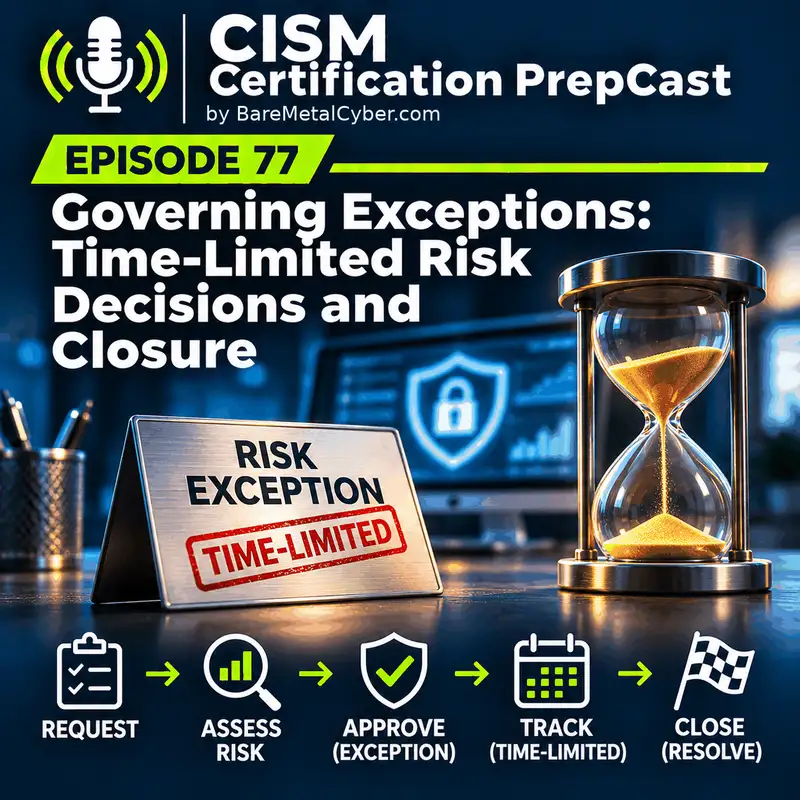
Governing Exceptions: Time-Limited Risk Decisions and Closure
In this episode, we are governing a time-limited exception from request through approval, monitoring, expiration, renewal, or verified closure. The objective is to connect the topic to business impact, decision authority, operating responsibility, and evidence rather than treating it as a slogan or isolated technical task.
Consider Eastbridge Manufacturing, a fictional teaching organization. It has a legacy application that cannot meet a new access requirement before an important product release. The business requests an exception and proposes extra monitoring, restricted network access, and a fixed retirement plan. The architect can recommend the design, but only the authorized risk owner can accept the remaining exposure. The organization must prevent a temporary decision from becoming permanent by neglect. This scenario is not an official examination question. It gives us a practical setting in which to examine the management choices and the reasons behind them.
The first task is to confirm the obligation and what discretion is actually permitted. The manager must then identify the risk owner and delegated acceptance threshold. Next, the responsible teams should compare alternatives and compensating safeguards. Before the decision is closed, the organization must document scope, conditions, evidence, monitoring, and expiration. Finally, it should close, renew, or escalate using current evidence before the exception lapses. These actions may occur in parallel when authority and urgency permit, but none should disappear from the management record.
To deepen the lesson on governing exceptions: time-limited risk decisions and closure, begin with the management principle behind the decision. An exception is a time-bounded authorization to deviate from a defined requirement, and it must be anchored to a specific policy or standard statement. If the request cannot cite the exact requirement being waived, it is not an exception; it is confusion about expectations. A proper request describes business justification, scope, duration, and the precise control gap that will exist during the exception period. That specificity matters because governance decisions must be traceable, comparable, and defensible under scrutiny.
The next part of the analysis concerns the evidence and accountability behind the decision. A useful mental model is that exceptions move risk, they do not eliminate it, so the organization must decide where the risk is allowed to land. If a system cannot meet a standard for encryption at rest, the exception is a decision to accept increased confidentiality risk, or to implement a compensating control that changes the risk profile. Compensating controls should be described in terms of outcomes, not hopes, and they should be measurable enough to assess whether they actually reduce exposure. The governance instrument is the risk register or risk acceptance record, not the email thread where someone said “fine.”
Viewed through this episode’s purpose, the practical implication is important. Authority and accountability are where exception programs either work or quietly rot. The approval authority should align with risk ownership, meaning the person who owns the business outcome also owns the risk that comes with the exception. Security can recommend, constrain, and document, but security should not be the sole authority to accept business risk on behalf of the enterprise. When exception approval is pushed downward to convenience roles, exceptions become the default path of least resistance. When approval is pushed upward without structure, leaders approve blindly and governance becomes ceremonial.
A manager should connect this point to ownership, operating reality, and the business consequence. Time bounds are not administrative details; they are the control that prevents exceptions from becoming permanent shadow standards. An exception should have an expiration date, a remediation plan, and a review trigger that forces an explicit decision to renew, close, or escalate. If exceptions can be renewed indefinitely with no evidence of progress, the organization has effectively rewritten the standard without governance. Good programs treat renewal as a higher bar than initial approval, because continued deviation implies either chronic underinvestment or an unrealistic requirement. The best-answer logic is to require periodic reassessment and evidence-driven renewal decisions.
This distinction becomes especially useful when several plausible actions compete for attention. Evidence is the difference between controlled deviation and unmanaged drift. The organization should retain documentation of the exception request, approval, compensating controls, testing results if applicable, and the decision rationale in a system of record. This documentation is not busywork; it is how governance proves that deviations were knowingly managed rather than ignored. During an audit or post-incident review, exceptions are examined as signals of control weakness and governance maturity. A clean exception trail can demonstrate responsible management even when the underlying control gap is real.
The governance question is not whether the idea sounds secure, but whether it is authorized, workable, and verifiable. Exceptions also need aggregation and trend oversight because individual approvals can look reasonable while the combined effect undermines the program. If many teams request the same exception, the issue is likely the standard’s feasibility, the organization’s resourcing, or an architectural constraint that governance must address. Trend review helps leadership decide whether to invest in remediation, adjust timelines, or revise standards to match operational reality without diluting risk intent. Governance should watch for clusters around critical controls, such as identity, logging, vulnerability remediation, and segmentation, because those clusters often correlate with incident pathways. In exam framing, recurring exceptions are a governance signal, not an operational footnote.
The operational consequence also matters because a plan that cannot be sustained will not manage risk for long. A typical scenario is a merger integration where the acquired company’s identity platform cannot immediately meet the parent organization’s multi-factor authentication standard for privileged access. The business demands rapid integration, the security team demands enforcement, and operations warns that enforcing immediately will break access for administrators supporting revenue-critical systems. A controlled exception would specify which privileged accounts are in scope, what compensating controls will be applied (such as stricter monitoring, jump host use, or limited network paths), and the exact date by which the identity control will be brought into compliance. The “best answer” is the one that documents risk ownership, applies measurable compensating controls, and forces a revisit, rather than the one that simply delays compliance with no structure.
Use this point to challenge assumptions and to identify what must be demonstrated before the next decision. Differentiate policy, standards, procedures, and guidelines until you can classify them on sight. Take five existing security artifacts you have access to and label each as policy, standard, procedure, or guideline based on what it actually does, not what it is called. Rewrite one confusing artifact by separating executive intent (policy), measurable requirements (standards), step-by-step execution (procedures), and optional guardrails (guidelines). Use this exercise to train your exam instincts: when a question asks for executive mandate, choose policy; when it asks for testable requirements, choose standards.
The exam lens here is to separate the activity from the outcome that leadership actually needs. Anchor every exception to a specific requirement and a time-bound risk decision. Drill yourself on the mechanics: an exception must cite the exact policy or standard statement being waived, define scope, name a business justification, and include an expiration date. In a practice scenario, identify who should approve the exception by aligning approval authority with risk ownership, not convenience. In your work, take one recurring “temporary” deviation and convert it into a documented, time-bounded exception with a remediation plan and a clear owner.
A defensible approach keeps the scope, owner, evidence, and remaining uncertainty visible. Reject vanity metrics by forcing every metric to answer a decision-grade question. For each metric you see in a scenario, ask what decision it supports (prioritization, escalation, resourcing, or accountability) and discard metrics that only show activity volume. Train yourself to separate effort, coverage, quality, and outcome measures and to recognize when the exam is prompting for the most governance-relevant option. In your environment, pick one dashboard metric and refine it by adding scope clarity and risk weighting so it highlights critical services and material exposure instead of raw counts.
Apply this principle directly to the management decision in this episode. Transfer is the option most frequently misunderstood because it is easy to overstate what it accomplishes. Transferring risk is typically about shifting financial impact or certain operational burdens, such as through insurance, warranties, or contractual indemnification, but the organization rarely transfers the mission impact, reputational harm, or regulatory responsibility. If a third party fails, the organization still experiences downtime, customer harm, and scrutiny, even if some costs are reimbursed. Exam questions often reward answers that acknowledge this nuance by treating transfer as a complement to treatment rather than a substitute for it. If the scenario involves legally protected data, critical services, or executive-level reputational stakes, transfer alone is almost never the best answer.
The next part of the analysis concerns the evidence and accountability behind the decision. Risk acceptance is a formal management decision to tolerate residual risk, and its credibility depends on the quality of the documentation that supports it. In exam scenarios, acceptance is often the correct response when additional controls are disproportionate to the benefit, when constraints make treatment impractical, or when the exposure is already within tolerance. The documentation is what converts acceptance from an informal shrug into a governed choice that can be defended to leadership, auditors, and regulators. A common trap is to confuse acceptance with neglect, or to assume that stating “the business accepts the risk” is sufficient without specifying what risk, at what level, and for how long. The best answers treat acceptance as a controlled exception that is explicit, time-bound when appropriate, and owned by the correct risk owner.
Viewed through this episode’s purpose, the practical implication is important. A well-documented acceptance begins with a clear risk statement that names the asset or process, the threat scenario, the vulnerability or condition, and the business impact. It should also capture the assessment outcome in a way that makes the decision legible, including the likelihood and impact ratings used by the organization’s method and the resulting risk level. The key exam concept is residual risk, meaning the risk remaining after existing controls are considered, because acceptance is almost always about residual risk rather than inherent risk. If existing controls are unknown or not documented, acceptance is not defensible because the organization cannot demonstrate what it is actually accepting. Good documentation therefore connects the acceptance to the current control environment and makes it clear that the decision was made with informed context.
A manager should connect this point to ownership, operating reality, and the business consequence. Ownership and authority are central, because acceptance must be made by the party accountable for the business outcome, not by the security team acting alone. In exam logic, that usually means the system owner, process owner, or executive sponsor with the authority to accept the consequences if the risk materializes. The security function’s role is to advise, articulate tradeoffs, and ensure the decision is recorded properly, but not to absorb the business’s exposure by default. Documentation should name the risk owner, the approver, and any consulted stakeholders, especially when the risk spans multiple functions. If the scenario involves material impact, regulated data, or enterprise-wide exposure, the best answer tends to involve higher-level approval and governance committee visibility.
This distinction becomes especially useful when several plausible actions compete for attention. Exceptions are closely related to acceptance, but they are best treated as controlled deviations from policy or standard that require specific justification and compensating measures. An exception should state which requirement is being deviated from, why the deviation is necessary, and what alternative measures will be used to reduce exposure during the exception period. The exam trap is to treat an exception as a permanent waiver, which undermines governance and allows risk creep to become normal operations. A credible exception includes boundaries, such as limiting scope to a particular system, environment, or time window, rather than allowing the deviation to spread. Even when the organization chooses to tolerate the residual risk, exception documentation should show that the deviation was evaluated and that any feasible mitigations were considered.
The governance question is not whether the idea sounds secure, but whether it is authorized, workable, and verifiable. Time horizons and review cycles make acceptance and exceptions operational rather than purely administrative. If the decision is based on temporary constraints, such as a pending system replacement or an incomplete project, the documentation should include an expiration date or a reauthorization requirement. If the risk is accepted because it is within tolerance, a periodic review is still appropriate to ensure conditions have not changed, such as new threats, new dependencies, or changes in business criticality. For exam purposes, including a revalidation or review requirement signals disciplined governance and aligns with the idea that risk is dynamic. A decision that is never revisited is likely to drift outside tolerance without anyone noticing.
The operational consequence also matters because a plan that cannot be sustained will not manage risk for long. Compensating controls are not always required for acceptance, but they are frequently relevant for exceptions, particularly when the deviation weakens a key safeguard. A compensating control is not a perfect substitute; it is a practical alternative that reduces risk in a different way, often through monitoring, restriction, or procedural checks. The exam emphasizes that compensating controls should be tied to the specific weakness created by the exception, not generic security improvements. For example, if an exception allows delayed patching due to operational constraints, compensating measures might focus on reducing exposure through access restrictions and heightened monitoring rather than unrelated controls. Documentation should connect the compensating measures to the risk statement so the decision remains coherent.
Use this point to challenge assumptions and to identify what must be demonstrated before the next decision. Good acceptance documentation also captures the rationale in business terms, because risk response is ultimately about objectives and tradeoffs. This does not mean vague statements like “cost is too high,” but rather a reasoned explanation such as resource limits, competing priorities, or risk reduction options that are not proportionate to the impact reduction achieved. The rationale should acknowledge alternatives that were considered, including treatment and termination options, and why they were not selected under current constraints. In exam questions, the best answer often includes evidence of this evaluation process because it demonstrates that acceptance is informed, not accidental. This is also where you would note dependencies, such as vendor limitations or architectural constraints, that explain why full compliance is not feasible yet.
The exam lens here is to separate the activity from the outcome that leadership actually needs. The same logic applies when the security function is tempted to “own” risks simply because it tracks them. Security often facilitates risk identification, maintains the risk register, provides analysis, and ensures consistency in risk scoring, but facilitation is not ownership. If security is both scoring the risk and approving acceptance, the independence of the decision collapses, and reporting becomes less credible to executives and auditors. A better model is for security to provide decision-quality information and to challenge assumptions, while the business risk owner makes the acceptance choice and the control owners execute the response. When you see answers that describe security as “accountable for business risk,” treat them skeptically unless the scenario explicitly assigns business authority and consequence to security leadership.
A defensible approach keeps the scope, owner, evidence, and remaining uncertainty visible. If you want a quick exam filter, look for the verb in the question and assign it to the right owner. “Accept residual risk” points toward the authorized risk owner. For verbs such as “approve,” “prioritize” and “decide,” identify the subject of the decision and the authority assigned in the governance model. Verbs like “implement,” “operate,” “monitor,” and “remediate” point toward the control owner, because they require hands-on responsibility for performance and evidence. When a question includes both decision and execution activities, the best answer usually separates roles and describes the escalation path between them. That separation is not bureaucracy for its own sake; it is the mechanism that prevents risk from being treated as a technical ticket instead of a business decision.
Apply this principle directly to the management decision in this episode. Indicators are only useful when they reduce uncertainty for the next decision, and the most common exam trap is treating all metrics as if they serve the same purpose. A Key Performance Indicator (KPI) measures how well a process or capability is performing against a target, typically in terms of efficiency, quality, or throughput. A Key Risk Indicator (KRI) measures changes in exposure, signaling that the likelihood or impact of a risk event is increasing or decreasing. KPI's are about “Are we doing what we planned well,” while KRI's are about “Is the environment shifting in a way that makes failure more likely or more costly.” When an organization mistakes performance health for risk health, it can report green dashboards right up to the moment an incident turns those dashboards into historical artifacts.
The next part of the analysis concerns the evidence and accountability behind the decision. Another key function of recurring cycles is preventing control decay through routine validation rather than reactive discovery. Controls that were effective at deployment can degrade as configurations change, staff rotates, tooling evolves, and shortcuts become normalized. Recurring validation (through testing results, review attestations, and monitoring evidence) keeps the organization from assuming that “implemented” means “effective.” When validation fails, the cycle should treat it as a governance event, not merely as a technical defect, because it changes the organization’s risk posture. In exam scenarios, the presence of recurring validation and evidence review is a strong signal of mature governance practices.
Viewed through this episode’s purpose, the practical implication is important. Recurring cycles also support audit and assurance needs by creating traceability that is both timely and defensible. Decisions should be recorded with the risk statement, the evidence considered, the rationale, the owner, and the expiration date or next review date for any acceptance or exception. That “review-by” requirement is critical, because it forces temporary choices to remain temporary and prevents acceptance from becoming permanent by neglect. Evidence should be proportional and consistent, avoiding both extremes of “no proof” and “overcollection,” because governance that cannot be audited will not be trusted. The exam frequently frames this as demonstrating due care and maintaining a risk register that reflects current decisions and status.
A manager should connect this point to ownership, operating reality, and the business consequence. Finally, sustainable cycles require cultural reinforcement: people need to believe that the forum matters, that decisions will be enforced, and that escalations are safe. If control owners are punished for reporting weakness, they will report less, and governance will become fiction. If risk owners routinely ignore thresholds without documenting acceptance, the cycle becomes theater and control owners will disengage. The healthiest pattern is a predictable cadence with clear expectations, where bad news is treated as a prompt for decision and investment rather than as a personal failure. In exam reality, the “best answer” is usually the one that institutionalizes governance through recurring, evidence-driven reviews with accountable decisions and tracked follow-up, because that is how risk stays real over time.
This distinction becomes especially useful when several plausible actions compete for attention. Sustained risk governance depends on discipline more than documentation, and on decisions more than artifacts. Clear separation between who owns risk and who operates controls keeps accountability intact when tradeoffs become uncomfortable or expensive. Indicators, reports, and review cycles only add value when they are designed to surface changing exposure and force timely choices by the right leaders. When these elements operate together, risk remains a living input to management rather than a static record of past assessments. This approach ensures that oversight keeps pace with the business and that risk decisions remain intentional, reviewable, and aligned with organizational objectives.
The governance question is not whether the idea sounds secure, but whether it is authorized, workable, and verifiable. Separate risk decisions from control execution in your governance language and artifacts. Practice rewriting a few risk statements so they clearly identify a business risk owner accountable for acceptance and distinct control owners accountable for implementation and operation. In your day-to-day work, ensure approval workflows reflect this split so residual risk acceptance does not silently migrate into technical teams. For exam prep, connect “accept residual risk” to the authorized risk owner. For other approvals, identify what is being approved and whose charter or delegated authority covers that decision.
The operational consequence also matters because a plan that cannot be sustained will not manage risk for long. Choose KRI's to inform risk decisions and KPI's to assess performance against objectives. Take an operational area such as vulnerability management or incident response and define one of each. Explain what decision the indicator supports and whether it provides a leading signal, lagging evidence, or both in the chosen context. For an early-warning KRI, verify that it can change before the relevant loss event. For any KRI, connect it to a specific risk statement and response threshold. For exam practice, justify the indicator by its purpose rather than by how easy it is to measure.
Use this point to challenge assumptions and to identify what must be demonstrated before the next decision. Maintenance discipline is what prevents procedures from becoming historical artifacts. A disciplined procedure lifecycle includes routine review, clear versioning, and a trigger-based update model when upstream dependencies change, such as tooling migrations, organizational restructures, or new regulatory obligations. Procedures should be written so that the steps reflect reality as it is performed today, not as it was imagined during a policy rollout. When procedures are not maintained, people stop trusting them, and once trust is gone, the procedure becomes optional in practice regardless of what governance says.
The exam lens here is to separate the activity from the outcome that leadership actually needs. An exam-style scenario illustrates how ownership failures become security failures: a privileged access provisioning procedure exists, but it was written years ago by a security analyst who left the company. Identity management has since changed, and teams now grant access using a different workflow, yet the old procedure remains the “documented” one. An access review finds that approvals are inconsistent and evidence is incomplete, because the procedure does not match reality and no one feels authorized to fix it. The best answer is to assign procedure ownership to the process owner and establish maintenance discipline, rather than rewriting policy language or adding more approvals.
A defensible approach keeps the scope, owner, evidence, and remaining uncertainty visible. Procedures must also be maintainable, which means they should avoid hard-coding details that change frequently unless the organization can keep up. A good procedure may reference controlled artifacts, such as configuration baselines, approved tool lists, or templates that can be updated independently. This reduces the frequency of procedure rewrites while still keeping execution accurate. The measure of quality is whether a new team member can follow the procedure successfully without needing a private briefing from the one person who “really knows how it works.”
Apply this principle directly to the management decision in this episode. A controlled waiver process ensures the right decision-maker owns the risk, not the person experiencing the inconvenience. If the control owner approves their own noncompliance, the process is structurally biased toward “yes,” because the same party bears the operational friction and controls the approval. Effective governance separates request, analysis, and approval so that the risk owner can make an informed decision with input from security and operations. The core exam logic is that risk acceptance belongs to management, and the waiver mechanism is how that principle shows up in day-to-day operations.
The next part of the analysis concerns the evidence and accountability behind the decision. The most important design feature of waivers is time-boundedness with explicit expiration. A waiver without an end date is not a waiver; it is a permanent policy rewrite done in the shadows. Expiration creates a forcing function to remediate, replace, or formally adjust the baseline if the requirement is no longer appropriate. Time-boundedness also allows governance to tolerate practical constraints without becoming cynical, because the exception is treated as a temporary risk posture, not a new normal.
Viewed through this episode’s purpose, the practical implication is important. An exam-style scenario shows how governance collapses when exceptions are unmanaged: a revenue-critical application cannot meet a logging retention standard due to storage constraints, so the team requests “temporary relief.” The request is approved informally via email, no compensating control is defined, and the waiver is never revisited because the system keeps generating revenue. Months later, an incident investigation fails to reconstruct actions because the relevant logs were overwritten, and leadership is surprised because they believed the standard was in place. The best answer is not simply “increase retention” but to implement a formal waiver process with a risk owner decision, compensating controls, and an expiration date.
A manager should connect this point to ownership, operating reality, and the business consequence. A mature waiver process requires structured justification that is specific enough to be reviewed and challenged. The request should identify the exact requirement being waived, the scope of affected systems, and the operational constraint preventing compliance. It should include a risk statement describing what could happen because of the deviation, not just why the team dislikes the requirement. It should also specify compensating controls or interim safeguards, along with a remediation plan that explains how compliance will be achieved or how the baseline will be updated through governance.
This distinction becomes especially useful when several plausible actions compete for attention. Waivers must be measurable and auditable, because undocumented exceptions create invisible risk. Governance collapses when waiver tracking is scattered across inboxes, when evidence of approvals cannot be produced, or when nobody can report how many waivers exist and which ones are overdue. The organization should be able to answer basic questions without improvisation, such as which standards generate the most waivers, which business units rely on exceptions, and which waivers are approaching expiration. This is not bureaucracy for its own sake; it is basic risk visibility and control integrity.
The governance question is not whether the idea sounds secure, but whether it is authorized, workable, and verifiable. Exception handling should also include escalation paths and consequences that are predictable, not punitive. If the waiver is denied, there should be a clear route for reconsideration based on new information, alternative compensating controls, or revised scope. If a waiver expires without remediation, the organization should have a defined response, such as forcing a risk acceptance renewal at a higher authority level, restricting exposure, or prioritizing remediation funding. Governance collapses when expired waivers are silently extended by default or when teams learn that deadlines do not matter.
The operational consequence also matters because a plan that cannot be sustained will not manage risk for long. Finally, the waiver process should produce learning, not just paperwork. If the same requirement generates frequent waivers, the organization may have a standards problem, a tooling problem, or a capability gap that needs investment. Repeated waivers can indicate that the baseline is misaligned with the operating environment or that implementation support is insufficient for teams to comply. When governance uses exception trends to improve standards, align procedures, and fund control enablement, waivers become a mechanism for resilience rather than an escape hatch that slowly erodes the entire control program.
Return to the fictional Eastbridge Manufacturing scenario. A valid exception is a governed risk decision with a defined boundary, owner, conditions, expiration, monitoring, and closure evidence. A label or technical sign-off is not enough. The strongest management response makes the underlying choice visible, names the accountable owner, and states how the result will be verified. It also preserves the distinction between an authorized technical action and the governance decision that gives that action direction, limits, and follow-through.
For practice, prepare an exception record for Eastbridge. Include the unmet requirement, business reason, alternatives considered, compensating safeguards, residual risk, approving authority, start and expiration conditions, monitoring indicator, renewal criteria, and evidence required to close the exception. Then challenge your own answer by identifying one plausible alternative that appears reasonable but fails because of authority, timing, scope, evidence, or business impact. This exercise develops the habit of explaining not only what should happen, but why that action is the best management decision under the stated conditions.