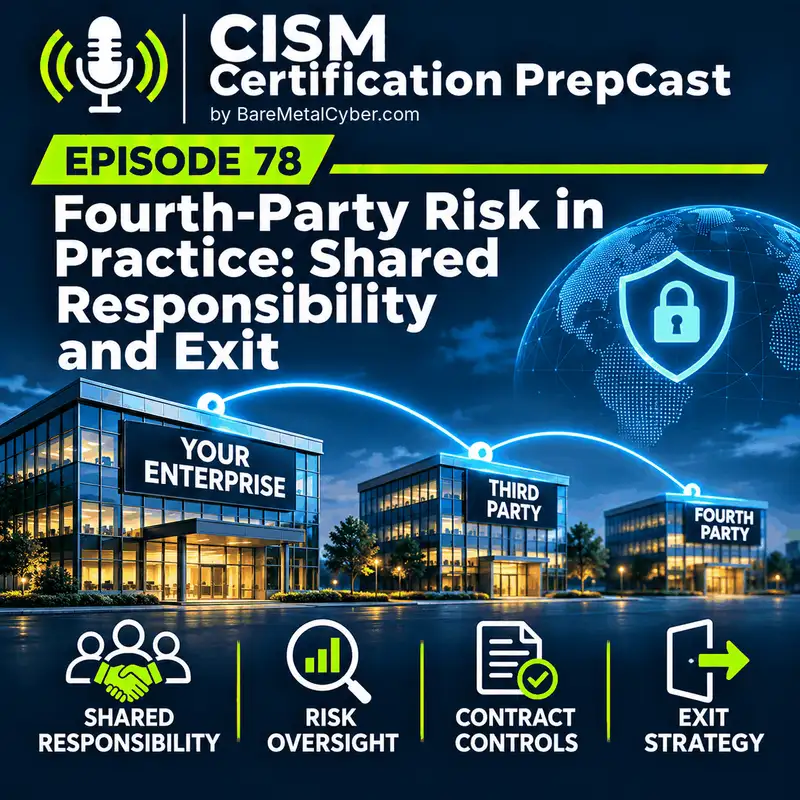
Fourth-Party Risk in Practice: Shared Responsibility and Exit
In this episode, we are managing fourth-party risk by following a service beyond the directly contracted supplier through shared responsibility, assurance, continuity, and exit. The objective is to connect the topic to business impact, decision authority, operating responsibility, and evidence rather than treating it as a slogan or isolated technical task.
Consider Crescent Travel Services, a fictional teaching organization. It buys a reservation service from a primary provider. That provider relies on a downstream hosting platform, an identity service, and a specialized support contractor. The company has no direct contract with those fourth parties, but their failures could interrupt reservations or expose customer information. The security manager must understand responsibilities, evidence access, incident cooperation, continuity, and orderly exit. This scenario is not an official examination question. It gives us a practical setting in which to examine the management choices and the reasons behind them.
The first task is to map material downstream dependencies and business impact. The manager must then assign shared responsibilities without claiming control the organization does not have. Next, the responsible teams should evaluate assurance evidence within its scope and limitations. Before the decision is closed, the organization must define service changes and incidents that trigger reassessment. Finally, it should plan data return, access removal, retained copies, continuity, and exit verification. These actions may occur in parallel when authority and urgency permit, but none should disappear from the management record.
To deepen the lesson on fourth-party risk in practice: shared responsibility and exit, begin with the management principle behind the decision. A practical risk lens starts with dependency mapping: what business outcomes rely on the third party, and what would break if the provider failed or behaved unexpectedly. This includes obvious dependencies such as critical SaaS platforms, cloud infrastructure, and managed security services, but also less visible ones such as niche data feeds, integration middleware, and outsourced development pipelines. The risk conversation should be framed in business terms like revenue interruption, regulatory exposure, safety impact, reputational damage, and strategic disruption. That framing prevents a common governance failure where vendor reviews focus on technical artifacts while ignoring business criticality. In certification logic, risk decisions are stronger when tied to enterprise objectives and impact tolerance, not to a vendor’s marketing claims.
The next part of the analysis concerns the evidence and accountability behind the decision. Third-party risk also differs because the organization has limited visibility and limited control over how safeguards are implemented. You can require certain outcomes, request assurance evidence, and define contractual obligations, but you typically cannot redesign the provider’s environment to meet your preferences. That constraint makes assurance and monitoring central controls, not optional extras. Assurance is the mechanism for establishing confidence at a point in time, while monitoring is the mechanism for detecting drift, degradation, or new exposure over time. A mature program acknowledges that vendors change: they acquire companies, shift data centers, alter subprocessors, introduce new features, and occasionally suffer incidents. The “extension of enterprise risk” concept is operationalized by treating those changes as risk events that require governance attention.
Viewed through this episode’s purpose, the practical implication is important. A common exam-style scenario is a business unit rapidly adopting a new SaaS tool to accelerate delivery, with a contract signed before security has defined data handling requirements. After rollout, the organization discovers the tool lacks sufficient audit logging, uses weak administrative controls, and stores sensitive data in an unacceptable jurisdiction. The security team is then asked to “fix it” without breaking the business process, which often means expensive compensating controls or disruptive migration. The lesson is that third-party risk control points must happen before commitment, when leverage exists. On the exam, preventative governance (requirements, due diligence, and risk-based approval authority) beats reactive remediation in most “best answer” situations.
A manager should connect this point to ownership, operating reality, and the business consequence. Third-party risk management is strongest when it is tiered, because not every vendor warrants the same depth of assessment. Tiering should be based on potential impact and exposure, such as the sensitivity of data handled, the criticality of the service, the level of privileged access granted, and the degree of integration into core processes. A marketing email platform and a cloud identity provider do not belong in the same treatment category, even if both are “SaaS.” Tiering drives proportional controls, including what evidence is required, how often reassessments occur, and what monitoring expectations apply. This approach aligns with governance principles because it reserves intensive review for high-impact relationships and avoids wasting effort on low-risk suppliers.
This distinction becomes especially useful when several plausible actions compete for attention. Vendor assurance should be treated as evidence for risk decisions rather than a hunt for perfect security. Evidence might include independent audit reports, security testing summaries, incident response commitments, and operational transparency about subprocessors and data flows. The risk manager’s job is to translate that evidence into a view of control coverage, control gaps, and the residual risk the enterprise must accept or mitigate. A vendor with strong controls can still represent unacceptable risk if the service model conflicts with enterprise requirements, such as data residency, segregation needs, or logging obligations. Conversely, a vendor with minor gaps may be acceptable if the business impact is low and compensating controls are feasible. The exam will often test whether you can weigh control evidence against business context rather than treating a missing artifact as an automatic rejection.
The governance question is not whether the idea sounds secure, but whether it is authorized, workable, and verifiable. Subcontractors and downstream providers are where third-party risk quietly becomes fourth-party risk, so contracts must address them explicitly. The agreement should require disclosure of material subcontractors involved in storing, processing, or accessing the organization’s data, and it should impose flow-down obligations so subcontractors are held to equivalent security requirements.
The operational consequence also matters because a plan that cannot be sustained will not manage risk for long. Notification expectations matter here as well, because an incident at a subcontractor can be just as damaging, and delayed disclosure can be worse than the incident itself. Without these clauses, the organization may discover too late that its data traveled through an unexpected chain of custody. In exam questions that mention subcontracting, the strongest answers usually emphasize flow-down controls and visibility into the supply chain.
Use this point to challenge assumptions and to identify what must be demonstrated before the next decision. Shared responsibility models exist because modern services rarely map cleanly to a single control owner, even when one party pays the invoice. In most arrangements, the provider owns some combination of facilities, core infrastructure, and platform operations, while the customer owns identity decisions, data classification, and how the service is configured and used. The security risk emerges in the seams: the provider may secure the “thing,” but the customer can still misconfigure the “way it’s used” into an incident. A security leader should treat shared responsibility as a control allocation problem, not a slogan, and should insist on documenting who does what for each meaningful control objective. The exam-friendly move is to identify the gap created by ambiguous ownership and close it with explicit accountability.
The exam lens here is to separate the activity from the outcome that leadership actually needs. Auditability is the practical test of whether shared responsibility is being managed or merely assumed. If the organization cannot obtain evidence that controls exist and operate, then any assurance is effectively faith-based, which is not a defensible risk position. Auditability is not limited to financial audits; it includes the ability to assess security controls, confirm data handling practices, and verify that incident response processes are usable. In third-party contexts, auditability must account for what can be verified directly versus what must be verified through independent assurance reporting. The best answer logic typically prefers controls that produce verifiable evidence over controls that only sound “strong.”
A defensible approach keeps the scope, owner, evidence, and remaining uncertainty visible. A common scenario is a cloud-hosted application where the provider secures the underlying platform, but the customer controls tenant configuration, access, and data governance. The provider may patch the hypervisor and maintain redundancy, yet the customer decides who can create admin accounts, how authentication is enforced, and what data is placed into the system. If the customer fails to enable logging or sets overly permissive access rules, the resulting exposure is still the customer’s risk, even if the service itself never “failed.” This is why shared responsibility must be expressed as responsibilities for specific control activities such as account provisioning, key management choices, and monitoring configuration. Exam questions often reward the answer that identifies configuration and access governance as the customer’s primary leverage point.
Apply this principle directly to the management decision in this episode. Independent assurance reports can support auditability, but only when the organization understands their scope and limitations. Assurance documentation typically describes which controls were evaluated, the time period covered, and whether exceptions were found, which matters because a narrow scope may exclude the very control you are relying on. A report that focuses on general controls may not validate service-specific configurations that are owned by the customer, so it cannot replace internal verification of customer-side responsibilities. Security leaders should be able to explain which risks are reduced by the provider’s assurance and which risks remain because they depend on customer behavior or optional service features. The best-answer move is to avoid overreliance on a single document and instead align assurance artifacts to the specific control objectives at stake.
The next part of the analysis concerns the evidence and accountability behind the decision. Shared responsibility breaks down quickly when incident response and breach notification expectations are not aligned across parties. The provider may detect infrastructure events while the customer detects account misuse, and if escalation paths are unclear, both parties can assume the other is handling the problem until it becomes a headline. Auditability here means verifying that incident processes are coordinated: who declares an incident, who preserves evidence, how communications occur, and what timeframes apply. The organization should also understand what forensic support is available, what information the provider can legally share, and whether the provider will cooperate with regulators or law enforcement when appropriate. In exam scenarios, the strongest answers connect responsibility allocation to measurable response obligations and evidence preservation.
Viewed through this episode’s purpose, the practical implication is important. Fourth-party dependencies introduce an additional layer where shared responsibility can become diluted into “somebody else.” If the provider relies on sub-processors or downstream platforms for storage, messaging, identity, or content delivery, the customer’s auditability challenge becomes verifying that obligations flow through the chain. The customer may not have direct audit rights over the fourth party, so the practical control becomes requiring the primary provider to manage and attest to its subcontractor controls. This reinforces why shared responsibility must be mapped to control objectives rather than to organizational charts, because the control objective does not care how many companies are involved. In exam questions that mention “subcontractor” or “sub-processor,” the best logic usually emphasizes flow-down assurance and clear responsibility for oversight.
A manager should connect this point to ownership, operating reality, and the business consequence. Effective shared responsibility management requires the organization to define what “done” looks like for controls that span both sides. For example, a provider may offer encryption at rest, but the customer still decides whether to use customer-managed keys, how key rotation is governed, and who can request key access. Similarly, a provider may support multi-factor authentication, but the customer must enforce it, manage exceptions, and monitor administrative changes. Auditability follows from these decisions: if the customer cannot demonstrate enforcement and monitoring, the control is not operating as intended regardless of the provider’s capability. The exam-reality wink is that “available” is not the same as “enabled,” and test questions often hinge on that difference.
This distinction becomes especially useful when several plausible actions compete for attention. Ultimately, shared responsibility models and auditability converge on one practical outcome: the organization must be able to prove control coverage across the full service, including provider and customer activities, without hand-waving. That means mapping control objectives to owners, defining evidence sources, and confirming that evidence can be produced during audits, incidents, or executive review. When tradeoffs appear, the best answer usually prioritizes transparency and verifiability, because a control you cannot validate is difficult to defend and harder to improve. Shared responsibility is not a reason to outsource accountability; it is a reason to be explicit about it. The most defensible position is one where the organization can show who owns each control activity and how it is evidenced over time.
The governance question is not whether the idea sounds secure, but whether it is authorized, workable, and verifiable. Ongoing monitoring is the discipline of staying aligned with reality after the contract is signed, because third-party risk changes faster than procurement cycles. Vendors evolve their architectures, rotate staff, adjust processes, and acquire other companies, and each change can affect confidentiality, integrity, availability, and compliance. The customer environment changes too, especially when new integrations and expanded data uses are introduced without re-evaluating the original risk assumptions. A mature program treats monitoring as continuous risk validation rather than periodic paperwork, with a focus on detecting drift in control performance and service behavior. The exam-oriented mindset is to prioritize monitoring that catches material changes early enough to act.
The operational consequence also matters because a plan that cannot be sustained will not manage risk for long. Security monitoring should also evaluate the provider’s control health through observable outputs, even when internal details are inaccessible. Evidence-driven indicators include timely delivery of assurance artifacts, credible remediation of reported issues, and consistency in security communications when events occur. Providers that routinely delay, downplay, or provide vague responses may be signaling governance weaknesses that become critical during incidents. The customer should also watch for patterns like repeated unplanned outages, increasing service desk escalations, and growing numbers of exceptions to security requirements, because these correlate with operational strain. The “best answer” logic in exam questions often prefers monitoring based on trends and repeatability over one-time snapshots.
Use this point to challenge assumptions and to identify what must be demonstrated before the next decision. Fourth-party monitoring is harder because customers rarely have direct visibility, but indirect signals still exist and can be required. If the provider discloses sub-processors, the customer can monitor changes to that list and treat material changes as triggers for review. If the provider depends on major platforms for identity, hosting, or content delivery, disruptions and advisories from those platforms can become relevant indicators of inherited risk. While the customer may not control the fourth party, the customer can control how quickly it learns about changes and whether the primary provider is accountable for managing them. In exam terms, the best approach usually emphasizes governance mechanisms that preserve visibility and enforce flow-down obligations, rather than pretending fourth-party risk can be ignored.
The exam lens here is to separate the activity from the outcome that leadership actually needs. The final test of monitoring is whether it enables timely decisions, because signals without response are just dashboard decoration. Monitoring should feed defined actions such as raising issues, requiring remediation plans, adjusting usage, implementing compensating controls on the customer side, or initiating exit planning when risk exceeds tolerance. A risk-aware organization treats negative trends as triggers for governance, not as background noise to be accepted until renewal time. The exam-reality wink is that “we review annually” is often too slow, because drift does not wait for calendars. The best answer typically aligns monitoring with clear thresholds and the ability to intervene before a problem becomes irreversible.
A defensible approach keeps the scope, owner, evidence, and remaining uncertainty visible. Offboarding is a security event in slow motion, because it concentrates operational change, elevated access, and data movement into a short window where mistakes are common. When a service is being replaced, teams are under delivery pressure, and controls that were stable during steady-state operations can be bypassed “just to get it done.” The risk is not limited to availability; it includes unauthorized data retention, incomplete deletion, exposure during transfer, and loss of evidence needed for future investigations or audits. A well-run program treats exit planning as part of service lifecycle management, not as an awkward add-on when the relationship is already deteriorating. On exams, the best answer usually recognizes that exit risk is predictable and should be designed for up front.
Apply this principle directly to the management decision in this episode. For a planned exit, sequence the work around a tested transition. Verify that the replacement service and returned data support the business process, preserve required evidence, and obtain the agreed cutover authorization. Limit temporary access to what the transition needs, then revoke or rotate remaining vendor access when it is no longer required. Confirm data disposition after retention obligations and legal holds are addressed. Revoking every connection before validating the replacement can interrupt essential operations. An active compromise may require immediate containment under the incident plan; that is a different decision from routine service termination.
The next part of the analysis concerns the evidence and accountability behind the decision. Data return requirements should be explicit about format, completeness, and timeliness, because “we’ll give you your data back” is not a plan. The organization should be able to receive data in a usable, documented structure, including metadata necessary to preserve meaning, integrity, and audit context. If the service includes configurations, workflows, access rules, or policies that are operationally significant, those items may be as important as the primary data set and should be included in return expectations. Timeliness matters because dual-running systems or extended migrations increase exposure windows and cost, which can drive risky shortcuts. In best-answer logic, strong exit terms define what is returned, how it is validated, and when it will be delivered.
Viewed through this episode’s purpose, the practical implication is important. Exit risk includes more than exported data; it includes the organization’s ability to continue operations during transition. A common scenario is a business that can export its records but cannot replicate the service’s reporting logic, integration behavior, or automation rules, leading to operational disruption that becomes a security problem when teams invent workarounds. Dependencies should be identified early, including downstream systems that consume the service’s outputs and upstream systems that feed it data. If the vendor controls critical interfaces, the customer should ensure access to documentation and migration support so the organization can maintain continuity without unsafe improvisation. Exam questions often treat “business continuity during transition” as the driver for why exit planning belongs in vendor management.
A manager should connect this point to ownership, operating reality, and the business consequence. Data deletion and retention are frequent points of misunderstanding, especially when backups, archives, and replicated storage are involved. Deletion terms should address what happens to primary storage, cached copies, search indexes, and backups, and should define what “deletion” means in operational terms. Some services can only commit to rendering data inaccessible and aging it out through backup lifecycles, which may be acceptable if the risk is understood and approved, but it must not be assumed. The organization should also consider whether the provider retains logs or administrative records that contain sensitive information, and whether those records are subject to different retention rules. For exam purposes, the strongest control is the one that ensures verifiable disposition aligned to policy and obligations, not a vague promise of “secure deletion.”
This distinction becomes especially useful when several plausible actions compete for attention. Access revocation during offboarding is a practical control that prevents post-exit surprises and reduces insider risk during transition. Vendor accounts, API keys, service credentials, and federated identity connections should be reviewed, rotated, and disabled in a controlled sequence that preserves continuity until cutover. The customer should also validate that vendor personnel access is removed and that any emergency or break-glass mechanisms are addressed, because those are often overlooked. A common failure mode is leaving integration tokens active “temporarily,” which becomes permanent and quietly expands the attack surface. In exam scenarios, revoking or rotating access credentials is often a high-priority action because it directly reduces exposure with clear accountability.
The governance question is not whether the idea sounds secure, but whether it is authorized, workable, and verifiable. Exit risk also includes the loss of monitoring and evidence, which can be critical if an incident is discovered after termination. The organization may need to preserve logs, audit trails, and support tickets for legal, regulatory, or investigative purposes, especially if the service handled sensitive transactions. Contracts and operational plans should define how evidence is preserved, how long it remains accessible, and what assistance the provider will offer for reasonable post-termination inquiries. If the organization relies on the vendor’s tooling to interpret logs, it may need exports in formats that remain usable outside the vendor environment. The best-answer mindset is that evidence continuity is part of security lifecycle management, not an afterthought.
The operational consequence also matters because a plan that cannot be sustained will not manage risk for long. Financial and contractual friction can become a security risk when it impedes timely exit. If termination triggers punitive fees, automatic renewals, or restrictive notice periods, the organization may remain in a risky relationship longer than its risk appetite would otherwise allow. Data egress fees, support limitations, and restrictive migration assistance can also push teams toward shortcuts that increase exposure. This is why exit terms should be reviewed as part of due diligence, not discovered during a crisis, and why legal language should be aligned with operational reality. Exam questions that involve “being locked in” typically reward answers that emphasize negotiating exit rights and data portability early.
Use this point to challenge assumptions and to identify what must be demonstrated before the next decision. Fourth-party entanglements can complicate exit because the primary provider may not fully control data disposition across sub-processors. If the provider relies on sub-processors for storage, analytics, or support, the customer’s exit plan should account for how flow-down deletion and retention obligations are enforced. The customer may not get direct evidence from each downstream party, but it can require the primary provider to attest to completion and to manage subcontractor compliance. Changes in sub-processor lists during the relationship can alter exit complexity, which is another reason why ongoing monitoring of subcontractors matters. In exam logic, the most defensible answer emphasizes that the primary vendor remains accountable for subcontractor handling as part of the service.
The exam lens here is to separate the activity from the outcome that leadership actually needs. Exit risk is minimized when the organization plans for it while the relationship is healthy, because cooperation tends to decline when termination is contentious. A disciplined program maintains current documentation of configurations, integrations, data flows, and operational dependencies, so the organization is not reconstructing its environment under deadline. It also tests portability in low-risk ways, such as periodic exports or validation of retrieval processes, so the organization learns constraints before they become urgent. When negative signals appear, the organization can treat them as triggers to harden exit readiness rather than waiting for formal renewal cycles. The best answer, both on exams and in practice, is the one that treats offboarding as a governed control process with defined evidence, not as a frantic migration project with security bolted on at the end.
A defensible approach keeps the scope, owner, evidence, and remaining uncertainty visible. Third-party and fourth-party services expand capability, but they also expand exposure by moving critical data and operations beyond direct control. The most defensible approach treats vendor relationships as lifecycle risk: reduce uncertainty through due diligence and enforceable contracts, clarify shared responsibility with verifiable evidence, and monitor for drift before it becomes failure. Offboarding is not a paperwork step but a concentrated period of access changes and data movement that must be governed with the same rigor as onboarding. When responsibilities are explicit, evidence is obtainable, and exit is planned, the organization is positioned to use external services without outsourcing accountability.
Apply this principle directly to the management decision in this episode. Document shared responsibility by control objective, not by vendor promises. Build the habit of assigning ownership for each meaningful control activity (especially identity decisions, configuration, logging, and data handling) so “available” features are not mistaken for “enabled” controls. Study by taking common cloud-style scenarios and identifying where customer misconfiguration creates risk even when the provider performs correctly. At work, use the same approach to prevent seam failures, where each side assumes the other is accountable.
The next part of the analysis concerns the evidence and accountability behind the decision. Plan exit and offboarding as a governed control process, not a last-minute project. Study by outlining what “good exit” requires: usable data return (including configuration and metadata), a tested replacement and authorized cutover, preservation of required evidence, controlled access revocation, and verifiable disposition across primary systems and backups. Reinforce the exam logic that lock-in terms and unclear retention commitments are security risks because they delay or complicate risk-driven decisions. In practice, treat portability and evidence continuity as lifecycle requirements that are validated before urgency forces unsafe shortcuts.
Viewed through this episode’s purpose, the practical implication is important. Strategy options differ primarily in cost, speed, and complexity, and exam items often test whether the chosen option matches criticality. Hot sites and active-active designs reduce downtime but demand ongoing synchronization, higher operational maturity, and rigorous change control to prevent configuration drift. Warm sites reduce some cost but introduce time for infrastructure readiness, application promotion, and data catch-up, which must be reflected in RTO claims. Cold sites can be appropriate for less critical services, but they assume the organization can procure and configure equipment and licenses under pressure, which is often unrealistic unless contracts and runbooks are exceptionally mature. The best answer usually ties the strategy to a service’s impact profile rather than asserting one strategy is universally superior.
A manager should connect this point to ownership, operating reality, and the business consequence. Third-party and supplier assumptions are increasingly central because many organizations’ “core services” run on vendors’ platforms. A recovery strategy that depends on a SaaS provider’s resilience inherits that provider’s incident response and continuity posture, including their own RTO and RPO commitments and their ability to prioritize your recovery during widespread events. Vendor concentration risk matters on the exam, particularly when multiple critical services rely on the same cloud region, identity provider, or managed service partner. If the scenario describes a provider outage, the best answer often acknowledges contractual and architectural limits, such as multi-region or multi-provider options for only the most critical capabilities. A plan that assumes instant vendor support without a defined escalation path and tested procedures is a plan that will fail quietly.
This distinction becomes especially useful when several plausible actions compete for attention. Architecture reviews should challenge apparent independence. Two recovery regions may still rely on the same identity service, administrative account, encryption keys, or provider support process. If that shared dependency is unavailable or compromised, moving the application may not restore trusted service. Ask architects and service owners to show which failure conditions the design covers, how responders obtain controlled recovery access, and how backup integrity and required monitoring will be verified. Exercise those assumptions before treating the alternate environment as an available capability. The management decision is whether the demonstrated resilience meets business requirements at an acceptable cost.
The governance question is not whether the idea sounds secure, but whether it is authorized, workable, and verifiable. Security assumptions must be explicit, because restoring quickly but insecurely is not recovery; it is controlled failure with extra steps. Recovery procedures often require privileged access, emergency changes, and temporary policy exceptions, and those actions create risk if they bypass normal controls without compensating measures. Exam items frequently reward preserving core security controls during recovery, such as identity assurance, logging, and configuration integrity, because those controls prevent a second incident while the first one is still unfolding. A recovery strategy that includes “disable MFA to speed access” is rarely the best answer, because it trades short-term convenience for a predictable escalation of compromise. The better approach is typically pre-staged privileged access, break-glass accounts with strong monitoring, and validated restoration baselines.
The operational consequence also matters because a plan that cannot be sustained will not manage risk for long. Testing is where resource assumptions are revealed, because tabletop exercises can confirm intent, but only realistic testing exposes friction. If a plan has never been executed with the same staffing levels, the same vendor dependencies, and the same data restoration volumes it would face in production, its recovery claims are aspirational. Exam questions often separate “documented” from “tested” by describing a plan that exists but has not been exercised under plausible constraints. The best answer usually prioritizes validating assumptions that drive RTO and RPO feasibility, such as bandwidth for restores, time to rebuild identity, and time for business validation. Testing is less about proving heroism and more about proving the plan fits reality.
Return to the fictional Crescent Travel Services scenario. Fourth-party risk is managed by understanding dependency and accountability, requiring the primary supplier to govern downstream obligations, validating relevant evidence, and preserving practical options when the service changes or ends. The strongest management response makes the underlying choice visible, names the accountable owner, and states how the result will be verified. It also preserves the distinction between an authorized technical action and the governance decision that gives that action direction, limits, and follow-through.
For practice, create a responsibility and evidence map for Crescent Travel. Include the primary provider, each material downstream dependency, the control responsibility, available evidence, incident-cooperation duty, continuity dependency, change trigger, and the step that proves data and access were handled correctly at exit. Then challenge your own answer by identifying one plausible alternative that appears reasonable but fails because of authority, timing, scope, evidence, or business impact. This exercise develops the habit of explaining not only what should happen, but why that action is the best management decision under the stated conditions.