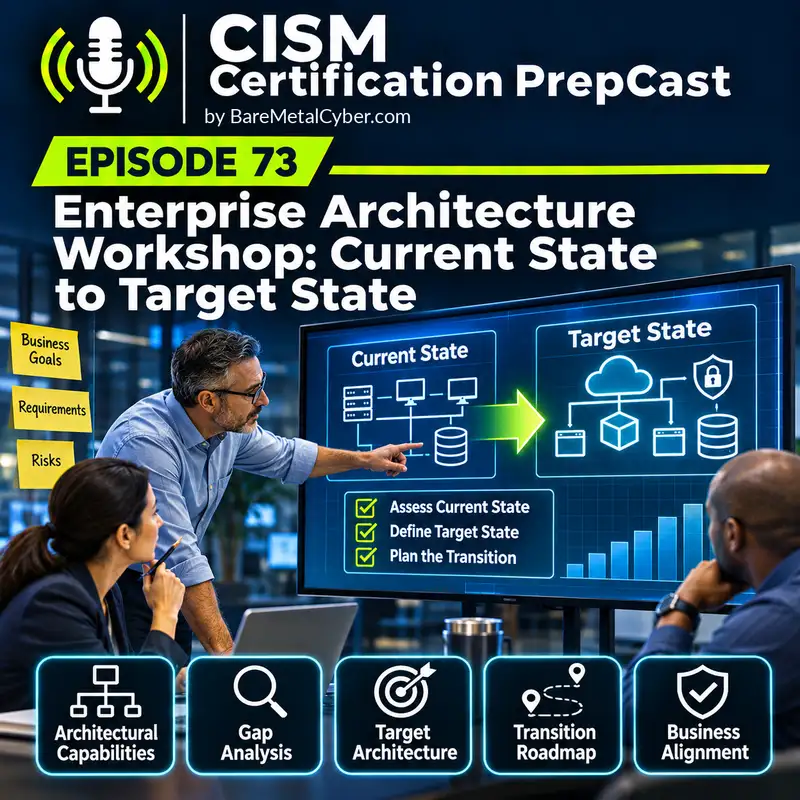
Enterprise Architecture Workshop: Current State to Target State
In this episode, we are conducting an enterprise architecture workshop that traces a business change from current state through target state and governed transition. The objective is to connect the topic to business impact, decision authority, operating responsibility, and evidence rather than treating it as a slogan or isolated technical task.
Consider Blue Canyon Services, a fictional teaching organization. It has acquired a smaller competitor and wants one customer-support experience before the next contract cycle. The two businesses use different customer records, identity stores, support tools, hosting providers, and recovery arrangements. Executives want a shared portal quickly, but no one has yet established which record is authoritative or who owns access decisions across the combined organization. This scenario is not an official examination question. It gives us a practical setting in which to examine the management choices and the reasons behind them.
The first task is to state the business capability and desired outcome. The manager must then validate the current state with business and technical owners. Next, the responsible teams should define the target state across information, applications, technology, and accountability. Before the decision is closed, the organization must design transition stages with dependencies and evidence gates. Finally, it should assign decision authority, funding, and reconsideration triggers. These actions may occur in parallel when authority and urgency permit, but none should disappear from the management record.
To deepen the lesson on enterprise architecture workshop: current state to target state, begin with the management principle behind the decision. Enterprise architecture is a maintained view of how the enterprise’s business capabilities, information, applications, and supporting technology work together. It helps leaders judge whether a proposed change supports the mission and what else must change with it. The security manager uses this view to connect business impact to design choices, shared dependencies, and investment. A network diagram alone cannot explain those relationships.
The next part of the analysis concerns the evidence and accountability behind the decision. The business view describes what the organization must be able to do, such as fulfill an order or resolve a customer complaint, and who is accountable for that outcome. The data view describes the information required, its ownership and sensitivity, and where it moves. The application view identifies the services and integrations that process the information. The technology view identifies the infrastructure and platforms those applications depend on. Read across these views: a change to customer data may affect service delivery, application interfaces, access decisions, and recovery arrangements at the same time.
Viewed through this episode’s purpose, the practical implication is important. A current-state view describes what actually operates today. Validate it with business and technical owners because an approved diagram may omit a manual workaround or a newly connected provider. A target-state view describes the capabilities and relationships needed to meet the chosen business direction. The gap between them identifies work, but does not by itself establish priority. Compare each gap with business impact, obligations, available resources, and the consequences of the transition.
A manager should connect this point to ownership, operating reality, and the business consequence. Consider a retailer integrating an acquired business into one customer-service portal before seasonal demand increases. Today, the businesses keep separate customer records and identity stores, and an external support provider reaches both environments. The proposed target offers a consistent customer experience with controlled information sharing, accountable access, useful monitoring, and tested continuity. These are business and protection outcomes. Buying a portal platform addresses only part of the change.
This distinction becomes especially useful when several plausible actions compete for attention. The enterprise view exposes decisions that a project inventory can miss. Who determines which customer record is authoritative? Which support activities require access to both businesses’ information? Can order fulfillment continue if the shared identity service is unavailable? Which existing connections must be retired after migration? A shared service can improve consistency and reduce duplicated work while concentrating failure impact. The manager should assess both effects instead of assuming that consolidation automatically reduces risk.
The governance question is not whether the idea sounds secure, but whether it is authorized, workable, and verifiable. Keep decision rights visible. Business leaders own service outcomes and priorities; enterprise architects coordinate the overall design; security specialists define and assess protection needs; operational owners confirm that the result can be supported. The security manager brings risk scenarios, applicable obligations, resilience requirements, and evidence of control dependencies to the discussion. The person who approves an architecture pattern may not be authorized to accept the business consequences of departing from it.
The operational consequence also matters because a plan that cannot be sustained will not manage risk for long. Transition states describe workable steps between today and the target. The retailer might first establish reliable customer and access ownership, then pilot the shared portal with a limited support group, and expand only after its controls and continuity arrangements are demonstrated. Each step needs an owner, entry conditions, a definition of success, and a response if assumptions fail. Keep the current view updated as changes go live, so the next decision starts from observed reality.
Use this point to challenge assumptions and to identify what must be demonstrated before the next decision. Enterprise architecture provides this enterprise-wide context. Information security architecture develops the protection requirements, boundaries, and control interactions within it, which another lesson in this course explores. The security program’s operating model supplies the people, authority, workflows, and resources that keep those arrangements working. Distinguishing these purposes helps leaders fund a coherent change rather than treating three different needs as one architecture document.
The exam lens here is to separate the activity from the outcome that leadership actually needs. Prioritization starts by comparing risks in a way that business leaders recognize, using consistent criteria rather than the volume of findings in a vulnerability scanner. The practical inputs are impact to enterprise objectives, exposure of critical assets, feasibility of exploitation, and the organization’s ability to detect, respond, and recover. This is where the concept of risk treatment becomes concrete: mitigate reduces likelihood or impact, transfer shifts consequences contractually or via insurance, accept acknowledges residual risk, and avoid changes the plan to remove the risky activity. A good roadmap reflects explicit treatment choices, not accidental ones made by neglect. On exams, the “best answer” is typically the option that reduces enterprise risk in the most defensible, measurable way while respecting constraints.
A defensible approach keeps the scope, owner, evidence, and remaining uncertainty visible. Return to the retailer’s shared portal. A useful transition roadmap first establishes ownership of customer records, identities, and critical integrations. It then funds a limited pilot with the external support provider, including access controls, monitoring, support procedures, and continuity testing. Wider rollout follows demonstrated readiness, with legacy connections retired when their business use ends. If the identity service or operational support is not ready, buying a second portal feature does not remove that dependency. The roadmap should show the risk during coexistence, not only the benefits promised for the target state. another lesson in this course follows this case into the funding decision.
Apply this principle directly to the management decision in this episode. Roadmaps also need to account for architectural choke points where a small change has outsized effect. Identity and access management often sits at the center of multiple objectives because it reduces the blast radius of credential compromise, limits lateral movement, and supports accountability through logging and review. Asset inventory and configuration management are similarly foundational, because you cannot protect what you cannot locate, classify, or patch in a repeatable way. Network segmentation and egress control can be high-impact, but they require operational maturity to avoid outages, so sequencing must incorporate testing and rollback capability. The roadmap’s job is to pick the few foundational enablers that unlock many objectives, then build from there.
The next part of the analysis concerns the evidence and accountability behind the decision. A roadmap also has to acknowledge interdependencies across teams, because security outcomes rarely sit inside a single department’s boundary. Engineering may own application security improvements, infrastructure may own hardening and identity integration, operations may own monitoring and incident response runbooks, and procurement may own third-party risk controls and contract language. Sequencing work without confirming these dependencies is a recipe for stalled initiatives and ambiguous accountability. In exam terms, the best governance-aligned answer is the one that assigns clear ownership and ensures prerequisites are met before committing to delivery dates. Roadmaps are not just lists of projects; they are agreements about who will do what, when, and with what definition of “done.”
Viewed through this episode’s purpose, the practical implication is important. For each transition, record the gap being closed, the accountable owner, the enabling investment, the dependency that could delay it, and the evidence required to move forward. A pilot can reveal that a shared identity change raises availability risk for other services. That finding should change scope, safeguards, or sequencing before the investment committee releases the next tranche of funding.
A manager should connect this point to ownership, operating reality, and the business consequence. Finally, prioritization and sequencing decisions must be revisited as conditions change, but that does not mean constantly rewriting the roadmap. Trigger events (like a new acquisition, a major product launch, a material incident, or a regulatory change) justify reassessing priorities and rebalancing investment. However, the underlying security objectives should remain stable, and the roadmap should adapt by accelerating, pausing, or reshaping initiatives while preserving traceability. This is how security strategy stays resilient under real-world pressure: stable objectives, flexible execution, and a roadmap that can explain every major change in terms leadership recognizes.
This distinction becomes especially useful when several plausible actions compete for attention. Security funding decisions succeed when they connect technical controls to outcomes leaders already manage: reduced loss exposure, reliable operations, and defensible compliance. The core task is translating risk into decision-ready language: what could happen, how it would disrupt the business, and which investments most credibly change that outcome. Because resources are always constrained, the goal is not to buy “more security,” but to prioritize a sequence of improvements that meaningfully reduce likelihood, limit impact, and strengthen recovery. Done well, the conversation shifts from tools and fear to governance and tradeoffs, allowing non-security leaders to make clear, accountable choices about residual risk and organizational resilience.
The governance question is not whether the idea sounds secure, but whether it is authorized, workable, and verifiable. A security funding request succeeds when it translates technical work into business outcomes that leaders already recognize: fewer losses, less downtime, and fewer surprises. Risk reduction is the most direct translation, but it has to be expressed as reduction in likelihood, reduction in impact, or improved detection and response speed. A vague claim like “improves security posture” is not a business case; it is a sentiment. A defensible case ties a proposed control to a specific threat scenario, a known exposure, and the decision the organization is trying to make.
The operational consequence also matters because a plan that cannot be sustained will not manage risk for long. Consider a simple scenario: a mid-sized company relies on a single identity provider and uses VPN access for contractors, and leadership is worried about ransomware after a peer organization’s outage. The security leader proposes phishing-resistant MFA, conditional access, and privileged access hardening for key admin roles, but finance asks why this is urgent now. The “best answer” logic is to map the change to a credible loss pathway: identity compromise leading to privileged access, then lateral movement, then business interruption. When the request is framed as “reduce probability of privileged account takeover and shorten time-to-containment,” it becomes measurable and comparable to other investments.
Use this point to challenge assumptions and to identify what must be demonstrated before the next decision. Risk reduction arguments are strongest when they distinguish inherent risk from residual risk and then show how a control changes the residual risk to within risk appetite. Executives do not need a lecture on risk theory, but they do need to hear what remains true after spending money. If a proposed control primarily reduces likelihood, state it plainly and acknowledge what it does not solve, such as legacy systems that still cannot be patched quickly. If the control reduces impact, link that to actual business processes, such as shortening the maximum tolerable downtime for order fulfillment or payroll.
The exam lens here is to separate the activity from the outcome that leadership actually needs. Resilience is often the more persuasive sibling of risk reduction because it emphasizes continuity rather than fear. Resilience means the organization can absorb disruption, continue critical services, and recover to an acceptable state within defined time objectives. When funding is requested for backups, segmentation, failover, incident response tooling, or tabletop exercises, the business translation is reduced outage duration and reduced operational chaos. In exam terms, this is where a program demonstrates it can withstand incidents and manage them as predictable events, not as existential surprises.
A defensible approach keeps the scope, owner, evidence, and remaining uncertainty visible. A resilience-based case gains credibility when it anchors on dependencies and recovery constraints rather than on generic “best practices.” If a customer-facing application cannot operate without a third-party payment processor, then resilience investments may be targeted at alternate processing paths, degraded-mode features, or contract-driven recovery expectations. If recovery time objectives are unrealistic given current architecture, the best move is to propose incremental investments that reduce the gap over time and make the tradeoffs explicit. Resilience also includes the human system: on-call coverage, runbooks, and escalation paths that reduce decision latency when minutes matter.
Apply this principle directly to the management decision in this episode. Compliance is not the same as security, but it is frequently the budget door that opens first because it carries defined obligations and deadlines. A compliance-driven case should identify the requirement category (legal, regulatory, contractual, or internal policy) and then explain what evidence is needed to demonstrate adherence. Leaders respond better to “we must produce auditable evidence of access reviews and logging retention” than to “we need a compliance platform.” The strongest compliance arguments avoid treating compliance as a checkbox and instead show how compliance activities reinforce risk reduction, such as stronger identity governance reducing insider misuse and credential drift.
The next part of the analysis concerns the evidence and accountability behind the decision. Return to the retailer’s portal transition. Suppose the first-year funding limit is dollars one hundred eighty thousand. An illustrative proposal allocates dollars one hundred twenty thousand to identity integration and a limited pilot, dollars forty thousand to operations and training, and dollars twenty thousand to contingency. An analytics alternative costs dollars one hundred fifty thousand to deploy plus dollars sixty thousand to operate in the first year, exceeding the same limit. Its usefulness also depends on reliable identity and event data, which the assessment found incomplete.
Viewed through this episode’s purpose, the practical implication is important. The recommendation is therefore to fund the shared identity foundation and pilot first, with the retail operations sponsor accountable for the business outcome. This decision follows the evidence and dependencies, not a rule that one technology always comes first. Show costs in later years, migration and retirement obligations, and the assumptions behind expected risk reduction. At the ninety-day review, the sponsor and service owner examine whether access is accountable, monitoring works and continuity has been tested before releasing expansion funding. If evidence is weak, revise the scope or treatment instead of claiming success because the money was spent.
A manager should connect this point to ownership, operating reality, and the business consequence. A useful mental model is to treat every proposed initiative as competing for the same scarce resources: people, time, and change windows. In practice, many initiatives fail not because the technology is wrong, but because the organization cannot deploy, operate, and sustain it. If a proposal requires extensive customization, continuous tuning, and deep expertise, it may be a poor choice during scarcity unless it addresses an existential risk. Under exam conditions, the better answer is often the control that reduces high-impact exposure while remaining operationally realistic.
This distinction becomes especially useful when several plausible actions compete for attention. Clarity improves when the message begins with the business process at risk and then moves backward to the technical control, rather than starting with the control and hoping the audience infers the impact. For example, instead of “we need better endpoint telemetry,” lead with “if ransomware encrypts the file shares that support billing, cash collection slows within forty-eight hours.” Once the business consequence is established, the control discussion becomes a targeted mitigation of that consequence. The exam’s best answers tend to favor this outcome-first framing because it aligns security with governance and enterprise risk management.
The governance question is not whether the idea sounds secure, but whether it is authorized, workable, and verifiable. Metrics can help, but only when they measure outcomes or capability maturity rather than raw activity. Executives do not gain much from the number of alerts or the volume of logs, but they do understand time-to-detect, time-to-contain, recovery time, and the percentage of critical systems covered by a control. Even better are metrics that show trend and confidence, such as reduced privileged accounts, improved patch latency for high-severity exposures on critical assets, or successful recovery testing at defined intervals. The exam signal is to use metrics to support decisions, not to impress with technical detail.
The operational consequence also matters because a plan that cannot be sustained will not manage risk for long. Risk language should be calibrated to the organization’s risk appetite and expressed as residual risk after proposed changes. A security leader gains credibility by stating what the investment will and will not accomplish, including what remains unmitigated due to architectural constraints or business decisions. Statements like “this reduces the probability of credential-based compromise for privileged users, but it does not eliminate phishing risk for all users” are more persuasive than blanket promises. Executives are accustomed to imperfect risk tradeoffs and respond well to precise, bounded claims.
Use this point to challenge assumptions and to identify what must be demonstrated before the next decision. Procurement also needs a clear decision path for risk acceptance, because “security says no” is rarely a sustainable business posture. Sometimes the business will proceed with a solution that has known gaps because the opportunity cost of delay is greater than the expected loss, or because compensating controls can reduce exposure. The control point is who is authorized to accept that risk, what evidence supports the decision, and what conditions are attached to the exception. A risk acceptance that is not documented, time-bound, and assigned to a risk owner is not risk management; it is unmanaged liability. Exam questions often test whether you recognize the difference between documenting a risk and actually ensuring the right accountability for accepting it.
The exam lens here is to separate the activity from the outcome that leadership actually needs. The most effective integration is achieved when change and procurement share a common risk language and a consistent set of control expectations. If procurement demands strong logging but change management allows deployments that disable log forwarding, the program is internally inconsistent and will fail in real operations and in audit evidence. Similarly, if change approvals consider availability impacts but ignore integrity controls like configuration management and access restrictions, incident response becomes reactive and expensive. Consistency comes from aligning change categories, risk criteria, and approval authority with enterprise risk appetite and business criticality. That alignment is what turns security from a parallel process into part of how the organization runs.
A defensible approach keeps the scope, owner, evidence, and remaining uncertainty visible. Operationally, embedded security is sustained through feedback loops that improve decisions over time. After changes, organizations learn from outages, near misses, and security events to refine what counts as “high risk” and what controls are non-negotiable. After procurements, lessons from vendor performance, incident handling, and integration effort should update requirements so future selections are better informed. These feedback loops are governance controls because they reduce repeat failure, increase predictability, and strengthen evidence that risk is being managed rather than merely discussed. In exam terms, the strongest programs are those that institutionalize learning and accountability, not those that rely on one-time reviews.
Apply this principle directly to the management decision in this episode. Third-party risk management is strongest when it is tiered, because not every vendor warrants the same depth of assessment. Tiering should be based on potential impact and exposure, such as the sensitivity of data handled, the criticality of the service, the level of privileged access granted, and the degree of integration into core processes. A marketing email platform and a cloud identity provider do not belong in the same treatment category, even if both are “SaaS.” Tiering drives proportional controls, including what evidence is required, how often reassessments occur, and what monitoring expectations apply. This approach aligns with governance principles because it reserves intensive review for high-impact relationships and avoids wasting effort on low-risk suppliers.
The next part of the analysis concerns the evidence and accountability behind the decision. Vendor assurance should be treated as evidence for risk decisions rather than a hunt for perfect security. Evidence might include independent audit reports, security testing summaries, incident response commitments, and operational transparency about subprocessors and data flows. The risk manager’s job is to translate that evidence into a view of control coverage, control gaps, and the residual risk the enterprise must accept or mitigate. A vendor with strong controls can still represent unacceptable risk if the service model conflicts with enterprise requirements, such as data residency, segregation needs, or logging obligations. Conversely, a vendor with minor gaps may be acceptable if the business impact is low and compensating controls are feasible. The exam will often test whether you can weigh control evidence against business context rather than treating a missing artifact as an automatic rejection.
Viewed through this episode’s purpose, the practical implication is important. Contracts and service agreements are governance controls because they define the levers available when risk becomes real. Security-relevant terms typically include breach notification timelines, cooperation obligations during investigations, limitations on subcontracting, data ownership and deletion requirements, and audit or assurance rights. The goal is not to win a legal debate; it is to ensure the enterprise can detect issues, respond effectively, and enforce expectations when a vendor’s performance threatens enterprise objectives. Weak contractual language can convert a manageable technical incident into a prolonged business crisis by delaying notification or limiting access to evidence. In exam logic, contractual mechanisms are often the “best answer” when the question asks how to institutionalize accountability for a provider.
A manager should connect this point to ownership, operating reality, and the business consequence. Third-party risk is also cumulative, because the enterprise may depend on dozens or hundreds of providers, each with its own failure modes and attack surface. This creates concentration risk when multiple critical processes rely on the same provider category, region, identity system, or network backbone. It also creates systemic exposure when a widely used supplier suffers a breach that cascades across many customers, even if each individual relationship was assessed as acceptable in isolation. An enterprise risk view requires looking across the portfolio to identify common dependencies, shared subprocessors, and single points of failure. When the exam hints at “enterprise impact” or “strategic risk,” the strongest response typically elevates the view from one vendor to the aggregated risk landscape.
This distinction becomes especially useful when several plausible actions compete for attention. Projects are where strategy becomes systems, and where unmanaged risk becomes expensive. In governance terms, a project is not just a delivery vehicle; it is a sequence of decisions that introduce, modify, or retire risk. Security leaders should treat projects as controlled experiments with defined outcomes, measurable requirements, and explicit risk ownership. The exam angle is straightforward: the “best answer” usually embeds risk decisions into project governance rather than relying on a final security review. When risk is handled only at the end, the organization has already committed budget, timelines, and stakeholder expectations, which reduces options and raises impact.
The governance question is not whether the idea sounds secure, but whether it is authorized, workable, and verifiable. Operational handoff is a stage gate that is often neglected, yet it is where projects either become sustainable services or fragile liabilities. A secure build can still fail as a control if the operations team lacks documentation, access boundaries, and runbooks for routine and emergency actions. From a risk perspective, ownership must transfer clearly, with responsibilities for patching, access approvals, logging review, and incident response assigned and accepted. If ownership is unclear, problems are discovered late, and accountability becomes political rather than procedural. Exam questions that ask about “ensuring ongoing security” or “maintaining control effectiveness” often point to this handoff decision.
The operational consequence also matters because a plan that cannot be sustained will not manage risk for long. A useful exam-style scenario is a project team that has met schedule but requests a waiver to deploy without centralized logging because “it will be added next sprint.” The risk-based response is not to debate the value of logs in the abstract; it is to evaluate whether the lack of logging breaks the risk assumptions that justified approval. If the system handles sensitive data or has privileged access paths, missing logs may eliminate detection capability and make incident response ineffective, changing the residual risk materially. The stage gate forces that reality into a decision, requiring either remediation, compensating controls, or formal acceptance by the right authority. The control lesson is that stage gates convert hidden risk into explicit choices with accountable owners.
Use this point to challenge assumptions and to identify what must be demonstrated before the next decision. Stage gates also create a portfolio-level advantage: they standardize how the organization makes risk decisions across many projects. Consistent gates enable leadership to compare initiatives, allocate security effort where it matters most, and detect patterns like recurring control gaps or chronic exception requests. They also generate audit-ready evidence that risk was evaluated systematically, which reduces reliance on personal credibility and institutional memory. In exam terms, this is governance maturity: repeatable decisions, documented rationale, and clear accountability.
Return to the fictional Blue Canyon Services scenario. The workshop should produce a decision map, not merely a diagram. Each transition must connect a business outcome to an owner, dependency, risk, investment, and evidence required before the next step. The strongest management response makes the underlying choice visible, names the accountable owner, and states how the result will be verified. It also preserves the distinction between an authorized technical action and the governance decision that gives that action direction, limits, and follow-through.
For practice, narrate Blue Canyon’s current state, target state, and first two transition stages. Name the owner of customer data, the identity dependency, the recovery question, the funding decision, and the evidence that permits movement from pilot to broader deployment. Then challenge your own answer by identifying one plausible alternative that appears reasonable but fails because of authority, timing, scope, evidence, or business impact. This exercise develops the habit of explaining not only what should happen, but why that action is the best management decision under the stated conditions.