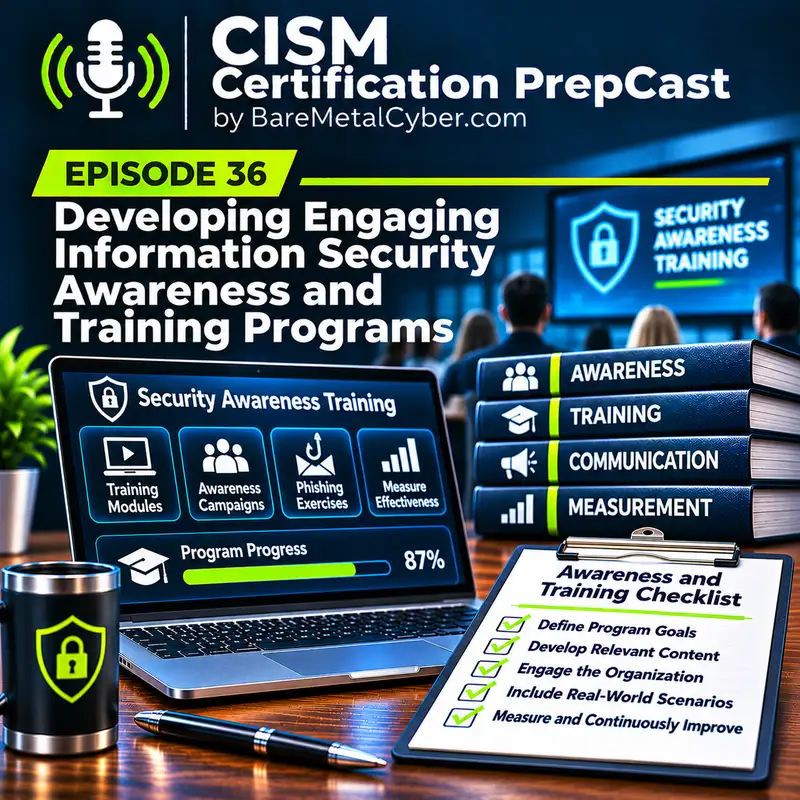
Developing Engaging Information Security Awareness and Training Programs
In this episode, we are developing information security awareness and training programs that change behavior. Completion records matter, but they do not prove that people can recognize risk or make the right decision. We will connect general awareness, role-based learning, reinforcement, culture signals, and evidence of improved performance.
Consider a fictional manufacturer called Stonebridge Manufacturing. Every employee completes annual security awareness training, yet credential theft and unsafe data sharing continue. The security manager discovers that the course presents generic examples, gives the same content to every role, and measures only completion. The organization redesigns the program around behavior. All personnel receive a concise foundation, while finance, developers, administrators, executives, and customer-support teams receive targeted scenarios tied to their decisions. Reinforcement appears in workflows, manager conversations, simulations, and job aids. The program measures reporting quality, error patterns, response behavior, and recurring control bypasses rather than relying on attendance alone. This fictional scenario shows that awareness is not an annual event. It is a managed capability that should reduce risky behavior, strengthen culture, and provide evidence that learning transfers into work.
Awareness begins by deciding what everyone needs and what particular roles need in addition. Under most governance models, awareness and training exist to reduce human-enabled risk, not to check a compliance box. General training is the baseline: it sets shared expectations for acceptable use, reporting, data handling, and the organization’s security “common language.” Role-based training is the control that acknowledges reality: different jobs create different exposure paths, different privileges, and different failure modes. The practical decision is not “one or the other,” but what belongs in the baseline versus what must be specialized to meaningfully change outcomes.
Consider a scenario where a finance analyst approves wire transfers, a customer support agent resets accounts, and a cloud engineer deploys infrastructure changes. All three complete the same annual phishing module and pass the same short quiz, yet the organization’s real risk is wildly uneven across those roles. The finance analyst is exposed to business email compromise patterns and authority spoofing, the support agent is exposed to social engineering and identity proofing gaps, and the engineer is exposed to misconfiguration and credential handling errors. Treating those roles as equivalent because they all “use email” creates a false sense of coverage while leaving the highest-impact decisions undertrained.
General training should therefore be designed as a minimum viable standard that supports policy compliance and consistent escalation behavior. It typically covers how to recognize common lures, how to report suspicious activity, how to handle sensitive data, and how to follow core policies that apply to everyone. Its value is breadth, consistency, and repeatability, and it must be understandable for nontechnical staff without distorting the risk. When general training tries to address every specialized scenario, it becomes long, forgettable, and often ignored by the people who need it most.
Role-based training should be driven by risk analysis and mapped to specific job tasks that can cause or prevent loss. Start with the actions that matter: approving payments, granting access, administering endpoints, handling regulated data, deploying code, responding to incidents, and managing third parties. For each action, identify the most likely error patterns and the most damaging outcomes, then train to prevent those errors with job-relevant cues and decisions. The best role-based content does not “teach security”; it teaches the job safer, using the organization’s actual workflows, tools, and escalation paths.
A common mistake is to define roles too broadly, which turns role-based training into “technical versus nontechnical” and misses the point. A database administrator, a security operations center analyst, and a software developer all look “technical,” but their threat exposures and required decision skills are different. Conversely, executives, procurement staff, and human resources (HR) teams are often grouped as “business users,” even though they face distinct influence tactics, confidentiality pressures, and approval authorities. Training becomes effective when the role definition matches a controllable set of tasks, privileges, and business decisions, not a job title category.
Another scenario illustrates why the “baseline plus targeted” model works: a new hire joins a sales team and immediately receives access to a customer relationship management platform and a document-sharing tool. General training can teach how to report suspicious links and classify customer information, but it will not teach how to share proposals without generating public links or bypassing retention controls. A short role-based module can demonstrate safe sharing patterns, approval thresholds for discounts, and the exact reporting steps if a device is lost during travel. The training decision is justified because the role’s day-one behavior can create long-lived exposure.
Role-based training also needs to account for privilege concentration and “blast radius,” which is why high-privilege roles warrant deeper and more frequent reinforcement. Privileged access is not only an access control problem; it is a human decision problem under time pressure, fatigue, and change windows. Administrators and engineers require training on credential hygiene, change discipline, and recognizing high-risk shortcuts that feel efficient but create systemic vulnerability. When training is aligned to privileged workflows, it supports preventive controls like separation of duties and change management rather than competing with them.
In mature programs, role-based versus general training decisions are governed like any other risk treatment: by defined objectives, scope, and accountability. The security manager should be able to explain why a role received specialized training using a traceable rationale tied to risk, audit findings, incidents, or control requirements. The organization should also be able to defend why certain roles did not receive specialized training because their tasks do not create meaningful incremental exposure beyond the baseline. This prevents “training sprawl,” where every stakeholder demands custom content and the program loses focus and credibility.
Finally, the decision must include operational constraints that busy organizations cannot ignore: time, attention, and reinforcement cadence. General training should remain short enough to be completed without resentment, while role-based training should be tightly scoped to the handful of decisions that prevent high-impact failures. If the program requires hours of content per person, people will multitask, speed-click, and retain nothing, which converts training into theater. A defensible approach is to keep the baseline consistent, then concentrate additional time only where job-specific decisions meaningfully change the probability or impact of loss.
Completion records show attendance, while comprehension and behavior evidence show whether learning worked. Completion is an administrative metric: it tells you that a person opened a module, spent some minimum amount of time, and reached the end. Comprehension is a risk metric: it tells you whether that person can recognize a threat, make the right decision under time pressure, and follow the expected escalation path. Organizations often default to completion because it is easy to collect, easy to report, and easy to audit. That convenience is precisely the problem, because it can produce “green dashboards” while incident patterns remain unchanged.
A common exam-style scenario looks like this: after a phishing campaign, the training portal shows ninety eight percent completion within the deadline, yet the help desk still receives multiple tickets from users asking whether they should click “verify your password” links. The organization met its training requirement, but employees did not internalize the recognition cues or the reporting behavior. In real operations, the cost of this gap shows up as delayed reporting, repeated credential exposures, and leadership confusion about why “training didn’t work.” The best answer logic is to treat completion as necessary evidence of participation, but insufficient evidence of risk reduction.
Measuring comprehension starts with defining what “understanding” means in operational terms. For awareness topics, comprehension is usually the ability to identify high-risk indicators, choose the correct next action, and avoid actions that increase blast radius. For role-based topics, comprehension may include applying an approval threshold, using a secure workflow, or recognizing when a request violates policy even if it comes from an executive. These definitions must be explicit because vague goals like “increase awareness” cannot be measured in a way that informs governance decisions.
The next step is designing assessments that mirror real decisions rather than testing trivia. A quiz question that asks for the definition of phishing can be answered through memorization without improving behavior. A better assessment presents a realistic email, message, or request and asks what the employee should do next, including how to report it and what not to do. The distinction matters because behavior change depends on decision practice, not vocabulary recall, and security incidents usually begin with a decision point rather than a knowledge gap.
Another scenario highlights how superficial testing fails: an employee correctly answers that sensitive data should be encrypted, but later uploads a spreadsheet containing customer identifiers into an unsanctioned file-sharing site to “move fast.” The employee knew a principle, but did not understand the organization’s practical rules for approved tools, sharing settings, and escalation. Comprehension measurements should therefore be tied to the workflows people actually use, including the defaults and friction points that cause policy drift. When the measurement is grounded in real work, the findings become actionable for both security leadership and business owners.
Operational comprehension metrics should also focus on leading indicators that predict incident reduction. Examples include the rate of correct reporting during simulations, the time-to-report suspicious messages, and the proportion of employees who choose the safest action when presented with a realistic dilemma. These measures align with governance because they help answer whether training is reducing likelihood, improving detection, or limiting impact. Completion rates, by contrast, mostly answer whether the learning management system (LMS) is functioning and whether managers enforced deadlines.
Assessment quality matters as much as assessment frequency, because low-quality questions can produce misleading confidence. If the correct answers are obvious or the distractors are unrealistic, employees learn to “test for patterns” rather than apply judgment. If the content is too technical for the intended audience, employees guess, disengage, and treat the process as punishment. Strong comprehension checks use plain language, realistic options, and explanations that reinforce the decision logic employees are expected to use in real situations.
Measuring comprehension must also account for retention over time, not just immediate recall after a module. People can pass a quiz minutes after training and forget most of it within weeks, especially when the learning is not reinforced by day-to-day practice. Retention can be tested through periodic micro-assessments or scenario prompts that reintroduce key decisions in smaller doses. From a governance perspective, this shifts training from a single annual event to a controlled process that maintains competency where it matters.
Finally, comprehension measurement should feed back into governance decisions rather than existing as a reporting artifact. If comprehension remains low in a particular role or business unit, the response should be to adjust content, increase targeted reinforcement, or reduce friction in secure workflows, not simply to assign more modules. If comprehension is high but incidents persist, the problem may be control design, incentives, or operational constraints rather than awareness. The program becomes defensible when metrics are used to guide risk treatment choices, not just to prove that training happened.
High-risk roles require targeted reinforcement tied to the decisions and actions they perform. High-risk roles are not defined by seniority or job prestige; they are defined by how much damage a single human decision can cause. A role becomes high risk when it combines access, authority, and opportunity in a way that meaningfully changes likelihood or impact. Access includes privileged credentials, sensitive data, and administrative interfaces, while authority includes approvals, exception granting, and policy overrides. Opportunity includes frequent exposure to external contact, high message volume, and time pressure that encourages shortcuts.
A familiar scenario is a payroll manager receiving an urgent message, purportedly from the chief executive officer (CEO), instructing an immediate bank account change for a vendor. The manager has the authority to update payment details and the access to execute that change quickly, while the opportunity exists because these requests often arrive during month-end processing when attention is divided. General training that says “watch for phishing” is not enough when the attack is tuned to the target’s workflow and approval paths. Targeted reinforcement for that role focuses on verification steps, out-of-band confirmation, and what constitutes a valid emergency versus a social engineering tactic.
High-risk roles also include positions that can create systemic exposure through configuration and deployment decisions. Cloud administrators, identity and access management (IAM) operators, network engineers, and endpoint management teams can unintentionally expand attack surfaces with a single misconfiguration. Their mistakes can be durable and invisible, persisting long after the change window ends and long after any training completion record is filed. Reinforcement for these roles must connect security outcomes to specific tasks such as credential handling, permission boundaries, logging enablement, and change approval discipline.
Roles that perform identity proofing and account recovery are frequently underestimated in risk discussions, yet they sit directly on the path of account takeover. Help desk agents and customer support teams are trained to be helpful, fast, and empathetic, which are the same traits attackers exploit through pretexting. A targeted reinforcement approach teaches these teams how to validate identity, handle edge cases, and escalate when a request triggers fraud indicators. It also teaches what “good friction” looks like, so agents do not bypass controls to reduce call time and inadvertently increase compromise rates.
Executives and their assistants often qualify as high-risk roles because they combine decision authority, access to strategic information, and exposure to tailored influence operations. Attacks against these roles are frequently low-volume and high-craft, relying on context, impersonation, and urgency rather than mass phishing. Reinforcement for leadership should therefore prioritize decision controls: verifying unusual requests, delegating approvals properly, and recognizing when a message is attempting to weaponize authority. The goal is not to turn executives into analysts, but to ensure their actions do not bypass the organization’s protective layers.
Targeted reinforcement is most effective when it is specific, frequent, and aligned to the role’s real workflow triggers. “Specific” means reinforcing the handful of decisions that prevent high-impact failures, such as how to validate a payment change or how to respond to unexpected multifactor authentication (MFA) prompts. “Frequent” means short touchpoints spaced over time, because high-risk roles face repeated exposure and need habits, not one-time awareness. “Aligned” means the guidance matches the tools, policies, and approval paths people actually use, so the safer choice is clear and feasible.
Another exam-style scenario demonstrates why reinforcement beats one-time instruction: a system administrator completes privileged access training, but six weeks later receives a message that a production outage is imminent and shares credentials to “get things back online.” The administrator remembered the rules, but under operational stress chose a shortcut that seemed justified in the moment. Reinforcement would have focused on preplanned break-glass procedures, escalation paths, and how to distinguish legitimate urgency from manipulation. It would also have validated the operational realities that drive shortcuts while still holding the line on behaviors that create unacceptable risk.
Targeted reinforcement should be prioritized using evidence rather than intuition, because perceptions of risk often lag reality. Indicators include incident trends, near-miss reports, simulation results, audit findings, and patterns of exception requests. Roles with repeated exposure, repeated mistakes, or consistently low comprehension scores should receive more frequent and more job-specific reinforcement. This keeps the program defensible and ensures resources are concentrated where they measurably reduce likelihood or limit impact.
Finally, targeted reinforcement must be supported by management expectations and operational design, or it becomes a message that conflicts with reality. If a high-risk role is measured solely on speed or throughput, people will optimize for those metrics even when training says otherwise. If secure workflows are cumbersome, employees will route around them regardless of awareness. Reinforcement works when it is paired with controls, incentives, and leadership support that make the safest behavior the easiest behavior to sustain.
Repeated failures may indicate cultural and process weaknesses rather than a simple lack of information. Repeat offenders are rarely just “bad employees,” and treating them that way usually produces the wrong management response. In most environments, repeated risky behavior is a signal that either the expectations are unclear, the workflow is forcing unsafe shortcuts, or accountability is inconsistent. Sometimes the individual is careless, but just as often the organization has created conditions where the secure path is slower, harder, or socially discouraged. The best governance-minded approach is to treat repeat behavior as data that points to control gaps, cultural norms, or misaligned incentives.
A typical scenario is an employee who repeatedly clicks simulated phishing links and also fails to report suspicious messages when prompted. If the only response is to assign the same generic module again, the organization is measuring compliance while the underlying risk persists. A better response begins by identifying what decision the employee is failing to make and why: do they not recognize cues, do they not know how to report, or do they believe reporting will cause trouble? The distinction matters because each root cause implies a different corrective action, and the exam “best answer” tends to be the one that addresses the underlying risk, not the most punitive option.
Repeat offenses also reveal how well the organization’s culture supports secure behavior. If employees believe mistakes will be punished harshly, they may hide incidents, delay reporting, or avoid asking questions, which increases impact. If leadership treats security controls as obstacles to “real work,” employees receive a clear signal that shortcuts are acceptable when deadlines loom. If managers ignore training expectations, completion rates and comprehension measures become performative rather than meaningful. Culture signals are not abstract values statements; they are the patterns employees observe in what gets rewarded, what gets ignored, and what causes friction.
Handling repeat offenders effectively requires a structured escalation model that is consistent, proportionate, and transparent. Early interventions should be supportive and practical, such as a brief coaching conversation focused on one or two concrete decisions and the correct reporting path. If behavior continues, the response should become more specific to the role and the observed failure mode, using realistic scenarios that mirror the employee’s daily work. Escalation to formal performance management should be reserved for willful noncompliance or repeated high-risk actions after support has been provided, because governance aims to reduce risk while maintaining fairness and credibility.
Another scenario shows why consistency matters: two employees commit the same policy violation, but only one is corrected because their manager cares. Over time, teams learn that security rules are negotiable and unevenly enforced, which undermines every training message. Inconsistency also makes it hard to defend the program to audit stakeholders, because it suggests that requirements exist on paper but not in practice. A consistent model does not have to be harsh, but it must be predictable enough that employees understand the boundaries.
Repeat offender handling should also include a control-design review, because repeated human errors often indicate a preventable systems problem. If employees repeatedly send sensitive data to the wrong recipients, the issue may be unclear classification, poor tooling defaults, or a lack of friction on external sharing. If employees repeatedly reuse passwords or mishandle credentials, the issue may be excessive credential prompts, poor password manager adoption, or confusing access processes. When leadership responds by improving workflows or implementing safeguards, it sends a culture signal that security is a shared responsibility, not a personal failing.
Communication style is itself a culture signal, and it shapes whether employees engage or disengage. Public shaming, sarcasm, or “gotcha” messaging can reduce clicks in the short term while increasing concealment and distrust in the long term. Clear, calm messaging that explains the risk in plain language and reinforces the expected action supports psychological safety without lowering standards. The goal is to make it socially acceptable to report quickly and ask questions early, because timely reporting often determines whether an event becomes a minor incident or a major breach.
Leadership behavior is the strongest culture signal in the organization, because executives and managers set norms through their own exceptions and requests. When leaders bypass controls, demand urgent action without verification, or pressure teams to “just make it work,” they train the organization to accept risky behavior. When leaders follow verification steps, accept delays for safety checks, and praise fast reporting (even when it reveals a mistake) they model the behavior training is trying to produce. In exam terms, tone at the top is not a slogan; it is an operational control that changes how people behave when the stakes are high.
Finally, the most defensible approach is to treat repeat offenses as a feedback loop between human behavior and governance outcomes. Track repeat patterns by role, team, and workflow to identify where the system is generating predictable mistakes. Use that data to refine targeted reinforcement, adjust processes, and clarify accountability so that expectations are realistic and enforceable. When repeat offender handling improves both behavior and process, it becomes a visible signal that security is integrated into how work gets done, not bolted on as an annual requirement.
Now apply the idea to the management decision at hand. Policy adoption is rarely a comprehension problem; it is usually an incentive problem paired with a friction problem. If doing the secure thing is slower, more complex, or more likely to get someone blamed for delays, people will find workarounds even when they agree with the policy in principle. Conversely, when secure behavior is the path of least resistance and leadership rewards it, adoption becomes normal work rather than extra work. For exam questions, the key insight is that governance must shape behavior, not just publish requirements.
Use the role-based awareness and training process in an earlier lesson to support adoption; here, concentrate on whether incentives and authority make the required behavior feasible. Incentives operate at multiple layers, from executive scorecards to team-level delivery metrics to individual performance reviews. If leaders measure “time to market” aggressively but do not measure risk outcomes like remediation timeliness, control effectiveness, or incident rates, the system will optimize for speed and discount security. If leaders include security objectives that are specific and measurable, teams begin to plan for controls rather than negotiate for exceptions at the last minute. The exam-relevant pattern is that incentives should be aligned to risk appetite and business objectives, not to a generic idea of “more security.”
Enforcement is necessary, but it should be predictable and proportional, or it will drive concealment. When enforcement is inconsistent, people learn that policy is optional and that outcomes depend on who is asking, which undermines governance credibility. When enforcement is overly punitive, near-misses are hidden and the organization loses the early-warning signals it needs to prevent incidents. A mature posture enforces minimum controls consistently while treating honest reporting and fast correction as desired behavior, which supports both compliance and resilience.
A practical way to think about policy adoption is to view it as a product that must be usable. Policies that are vague, overly long, or written in legal language often fail because they do not translate into actionable steps for engineers, administrators, or business users. Policies that connect to standard procedures, approved patterns, and available tooling create a clear “how,” which reduces variation and increases evidence quality. For exam answers, the best approach often combines clear policy with supporting standards and procedures, even when the question only names “policy,” because adoption depends on operationalization.
Consider a scenario where a sales team needs to share a large customer dataset with a partner for a pilot and the approved secure transfer process requires multiple approvals and a tool the partner does not support. The team is measured on closing the pilot quickly, so they propose using a consumer file-sharing platform and promise to delete it later. In a weak incentive model, the team succeeds by bypassing controls and learns that policy is negotiable under revenue pressure. In a strong model, the organization provides a fast, supported secure sharing path, and leadership reinforces that using it is part of doing the job, not an obstacle to the job.
Enforcement mechanisms should be designed to prevent predictable failure modes rather than relying on training and hope. Preventive controls like identity-based access restrictions, approved application lists, and data loss prevention can reduce the opportunity for policy violations that are easy to commit under stress. Detective controls like logging, alerting, and periodic reviews create the evidence trail needed for accountability and continuous improvement. In exam logic, the best answer often includes the right mix of preventive and detective measures, because enforcement without visibility is weak, and visibility without consequence is ignored.
Policy adoption improves when security is embedded into workflows rather than positioned as a gate at the end. If security requirements are addressed during planning, architecture, and backlog grooming, teams can estimate time and resources realistically and avoid last-minute conflicts. If security appears only at release time, it will be experienced as unpredictable friction, which drives exception requests and resentment. The exam commonly frames this as aligning security with the system development life cycle and change management so controls are repeatable and auditable.
Another indicator is how the organization treats exceptions, because exceptions are where incentives and enforcement collide. If exception processes are slow, ambiguous, or punitive, teams will avoid them and bypass controls. If exception processes are fast, time-bound, and require the correct risk owner’s approval, teams will use them, and the organization gains visibility into where policies are misaligned with reality. A mature governance model uses exception data to refine standards and tooling, reducing the need for exceptions over time rather than simply denying them.
Finally, policy adoption should be reinforced through feedback loops that connect behavior to outcomes. When a near-miss is reported and leadership responds by improving a process, teams learn that reporting is valuable and that governance listens. When repeated violations occur and the organization responds with targeted control improvements, accountability, and measurable changes, teams learn that enforcement is real and not performative. The exam “best answer” tends to be the option that aligns incentives with desired behavior, enforces consistently with clear authority, and reduces friction through usable processes, because that combination produces sustained adoption rather than temporary compliance.
Return to the fictional scenario from the beginning of this lesson on developing engaging information security awareness and training programs. The strongest management response is not a slogan or an isolated tool purchase. It is a documented decision that connects business impact, authority, evidence, operating responsibility, and follow-through. Ask what must be true before the organization can proceed, who is accountable for making or accepting the decision, and how the result will be verified over time. That reasoning pattern helps on the CISM exam because it prevents a technically plausible action from being mistaken for the best management action.
For practice, choose one general audience and one high-risk role. Define the behaviors each group must demonstrate, the scenarios that will make the learning relevant, and the evidence that will show improvement. Include reinforcement after the initial training and a response for repeated unsafe behavior that considers process and culture. Avoid using completion percentage as your only success measure.