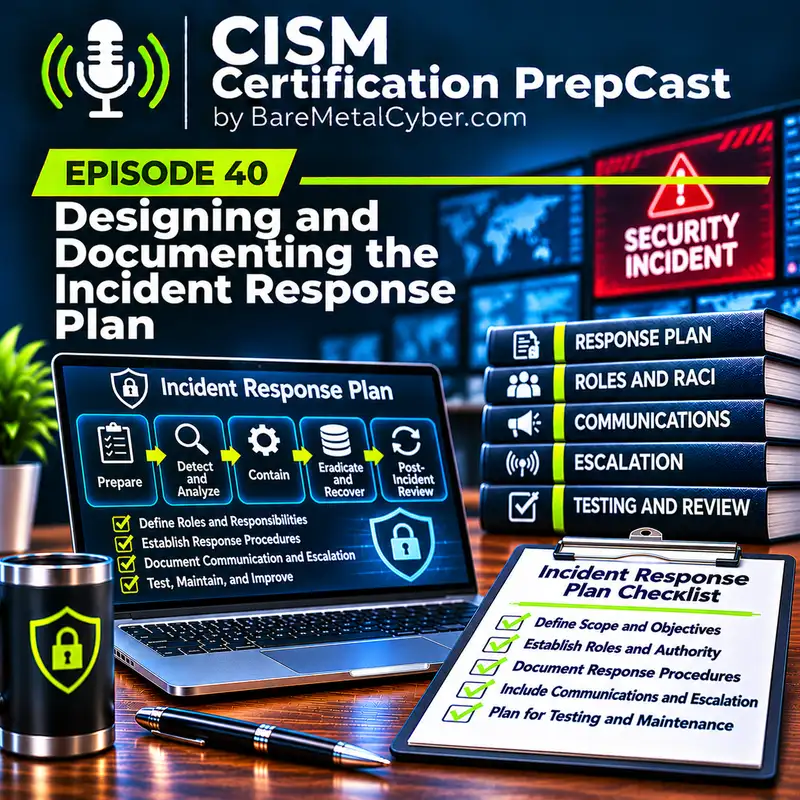
Designing and Documenting the Incident Response Plan
In this episode, we are designing and documenting the incident response plan. A useful plan connects activation criteria, authority, roles, workflows, tools, evidence, communications, and business priorities. Its purpose is to help authorized people make coordinated decisions under pressure rather than search for responsibilities during the incident.
Consider a fictional distributor called Northstar Distribution. A ransomware alert appears on a server that supports order fulfillment. The incident response plan lists technical steps but does not identify who can declare a major incident, isolate the warehouse network, authorize business workarounds, contact the cyber insurer, or approve external communication. Responders begin acting independently, and valuable time is lost reconciling authority. A better plan would connect detection and classification to activation criteria, decision rights, roles, secure communications, evidence handling, suppliers, continuity, and recovery. It would make clear which actions are preauthorized and which require escalation. This fictional scenario shows why a response plan is more than a checklist. It is an operating agreement for coordinated action under uncertainty, and its design must reflect the organization’s actual services, architecture, obligations, and leadership structure.
An incident response plan needs a structure that connects authority, roles, workflows, and evidence. An incident response plan is a management instrument before it is a technical playbook, because it defines how an organization will decide, coordinate, and act under pressure. The plan should be structured so that anyone can find the right “who, what, and when” in minutes, not after a meeting invitation is accepted. A practical structure separates governance content (policy alignment, authority, roles, metrics) from operational content (procedures, checklists, technical references), while still keeping a single, controlled document set. The plan also needs an explicit relationship to incident classification and severity, because structure without decision triggers becomes a binder that only grows.
Ownership starts with distinguishing accountability from execution, which matters because incident response is cross-functional by design. A single accountable owner should be named for the incident response program, with clear responsibility for plan maintenance, readiness reporting, and continuous improvement. That owner is rarely the person who will personally reverse malware on endpoints at two o’clock a.m., and the plan should not pretend otherwise. The best ownership model treats incident response as a service the organization provides to itself, with an accountable leader coordinating multiple executing teams. That leader must have enough organizational standing to resolve conflicts across IT, security, operations, and business units without negotiating basic participation every time.
The plan’s internal architecture should make ownership visible in the way it presents roles and responsibilities, not buried in job descriptions. Each major function (triage, containment, eradication, recovery, and post-incident review) should map to a role with a named primary and named backup, because ownership cannot depend on a single person’s availability. For exam purposes, the “best answer” is usually a RACI-style clarity (Responsible, Accountable, Consulted, Informed), even if the plan does not literally use that term. A mature plan ties roles to capabilities such as log access, endpoint isolation tooling, and credential reset authority, because paper ownership without access becomes performative. It should also state the escalation path for disagreements, since incident response often surfaces competing priorities between uptime, evidence preservation, and customer impact.
A workable plan has layers, which is how you avoid forcing executives to read packet captures and forcing engineers to interpret board-level risk statements. The top layer sets purpose, scope, activation criteria, and program ownership, while the middle layer describes the incident management process and coordination model. The bottom layer contains role-specific runbooks and technical procedures that can be updated frequently without rewriting governance language every quarter. This layered approach also supports change control, because the cadence for updating an executive-approved charter is different from updating a ransomware containment checklist. When the plan is structured this way, ownership becomes distributed but still coherent: one program owner, many operational owners, and a controlled way to keep everything aligned.
Ownership must also cover the lifecycle of the plan, including how it is reviewed, tested, trained, and improved. The plan should state review triggers such as organizational changes, major technology changes, significant incidents, and scheduled periodic reviews, because “we’ll update it when needed” is not a control. Testing ownership matters because tabletop exercises are not a side project; they are the primary mechanism for validating that the structure actually works when information is incomplete. Training should be role-based, so the communications lead is trained on message discipline and approval paths while the forensic lead is trained on evidence handling and system imaging constraints. A responsible owner maintains an exercise schedule and captures action items, then uses them to drive measurable improvements rather than collecting meeting minutes.
The plan should clarify how ownership integrates with operational dependencies like asset inventories, logging, and identity and access management, because responders cannot secure what they cannot see. A common failure mode is assigning a response role while ignoring that the role lacks the necessary visibility into cloud control planes, endpoint management, or network telemetry. The plan structure should explicitly reference where authoritative data lives (asset inventories, configuration management databases, log management systems) without turning the plan into a catalog of every tool in the environment. Ownership includes ensuring that integrations are reliable, such as time synchronization and log retention, because those are prerequisites for credible timelines and containment decisions. When these dependencies are acknowledged in the structure, the plan becomes actionable rather than aspirational.
Because organizations change faster than documents, the plan should treat ownership as a governance process with controlled delegation. Delegation is essential, but it must be documented: who can approve updates, who can publish new runbooks, and how changes are communicated to the incident response team. If the plan lives in a repository, ownership includes access control, versioning, and an audit trail for edits, which supports both operational integrity and later accountability. The plan should define the minimum distribution: who must have immediate access during an incident, even if systems are degraded or accounts are locked. A plan that cannot be accessed during a real outage is functionally the same as having no plan at all.
Finally, ownership should be framed in terms of outcomes, not just document stewardship, because the plan exists to reduce harm and restore trust under constrained conditions. The accountable owner should define readiness indicators that reflect whether the structure is working, such as time-to-triage, time-to-containment, and whether roles were staffed as designed during exercises and real events. The plan should also set expectations for post-incident review ownership, including who owns corrective actions and how leadership tracks completion, because repeating the same incident is a governance failure. When ownership is explicit, layered, and tied to access and metrics, the plan becomes a system for coordinated decision-making rather than a ceremonial artifact. That is the difference between “we have a plan” and “we can execute a plan.”
Authority to declare, contain, communicate, and recover must be established before pressure arrives. Authority is the quiet failure point in incident response, because the fastest teams still stall when no one is sure who can make a binding decision. A response plan should explicitly define what “declare an incident” means in that organization, including the operational consequences that follow. In some environments, declaration triggers an on-call bridge, a ticket severity change, or mandatory executive notification, while in others it triggers legal hold and customer communications preparation. The plan needs to state these triggers as concrete actions, because ambiguity turns early minutes into polite debate. For exam purposes, the best answer is usually the model that enables rapid action while preserving appropriate oversight and accountability.
Authority depends on the approved response plan, the proposed action, its scope and impact, and any emergency delegation. Act promptly within that authority; otherwise obtain a decision from the designated role or alternate. Record and report both immediate actions and escalated decisions. Following a decision does not imply automatic approval.
A practical approach separates the authority to classify from the authority to commit organizational resources. Classification is the act of labeling an event as an incident and assigning severity based on predefined criteria, which should be delegated to trained responders who are closest to the evidence. Resource commitment is the act of mobilizing business-wide support, approving disruptive containment steps, and invoking crisis management structures, which often requires leadership involvement. If the same person must do both, incidents tend to be under-declared until impact is undeniable, which is the opposite of effective management. The plan should therefore define multiple “decision rights” rather than a single binary authority, because response decisions occur continuously, not once. This distinction also helps prevent the common anti-pattern where “incident” is treated as a politically loaded word instead of an operational status.
Authority should be mapped to action types, likely business impact, and severity thresholds, so responders do not invent governance in the moment. The plan should identify urgent containment that an incident commander or response team may perform under authority delegated in advance, even during a high-severity incident. It should also identify actions outside that mandate, such as a shutdown affecting several critical services, that require escalation to a named decision-maker or alternate. Severity alone does not mean every action must wait for fresh business-owner approval. Define who can authorize emergency changes and spending, including external response support, and require prompt notification and a decision record. Clear boundaries make fast action accountable.
The incident commander role is central to authority design because it creates a single point of coordination without centralizing every technical decision. The incident commander should have authority to direct response activities across teams, assign tasks, and set the tempo of communications, even if they are not the most senior person involved. That authority must be granted in advance and reinforced by leadership, otherwise functional managers will revert to their normal reporting lines and the response will fragment. The plan should also define who can appoint or replace the incident commander, since leadership changes mid-incident can create confusion if not handled deliberately. In mature organizations, the incident commander is empowered to act within defined boundaries while escalating decisions that exceed those boundaries, which keeps response fast and governed.
Authority must also cover declarations that have legal, regulatory, or contractual implications, because those decisions carry risk beyond technical containment. The plan should define who can declare that an incident is likely to meet breach notification thresholds, who can initiate legal hold, and who can approve disclosure language. These decisions are rarely made by security alone, but security often provides the technical basis for them, so the handoff points must be explicit. The best governance model is one where security can trigger consults immediately while legal and compliance retain authority for external determinations and filings. When the plan makes these boundaries clear, it reduces the chance of premature statements or delayed regulatory engagement.
A common exam-relevant scenario is a responder who sees indicators of compromise and wants to isolate systems, but operations resists due to uptime commitments. The plan should address this by defining “containment authority” for time-critical actions, including emergency powers under specific conditions. A limited emergency authority might permit temporary isolation of a suspected endpoint, revocation of a compromised credential, or blocking of known malicious indicators without waiting for a meeting. That authority should come with requirements for rapid notification and documentation, so actions are transparent and reviewable. The goal is not to bypass governance, but to design governance that acknowledges the physics of incidents, where minutes can matter more than perfect consensus.
For example, a playbook may authorize the duty incident commander to isolate a compromised workstation and revoke its active sessions while notifying the service owner. Disconnecting the shared identity platform could affect several business services and may exceed that delegation. The plan must say who decides, how quickly an alternate takes over, and which emergency authority applies if delay would allow serious harm. An authority matrix is an organization-specific agreement, not a rule that business owners must personally approve every containment action. Business accountability remains in place when trained responders act within an approved mandate.
Authority design should also include communications authority, because messaging is part of incident control. Internally, the plan should specify who can send organization-wide alerts, who can instruct employees to take protective actions, and who can communicate with executives during the incident. Externally, the plan should designate authorized spokespeople and define who can communicate with customers, regulators, law enforcement, and the media. The designated external spokesperson should work within the communications plan, with security providing verified technical facts and legal or compliance input where needed. The role may be held by an appropriately authorized security leader; the deciding factor is the assigned mandate, not the person’s job title. When communication authority is defined, teams avoid the twin risks of silence that fuels rumors and uncontrolled statements that create legal exposure.
Finally, authority must be resilient to real-world constraints like vacations, time zones, and simultaneous incidents. The plan should name alternates for all key authorities and define how authority transfers when primary approvers are unreachable. It should also include pre-authorized decisions for common scenarios, such as credential compromise or malware containment, so response does not depend on a single individual’s availability. Authority is not only about who can say “yes,” but also about who can say “stop” when actions increase risk, and that stopping power should be explicit and limited to defined roles. When an organization clearly defines who can declare what, and what that declaration triggers, it replaces uncertainty with predictable, auditable decision-making under pressure.
Legal, human resources, communications, and business leadership must be integrated before an incident demands them. Early integration is not a courtesy; it is a control that reduces the probability that technical response actions create avoidable legal, employment, or reputational damage. Incident response is often described as a sequence (detect, contain, eradicate, recover) but real incidents are messy and multi-threaded from the start. Legal considerations can shape evidence handling and disclosure timing, HR considerations can shape insider-risk response and employee communications, and communications considerations can shape what leaders say while facts are still forming. If these functions are pulled in late, the organization typically pays for it twice: first in rework, and later in scrutiny. The plan should therefore treat legal, HR, and communications as early consults for defined triggers, not optional add-ons once the “technical part” is finished.
Legal involvement begins with preserving privilege and ensuring the organization’s investigative steps are defensible if challenged. The plan should define when legal counsel is engaged, such as suspected data exfiltration, ransomware with extortion demands, incidents involving third parties, or any event likely to trigger regulatory or contractual notifications. Legal can advise on how to structure investigations, including whether outside counsel or external forensics firms should be engaged and how statements should be framed to avoid speculative assertions. Legal also influences how information is shared internally, because incident channels and written summaries may later become discoverable depending on jurisdiction and context. The practical goal is not secrecy; it is disciplined communication and documentation so the organization can respond effectively without creating unnecessary legal exposure. For exam questions, the best answer generally prioritizes early legal engagement when there is potential for notification, litigation, or law enforcement involvement.
HR integration is essential because people are both assets and threat surfaces, and many incidents intersect with employment actions. If an incident involves suspected insider activity, credential misuse, policy violations, or employee devices, HR helps ensure that investigative actions align with workplace policies and labor requirements. HR also owns or influences employee-facing guidance, such as instructions about phishing campaigns, password resets, or temporary restrictions on tools, and those messages must be clear and consistent. In scenarios involving termination or suspension, HR coordinates timing and process so security actions like access revocation are synchronized with employment actions to reduce risk. HR can also support responder wellbeing and logistics in prolonged incidents, which is operationally important even if it does not appear on a network diagram. When HR is engaged early, the response is less likely to trigger avoidable employee relations issues or procedural missteps.
Communications involvement is often misunderstood as “press release writing,” when the real need is message discipline across internal and external audiences. During incidents, executives, customer-facing teams, and employees will communicate even when they are told not to, because uncertainty invites improvisation. The plan should therefore establish a communications function that produces timely, factual, and bounded messages, including what is known, what is being done, and what people should do now. Communications also manages the cadence of updates, because too many updates create noise while too few create rumor. A mature approach includes prepared templates for internal advisories and stakeholder updates, but the key is governance: who drafts, who approves, and who delivers. For exam logic, communications should be integrated early to control narrative risk, not late after external parties have already defined the story.
Integrating these functions early requires clear triggers, because “early” is meaningless without criteria. Triggers can include confirmed unauthorized access, suspected data exposure, ransomware or extortion communications, credible insider suspicion, or an outage with customer impact. The incident commander should have authority to request immediate participation from legal, HR, and communications based on these triggers, even if severity is still being validated. This model avoids the common trap where teams wait for certainty before involving stakeholders, even though stakeholder actions are necessary to achieve certainty. Early involvement also supports parallel workstreams, where legal assesses notification obligations while security investigates scope and communications prepares controlled language. The objective is coordinated decision-making under uncertainty, which is the default condition of incident response.
A realistic scenario illustrates the stakes: a security team discovers anomalous database queries consistent with credential misuse and begins collecting logs and imaging systems. Without legal guidance, responders may over-collect personal data, mishandle third-party evidence, or write speculative summaries that later create risk. Without HR, the organization may confront an employee or contractor informally, compromising the investigation and violating policy. Without communications, managers may tell their teams inconsistent stories, or customer-facing staff may reassure customers inaccurately, creating a mismatch between reality and expectations. None of these failures are primarily technical, yet they can degrade the response and increase downstream harm. The “best answer” pattern is to establish early consults and controlled messaging while maintaining investigative integrity.
Early integration also improves the quality of decision-making about containment steps that affect people and commitments. Actions like disabling accounts, seizing devices, or restricting remote access can have immediate operational and employee impacts, and HR and communications help shape how those impacts are managed.
Legal helps evaluate whether the organization should involve law enforcement, especially in cases involving extortion, significant fraud, or threats to safety. Each of these decisions involves tradeoffs: speed versus thoroughness, transparency versus speculation, disruption versus risk reduction. When legal, HR, and communications participate early, the tradeoffs are surfaced and documented rather than discovered after the fact when options are narrower. That is how incident response becomes a coordinated business process rather than a series of isolated technical acts.
Finally, early integration should be operationalized through pre-defined participation models, not dependent on personal relationships. The plan should specify named roles, alternates, and on-call availability for legal, HR, and communications, including how they join incident bridges and how they receive updates. It should define minimum information packages for each function, so security does not overwhelm them with raw telemetry while still providing actionable context. It should also define how decisions are recorded, including what was decided, who approved it, and what assumptions were used at the time. When these integrations are designed into the response process, the organization reduces coordination friction and improves outcome predictability, which is exactly what a program is supposed to deliver.
Incident documentation must support operational coordination and preserve defensible evidence. Documentation is not a clerical afterthought in incident response; it is the mechanism that turns activity into evidence, decisions into defensible actions, and chaos into a coherent narrative. From the first alert, responders should assume that their notes may be reviewed by executives, auditors, regulators, or legal counsel long after systems are restored. The incident response plan should therefore require contemporaneous documentation of what was observed, what was done, who authorized it, and when it occurred. This record is not meant to be literary or exhaustive, but it must be accurate, time-ordered, and attributable. For exam scenarios, the correct emphasis is on disciplined, timely documentation rather than reconstructing events from memory after the fact.
Evidence integrity, provenance, and controlled retention matter throughout response. A formal chain-of-custody process is applied when required by the organization’s evidence policy and the incident’s legal, regulatory, or disciplinary needs; it is not a mandatory identical procedure for every incident. Logs, screenshots, email headers, chat transcripts, and even handwritten notes can become part of an evidentiary record depending on the incident. The plan should define what constitutes evidence in the organization’s context and when chain-of-custody controls are required. At a minimum, this includes documenting who collected the evidence, how it was collected, when it was collected, where it was stored, and who accessed it thereafter. The purpose is to demonstrate integrity and continuity, not to satisfy an abstract legal ideal, and the standard should be proportionate to the risk and likely scrutiny.
A common mistake is assuming that chain-of-custody only matters if law enforcement is involved, which underestimates how often incident records are examined later. Regulatory inquiries, civil litigation, insurance claims, and internal disciplinary actions all rely on credible records. If evidence handling is sloppy, the organization may still recover technically but lose credibility in these secondary processes. The plan should therefore establish baseline procedures for evidence handling that responders can execute without waiting for legal escalation. This includes using approved tools, capturing hashes where appropriate, and storing evidence in controlled locations with access logging.
Documentation should follow a consistent structure so multiple responders can contribute without fragmenting the record. A single authoritative incident log or case file should exist, with time-stamped entries that capture key observations, actions, decisions, and communications. The log should distinguish between facts, assessments, and hypotheses, because blending them creates confusion and weakens credibility. For example, noting that “malware beaconing was observed to an external IP” is different from asserting that “data was exfiltrated,” and the record should reflect that difference clearly. For exam purposes, clarity and separation of fact from inference is often the deciding factor in “best answer” questions.
Time is a critical dimension of documentation, and responders should be trained to record events in a consistent time standard. The plan should specify the time zone and format used for incident records, typically Coordinated Universal Time, to avoid confusion when correlating logs from different systems. Clock synchronization issues should be acknowledged as a risk, especially in distributed or cloud environments, and noted when they affect confidence in timelines. Even when exact times are uncertain, documenting that uncertainty is better than forcing precision that cannot be defended. Accurate timelines support containment decisions during the incident and analysis afterward, which is why time discipline is a foundational control.
Chain-of-custody also intersects with access control and segregation of duties, because evidence must be protected from both accidental and intentional alteration. The plan should define who is authorized to collect evidence, who can analyze it, and who can approve its release or destruction. These roles do not need to be staffed by different people in every case, but the separation should be documented when it cannot be achieved. Evidence repositories should have controlled access, logging, and retention rules aligned with legal and regulatory requirements. From an exam perspective, the presence of defined roles and controls is more important than the specific technology used to enforce them.
Documentation obligations extend beyond the technical response to include decision-making and communications. When leadership approves a disruptive containment action or decides to delay notification pending further investigation, that decision and its rationale should be recorded. This context matters because incident response decisions are often made with incomplete information, and later reviewers need to understand the assumptions at the time. Recording approvals, dissenting views, and risk considerations demonstrates governance rather than indecision. It also protects responders by showing that actions were taken within an authorized framework.
Finally, documentation and chain-of-custody fundamentals support learning and improvement, not just defense. A well-maintained record enables effective post-incident review, root cause analysis, and control improvement without relying on selective memory. The plan should require that incident records be reviewed for completeness and accuracy before closure, with gaps identified and addressed while details are still fresh. Over time, consistent documentation reveals patterns in detection gaps, response delays, and decision bottlenecks that management can act on. When documentation is treated as a core response activity, it strengthens both immediate incident handling and the organization’s long-term security posture.
Return to the fictional scenario from the beginning of this lesson on designing and documenting the incident response plan. The strongest management response is not a slogan or an isolated tool purchase. It is a documented decision that connects business impact, authority, evidence, operating responsibility, and follow-through. Ask what must be true before the organization can proceed, who is accountable for making or accepting the decision, and how the result will be verified over time. That reasoning pattern helps on the CISM exam because it prevents a technically plausible action from being mistaken for the best management action.
For practice, walk through a fictional incident from detection to recovery and identify every authority decision. Include declaration, classification, containment, evidence collection, legal involvement, communications, continuity, eradication, restoration, and closure. Then verify that the plan names the responsible role, an alternate, the evidence required, and the escalation path for each decision. Missing authority is a predictable source of delay.