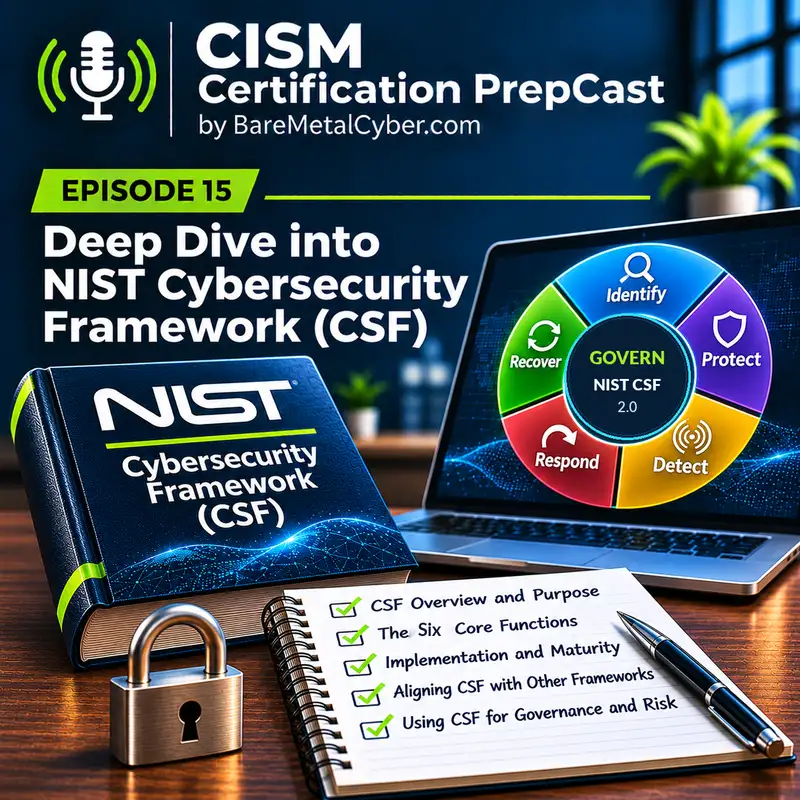
Deep Dive into NIST Cybersecurity Framework (CSF)
In this episode, we are examining a deep dive into the NIST Cybersecurity Framework. The NIST Cybersecurity Framework two point zero provides a taxonomy of high-level cybersecurity outcomes that organizations can use to understand, assess, prioritize, and communicate cybersecurity risk. It is designed for organizations of different sizes, sectors, and maturity levels. It does not prescribe the exact controls or products used to achieve those outcomes.
The framework core is organized into six functions: Govern, Identify, Protect, Detect, Respond, and Recover. Govern establishes and monitors cybersecurity risk management strategy, expectations, policy, roles, oversight, and supply-chain considerations. The other five functions describe outcomes across understanding risk, safeguarding assets, finding events, managing incidents, and restoring capabilities.
Govern surrounds and informs the other functions. Without governance, asset identification may lack ownership, protection may not reflect priorities, detection may collect data without decision paths, response may exceed authority, and recovery may restore services without business acceptance. The addition makes the management perspective explicit.
Identify develops understanding of assets, business context, dependencies, risk, and improvement needs. It supports prioritization by clarifying what the organization relies on and why. An inventory without ownership or business context is incomplete because it cannot reliably guide protection or response.
Protect covers safeguards that reduce the likelihood or impact of cybersecurity events. Outcomes include identity and access, awareness, data security, platform security, and resilience. The function does not imply that prevention is perfect. It establishes capabilities that support secure operation and limit harm.
Detect covers timely discovery and analysis of anomalies and events. Monitoring should reflect the systems, services, threats, and decisions the organization needs to support. More alerts do not necessarily mean better detection. Coverage, quality, context, and response integration determine value.
Respond covers incident management, analysis, reporting, communication, and mitigation. Roles, authority, external obligations, and coordination should be established before the event. The framework outcome must be translated into plans, procedures, tools, training, and evidence that fit the organization.
Recover covers restoration, improvement, and communication after an incident. Recovery should connect to business priorities, tested objectives, dependencies, and authorization. Restoring technology is not sufficient if the service remains unsafe, data integrity is uncertain, or stakeholders are not informed appropriately.
Profiles allow an organization to describe current and target cybersecurity outcomes. Comparing them can reveal gaps and help prioritize action. A profile should reflect business context and risk rather than becoming a generic maturity score. The organization still needs owners, resources, sequencing, and measures for the roadmap.
Implementation Tiers describe characteristics of how cybersecurity risk governance and management are practiced, ranging from less formal and reactive characteristics to more adaptive and integrated ones. They should support discussion and target-setting, not be treated as a simplistic certification ladder. The most appropriate target depends on risk, mission, resources, and obligations.
The framework can map to standards, regulations, and control catalogs. Informative references and organizational mappings can help translate outcomes into requirements and mechanisms. Mapping should reduce duplication while preserving scope and meaning. A crosswalk is not proof that a control operates.
A fictional city government might use a Current Profile to show that asset ownership and recovery testing are weak across essential services. Its Target Profile could define improved outcomes under Govern, Identify, and Recover. The roadmap would then assign owners, funding, architecture changes, exercises, and evidence. The framework helps organize the conversation, but the city must still execute the work.
CISM candidates should recognize that the framework is outcome-oriented and flexible. The best answer may use it to communicate posture, establish a target, identify gaps, or integrate cybersecurity risk into enterprise governance. The weak answer treats it as a fixed list of products or assumes adoption alone creates compliance.
The framework should remain dynamic. Business changes, supplier dependencies, incidents, threat intelligence, and control testing may change the Current Profile or target priorities. Governance reviews should decide when those changes require updates to strategy and resources.
The framework should be adopted as a governance instrument with defined purpose, scope, ownership, and integration. Its outcomes must be tailored to the organization rather than treated as an external checklist.
The framework core provides functions, categories, and subcategories that describe outcomes. It does not prescribe one technology or a single implementation sequence. An organization chooses the outcomes relevant to its scope and translates them into controls, processes, roles, and evidence. This outcome orientation makes the framework usable across different industries and architectures, but it also means leaders must supply the governance needed to make the outcomes operational.
Govern gives the framework an explicit enterprise foundation. It addresses organizational context, risk-management strategy, roles and responsibilities, policy, oversight, and cybersecurity supply-chain risk management. These subjects influence how the other functions are prioritized and resourced. If risk tolerance is unclear or owners lack authority, the organization may identify assets and deploy controls without producing coherent decisions. Govern makes cybersecurity risk management part of enterprise direction.
Organizational context under Govern means understanding mission, stakeholders, legal and contractual obligations, critical services, and dependencies. A hospital, manufacturer, local government, and online retailer may use the same framework but define very different priorities. The manager should identify which business outcomes must be protected and what external expectations constrain decisions. The framework begins with this context rather than assuming that all assets and threats have equal importance.
Risk-management strategy establishes how cyber risk is identified, assessed, responded to, monitored, and communicated. It should align with enterprise risk methods and approved appetite. Criteria need to be consistent enough for comparison while remaining appropriate to the organization. A strategy that defines ratings without decision thresholds is incomplete. Leaders need to know what exposure can be handled operationally and what must be escalated.
Roles, responsibilities, and authorities make the framework actionable. Business owners, service owners, risk owners, control owners, security teams, legal, audit, suppliers, and executives contribute different decisions and evidence. The organization should define who can approve policy, accept residual risk, declare an incident, authorize containment, and approve recovery. The framework does not assign these roles for you. It prompts the organization to make them explicit.
Oversight under Govern requires review of performance, risk, and changing context. Governance forums should receive reliable information, compare outcomes with expectations, and direct corrective action. A dashboard that lists completed activities without showing exposure or control quality does not provide meaningful oversight. The manager should connect framework outcomes to thresholds, owners, trends, and decisions. Oversight is demonstrated through action and follow-through.
Supply-chain risk management is integrated into Govern because third parties can affect every other function. The organization should understand critical suppliers, shared responsibilities, concentration risk, contractual obligations, incident cooperation, and exit dependencies. A provider's assurance report may support evaluation, but it does not remove the customer's accountability. Supplier outcomes should be included in profiles and monitoring when they are material to the service.
Identify establishes understanding of the environment and risk. Asset management includes hardware, software, systems, services, data, people, facilities, and external dependencies. The purpose is not inventory for its own sake. The organization needs enough accuracy to connect assets to owners, business services, data classifications, threats, vulnerabilities, and recovery priorities. Unknown or unowned assets weaken every later function.
Risk assessment within Identify develops credible scenarios and priorities. It considers threats, vulnerabilities, likelihood, impact, existing safeguards, and uncertainty. The output should guide treatment and resource decisions. A vulnerability score alone does not establish organizational risk. The manager should ask whether the affected asset is exposed, what business objective could be harmed, how existing controls perform, and who owns the resulting decision.
Improvement is also part of Identify because lessons from assessments, exercises, incidents, and operations should change the program. Findings should be analyzed for systemic causes, assigned to owners, prioritized, and tracked. A lesson learned that produces no change is only an observation. The framework encourages a feedback loop in which new evidence updates profiles, priorities, and controls.
Protect describes safeguards that reduce the likelihood or consequence of adverse events. Identity management, authentication, access control, awareness, data security, platform security, and technology resilience are examples of outcome areas. The selected safeguards should reflect risk and architecture. Implementing the same control strength everywhere can waste resources or create friction without improving important outcomes.
Protect also includes the human and operational conditions that sustain safeguards. Users need role-appropriate awareness, administrators need secure processes, configurations need controlled change, and data needs lifecycle protection. A tool can support these outcomes, but ownership and procedures determine whether it remains effective. Protection should be evaluated through evidence of operation, not only through proof that a product was purchased.
Detect focuses on discovering and analyzing adverse events. Continuous monitoring should cover the identities, networks, endpoints, applications, cloud services, data, physical environments, and suppliers relevant to prioritized scenarios. Coverage must be matched with context and response capability. Collecting more events does not improve detection when the organization cannot distinguish meaningful signals or act on them.
Adverse-event analysis determines what the signal means. Teams need baselines, correlations, threat context, asset importance, and defined criteria for escalation. Detection outcomes should support timely classification and decision-making. The strongest program measures whether important scenarios are detected with sufficient accuracy and speed, not merely how many alerts are generated. False positives, blind spots, and delayed triage all affect risk.
Respond organizes incident management, analysis, reporting, communication, and mitigation outcomes. Plans should establish declaration criteria, roles, authority, evidence handling, stakeholder coordination, and legal or contractual reporting. During an event, the framework helps teams connect technical actions to governance. Containment should reduce harm while respecting business impact and delegated authority. Communications should distinguish confirmed facts from assumptions.
Mitigation during response is not the same as permanent remediation. Blocking an account, isolating a host, or restricting a supplier connection may contain immediate harm while investigation continues. The organization later determines root cause, eradication, control changes, and risk treatment. This distinction matters on the examination because the first appropriate action during active harm may differ from the long-term program improvement.
Recover focuses on restoring services, communicating status, and improving resilience. Recovery priorities should come from business impact analysis, architecture, dependencies, and approved objectives. Restoration is not complete simply because a system starts. Data integrity, identity, monitoring, security controls, and business functionality need validation. The authorized owner should understand residual concerns before approving return to normal operation.
Recovery communication should address employees, customers, suppliers, regulators, and executives according to need and obligation. Messages must be coordinated and accurate. After restoration, the organization uses lessons learned to update plans, controls, profiles, and priorities. Recover therefore connects directly back to Govern and Identify. The six functions operate as an integrated system rather than a one-way checklist.
A fictional public-transportation service illustrates the relationship. Govern defines service priorities, risk authority, supplier oversight, and reporting. Identify maps operational systems, passenger data, dependencies, and credible attack paths. Protect applies access, segmentation, data, and resilience safeguards. Detect monitors important identities and service behavior. Respond coordinates containment and communication. Recover restores validated service and turns lessons into new governance decisions.
The framework can be implemented incrementally. An organization may begin with one critical service, define a Current Profile, establish a Target Profile, identify priority gaps, and create an action plan. Evidence from operation then informs the next cycle. This approach is often more effective than trying to score every outcome across the enterprise before any improvement begins. Scope and priority should be explicit so progress remains credible.
Categories and subcategories provide enough detail to structure assessment without dictating a control product. The organization may satisfy an outcome through several mechanisms, depending on architecture and risk. When selecting implementation methods, document the connection from outcome to control, owner, evidence, and measure. This traceability allows a later assessor to understand why the organization believes the outcome is achieved and where confidence is limited.
Profile development should involve business and technical stakeholders. Security can facilitate the process, but service owners understand mission priorities, operations teams understand dependencies, legal and compliance teams understand obligations, and executives determine tolerance. A profile built only by security may be technically complete yet misaligned with the service. Collaborative development also creates ownership for the resulting action plan.
The Target Profile should describe desired outcomes, not an unrealistic state where every subcategory receives maximum implementation. Prioritize based on mission, risk, obligations, architecture, and available resources. Some gaps require immediate treatment because they affect critical services or active exposure. Others can be sequenced into later improvement. The profile should make those tradeoffs visible rather than hide them behind a single maturity score.
Implementation Tiers provide context about the rigor and integration of cybersecurity risk governance and management. They should not be used as simplistic grades or assumed destinations. A higher tier may require cost and formality that are not justified for every scope. Leaders should choose a target consistent with risk and business needs, then use evidence to determine whether current practices show the expected characteristics.
A framework crosswalk can reduce duplicate work, but a mapping is not proof of conformance or effectiveness. One control may contribute to several outcomes and several obligations. The organization should maintain mappings when they support decisions, evidence reuse, or audit preparation. When mappings become stale or overly broad, they can create false confidence. Owners should review them when frameworks, controls, or services change.
Sector and community profiles can accelerate adoption by identifying common outcomes and assumptions for a group. They are starting points, not replacements for organizational context. A healthcare provider, energy operator, and software supplier may share concerns but have different critical services, dependencies, and tolerance. The manager should adapt community guidance to the actual service and document significant differences.
Evidence quality matters throughout the framework. Policy statements show intent, configuration records show implementation, logs show operation, tests show performance, and incident results show behavior under stress. No single artifact proves every outcome. The organization should collect sufficient evidence without creating an unsustainable burden. Confidence should reflect scope, sampling, timeliness, and known limitations.
Measures should connect framework outcomes to governance decisions. Asset coverage, privileged-access control, detection performance, incident escalation, recovery testing, supplier assurance, and exception aging can all support profiles when their definitions are clear. Avoid counting activity without context. A metric becomes useful when it shows a trend, compares performance with a threshold, names an owner, and triggers an action.
Common implementation failures include treating every subcategory as equally urgent, assigning all outcomes to the security team, creating a profile without an action plan, and reporting colors without evidence. Another failure is using the framework only during audit preparation. The framework should influence strategy, architecture, projects, operations, incidents, and improvement throughout the year. Otherwise, it becomes a documentation exercise rather than a management tool.
In an examination scenario, first identify which function and management problem are most relevant, but do not choose an answer merely because it contains the function's name. A Govern issue may require clarified authority, an Identify issue may require asset or risk understanding, a Protect issue may require a safeguard, a Detect issue may require monitoring, a Respond issue may require coordinated action, and a Recover issue may require validated restoration. The best answer still depends on role, timing, evidence, and business impact.
Framework use should be integrated with enterprise architecture and program planning. Profiles can reveal where target outcomes depend on shared identity, logging, data, supplier, or recovery capabilities. Those dependencies should influence roadmaps and funding rather than remaining isolated gaps. When several services depend on the same weak capability, a shared improvement may reduce more risk than separate local projects.
The framework also helps explain cybersecurity to executives without removing necessary detail from operators. Leadership can view priorities and trends through the six functions, while teams work with categories, subcategories, controls, and procedures. This layered communication is valuable because it keeps strategic reporting connected to operational evidence. The same framework language can support both audiences when scope and purpose are clear.
Use a service-centered scope when practicing. Name the service, its owner, important data, suppliers, recovery needs, and risk decisions before selecting outcomes. This keeps the framework connected to a real operating environment and prevents a broad enterprise profile from hiding the services that matter most.
For practice, build a Current and Target Profile for a fictional service using all six functions. Identify three gaps, rank them by business impact, assign owners, and state what evidence would show progress. Avoid naming tools until the desired outcomes are clear.
Remember the six functions in their management relationship: Govern, Identify, Protect, Detect, Respond, and Recover. Together they organize outcomes, but leadership, architecture, controls, people, and evidence make those outcomes real.
A Current Profile should describe selected outcomes as they are achieved today, based on evidence rather than aspiration. A Target Profile should describe outcomes the organization intends to achieve because of mission, risk, obligations, or strategy. The gap is not automatically a deficiency. Leadership decides which gaps matter, what sequence is feasible, and which risks remain acceptable during transition.
Profiles can be built for an enterprise, business unit, service, supplier relationship, or another meaningful scope. Scope should be explicit so readers do not assume that an outcome achieved in one environment applies everywhere. Dependencies and interfaces should be visible because a service may rely on identity, cloud, telecommunications, data, and recovery capabilities outside the profile boundary.
Community Profiles can help groups describe common outcomes for a sector, technology, or use case. An organization can use that work as a reference, but it should still evaluate its own context. Industry alignment does not remove the need for local ownership, architecture, risk decisions, and evidence. A profile is useful when it accelerates informed tailoring rather than replacing it.
Implementation Tiers should be discussed with care. They describe characteristics of risk governance and management, including whether practices are informal, repeatable, risk-informed, adaptive, and integrated. A higher tier is not automatically required for every organization or every service. The target should reflect consequences, obligations, resources, and the value of greater integration.
Supply-chain cybersecurity is visible across the framework, especially through Govern. The organization should understand material dependencies, establish expectations, perform due diligence, monitor providers, coordinate incidents, and plan exit. The framework outcome can guide the program, but contracts, architecture, evidence, and accountable owners create the actual capability.
The framework can also support executive communication because the six functions provide a recognizable view of the cybersecurity lifecycle. Leaders can discuss whether governance is clear, important assets are understood, safeguards operate, events are detected, incidents are managed, and services recover. Supporting detail should remain available, but the high-level structure helps connect technical work to decisions.
A common implementation mistake is creating a large spreadsheet that assigns a color to every subcategory without agreeing on evidence or business relevance. The result may look precise while teams interpret ratings differently. Define the outcome, scope, evidence, owner, and decision criteria before scoring. Use the assessment to prioritize improvement, not to manufacture a single maturity number.
Another mistake is treating the framework as a project with an end date. Profiles, priorities, and evidence should change when the business, architecture, suppliers, threat conditions, or obligations change. Governance establishes the review cadence and event triggers. Continuous use is what turns the framework into an operating language rather than a one-time assessment artifact.
Framework mappings should be governed like other program documentation. A mapping may show that one control supports several outcomes, but the organization must preserve the meaning and scope of each relationship. When a control changes, owners should review the affected outcomes, requirements, tests, and reports. Otherwise, a crosswalk can remain green while the operating control has drifted.
Use the framework during incidents as well as planning. Govern clarifies authority and communication, Identify supplies asset and business context, Protect shows safeguards that may have failed, Detect supports discovery, Respond organizes management of the event, and Recover guides restoration and improvement. The functions are not rigid incident phases, but they help leaders see where capability and evidence connect across the lifecycle.
For examination questions, do not assume that the most detailed subcategory or the highest tier is automatically the best answer. Read the organization’s objective and current condition. The correct action may be to define governance, create a profile, identify a material gap, assign an owner, or integrate an outcome into the existing program. The framework supports the decision, but it does not make the decision for leadership.
The security manager should also confirm that framework language is understood by the people expected to use it. Terms such as profile, tier, category, and outcome should support shared decisions rather than create another specialized vocabulary barrier. Training and examples should show how the framework connects to existing policies, architecture reviews, risk registers, incident plans, and executive reporting.
Framework use should remain proportional to the decision. A small service may need a focused profile and a few clear outcomes, while an enterprise program may require broader mappings, governance forums, and evidence.
A useful NIST Cybersecurity Framework discussion should therefore end with an accountable decision, not merely a colored profile or maturity label. The current and target states matter because they help leaders choose priorities, assign owners, fund improvements, and verify whether the intended cybersecurity outcomes are becoming more reliable over time.