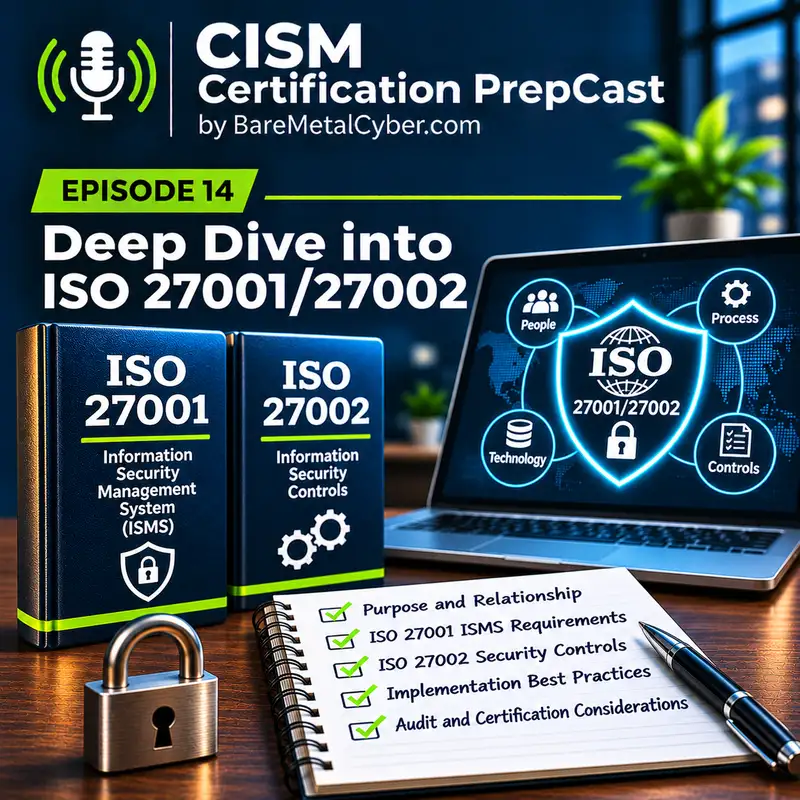
Deep Dive into ISO 27001/27002
In this episode, we are examining a deep dive into ISO slash IEC twenty-seven thousand one and twenty-seven thousand two. ISO slash IEC twenty-seven thousand one, two thousand twenty-two defines requirements for establishing, implementing, maintaining, and continually improving an information security management system, commonly called an ISMS. It is a management-system standard, which means it governs how the organization manages information security within a defined scope rather than prescribing one universal technical architecture.
ISO slash IEC twenty-seven thousand two, two thousand twenty-two provides guidance for information security controls. It supports control selection and implementation, but it is not the same as the certifiable requirements standard. Confusing the two can lead candidates to treat control guidance as if it were the complete management system.
The management system begins with organizational context and scope. Leaders must understand interested parties, relevant requirements, internal and external issues, boundaries, dependencies, and interfaces. A narrowly defined scope may be legitimate, but claims about certification or assurance should not be extended beyond that scope.
Leadership commitment is essential. Top management establishes policy, ensures objectives align with strategy, provides resources, assigns responsibilities, and integrates the ISMS into business processes. Delegating operation to a security team does not remove leadership accountability for the management system.
Risk assessment and risk treatment drive control decisions. The organization establishes a repeatable method for identifying, analyzing, and evaluating information security risk. It selects treatment options and controls based on the risk, obligations, and objectives. The result should be traceable rather than a generic adoption of every possible safeguard.
The Statement of Applicability records the relevant control set, whether controls are included, and the justification for inclusion or exclusion. It connects risk treatment to the reference controls in Annex A and to the organization's actual control environment. A copied Statement of Applicability that does not match scope, risk, and operation creates false assurance.
ISO slash IEC twenty-seven thousand two, two thousand twenty-two organizes its control guidance into organizational, people, physical, and technological themes. The themes make the guidance easier to navigate, but controls still need owners, implementation details, evidence, and monitoring. The standard supports thoughtful selection rather than mechanical installation.
Documented information should be sufficient to operate and demonstrate the management system. Policies, objectives, risk methods, treatment decisions, procedures, evidence, audit records, and corrective actions may all matter. More documentation is not automatically better. The organization needs current, controlled information that supports execution and assurance.
Performance evaluation includes monitoring, measurement, internal audit, and management review. These activities should identify whether objectives are achieved, controls operate, risks change, and corrective action is needed. A management review should produce decisions, not merely acknowledge a report.
Nonconformities require correction and corrective action. Correction addresses the immediate issue. Corrective action examines cause and prevents recurrence. Closing an audit item without validating the underlying change weakens continual improvement. Evidence should show that the response was implemented and effective.
Certification is performed for a defined scope by an appropriate certification body and typically includes initial assessment and continuing surveillance. Certification can support assurance and market needs, but it does not guarantee that no incident will occur. Stakeholders must understand the scope and what the certificate does and does not establish.
A fictional company may seek certification for its hosted service. If shared corporate identity, development, suppliers, or recovery capabilities sit outside the declared scope, leaders must understand the interfaces and residual risk. Scope should reflect the intended assurance, not merely the easiest boundary to audit.
ISO can be integrated with COBIT, the NIST Cybersecurity Framework, legal requirements, and sector obligations. The organization should maintain one coherent operating model and cross-map requirements where useful. Parallel documentation systems create inconsistency and increase the risk that operators follow the wrong version.
An information security management system needs documented information that supports operation and proof. The organization should define the scope, information security policy, risk assessment approach, risk treatment plan, objectives, responsibilities, and the evidence needed to evaluate performance. Documentation should be proportionate to complexity and risk. The purpose is not to create a library that nobody uses. It is to preserve consistent decisions, communicate expectations, and show that the management system is operating as intended.
The scope statement is especially important because certification and assurance conclusions apply to a defined boundary. The scope may include particular business services, locations, systems, and organizational units. Dependencies outside that boundary still need to be understood when they affect the scoped service. A narrow scope can be legitimate, but it must not be described as though the entire enterprise has been evaluated. Security leaders should communicate scope accurately to executives, customers, and auditors.
The Statement of Applicability links risk treatment to the reference controls. It identifies which controls are applicable, why they are included, whether they are implemented, and why any reference control is excluded. It should not be copied from another organization or treated as a generic checklist. The reasoning should reflect the organization's risks, obligations, architecture, and operating context. When the Statement of Applicability is current and defensible, it becomes a useful bridge among risk owners, control owners, and auditors.
Risk assessment and treatment records should show a repeatable method rather than isolated judgments. The organization defines criteria for likelihood, consequence, and risk acceptance, identifies owners, evaluates existing controls, and selects treatment. The method must be applied consistently enough that results can be compared and reviewed. This does not require false numerical precision. It requires clear criteria, traceable decisions, and evidence that the treatment plan is being executed and reassessed.
Operational documentation should match actual work. Procedures, configuration standards, supplier requirements, incident plans, and awareness materials may support the management system when they are needed for consistent execution. A document that describes an ideal process while teams follow a different process creates audit and operational risk. Owners should validate documents with the people who use them, control versions, remove obsolete material, and ensure that records remain available during disruptions.
Evidence of competence and awareness is broader than attendance. Training records can show participation, but the organization should also determine whether people understand their responsibilities and can perform them. Role-specific exercises, observed work, incident performance, and quality reviews can provide stronger evidence. When a control depends on specialized skill, the management system should identify the required competence, provide development, and address gaps. The goal is reliable performance, not a completed training spreadsheet.
Internal audit evaluates whether the management system conforms to the organization's arrangements and the standard's requirements and whether it is effectively implemented and maintained. Independence and objectivity matter. Auditors should use defined criteria, review evidence, sample operations, and report findings without owning the corrective actions they later assess. Internal audit is not a rehearsal designed to hide weaknesses. It is a management tool that surfaces gaps before they undermine objectives or external assurance.
Management review is where leadership evaluates whether the information security management system remains suitable, adequate, and effective. Inputs include changes in context, audit results, objective performance, incidents, nonconformities, risk status, resources, and improvement opportunities. The output should include decisions and actions, not only discussion. Leadership may change priorities, allocate resources, revise objectives, or require corrective action. A management review that produces no decisions is unlikely to provide meaningful governance.
Nonconformity and corrective action should address cause, not only symptom. When a required activity is missed or a control does not operate as intended, the organization responds, contains consequences where necessary, determines why the issue occurred, implements corrective action, and verifies effectiveness. Repeating the same finding after several audits suggests that the underlying cause or accountability has not been addressed. Improvement is demonstrated when evidence shows that the corrective action changed the process and reduced recurrence.
Certification involves independent assessment of the defined management-system scope, but the certificate is not proof that every system is invulnerable or every control is perfect. Surveillance and recertification activities test continuing conformance, while the organization remains responsible for daily operation and improvement. Customers should read the scope and relevant assurance information rather than relying on a logo. Security managers should use certification as one source of evidence within a broader risk decision, not as a substitute for due diligence.
An ISMS depends on controls that are both appropriately designed and consistently operated. Documentation of intent does not prove performance.
In control testing, "effective" is never a vibes-based compliment; it is a claim you can defend with logic and evidence. The first part of that claim is design effectiveness, which asks whether the control, as written and architected, would prevent or detect the risk it is supposed to address. The second part is operating effectiveness, which asks whether that control actually ran as intended during the period that matters. Many exam questions hide the trick in plain sight by using the word "effective" without specifying which half of the claim is being tested. The best-answer move is to separate "could work" from "did work," then choose the option that matches the question's evidence and timeframe.
Design effectiveness is about suitability and completeness in context, not effort or complexity. A well-designed access control might require a unique user identity, strong authentication, role-based authorization, and timely revocation, because those elements map directly to common access risks. If the design ignores a realistic threat path (like privileged access that bypasses the standard workflow) then the design is ineffective even if the team executes it perfectly. Design effectiveness also depends on clarity: if the procedure cannot be followed consistently by different people, the design is too ambiguous to be dependable. When you see policy language that is aspirational but non-operational, treat it as a design weakness, not a training opportunity.
Operating effectiveness is about execution over a defined period, and it is where "we intended to" stops counting. A control can be beautifully designed and still fail because it was not performed, not performed on time, performed by the wrong role, or performed using incomplete inputs. Operating effectiveness also includes whether the control leaves reliable traces that show it happened, because controls that cannot be evidenced are indistinguishable from controls that were skipped. If approvals are required but routinely granted after work is completed, the control may exist but it is not operating as a preventive control. In exam logic, operating effectiveness is tied to observed behavior and artifacts, not to policy statements.
A short scenario makes the split obvious: a company requires manager approval for access to the production environment, and the request system enforces that workflow. The design is likely effective because it creates a gate that aligns with the risk of unauthorized change, and it assigns accountability to a defined role. During testing, however, you find multiple emergency access grants that were approved days later, and some were approved by peers rather than managers. That evidence points to weak operating effectiveness even though the workflow, in theory, is sound. The best answer is not "rewrite the policy," but "fix execution and enforcement," because the defect is in operation, not in design.
The exam frequently tests your ability to infer which type of effectiveness is being questioned from the type of evidence presented. If you are given walkthroughs, policy reviews, system configurations, and control descriptions, you are mostly in design territory. If you are given ticket samples, logs, screenshots of completed steps, and timestamps across months, you are mostly in operating territory. If you are given both, the question may be asking for an overall conclusion, which requires you to treat failure in either area as a failure of effectiveness. A control that is poorly designed cannot be rescued by perfect execution, and a well-designed control that is not executed is still not effective in practice. That "either side can fail the claim" rule is a safe exam anchor.
A common trap is mistaking the existence of governance artifacts for operating effectiveness. A signed policy, a completed training module, or an attestation form often proves awareness and intent, but it does not prove that the control function occurred at the right time for the right scope. Another trap is assuming that automated controls are automatically effective because they are automated. Automation can strengthen operating consistency, but it can also automate the wrong logic, apply to the wrong population, or break silently when upstream data changes. When a question mentions "configured" or "implemented" without showing results over time, treat it as insufficient to conclude operating effectiveness.
The best-answer mindset is: design can be evaluated at a point in time, while operating effectiveness requires a period of performance. The most useful way to think about design effectiveness is mapping the control to a risk statement and asking whether the control interrupts the risk path. If the risk is "unauthorized modification of financial reporting systems," a detective control that reviews changes quarterly may be poorly designed if the business needs rapid detection. If the risk is "data exfiltration from sensitive repositories," a control that only limits user access but ignores service accounts may be incomplete by design. Design effectiveness also considers whether the control is scalable and enforceable given the organization's structure and tooling. In exam scenarios, the "best" control design tends to be the one that is specific, enforceable, and directly tied to the risk, not the one that is most comprehensive on paper.
Operating effectiveness also depends on how the control handles exceptions, because real environments run on exceptions. Emergency changes, break-glass access, vendor activity, and operational outages create pressure to bypass controls, so operating effectiveness requires that exceptions are controlled, time-bound, and reviewed. If exceptions are frequent, undocumented, or not retrospectively validated, the control may be operating in name only. Conversely, if the exception process is defined, consistently used, and evidenced with timely approvals and post-event reviews, the control can still be operating effectively even under stress. Exam questions often reward answers that recognize controlled exceptions as part of operation rather than treating every exception as a failure.
Apply this distinction to the fictional portal architecture. Before release, examine the control allocation and test whether permitted work succeeds while unauthorized record requests fail. After release, examine evidence from the relevant operating period, including access changes, exceptions, supplier interfaces, and important service failures. Passing an acceptance test does not prove that a control operated throughout the following quarter. When findings reveal an incorrect design assumption, send them back to the architecture owner; when execution failed, assign corrective action to the responsible control owner and validate closure.
When you are forced to pick the next action, choose the move that matches the type of effectiveness failure. If the control is poorly designed, the next action is to redesign it so it aligns with the risk, clarifies responsibility, and is measurable in performance. If the control is well designed but not operating, the next action is to address execution: improve enforcement, fix workflow steps, ensure the right population is covered, and strengthen evidence capture. If you lack enough evidence to decide, the best answer is often to expand testing or obtain additional artifacts rather than declaring the control effective. That is the exam-reality wink: "effective" is a conclusion you earn, not a label you apply.
Audits and reviews rely on evidence that is sufficient, appropriate, reliable, and relevant to the period and scope. Evidence collection should be designed into operation rather than reconstructed at the last moment.
Control testing lives and dies on evidence, because evidence is the only thing that turns a control claim into a defensible conclusion. Evidence should be persuasive, relevant to the control objective, and anchored to the period under review rather than to a single convenient moment. The fastest way to miss an exam question is to treat any artifact as proof, when the artifact actually proves something adjacent, like training completion instead of access removal. Evidence also has a direction: some evidence supports that a control operated, while other evidence supports that it failed or was bypassed. The "best answer" mindset is to ask what the artifact proves, what it does not prove, and whether it covers the right scope and timeframe.
Good evidence aligns to the type of control being tested, and the exam often expects you to recognize that alignment. Preventive controls typically need evidence that the system or process prevented the undesired action, such as enforced configuration settings or workflow gates that block progress without required approvals. Detective controls usually need evidence of observation and follow-up, such as alerts, review records, incident tickets, or reconciliation reports with documented investigation and resolution. Corrective controls need evidence that something was fixed and that the fix was validated, not just that a plan was written or a change was requested. If the evidence does not connect cleanly to the control's mechanism, it is weak even if it looks official and polished.
Evidence quality is as important as evidence existence, and quality is usually revealed by completeness, integrity, and traceability. Completeness means the evidence covers the entire population and period the control is supposed to cover, not a partial view that conveniently omits exceptions. Integrity means the evidence is reliable and resistant to tampering, which is why system-generated logs and independently produced records often carry more weight than self-reported checklists. Traceability means you can connect the evidence to specific events, specific actors, and specific outcomes, rather than relying on generalized statements like "reviews occur monthly." On the exam, evidence that is specific, time-stamped, and attributable tends to be the strongest.
Sampling exists because populations are large, time is limited, and the exam wants you to think like a tester, not like a wishful manager. Sampling intuition starts with recognizing that a sample is not a random pile of artifacts; it is a deliberate method for gaining confidence about a control's operation across a population. The more critical the control, the higher the inherent risk, or the more variable the process, the stronger your sampling approach needs to be. Conversely, a stable, highly automated control with uniform operation across the population may require fewer samples to reach the same level of confidence. The test-friendly idea is that sample size and selection should reflect risk, variability, and the strength of the control environment.
Selection matters as much as size, because biased samples create false comfort. If you only sample "clean" cases, you will conclude that controls work precisely where they are easiest, which is not the claim you are trying to make. Including outliers, exceptions, and high-risk cases is often more informative than sampling only typical transactions, because failures tend to cluster in edge conditions. Time-based spread also matters: a sample that only covers the last week of the period cannot support a conclusion about the full quarter. The exam frequently rewards answers that choose a representative sample across time, business units, and transaction types rather than an overly narrow slice.
There is a practical difference between "sample enough to detect issues" and "sample enough to conclude effectiveness," and exam questions exploit that gap. A small sample can be sufficient to discover a problem, because one verified failure can undermine operating effectiveness for the period in scope. Proving effectiveness generally requires stronger coverage, especially when the control is manual, complex, or dependent on human judgment, because inconsistency is the primary failure mode. This is why manual approvals, periodic reviews, and exception handling often demand more samples than automated configuration checks. In exam logic, the more humans involved, the more your sampling needs to account for variation in execution.
Exception rates and error patterns are the hidden accelerators in sampling decisions. If early samples reveal repeated issues, the next best step is not to declare the control effective and move on; it is to expand testing, refine the population, and understand whether failures are isolated or systemic. A cluster of failures in one department can indicate localized training or oversight problems, while failures across departments can indicate design flaws or tooling gaps. When you see inconsistent evidence, the best answer is often to investigate root cause and scope of impact before accepting remediation promises. The exam is less impressed by "we will fix it" than by "we understand the extent of the problem and can measure improvement."
Evidence expectations also change when a control is outsourced or relies on a shared service, because you still need assurance without direct visibility. In those situations, the most persuasive evidence often comes from independent reporting, contractual commitments, and clearly defined responsibilities, rather than from internal statements that "the vendor handles it." The key is that evidence should still map to the control objective and allow you to evaluate performance over time. If the only evidence is a marketing slide, a generic assurance letter, or a vague claim of compliance, the evidentiary value is low. Exam questions often steer you toward evidence that is specific, scoped, and independently produced, rather than evidence that is broad and self-attested.
Sampling intuition becomes sharper when you treat it as a confidence problem rather than a math problem. You are trying to decide whether the evidence supports a reliable conclusion about the control's operation, given risk, variability, and the consequences of being wrong. If the control protects a high-value asset or a high-impact process, you need stronger evidence and broader coverage to justify confidence. If the control is prone to bypass through exceptions, you must include exception cases or you will miss the real operating picture. The best answers are the ones that connect evidence and sampling choices to risk and control behavior, not to arbitrary thresholds.
For practice, define a fictional ISMS scope and identify context, interested parties, risk method, treatment decisions, control owners, evidence, internal audit, management review, and improvement. Then explain what would remain outside the assurance claim.
ISO slash IEC twenty-seven thousand one provides management-system requirements, while ISO slash IEC twenty-seven thousand two supports control guidance. Keeping those purposes distinct is essential for both examination accuracy and credible implementation.