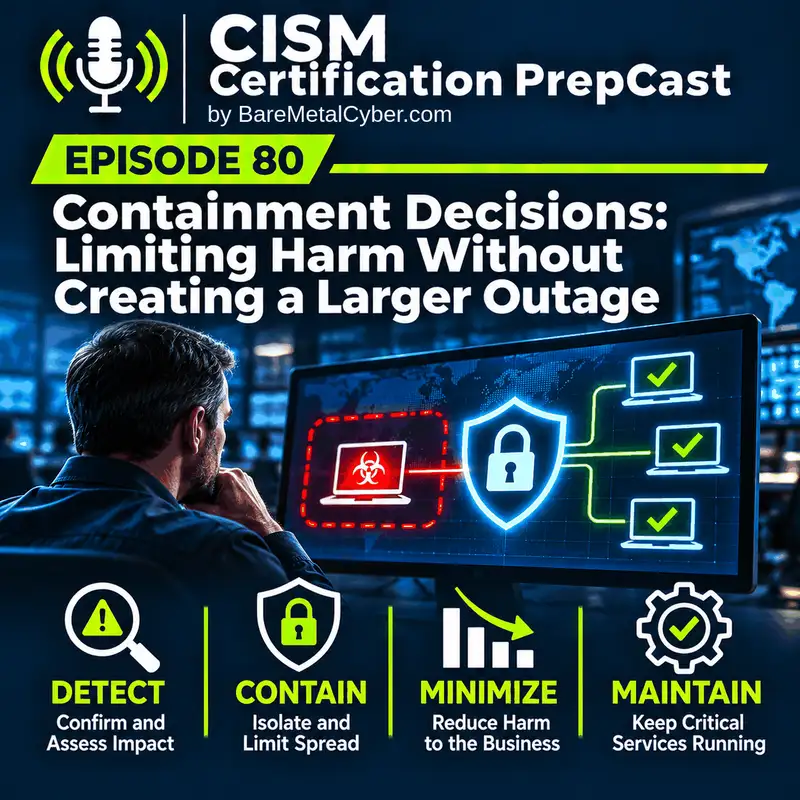
Containment Decisions: Limiting Harm Without Creating a Larger Outage
In this episode, we are examining containment as a management decision made under uncertainty. Containment is not simply the instruction to disconnect something, disable an account, or block traffic. It is the deliberate selection of an action that limits harm while respecting authority, evidence needs, business dependencies, and the possibility that an overly broad response could create a more serious outage.
Imagine a fictional company called Blue Marsh Logistics. It coordinates regional freight movements through a shared scheduling service used by dispatchers, warehouse teams, drivers, and several suppliers. Late one afternoon, monitoring shows that a supplier identity has downloaded unusual scheduling data and attempted to access an administrative function. The identity may be compromised, but the investigation is incomplete. The response team must decide whether to disable one account, suspend all supplier access, isolate a shared application segment, or shut down the scheduling service entirely.
Each option could reduce exposure, yet each has a different blast radius. Disabling the suspect identity is narrow and reversible, but it may not stop activity if the attacker has established another session or obtained a different credential. Suspending all supplier access could contain a broader identity problem, but it would interrupt legitimate warehouse coordination. Isolating the application segment may limit lateral movement while preserving some internal functions, but the technical team needs time to confirm dependencies. Shutting down the full service may stop current misuse, but it could strand shipments and disrupt safety-sensitive operations.
The first management question is not which tool is strongest. It is what harm must be limited now. The available evidence suggests unauthorized access and possible data collection, but it does not yet prove destructive activity or compromise of the entire platform. The team should identify the assets, services, and business outcomes at risk. Is the immediate concern confidentiality of customer routes, integrity of dispatch instructions, availability of scheduling, or all three? Clear harm framing helps the team select proportionate containment rather than reacting to the most alarming possibility.
Classification and categorization support that framing. The event may be classified as an incident because observed behavior exceeds the threshold for ordinary investigation. Its severity should reflect business impact, scope, sensitivity, and potential legal or contractual consequences. A high severity label can accelerate escalation and resource allocation, but it does not automatically justify the broadest technical action. Severity tells leaders how urgently to coordinate. The containment choice still requires analysis of what is known, what remains uncertain, and which action best reduces current exposure.
Containment is distinct from investigation, eradication, and recovery. Investigation seeks to establish facts, scope, cause, and evidence. Containment limits ongoing harm or prevents expansion. Eradication removes the cause or persistence mechanism after the organization understands enough to act safely. Recovery restores trusted operations and monitors for recurrence. These activities overlap in time, but confusing them can create poor decisions. A team may contain an account before it knows the full cause, yet it should not claim eradication merely because the suspicious activity stops.
The response leader should separate confirmed facts from inference. Blue Marsh Logistics has confirmed that the supplier identity performed actions outside its expected pattern. It has not confirmed whether the supplier employee initiated them, whether the credential was stolen, or whether another identity is involved. The team may infer compromise based on timing and behavior, but that inference should remain labeled. Assumptions, such as believing the attacker has no persistence, should be tested. This discipline prevents containment from resting on certainty the evidence does not support.
Authority is the next boundary. The incident response plan should identify who can disable individual accounts, who can suspend a supplier connection, who can isolate a network segment, and who can interrupt a critical business service. A security analyst may have authority to execute a predefined narrow action, while a broad service shutdown may require the incident commander and business owner. During urgent events, authority should be delegated in advance with clear thresholds. Waiting for improvised consensus can extend exposure, but acting beyond authority can create operational and governance failures.
Preauthorization is valuable for actions that must occur quickly. The organization might authorize the response team to revoke sessions and disable a suspect identity when specified evidence thresholds are met. It may authorize network isolation for a defined system category while requiring executive approval for actions that affect critical operations. These guardrails reduce decision latency without removing accountability. The plan should also define how responders document the basis, notify affected owners, and seek review after emergency action.
Reversibility is an important comparison factor. Disabling one identity can usually be reversed quickly if evidence changes. Deleting accounts, wiping systems, or making irreversible configuration changes may destroy evidence and complicate restoration. A reversible action is not automatically the best action, but it gives the team flexibility while facts develop. In uncertain conditions, a bounded and reversible measure often provides time for investigation without committing the organization to a larger disruption than necessary.
Blast radius is broader than the number of systems affected. It includes customers, employees, suppliers, contractual commitments, safety, data integrity, and recovery complexity. Suspending supplier access may appear narrow from a network perspective but could halt warehouse receiving across several regions. Isolating the scheduling application may protect other systems but prevent dispatchers from seeing current routes. A containment comparison should translate each option into service consequences so that decision-makers understand what they are trading.
The team should consider whether the action is likely to contain the actual pathway. If the suspect identity is the only observed access path, disabling it and revoking active sessions may be a reasonable first step. If evidence suggests token theft, simply changing the password may not terminate existing sessions. If several supplier identities exhibit similar behavior, the scope may justify a broader suspension. Containment should address the plausible mechanism, not merely the visible symptom.
Evidence preservation must be coordinated with speed. The organization should capture relevant logs, session information, authentication events, affected system state, and decision records according to its procedures. However, preservation should not become an excuse to leave active harm uncontained. The response plan should define minimum evidence steps that can occur quickly and in parallel with action. When the choice is between perfect evidence and preventing material damage, leadership should understand the tradeoff and document why a proportionate action was selected.
The technical team may propose taking a live memory capture before isolating an affected host. That can be valuable in some investigations, but the management question is whether the delay is acceptable given the observed threat and business impact. If harmful activity is continuing, isolation may take priority. If the system is stable and the evidence could materially affect legal or investigative outcomes, a short, controlled delay may be justified. CISM reasoning does not prescribe one universal sequence. It requires a decision aligned with risk, authority, and evidence needs.
Parallel work improves both containment and understanding. While one team disables the suspect identity and revokes sessions, another can review related authentication events, supplier contacts, endpoint telemetry, and access changes. The business owner can assess operational alternatives, while legal and communications teams evaluate notification triggers without making premature statements. This coordination avoids the false choice between acting and investigating. Mature incident management creates workstreams with clear ownership and shared decision points.
Communication with the supplier should be controlled. Blue Marsh Logistics needs the provider's help to verify whether the identity was used legitimately, preserve records, and understand possible downstream exposure. The message should state confirmed facts, requested actions, timing, and secure communication channels. It should not accuse a person or disclose unnecessary sensitive information. Contractual incident cooperation clauses can reduce delay, but the response team still needs a named contact and an escalation route that works outside normal business hours.
A broad shutdown may become necessary if the team cannot bound the threat. Suppose new evidence shows several administrative sessions, modified routing rules, and activity across shared infrastructure. The risk of continued operation could then exceed the disruption caused by stopping the service. The decision should be based on the expanded evidence and the organization's tolerance for integrity and safety impacts. Escalation is not failure. It is the mechanism for moving a decision to the authority capable of accepting the larger business consequence.
Conversely, a full shutdown may be excessive when a narrower control can contain the observed pathway. If the suspect account is disabled, tokens are revoked, privileged actions are blocked, and enhanced monitoring shows no other activity, the organization may preserve service while investigation continues. This is not complacency if the conditions are explicit and actively monitored. It is a bounded operating decision supported by current evidence. The team should define what new observation would trigger broader isolation.
Containment criteria should therefore include reassessment triggers. Examples include discovery of additional compromised identities, modification of critical data, failed attempts to bypass controls, evidence of persistence, loss of monitoring visibility, or supplier inability to cooperate. These triggers convert a temporary choice into an adaptive decision process. Without them, a narrow action can persist after the facts no longer support it. With them, responders know when authority and scope must expand.
Time also matters. A containment action that is effective for minutes may be unsuitable for days. Disabling supplier access may be acceptable while the organization validates scope, but prolonged suspension could create significant operational backlog. The team should identify a review time and an owner for the next decision. Temporary containment should not drift into an undocumented permanent state. Every extended restriction needs a business plan, risk evaluation, and path toward eradication or controlled restoration.
The organization should avoid changing too many things at once. Multiple uncoordinated containment actions can obscure which measure stopped the activity and can introduce new failures. A disciplined sequence may disable the identity, revoke sessions, restrict the affected interface, and increase monitoring while preserving a decision log. If evidence shows continued activity, the team can escalate to segment isolation or service interruption. Sequencing supports learning and reversibility while still allowing rapid expansion when needed.
Decision logging is essential under pressure. The record should capture the time, confirmed facts, assumptions, options considered, authority, selected action, expected effect, business consequence, and reassessment trigger. It should also record who was informed and what evidence was preserved. This is not administrative delay if the process is designed well. A concise log helps teams coordinate, supports later review, and prevents the organization from reconstructing critical choices from memory after the incident.
Containment should preserve the ability to recover. An action that blocks a system but also damages backups, destroys configuration records, or prevents access by recovery personnel may increase long-term harm. The team should consider how isolation affects logging, time synchronization, remote administration, and evidence collection. Network segmentation can be useful, but only if the isolated environment still supports the minimum functions needed for safe analysis. The manager's view includes the next stages, not only the immediate stop.
Business continuity alternatives can reduce pressure on the containment decision. If dispatchers can use a tested manual process for priority shipments, Blue Marsh Logistics may isolate more of the scheduling service without creating intolerable consequences. If no workaround exists, leadership may choose a narrower action while accepting additional monitoring and investigative risk. Continuity capability changes the set of feasible containment choices. This is why incident response, business continuity, and recovery planning should be coordinated before an event.
The security manager should also examine whether normal control design contributed to the incident. Perhaps the supplier identity had broader access than required, sessions lasted too long, or monitoring did not distinguish supplier behavior. Containment addresses the current event, but these observations should be captured for later risk treatment. It is too early to redesign everything during the response, yet it would be wasteful to ignore evidence about underlying control deficiencies. The incident can inform future architecture and program priorities.
Overly aggressive containment can create secondary incidents. Shutting down a shared identity platform might prevent malicious access, but it could also lock responders out of monitoring tools, interrupt emergency communication, or disable access to systems needed for safe operations. Disconnecting a network segment without understanding dependencies could stop warehouse controls or corrupt transactions in progress. The response leader should ask what new harm each option could cause and whether that harm is reversible. Containment is successful only when it reduces total risk, not when it merely stops one observable action.
Underreaction has its own cost. Teams sometimes delay because they fear disrupting the business, especially when evidence is incomplete. If the observed behavior is clearly unauthorized and the likely impact is material, waiting for certainty may allow expansion. The organization should use predefined thresholds to support timely action and avoid paralysis. Proportionate containment is not the same as minimal containment. It is the action reasonably matched to the risk and facts at the time.
Legal and regulatory considerations may affect the process without dictating a specific technical action. Preservation duties, contractual notice, privacy obligations, or law-enforcement coordination can influence evidence handling and communications. Security leaders should involve qualified internal functions rather than making universal legal assumptions. The incident plan should define when those functions join and what information they need. Their participation should support containment, not create an undefined approval bottleneck.
Metrics for containment should reflect decisions and outcomes. Time from validated detection to authorized containment can reveal delay. The number of incidents requiring emergency privilege may reveal gaps in predefined authority. Repeated use of broad shutdowns may indicate poor segmentation or weak playbooks. A low average containment time is not automatically good if actions routinely create unnecessary outages. Measures need context, impact, and review by people who can improve the system.
After the event, the organization should evaluate the containment choice using what was known at the time. A narrow action that later proves insufficient should be reviewed for whether the evidence and triggers supported escalation. A broad action that prevents harm but causes major disruption should be reviewed for whether better architecture or continuity options could reduce future tradeoffs. The goal is not to punish responders for uncertainty. It is to improve authority, playbooks, visibility, and options so the next decision is faster and better informed.
For exam scenarios, identify the incident phase and the decision verb. If the question asks for the first action during ongoing harm, an answer focused only on root-cause analysis may be too slow. If the question asks how to improve the program after containment, a temporary block may be incomplete. Pay attention to who is acting, what authority is stated, and whether the option protects evidence and business operations. The best answer often balances urgency with proportionality rather than choosing the most dramatic technical response.
Do not assume that a technical action is wrong merely because CISM emphasizes management. Disabling an account, isolating a host, or blocking traffic can be exactly the right choice when it fits the role, timing, evidence, and delegated authority. The management distinction is that the action is connected to a defined objective and accountable process. A manager ensures that responders know when they may act, what business consequences matter, and how the decision will be reviewed. Technical execution and management judgment support each other.
A useful decision comparison can be built with five questions. What immediate harm does the option reduce? What business service does it disrupt? How reversible is it? Who has authority to approve or execute it? What evidence or trigger will cause the team to maintain, expand, or reverse it? Writing these answers for each option turns vague debate into a structured decision. It also reveals when the team lacks information that can be gathered quickly without delaying necessary action.
For a learner exercise, return to the Blue Marsh Logistics scenario and compare four options: disable the suspect identity, suspend all supplier access, isolate the application segment, and stop the scheduling service. For each, describe the expected containment benefit, operational impact, evidence risk, authority, and reassessment condition. Then choose an initial action using only the confirmed facts. Add one new piece of evidence and decide whether your choice should change. This practice builds the habit of adaptive containment rather than static answers.
For another exercise, examine an incident response plan and locate its containment authorities. Ask whether the plan distinguishes individual account actions from business-service interruption. Determine whether after-hours authority exists and whether business owners know how they will be contacted. Look for evidence-preservation steps that can occur in parallel. If the plan lists tools but not decision rights, it may describe capability without providing operational governance.
Containment decisions should also account for the difference between confidentiality, integrity, and availability harm. If the primary concern is confidential data collection, restricting the identity and relevant data paths may be sufficient while investigation continues. If routing instructions may have been altered, the organization must protect integrity by validating pending transactions and preventing untrusted changes from reaching dispatchers. If the attack threatens service availability, the team may need to preserve essential functions even while isolating affected components. The same event can move among these priorities as evidence develops, so the response plan should not assume that one control objective remains dominant throughout.
Shared services deserve special caution because their containment blast radius is often hidden. The scheduling application may rely on common identity, messaging, logging, and network services used elsewhere in the company. Isolating one shared component can unintentionally affect unrelated business processes and can reduce the team's own visibility. Before taking broad action, responders should use current architecture information to identify dependencies and alternate paths. When time is limited, the architecture does not need to be perfect, but it should be good enough to explain which essential services could fail and who must be consulted.
Containment can also create contractual consequences. If Blue Marsh Logistics suspends a supplier connection, the contract may require notice, cooperation, service credits, or a defined escalation process. Those terms should not prevent urgent protective action, but they can shape communication and recovery planning. The organization should know whether the supplier can provide emergency credentials, alternate connectivity, or verified contacts. Contract language is most useful when it has already been translated into operational procedures that responders can use during the event.
The response team should protect decision quality from status pressure. Senior leaders may ask whether the incident is contained before the evidence supports a definitive answer. A disciplined update can say that the observed pathway has been blocked, monitoring has been increased, and no additional activity has been seen during a defined interval, while noting that the broader investigation continues. This is more accurate than declaring complete containment or refusing to provide any status. Clear qualification allows leaders to make business decisions without mistaking a current observation for final proof. It also creates a stable reference for the next update, so changes in scope, confidence, and operational impact can be explained rather than hidden behind a repeated label.
Containment should include a plan for controlled release. Restrictions are sometimes removed because users complain, not because evidence supports restoration. The team should define what must be true before access resumes, such as credential reset, identity validation, session revocation, supplier confirmation, integrity checks, and enhanced monitoring. A release decision may be staged, beginning with limited functions or a small group of users. This prevents the organization from undoing its own containment before the cause and scope are sufficiently understood.
Blue Marsh Logistics should begin with the narrow action that addresses the confirmed pathway, provided the response team has authority and the action does not leave an obvious active route. Disabling the suspect identity, revoking sessions, restricting the affected interface, preserving relevant evidence, and increasing monitoring may be proportionate while parallel investigation proceeds. The team should define triggers for broader supplier suspension or service isolation and keep the business owner informed. If evidence expands, the decision should expand with it.
The important lesson is not that narrow containment is always better. It is that containment should be bounded by current evidence, business impact, reversibility, and authority. A broad shutdown can be correct when the threat cannot be controlled otherwise. A targeted action can be correct when it meaningfully limits harm and preserves critical operations. The security manager's responsibility is to make the tradeoff visible, ensure the decision is authorized, and create the conditions for rapid reassessment.
Containment under uncertainty is disciplined action, not hesitation and not panic. Identify the harm, distinguish facts from assumptions, compare proportional options, preserve necessary evidence, and coordinate with the people who own the affected service. Record why the selected action is appropriate now and what would make it inappropriate later. That decision trail protects the organization from both uncontrolled threat activity and unnecessary self-inflicted disruption.
Containment authority should be designed before a crisis so responders know which actions are preapproved, which require rapid escalation, and which business consequences must be considered. That preparation allows the organization to move quickly without confusing urgency with unlimited permission or treating every system as equally expendable during a rapidly changing event.