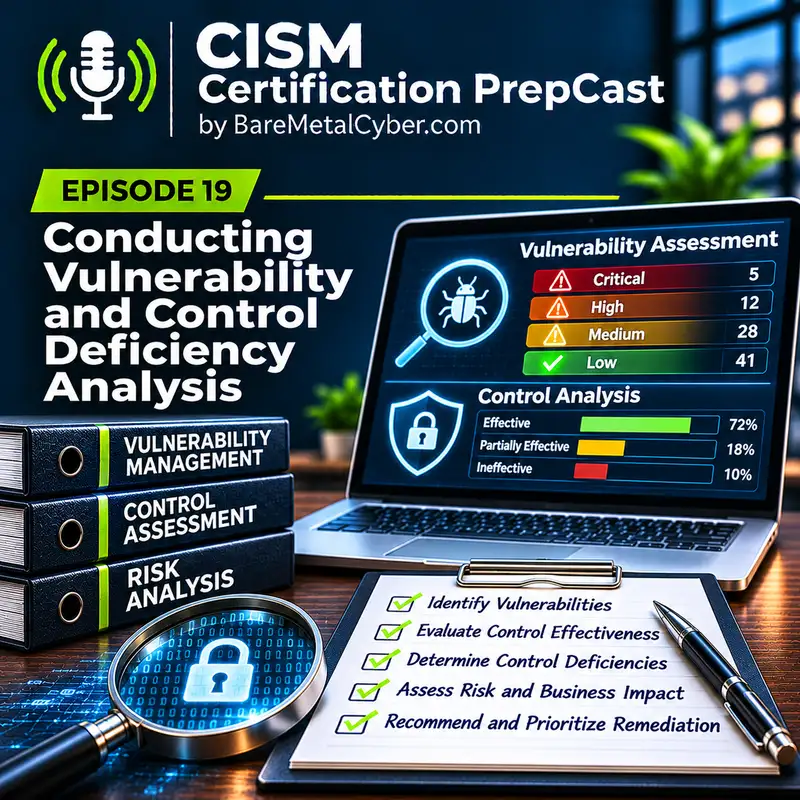
Conducting Vulnerability and Control Deficiency Analysis
In this episode, we are examining conducting vulnerability and control deficiency analysis. A vulnerability is a weakness that may be exploited or otherwise contribute to harm. A control deficiency is a problem in control design, implementation, operation, evidence, or scope. They can overlap, but treating them as identical leads to poor prioritization and incomplete remediation.
A fictional utility scans ten thousand assets and receives thousands of findings. The management challenge is not to sort by scanner severity alone. The organization must determine which findings affect critical services, which controls failed, what attack paths are plausible, and how remediation will be verified.
Vulnerability scanning outputs are best understood as technically derived observations about systems, applications, and configurations, while deficiency identification is a governance and assurance activity that determines whether controls are designed appropriately and operating effectively. A scanner can tell you that a host is missing a patch, exposes a service, or presents a known signature, but it cannot determine whether the organization's control objectives are being met. Deficiencies are grounded in criteria: policy, standards, regulatory requirements, contractual obligations, and internal control expectations. The key exam distinction is that vulnerabilities describe potential technical weakness, whereas deficiencies describe a shortfall against an expected control state, whether or not a tool detected it.
A common exam trap is assuming that a scanner finding is automatically a control deficiency. A critical CVE on an internet-facing service might be a vulnerability, yet not a deficiency if the organization has an approved risk acceptance with documented rationale, time-bounded mitigation steps, and ongoing monitoring that aligns with policy. Conversely, a control deficiency may exist even when scanning shows "clean," such as when asset inventory is incomplete and entire environments are missing from scan scope. Scanning is evidence, not judgment, and deficiency identification is the judgment applied to evidence. That judgment must tie to defined requirements and demonstrate that someone evaluated whether the control outcome is achieved.
Consider a scenario where a monthly scan report shows hundreds of medium findings across endpoints, but leadership's question is why recurring issues never decline. The vulnerability report provides volume and severity, but deficiency identification asks whether the patch management control is functioning as intended: Are systems covered, are exceptions controlled, are timelines enforced, and is accountability clear. The deficiency may not be "missing patches" as a standalone statement, but "patch management is not operating effectively to meet the defined remediation SLA and scope requirements." That framing turns technical noise into an auditable problem statement tied to control performance. On an exam, the best answer usually reflects that shift from raw findings to control effectiveness.
Vulnerability scanners operate with assumptions that matter when interpreting outputs as evidence. They depend on accurate discovery, credentialed access where applicable, correct network paths, and reliable signatures, and any weakness there can inflate false positives or hide true exposure. A scanner reporting "host unreachable" is not a benign technical footnote; it is potentially evidence of a control gap in asset management, monitoring, or segmentation visibility. Similarly, scanner categorization like "critical" is often vendor-defined, while organizational risk ratings should reflect business context and exposure. A mature deficiency analysis treats scan results as inputs that require validation and context, not as final conclusions.
Deficiency identification frequently starts outside the scanner, using outcomes that indicate control intent is not being met. Repeated emergency changes, inconsistent logging, privileged access exceptions, or unresolved audit issues can all signal deficiencies even when vulnerability metrics look stable. In those cases, scanning outputs may be used to corroborate patterns, but the deficiency is anchored in process performance, governance, and accountability. The exam-friendly mental model is that vulnerabilities are discovered weaknesses in assets, while deficiencies are discovered weaknesses in controls. If you can articulate the "control should do X, but evidence shows it does not," you are doing deficiency identification rather than listing technical findings.
Another useful distinction is that vulnerabilities tend to be itemized and technical, while deficiencies tend to be systemic and causal. A scan might list "TLS weak cipher" across twenty systems, but deficiency analysis asks why standards are not enforced at build time, why configuration baselines are not applied, and why detection did not prevent drift. The deficiency could be "secure configuration management is not consistently implemented," with the scan findings serving as representative evidence. This matters because remediation plans differ: patching and reconfiguring addresses individual vulnerabilities, while fixing a deficiency often requires changes to control design, workflow, ownership, and monitoring. Exam questions often reward answers that target the control level when the problem is persistent and recurring.
It is also important to separate detection capability from the control itself, because many controls are preventive or directive and may not show up as scanner findings. For example, an organization may have a strong secure development lifecycle control that reduces exploitable flaws, yet scanning will still detect third-party component issues that require governance over dependency management. Conversely, an organization might run scans faithfully while lacking an effective vulnerability management control, evidenced by unclear remediation timelines, inconsistent exception handling, and lack of risk-based prioritization. In that case, scanning is happening, but the control objective (reducing exposure to acceptable levels) is not being achieved. The exam framing emphasizes that tools support controls, but tools are not controls by themselves.
When translating scanning outputs into deficiency language, the highest-quality statements include scope, criteria, and consequence in a single coherent claim. Scope clarifies which environments, systems, or processes are affected and whether the issue is isolated or systemic. Criteria links the gap to a defined expectation, such as a patch timeline, configuration standard, or access control requirement. Consequence explains the risk in terms of likelihood and impact, especially where exposure exists to external threat paths or sensitive assets. This translation is what turns technical data into something an assurance function can act on, and it is often what exam questions are actually testing.
For the purpose of certification-style reasoning, remember that scanning outputs are one stream of evidence among many, and deficiency identification is the act of concluding that a control is missing, poorly designed, or not operating as intended. The most defensible conclusions combine scanner evidence with validation, such as configuration review, ticketing and change records, interviews, and sampling across the control lifecycle. A scanner finding might be resolved quickly but still reveal a deficiency if it indicates a recurring breakdown in preventive measures. Conversely, a large set of findings might not equal a major deficiency if they are low exposure, within agreed timelines, and trending down under an operating control. The best answers consistently separate "what the tool observed" from "what the control should achieve," and then connect them with criteria-based logic.
Findings become more valuable when the analysis reaches the cause rather than only the visible symptom. Repeated weaknesses often reveal governance, ownership, architecture, or process failure.
Control failures rarely occur because people "forgot" security; they occur because the control's design, placement, or operating model does not match how work actually happens. When a control is routinely bypassed, delayed, or inconsistently applied, that is a signal that the control is misaligned with incentives, capacity, or workflow. A CISM-minded analysis treats a control as a system: defined objective, clear ownership, repeatable execution, measurable performance, and evidence generation. If any of those pieces are weak, the control can exist on paper while failing in practice. The exam-relevant skill is recognizing the pattern behind the failure, not just the symptom.
For example, incorrect role mappings in a shared identity service may create access defects across several applications. Investigate the shared mapping owner and design before treating each application's finding as an unrelated remediation ticket.
One common pattern is unclear control intent, where teams do not share the same definition of what "compliant" looks like. Policies that state "apply patches promptly" or "log security events" without a measurable timeline, scope, and responsibility invite inconsistent interpretations. In that environment, different teams will optimize for local goals, and the control will appear to "work" until an incident or audit forces a precise reading. This is a design failure, not an execution failure, because the control cannot be reliably operated as written. The best corrective action is to make the control objective testable and unambiguous, so operating evidence becomes straightforward.
Another frequent root cause is ownership ambiguity, especially for controls that span multiple functions such as identity lifecycle, vulnerability remediation, or logging coverage. When no single role is accountable end-to-end, gaps appear at handoffs: tickets are created but not closed, exceptions are granted but not reviewed, and monitoring exists but is not tuned. The system may contain many responsible parties, but responsibility without accountability produces drift. On exams, the strongest answers often assign control ownership clearly and require measurable reporting, because that is how controls become dependable. A control that everyone supports but nobody owns is usually a control that fails.
Resource and capacity constraints create a predictable pattern of "controls that work only during calm weather." Teams may have enough staffing and tooling to operate controls in steady state, but not during peak change windows, outages, or incident response. When priorities shift, preventive and detective activities become optional, backlogs accumulate, and exceptions multiply. This produces a cycle where control failures become normalized and later treated as unavoidable technical debt. A risk-aware organization designs controls for real operating conditions, including surge capacity and fallback modes, rather than assuming perfect execution at all times.
A related pattern is excessive manual work in controls that must run at scale. If evidence collection, access reviews, configuration checks, or remediation tracking depend on spreadsheets and hero effort, control performance becomes sensitive to turnover, competing priorities, and time pressure. Manual controls can be appropriate in limited scope, but they degrade quickly when asset counts rise or environments change frequently. In practice, manual steps increase latency and reduce coverage, which creates the illusion of control while exposure grows underneath. The exam-friendly takeaway is that repeatability and evidence generation must be designed into the control, not bolted on after failures occur.
Control failures also cluster around poor integration with change and release practices. If secure configuration baselines, segmentation rules, or logging requirements are not embedded into build and deployment workflows, the organization becomes dependent on after-the-fact detection. That typically yields recurring findings because the pipeline keeps producing the same misconfigurations. In those cases, the root cause is not that remediation teams are slow, but that preventive controls are placed too late in the lifecycle. Strong control design places checks where they are cheapest to apply and hardest to bypass, which reduces both risk and rework.
Exception handling is another reliable failure pattern, because exceptions can quietly become a parallel operating system. When compensating controls, risk acceptances, and temporary waivers are not time-bounded, reviewed, and tracked to closure, they accumulate and erode the control environment. Over time, what started as an approved deviation becomes the default, and the organization loses a clear picture of its true risk posture. Many control failures are "papered over" by exceptions that were never revisited, making audits and incidents feel like surprises. A disciplined exception process is itself a control, and weak exception governance is often the root cause behind persistent deficiency narratives.
Metrics and feedback loops can also fail the control, even when execution appears consistent. Controls that are measured only by activity, such as "number of scans run" or "tickets created," can mask the real outcome, such as "exposure reduced within SLA" or "critical assets fully covered." Without outcome metrics and trend analysis, leadership cannot see when control effectiveness is deteriorating or when risk is concentrating in a particular environment. This often leads to misallocated effort, where teams chase volume rather than impact. Exam questions frequently reward answers that distinguish operational activity from risk-reduction outcomes.
Finally, control failures often reflect misaligned incentives, where speed, uptime, or feature delivery is rewarded while control adherence is treated as friction. In those environments, teams learn that bypassing controls has low cost, while following them has visible cost, so bypass becomes rational behavior. This is not solved by reminders or punitive messaging; it is solved by redesigning the control so that compliance is the easiest path and by making control performance part of normal management visibility. When incentives, workflow, and accountability align, control adherence becomes a byproduct of doing the job, not an extra job. That alignment is the durable fix that many "quick remediation" plans miss.
Compensating controls exist to reduce risk when a primary control cannot be implemented as intended, but they are not a permission slip to ignore the original requirement. The exam-relevant framing is that a compensating control must address the same risk scenario, to a comparable level, and in a way that can be evidenced and sustained. If the primary control is preventive and the compensating control is purely detective, you should immediately think about whether detection alone sufficiently reduces likelihood and impact in the given context. A compensating control is a deliberate design decision, not an improvised workaround, and it should be treated with the same rigor as any other control. The goal is not perfect equivalence in form, but sufficient equivalence in risk reduction.
Residual risk is what remains after controls are applied, and understanding it requires separating inherent risk from control effectiveness. Inherent risk is the exposure before controls, shaped by asset criticality, threat likelihood, and impact potential. Control design and operation reduce that exposure, producing residual risk that management must decide to accept, transfer, avoid, or further mitigate. In exam scenarios, "residual" is often where the best-answer logic lives, because it connects technical limitations to governance decisions. A risk decision without clear residual-risk reasoning is usually the wrong answer.
A short scenario makes the distinction clear: an organization cannot patch a legacy system supporting a critical business process because the vendor no longer provides updates. The vulnerability is real, but the question is whether the organization can reduce exposure through alternate means and whether the remaining risk is acceptable. A compensating control might include isolating the system from general network access, restricting inbound connections to only required sources, and increasing monitoring for abnormal behavior. If those measures meaningfully reduce the likelihood of compromise and limit blast radius, residual risk may drop to a level that can be formally accepted for a defined period. If the system remains internet-exposed with broad access, then no reasonable compensating control claim exists, and residual risk remains unacceptably high.
Compensating controls must be evaluated as a control package rather than a single tactic, because risk reduction often comes from layered effect. Replacing a missing preventive control with a combination of stronger access control, segmentation, and enhanced monitoring can be credible, but only if each element is implemented with clear scope and ownership. The most common failure is proposing a compensating control that sounds plausible but is not operationalized, such as "we will monitor closely" without defined telemetry, thresholds, response procedures, or staffing capacity. Another failure is treating a compensating control as permanent by default, which gradually normalizes exceptions and increases systemic exposure.
The exam wants you to recognize that compensating controls should be time-bounded and periodically revalidated. Residual risk logic should explicitly incorporate what the compensating control changes in the attack path. If the primary control would have reduced likelihood by removing a vulnerability, and the compensating control instead reduces likelihood by reducing reachability, you should be able to articulate that mechanism clearly. If the compensating control mainly reduces impact by limiting privilege or lateral movement, that also must be stated plainly. Good reasoning ties controls to outcomes: "this reduces exposure by narrowing access," "this reduces probability by requiring stronger authentication," or "this limits impact by containing the system's connectivity." If you cannot connect the control to a specific risk reduction effect, you are not doing residual-risk analysis; you are listing activities.
The formal acceptance of residual risk is an executive governance act, and exams typically expect that acceptance to follow documented evaluation. That evaluation includes the business rationale for why the primary control cannot be implemented, the compensating control plan, the assessed residual risk level, and the approval by the appropriate risk owner. It also includes conditions, such as an expiration date, a requirement to revisit after a system upgrade, or a trigger for reevaluation if threat conditions change. Risk acceptance is not "IT signs off," and it is not "security agrees"; it must sit with the role accountable for the business impact. In the exam mindset, the correct answer usually includes the right decision-maker and a clear record of the decision.
Residual risk is also shaped by control assurance: confidence that the compensating control is operating as expected. A compensating control that is untested, inconsistently applied, or weakly monitored provides less risk reduction than one that is reliable and evidenced. This is why evidence matters, because without it you are estimating risk reduction based on intent rather than performance. If monitoring is the compensating control, then logging coverage, alert fidelity, and response time become part of the residual risk calculation. When evidence is weak, residual risk should be assessed conservatively.
Another common exam angle is the difference between compensating controls and compensating measures that merely shift risk around. For example, moving a vulnerable workload behind a VPN may reduce internet exposure, but if VPN access is broad and identity controls are weak, the compensating measure may simply relocate the risk to the identity plane. Similarly, adding a web application firewall might reduce exploitability for certain classes of attacks, but it may not address underlying authorization flaws or insecure business logic. In those cases, residual risk remains high unless additional controls address the true weakness. The best answers show that you understand what problem is actually being compensated for and where risk may re-emerge.
Ultimately, compensating controls and residual risk logic are about disciplined tradeoffs under constraints. The exam rarely expects you to claim that every gap can be eliminated immediately, but it does expect that gaps are handled transparently and defensibly. If a primary control is infeasible, you reduce risk with credible alternate controls, measure what remains, and obtain appropriate acceptance with conditions and review. If a gap creates unacceptable exposure, you escalate rather than normalize it through indefinite exceptions. That is the governance posture that distinguishes risk management from risk narration.
After the issue and cause are understood, leaders still need a defensible order of action. Business impact, exposure, exploitability, dependencies, and feasibility should shape priority.
Remediation prioritization is where vulnerability data, control deficiencies, and business context are converted into an ordered plan that actually reduces risk. The exam-minded mistake is treating severity scores or scanner "critical" labels as the sole driver of priority, because those labels do not fully represent exposure or impact in your environment. A better priority decision combines what could happen, how likely it is to happen given current exposure, and what the business would lose if it did. Impact and exposure act like multipliers: a moderate weakness on a crown-jewel system with broad reachability can be higher priority than a critical weakness on an isolated test host. The "best answer" is usually the one that ties remediation order to real risk, not just technical urgency.
Impact begins with asset criticality and data sensitivity, because the same technical failure has different consequences depending on what the system supports. Systems tied to revenue generation, safety, regulated data, or privileged identity functions have outsized impact because compromise affects more than a single workload. This is why consistent asset classification is foundational to prioritization; without it, organizations default to reacting to the loudest report. In exam scenarios, look for cues like "internet-facing," "contains customer data," "supports financial reporting," or "domain administrator access," because these phrases signal impact. The correct prioritization often focuses on the systems that would create cascading harm if they fail.
Exposure describes how reachable and exploitable an issue is in real operating conditions, not in theory. External attack surface, network segmentation, identity controls, and privilege boundaries all affect exposure, as do compensating controls already in place. A vulnerability on a system that is not reachable from likely threat paths may represent lower immediate exposure, even if the vulnerability is severe in isolation. Conversely, broad access, weak authentication, and flat networks magnify exposure, even for modest technical findings. The exam wants you to notice exposure clues, because they translate directly into likelihood and time-to-exploit considerations.
A concise scenario shows the logic: two findings arrive on the same day, one a critical remote code execution on a lab server, and another a medium misconfiguration on an internet-facing identity service. If the lab server is isolated with no sensitive data and no route to production, impact and exposure are constrained even though the technical severity is high. If the identity service issue enables credential abuse or weakens authentication, the potential blast radius is larger and the exposure is immediate. The remediation plan that starts with the identity service better reflects impact and exposure, even if a scanner's ranking disagrees. That is the kind of reasoning exams tend to reward.
Prioritization also needs to differentiate "fix now" items from "fix next" items based on exploitability and operational timing. Issues with known active exploitation, simple attack preconditions, or direct external reachability typically rise to the top because the window for harm is short. Issues that require complex chaining, insider access, or highly specific conditions may still matter, but they can be scheduled behind more exposed weaknesses if resources are limited. This is not about minimizing effort; it is about reducing the most probable and most damaging loss paths first. A strong remediation approach recognizes that some risk is time-sensitive and must be handled with urgency.
Control deficiency remediation follows similar logic but often targets systemic levers rather than individual findings. If recurring vulnerabilities exist because secure configuration baselines are not enforced, prioritizing baseline enforcement can reduce an entire class of findings across many assets. If remediation backlogs are growing because patch ownership is unclear, fixing ownership and workflow may produce larger risk reduction than chasing individual tickets. Exams often probe whether you can see beyond single-issue remediation to control-level improvements that change outcomes over time. The best answer frequently includes stabilizing the process that generates and sustains the fixes, not only applying point fixes.
Impact and exposure prioritization should also consider concentration risk, where many moderate issues cluster on a shared control plane or common technology stack. A single vulnerable shared service, such as a central authentication component or a widely used management interface, can amplify impact across multiple business units. Similarly, weaknesses in privileged access paths can convert otherwise contained vulnerabilities into enterprise-wide compromise. When the control plane is at risk, prioritization shifts toward protecting trust anchors and choke points. In exam phrasing, prioritize controls and assets that, if compromised, enable lateral movement and privilege escalation.
Operational constraints and change risk are part of prioritization, but they do not excuse delay without compensating action. High-impact systems may require maintenance windows or careful testing, yet exposure may demand immediate interim measures such as tightening access, isolating services, or increasing monitoring until full remediation is deployed. The exam-friendly way to express this is: reduce exposure quickly, then execute durable remediation safely. That approach respects uptime concerns while still acknowledging that risk persists while the vulnerability remains. If an answer proposes "wait for the next scheduled patch cycle" without addressing immediate exposure, it is often incomplete.
Finally, good prioritization produces a remediation queue that is explainable to executives and defensible to auditors. That means you can articulate why a given issue is ahead of another in terms of impact, exposure, and control effectiveness, and you can show that decisions align with risk appetite and policy. It also means you track progress in a way that demonstrates risk reduction, not just closure rates, so leadership can see whether the most dangerous exposures are shrinking. When exam questions ask for the "best" prioritization method, they are usually looking for this risk-based rationale grounded in business consequence and real attack paths. That is what turns remediation from busywork into risk management.
Remediation is complete only when the required change has been implemented, evidence has been reviewed, and the risk record reflects the verified result. Closing a ticket without validation is administrative completion, not assurance.
For practice, compare two fictional findings with different scanner scores and business contexts. Explain which one should be addressed first, what control deficiency may underlie it, and what evidence would support closure.