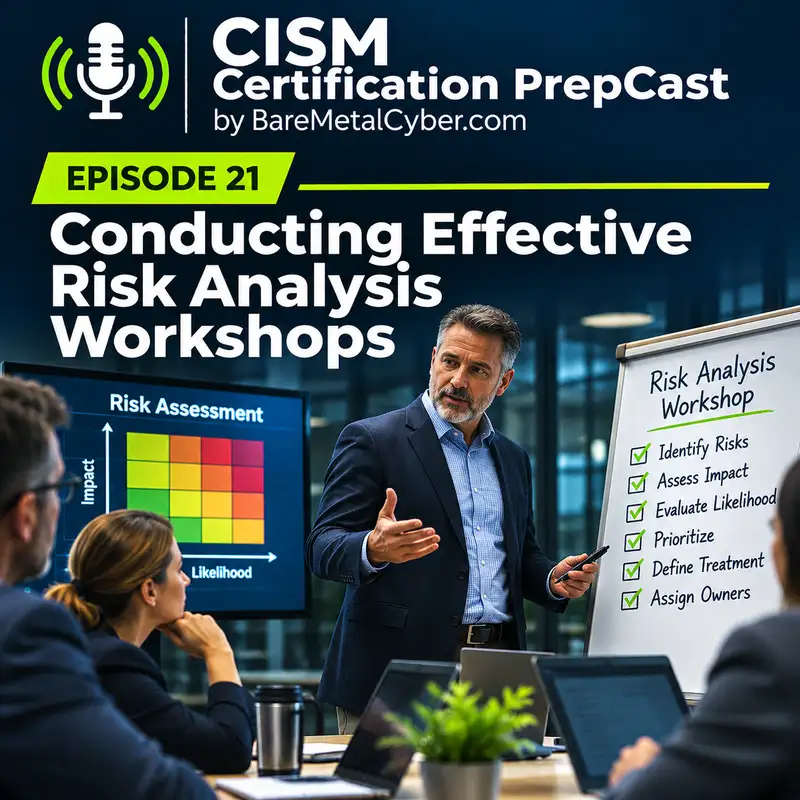
Conducting Effective Risk Analysis Workshops
In this episode, we are examining conducting effective risk analysis workshops. Risk workshops bring business, technical, legal, compliance, and operational knowledge into one structured decision process. Their value comes from disciplined preparation, neutral facilitation, explicit assumptions, and documented follow-through, not merely from gathering many people in a room.
Imagine a fictional company preparing to launch a connected medical device. Engineering understands the technology, operations understands support, legal understands obligations, and business leaders understand market objectives. A workshop helps combine those perspectives into risk scenarios and treatment decisions.
Risk analysis workshops serve a vital function within information security governance. These sessions bring together cross-functional perspectives to evaluate threats, vulnerabilities, and potential impacts on the organization. Rather than relying solely on technical assessments, workshops facilitate structured discussion across departments, including IT, business operations, compliance, and legal. This collaborative approach improves the accuracy of risk identification and supports consensus around prioritization. Risk analysis workshops also increase engagement by giving stakeholders a voice and a shared sense of ownership in managing risk.
Workshops are particularly useful for translating abstract security concepts into concrete operational terms. Through dialogue, participants can challenge assumptions, share frontline insights, and connect risk scenarios to actual business processes. The outputs of a risk workshop often feed directly into risk registers, treatment plans, and governance reporting. When done well, workshops transform the risk assessment process from a compliance activity into a strategic exercise with actionable outcomes.
Successful workshops begin with clear planning. The first step is to define the objective of the session. What is the intended outcome? Is the workshop focused on identifying new risks, reassessing existing ones, or informing specific control decisions? Clarity on purpose ensures that discussion remains focused and productive. It also helps shape the list of participants.
Selecting the right attendees is critical. Invite representatives from technical teams, business units, legal, risk, and compliance. A diversity of perspectives ensures a balanced view of exposure and impact. Prior to the session, distribute pre-read materials. These may include asset inventories, summaries of recent threat activity, and existing risk registers. Providing this information in advance allows participants to come prepared. Choose a workshop format that matches your needs, in-person, virtual, or hybrid, and design an agenda that balances discussion time with documentation and review checkpoints.
Facilitation is key to the success of a risk workshop. The facilitator's role is to guide the discussion without steering it toward a particular conclusion. They must remain neutral, enabling participation while ensuring the group stays focused. Strong facilitators encourage quieter voices and manage dominant participants to ensure equal input. They keep the discussion aligned with the organization's risk appetite, business priorities, and decision-making culture.
Facilitators should be prepared to explain key concepts like likelihood, impact, control strength, and residual risk. They must also document decisions, disagreements, and supporting rationale in real-time. This helps preserve the integrity of the process and ensures traceability from workshop outcomes to risk treatment actions. Skilled facilitation turns a complex group discussion into a structured risk narrative that informs strategic action.
Choosing the right risk analysis technique is an important part of planning. Many workshops use qualitative scoring, where risks are rated using scales such as high, medium, or low. This is often appropriate when precise data is unavailable. For mature organizations with better data access, quantitative methods, such as annualized loss expectancy, can be introduced to model financial exposure.
Structured frameworks also help guide the session. FAIR, NIST, and ISO slash IEC twenty-seven thousand five each offer models for assessing and quantifying risk. In some cases, threat modeling or control mapping exercises can be integrated to deepen the analysis. The choice of technique should match organizational maturity, data availability, and the desired level of output precision. Tailoring methods ensures the workshop delivers value without overwhelming participants.
The identification phase typically begins with high-value assets or critical business processes. These are the areas where risk can cause the most harm. From there, known threats and vulnerabilities are mapped to these assets. This exercise benefits from inputs like threat intelligence reports, past incident logs, and audit findings. Risk should be assessed in its inherent form, that is, without considering existing controls. This helps highlight raw exposure and supports better prioritization.
Non-technical risks must also be included. Legal, reputational, and compliance risks are equally important and often overlooked in technically-focused discussions. Subject matter experts should validate risk scenarios to ensure accuracy and completeness. A well-rounded identification phase lays the foundation for meaningful scoring and decision-making in later stages.
Scoring is the next step. Most organizations use predefined scales to assign values to both likelihood and impact. This may be a numerical scale, such as one to five, or a descriptive scale such as low, medium, or high. The key is consistency. During discussion, participants should reach consensus based on available evidence and collective judgment. The role of the facilitator is to keep scoring grounded in business relevance, not just technical possibility.
Residual risk should be considered after evaluating how well current controls perform. This helps teams distinguish between theoretical exposure and practical risk. Visual tools like heatmaps or risk matrices can be used to display the results and support prioritization. Risks should then be ranked based on combined scoring and strategic impact. Prioritization enables alignment between assessment results and resource planning.
Disagreements and uncertainty are natural parts of risk discussions. Participants may view the same scenario differently based on role, experience, or risk perception. The facilitator should acknowledge these differences and use tools such as the Delphi method or anonymous voting to build consensus. When historical data or threat intelligence is available, it can help anchor discussions and reduce speculation.
It's also important to revisit disagreements during review phases. Risk perspectives may shift once additional context or data is provided. All uncertainty and rationale behind differing views should be documented. Transparency around disagreements improves trust in the process and provides a clearer audit trail for future reference.
The final workshop outputs must be clearly documented. Identified risks should be consolidated into an updated risk register. Each risk should include scoring decisions, underlying assumptions, and assigned risk owners. Risks that require immediate attention or escalation should be clearly marked. The workshop summary should include objectives, participant list, key discussion points, and decisions made.
Traceability is essential. Each risk should be linked to relevant policies, control areas, or strategic goals. This enables follow-through and accountability. The documentation should serve as a reference not only for treatment planning but also for future assessments. When well-executed, workshop outputs become reliable inputs for governance, audit, and compliance activities.
Post-workshop follow-up is where value is realized. Begin by distributing the results and summary to all participants for validation and final comments. Assign responsibility for remediation planning, further analysis, or reporting. Integrate outcomes into governance, risk, and compliance platforms. This ensures alignment with organizational workflows and facilitates regular reporting.
Schedule follow-up sessions for deep dives or action planning if specific topics require more attention. Use participant feedback to refine future workshop structure, content, or facilitation style. Continuous improvement in workshop quality ensures they remain engaging, relevant, and valuable over time.
Embedding workshops into broader governance structures elevates their role in risk management. Establishing a recurring cadence, quarterly, annually, or aligned with project cycles, ensures that risk perspectives remain current. Risk workshops should be coordinated with strategic planning, compliance deadlines, and audit schedules. They are useful for validating existing risk assessments and uncovering blind spots missed by technical reviews.
Ensure that workshop outputs are visible to executive leadership. Summarized results should be included in board-level risk reports or steering committee updates. This visibility reinforces the importance of collaborative risk management. Ultimately, workshops should become a standard feature of the organization's risk culture. They reflect maturity, transparency, and cross-functional accountability, hallmarks of effective security governance.
Workshop output should improve the risk register rather than create a separate set of notes that disappears after the meeting. Quality signals help distinguish a decision record from a list of concerns.
A risk register is not a compliance artifact; it is a management instrument, and its quality can be judged by how well it supports decision-making. High-quality registers make it easy for leaders to understand what could go wrong, why it matters, and what is being done about it without translating from technical dialect. Each entry should clearly connect an asset or process, a plausible threat event, and a meaningful business impact. When those elements are missing or vague, the register may look complete but fails its core purpose.
For the retailer's portal, record the risk of excessive provider access to customer records, its business owner, the identity and data-flow assumptions, and the planned treatment. Carry that record into control design and later monitoring activities; pilot results may change the assessment.
Clear risk statements are one of the strongest signals of register quality. A useful statement describes the cause and the consequence in a single, coherent sentence, rather than listing a control gap or a generic fear. For example, stating that "unpatched systems exist" is less actionable than stating that "unpatched internet-facing systems could be exploited, leading to service disruption and regulatory exposure." The exam consistently favors answers that recognize this cause-and-effect structure because it aligns with management decision flows. A well-formed risk statement allows readers to immediately ask whether the risk is acceptable, reducible, transferable, or avoidable.
Another quality signal is consistency in how likelihood and impact are described across entries. When one risk uses precise financial figures, another uses vague adjectives, and a third uses technical severity ratings, comparison becomes impossible. Mature registers use a common vocabulary and scale so that leadership can prioritize without decoding each entry. This does not require false precision, but it does require discipline and shared definitions. In exam scenarios, inconsistent scoring and language are often subtle clues that a risk process is immature.
Ownership and accountability are also critical indicators of register effectiveness. Every meaningful risk should have a named owner who is accountable for monitoring conditions and advancing treatment decisions, not just a team that is vaguely "responsible." Ownership should align with authority, meaning the owner can influence controls, funding, or acceptance decisions related to the risk. When risks are unowned or owned by people without decision power, they tend to stagnate. The exam often tests this principle indirectly by contrasting operational task ownership with true risk ownership at the management level.
Actionability separates living risk registers from static inventories. High-quality entries document current treatment status, planned actions, and residual risk in language that reflects real progress rather than aspirational control lists. They also make clear whether a risk is being reduced, accepted, transferred, or avoided, and why that choice aligns with risk appetite. Registers that simply restate recommended controls without indicating decisions or outcomes signal process theater rather than governance. In exam logic, the better answer is the one that emphasizes informed choice over control accumulation.
Traceability is another signal that a risk register is doing its job. Risks should be traceable to business objectives, regulatory obligations, or strategic initiatives so leaders can see why a given risk exists now. This also allows the register to evolve as the organization changes, rather than accumulating obsolete entries. When a major system is retired, outsourced, or materially redesigned, related risks should change or disappear, and the register should reflect that. Exam questions often reward candidates who recognize that stale risks are a sign of poor governance rather than stability.
Quality registers also reveal how an organization thinks about dependencies and concentration risk. Entries that repeatedly point to the same underlying cause, such as identity lifecycle gaps or third-party reliance, indicate systemic issues rather than isolated problems. This clustering is valuable because it helps leadership see where a single improvement could reduce multiple risks. Registers that treat every symptom as a standalone issue miss this leverage. On the exam, recognizing systemic drivers often leads to the best answer because it reflects enterprise-level thinking.
Review cadence and update triggers are subtle but important quality indicators. A register that is reviewed on a calendar but not updated when conditions change is effectively static. High-quality registers are revisited after incidents, major changes, control failures, or shifts in threat activity, even if the formal review date is months away. This responsiveness signals that risk assessment is integrated into operations and governance, not siloed. In exam scenarios, a risk register that adapts to change is almost always presented as more mature than one that merely exists.
Ultimately, a strong risk register makes risk conversations shorter and decisions clearer. Leaders should be able to scan it and understand what deserves attention now, what is being worked, and what has been consciously accepted. When a register meets that standard, it supports prioritization, funding, and accountability without requiring technical translation. The exam consistently aligns with this view, favoring risk registers that function as decision tools rather than documentation exercises. That alignment is a reliable signal of what "good" looks like in risk management.
A workshop is also a point in a continuous process. Significant change, new evidence, incidents, control failure, or business decisions can require reassessment before the next scheduled cycle.
Risk reassessment is the mechanism that keeps risk management connected to reality rather than to last quarter's assumptions. A risk assessment is always a snapshot of conditions, and conditions are rarely static in modern environments. Threat behavior shifts, business priorities change, architectures evolve, and controls drift, all of which can invalidate yesterday's conclusions. Reassessment is not an admission that the prior work was wrong; it is the expected discipline of managing uncertainty over time.
Changes to shared identity, major data flows, the target architecture or program scope are reassessment triggers even when no incident has occurred. Material business change is one of the clearest triggers for reassessment because it can alter both impact and likelihood at once. Mergers, acquisitions, divestitures, and reorganizations reshape dependencies, expand access pathways, and introduce unfamiliar control environments. New products, new markets, and new customer segments can change what "impact" means, especially if they introduce new regulatory obligations or trust expectations. Even changes that appear operational, such as outsourcing a function, can shift accountability, visibility, and response capability. In exam scenarios, business change is often the clue that a prior risk rating should be revisited rather than assumed stable.
Technology change is an equally strong trigger, especially when it introduces new exposure or collapses old boundaries. Cloud migrations, new identity platforms, network redesigns, and major application refactors change trust relationships and control assumptions. Introducing new integrations or API's can expand attack surface and data flows in ways that were not present during the previous assessment. Retiring legacy systems can reduce certain risks, but it can also create transition risks when old and new run in parallel. The reassessment logic here is simple: if the architecture that shaped your original judgment has changed, the judgment must be revalidated.
Security control changes should also prompt reassessment, whether the change is an improvement, a degradation, or a shift in how the control is operated. Implementing stronger authentication, improving logging and alerting, or tightening privileged access can legitimately reduce likelihood, but only if the controls are operating effectively in practice. Conversely, staffing reductions, tool decommissioning, or widening exceptions can increase likelihood by reducing detection and response capability. Control drift is particularly important because it happens quietly, and a register can remain optimistic long after control effectiveness has degraded. The exam often frames this as "operating effectiveness" versus "design adequacy," rewarding answers that reassess when control performance changes.
Incidents and near misses are high-value reassessment triggers because they provide real evidence about threat pathways and organizational resilience. A successful attack, a significant outage, or a major policy exception reveals where assumptions about controls and exposure were incomplete. Near misses, such as a blocked intrusion that required manual heroics or a third-party disruption that almost halted operations, are equally informative. These events frequently expose hidden dependencies and single points of failure that were not captured in earlier assessments. In exam reasoning, the best answer typically treats incidents as feedback loops that should refine likelihood, impact, and treatment priorities.
Changes in the external environment can trigger reassessment even when the internal environment looks unchanged. New exploitation trends, public proof-of-concept releases, or increased targeting of a specific sector can raise the likelihood of certain threat events. Regulatory updates, enforcement patterns, or new contractual expectations from major customers can alter impact and tolerance. Market shifts can also change reputational stakes, especially if the organization moves into more trust-sensitive services. The key management skill is to avoid chasing headlines while still recognizing when external signals materially change risk conditions.
Reassessment is also necessary when the organization's risk appetite, strategic objectives, or governance expectations change. A company that decides to prioritize availability and customer experience may reassess risks previously tolerated in the name of cost control. A board that demands stronger assurance over third parties may require reassessment of vendor concentration and monitoring risks. Leadership transitions can shift what is considered acceptable exposure, especially if prior acceptance decisions were informal or poorly documented. In exam scenarios, governance changes often imply that risk acceptance should be revisited to ensure alignment with current direction.
Time-based reassessment still matters, but it should be calibrated to volatility and criticality rather than applied as a one-size-fits-all annual ritual. High-change environments and high-impact assets warrant more frequent review because assumptions expire faster. Stable environments can use longer cycles, but even then, periodic validation is needed to detect slow drift and creeping scope changes. A mature program combines scheduled reviews with event-driven triggers so reassessment happens when it matters most. The exam usually favors approaches that are risk-based and responsive, not merely calendar-driven.
The "why" of reassessment is ultimately about maintaining decision integrity. Leaders make funding, prioritization, and acceptance decisions based on the register, and those decisions become flawed when the underlying inputs are stale. Reassessment ensures that residual risk reflects current controls and that treatment plans remain appropriate to the organization's priorities. It also supports accountability by confirming whether promised mitigations actually changed exposure and likelihood as intended. In exam terms, reassessment protects governance by keeping risk management credible, actionable, and aligned with the environment it is supposed to represent.
The facilitator should separate facts, assumptions, uncertainty, and disagreement. Consensus is useful, but false consensus created by hierarchy or fatigue weakens the assessment. Document the rationale and assign owners for unresolved questions.
For practice, design a ninety-minute workshop for a fictional service. Define objective, participants, pre-read, scenarios, scoring method, decision authority, outputs, and follow-up. Then identify how you will prevent one dominant participant from determining every result.
Workshop preparation should define the unit of analysis. Participants may otherwise discuss a vulnerability, a business consequence, a control failure, and a strategic concern as if they were one risk. The facilitator should require a complete scenario and identify which assumptions must be resolved after the session. This discipline improves scoring and ownership.
The workshop should also distinguish recommendation from authorization. Participants may recommend treatment, but the appropriate risk owner or governance body must approve decisions within its authority. Record dissent when material uncertainty remains. A documented disagreement can be more honest and useful than a forced score that hides important differences in perspective.
After the workshop, validate the record with participants while memory is fresh. Assign owners and dates for missing evidence, treatment analysis, and approval. Integrate the result into normal governance and reporting rather than creating a workshop-only spreadsheet. The quality of follow-through determines whether the session changed risk management or merely produced discussion.
Risk workshops should be evaluated like other program activities. Track whether they identify material risks earlier, improve ownership, produce timely treatment decisions, and reduce recurring disagreements about scope or scoring. If workshops repeatedly generate unresolved actions, redesign the participant mix, preparation, facilitation, or decision process rather than accepting the meeting as successful because it occurred.
A workshop should end with a clear boundary between what was decided and what remains open. Record accepted risk statements, approved scoring assumptions, assigned owners, required analysis, and the governance forum that will make any unresolved decision. This prevents participants from leaving with different interpretations of the outcome and gives later reviewers a reliable explanation of how the assessment was formed.
The facilitator should also schedule a decision review when important evidence is missing. This preserves momentum without pretending that uncertainty has been resolved. At the review, owners present the requested facts, scores are reconsidered where necessary, and the risk record is finalized under the appropriate authority.
That final review should be recorded as part of the workshop lifecycle, not as an informal follow-up conversation. Traceability protects the integrity of the assessment.
A final quality check should compare workshop outputs with the original objective and scope. If the session was intended to prioritize service-launch risks but produced only a general enterprise list, the process did not meet its purpose. The facilitator should correct the scope, obtain the missing business decisions, and ensure that treatment planning begins from the validated scenarios rather than from unrelated concerns raised during discussion.