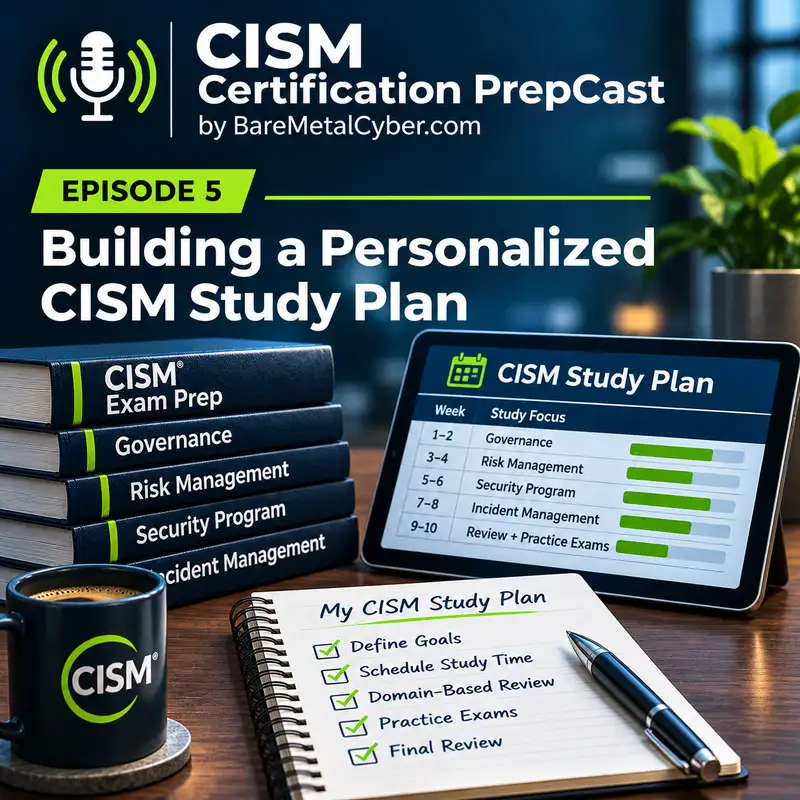
Building a Personalized CISM Study Plan
In this episode, we are building a personalized study plan for the revised CISM examination and the management judgment it is designed to assess. A useful plan does more than divide chapters across a calendar. It identifies your starting point, connects study activities to specific weaknesses, creates evidence of progress, and gives you enough flexibility to adjust when practice results challenge your assumptions.
Imagine a fictional candidate named Marcus. He has worked in security operations for eight years and is comfortable with incidents, monitoring, and technical controls. Governance language feels abstract to him, and he tends to choose immediate technical fixes in scenario questions. His colleague Alina has spent years in compliance and risk. She understands policies and reporting, but struggles when questions depend on architecture, control implementation, or operational sequencing. A single generic plan would waste time for both candidates because their experience creates different strengths and blind spots.
Your first step is to confirm which examination outline applies to your test date. This course targets the revised outline effective November third, two thousand twenty-six, with eighteen percent Information Security Governance, twenty percent Information Security Risk Management, thirty-three percent Information Security Program, and twenty-nine percent Incident Management. If your examination occurs under a different outline, use the official requirements for that date. Do not combine percentages from one version with task statements from another and assume the study plan remains aligned.
Next, separate the examination facts from the content outline. ISACA's candidate guidance describes one hundred fifty multiple-choice questions in four hours, with a passing threshold of four hundred fifty on a scaled range from two hundred to eight hundred. The scaled score is not a simple percentage. Administrative details can change, so verify current instructions directly before scheduling or testing. The study plan should reflect the applicable content, while your logistics checklist should reflect the current provider rules.
A baseline assessment should come before detailed scheduling. Review the current outline and attempt a legitimate set of practice questions without first refreshing every topic. The purpose is not to predict your final score. It is to observe how you reason when the material is not immediately familiar. Record the domain, the concept, the role in the question, the decision word, your selected answer, and why the explanation supports or rejects it. This creates a diagnostic record rather than a single discouraging percentage.
Classify each error by cause. Some mistakes come from missing knowledge. Others come from confusing closely related concepts, such as risk appetite and risk tolerance, policy and standard, verification and validation, or design effectiveness and operating effectiveness. Some are role errors, where you assign risk acceptance to the technical team. Others are sequencing errors, where you implement a solution before establishing scope or authority. A few may be reading errors caused by overlooking words such as first, best, primary, or most appropriate.
This classification matters because different problems need different treatments. Rereading a chapter may help a missing concept, but it will not necessarily correct a habit of ignoring role cues. More timed practice may improve pacing, but it will not repair a misunderstanding of residual risk. Memorizing a definition may help distinguish two terms, but scenario practice is needed to apply them under pressure. Your study plan should match the intervention to the learning problem, just as a security program matches controls to risk rather than deploying tools without a defined objective.
Build a simple capability matrix across the four domains and the foundational reasoning skills. Rate your present confidence and support the rating with evidence. Can you explain the concept without notes? Can you apply it to a new scenario? Can you identify the strongest competing answer and explain why it is weaker? Confidence without evidence often reflects familiarity rather than mastery. A topic may feel easy because you recognize the words, while application reveals that the distinction is still unclear.
Use the book’s chapter sequence to strengthen the reasoning foundation before treating the domains as isolated blocks. The opening chapters explain how CISM questions work, how to speak business context, how to think about controls, and how to use the decision ladder. Those skills influence every domain. A candidate who studies governance facts without learning to identify authority may still miss governance questions. A candidate who memorizes incident phases without understanding sequencing and business impact may still choose poor response actions.
Translate the capability matrix into study objectives. An objective should describe what you will be able to do, not merely what you will read. Instead of writing “study risk management,” write “construct a complete risk scenario, distinguish inherent from residual risk, compare four response options, and identify the authorized risk owner.” Instead of “review incident response,” write “classify an event, identify preauthorized containment, determine escalation triggers, and explain what evidence supports recovery approval.” Actionable objectives make progress observable.
Your preparation window should reflect your background, available time, and test date. Some candidates may need several months, while others with relevant experience may need less. Avoid selecting a schedule only because another person used it. Estimate the number of focused sessions you can sustain each week without relying on ideal conditions. A plan that assumes two hours every evening may collapse under work and family demands. A smaller, repeatable schedule is more valuable than an ambitious calendar that creates guilt and inconsistency.
Use the domain weights as a starting allocation, not a rigid formula. Information Security Program and Incident Management together represent sixty-two percent of the revised outline, so they require substantial attention. However, a weaker area may deserve more time than its weight alone suggests. Marcus may need extra governance practice even though it is the smallest domain. Alina may need more program and architecture work because her compliance experience does not automatically prepare her for implementation and integration questions.
A useful planning model includes learning, retrieval, application, and integration. Learning introduces or clarifies the concept. Retrieval requires you to explain it without looking. Application places it in a scenario. Integration connects it to other domains. For example, you might learn control ownership, retrieve the distinction between risk and control owner, apply it to an access review, and then integrate it with governance reporting and incident escalation. Each stage reveals a different kind of weakness.
Keep study sessions bounded. A focused session might last forty-five to ninety minutes and center on one objective. Begin by stating the question you want to answer. Review the relevant book section or episode. Close the material and explain the concept aloud or in writing. Apply it to a fictional scenario. Finish with several practice questions and record what changed in your understanding. The exact duration matters less than having a clear task and evidence of completion.
Short sessions can also build exam-speed judgment. Take one scenario and identify the decision verb, assigned role, business consequence, urgency, authority, and strongest distractor. Limit yourself to a few minutes, then review the reasoning. The goal is not to rush. It is to reduce the time spent wandering through irrelevant details. Repeated practice helps you recognize that a tool name may be background while the real decision concerns ownership, exception approval, or evidence.
Use spaced review rather than completing a topic once and abandoning it. Revisit important distinctions after increasing intervals. A concept that seems clear today may not be retrievable next week. Spaced review can be brief: explain the difference between a key performance indicator and a key risk indicator, describe the role of a Statement of Applicability, or compare recovery time objective with maximum tolerable downtime. If retrieval fails, return to the source and correct the gap before reinforcing an inaccurate explanation.
Interleave topics as your foundation grows. Real scenarios cross domain boundaries. A supplier incident may involve contractual requirements, risk ownership, classification, containment, communications, and recovery. A new application may involve strategy, architecture, resource planning, control selection, testing, and exception governance. Mixed practice trains you to identify which part of the situation the question is testing. It also prevents the false comfort that comes from answering ten nearly identical questions in a row.
The official outline should remain visible throughout preparation. Use it as a coverage checklist, but do not reduce every task statement to a definition. Ask what decision the task supports and what evidence would demonstrate competence. If the outline includes developing an information security strategy, practice connecting objectives to enterprise goals, current and target states, resources, architecture, and measures. If it includes incident management, practice authority, classification, communications, evidence, containment, recovery, and improvement.
The illustrated book is your primary explanatory resource for this course. Use it to understand distinctions, management framing, and the relationships among chapters. The podcast reinforces that material through spoken examples and decision analysis. The companion flash-card and question material supports retrieval and application. These resources have different purposes. Listening alone may create familiarity, while questions force commitment. Reading provides detail, while explaining a concept in your own words tests whether you can use it.
When using practice questions, review correct responses as carefully as incorrect ones. A correct answer may have been a guess or may rest on weak reasoning. Before reading the explanation, state why your choice is best and why the strongest alternative is weaker. Then compare your reasoning with the explanation. If the answer is correct but the reasoning is wrong, record the issue. Otherwise, a lucky result can create a dangerous sense of mastery.
Maintain an error log that is small enough to review. Each entry should identify the recurring mistake, the corrected distinction, and a new example. Marcus might write, “I selected the most detailed technical action even though the question assigned the decision to the risk owner.” Alina might write, “I treated a policy requirement as proof that the control operated.” Revisit the log using different scenarios. The objective is to reduce recurrence, not collect every question you ever missed.
Separate facts, inferences, assumptions, and unknowns during practice. A scenario may state that alerts increased, but that does not prove incidents increased. It may state that a vendor has a certification, but that does not prove the relevant service or control is within scope. It may state that a control was designed, but not that it operated effectively. Labeling the information prevents you from building an answer on an unsupported conclusion. This habit also improves professional decision-making beyond the exam.
Create domain-specific decision cues. In governance, look for alignment, authority, oversight, accountability, and policy. In risk management, look for assets, threats, vulnerabilities, impact, ownership, treatment, and monitoring. In program questions, look for architecture, resources, integration, lifecycle, metrics, and capability. In incident management, look for classification, authorization, communication, evidence, containment, recovery, and lessons learned. These cues help organize attention without becoming simplistic rules.
Develop a weekly cycle that includes new learning, cumulative review, and a progress check. At the end of the week, compare completed objectives with the plan. Review practice evidence by error type, not just score. Decide whether to continue, revisit, or adjust. If governance errors are declining but architecture errors persist, shift the next week’s allocation. This is the same feedback logic used in a mature security program: define expectations, observe performance, and change the plan when evidence indicates a gap.
Use milestones that reflect capability. A milestone might be explaining every major governance role without notes, completing a mixed question set while identifying decision verbs accurately, or writing a defensible risk treatment recommendation. Avoid milestones based only on pages read or videos watched. Consumption is an activity metric. Demonstrated application is closer to an outcome metric. Both can be tracked, but do not confuse the first with proof of readiness.
Schedule longer timed practice only after you have enough foundation to learn from it. Full-length or extended sessions can test endurance, pacing, and the consistency of your decision method. If you begin too early, you may repeat the same misunderstandings for hours. Build toward longer practice through smaller sets, then analyze performance by time, domain, question type, and error cause. One score is a data point. A pattern across several sessions is more useful evidence.
Pacing should be practiced, but not reduced to a rigid number for every question. Some items will take less time, and others require careful comparison. Use checkpoints to ensure you are not spending excessive time on a small number of questions. If the examination interface permits review or flagging, follow the current instructions and use the feature deliberately. Move on when continued analysis is not producing new evidence. Return later with a clear reason for reconsideration rather than changing answers because they feel uncomfortable.
Create a final review phase that integrates rather than introduces. In the last portion of preparation, revisit summaries, error patterns, decision rules, and mixed scenarios. Avoid adding large new resources simply because anxiety makes the existing plan feel insufficient. New material can introduce different terminology and distract from established understanding. Use the final phase to make reasoning more consistent, strengthen retrieval, and confirm logistics.
Your plan should include examination administration separately from content study. Confirm registration details, identification, delivery method, technical requirements, location, time zone, and provider instructions. Resolve these items before the final day. Do not rely on a podcast or an older checklist as the authority for current procedures. Administrative readiness protects attention so that logistical uncertainty does not compete with reasoning during the examination.
Rest and physical readiness belong in the plan. Exhaustion reduces reading accuracy, working memory, and judgment. A schedule that requires repeated late-night cramming may produce more study hours while reducing learning quality. Build sustainable routines, short breaks, hydration, and sleep around preparation. This is not a promise that comfort guarantees success. It is recognition that the examination asks you to sustain careful decisions over a long session.
Account for interruptions before they occur. Add buffer sessions and identify which objectives can move without damaging the whole plan. If work becomes demanding for a week, preserve the highest-value activities, such as spaced retrieval and error review, then reschedule deeper reading. Do not respond to every disruption by extending the study date or abandoning the plan. A resilient schedule absorbs ordinary variation and makes the tradeoff visible.
Consider using a study partner or group for explanation and challenge. The value comes from articulating reasoning, hearing alternative interpretations, and exposing assumptions. A group becomes less useful when members trade unverified rules, compare scores competitively, or allow one confident person to dominate. Anchor discussions to the approved source and current official outline. Ask participants to explain why an answer fits the role, decision, and sequence rather than simply announcing a choice.
Teaching a concept is another powerful test. Explain to someone why risk acceptance belongs to an authorized business owner, why a compensating control should be time-bounded, or why an assurance report has scope limits. If the explanation becomes circular or relies on memorized phrases, identify the missing understanding. You do not need an audience for every session. Recording a brief explanation or speaking aloud can expose gaps that silent rereading hides.
Visual tools can support relationships when used carefully. Draw a simple map connecting enterprise objectives, security objectives, architecture, program capabilities, controls, evidence, metrics, and governance decisions. Create a risk lifecycle showing identification, assessment, response, ownership, monitoring, and reassessment. Map the incident lifecycle from preparation through improvement. The value is the connection, not artistic detail. A diagram should help you explain why a concept belongs where it does.
Review your plan for balance between recognition and production. Recognition means you know a definition when you see it. Production means you can generate the explanation without prompts. Application means you can use it in an unfamiliar scenario. Examination readiness requires more than recognition. Flash cards can support retrieval, but scenario reasoning and explanation are needed to demonstrate application. Ensure the plan contains all three forms of practice.
Marcus’s plan might allocate extra early time to governance, business context, and the decision ladder, while maintaining his incident strengths through mixed practice. Alina’s plan might emphasize architecture, control implementation, testing, and operational evidence, while using her risk background to connect decisions. Both should still cover every domain. Personalization changes emphasis and method, not the obligation to understand the full outline.
As you monitor progress, resist changing the plan after every difficult session. Short-term variation is normal. Look for repeated patterns across several sessions. A single low score after a long workday may reflect fatigue. Repeated role errors across topics indicate a reasoning gap. A mature plan responds to evidence at the right level, just as a security manager avoids overreacting to one metric while ignoring a persistent trend.
Define a readiness review several days before the examination. Assess whether you can explain core distinctions, apply them under time pressure, and maintain accuracy across mixed topics. Review unresolved error patterns and decide what can realistically improve. Confirm logistics and protect rest. Readiness is not the feeling that you know everything. It is evidence that your reasoning is consistent enough to handle uncertainty and select the best available answer.
After the exam, preserve the learning system. If you pass, the material should continue to inform your work and future certification responsibilities. If you do not pass, use the available performance information and your study records to identify changes rather than restarting blindly. In either case, the plan has value beyond one result when it strengthens judgment, communication, and management practice.
Your next study action should be specific. Select one domain, one reasoning skill, and one measurable objective for the coming week. Schedule the sessions, choose the source material, decide how you will retrieve and apply the concept, and define what evidence will show improvement. Then review the result and adjust. A personalized plan is not a static calendar. It is a managed learning process built around objectives, evidence, and continuous improvement.
A personalized plan should also develop fast, repeatable judgment rather than only increase reading volume. Short decision drills help the candidate recognize roles, constraints, and sequencing under time pressure.
Exam-speed judgment is the ability to recognize the pattern in a scenario, identify what the question is really testing, and choose the "best answer" without second-guessing every detail. Security professionals often bring deep technical instincts, but exams reward structured decision logic more than raw knowledge. The goal is not to think faster by rushing; it is to think faster by narrowing the decision space. When the scenario is noisy, exam-speed judgment starts with isolating the governance question hiding inside the technical story.
Short sessions work because they force prioritization, and prioritization is exactly what the exam measures. A twenty-minute block is long enough to rehearse decision ladders, but too short to get lost in research or rabbit holes. The constraint pushes you toward repeatable mental prompts like "Who owns this risk?" and "What is the next best managerial action?" Over time, those prompts become automatic, and automatic is what you need when you are staring at a timed question and four plausible choices. The exam is less about memorizing perfect definitions and more about consistently selecting actions that reflect mature security management.
The fastest way to build this skill is to practice micro-scenarios that end with a decision, not a discussion. For example, imagine a critical vendor announces a security incident and your team has limited details, but leadership wants assurance by end of day. Your technical brain may want indicators, logs, and forensics, but the managerial decision path starts with governance: validate facts, assess exposure, invoke third-party response requirements, and assign an accountable owner. A short session would focus on deciding who must be engaged and what documentation or evidence is needed to support decisions. This approach trains you to answer what is being asked rather than what you would personally investigate first.
Exam-speed judgment improves when you learn to rank answer choices by scope and authority. Many questions include distractors that are technically correct but mis-scoped, like jumping to implement new controls when the scenario is about governance, or escalating to executives when the action is already pre-authorized at the operational level. In a short session, you can rehearse spotting those mismatches by asking whether the choice is setting direction, managing risk, executing a procedure, or gathering evidence. The "best answer" frequently sits at the governance layer for CISM-style questions, especially when the scenario mentions policy, risk acceptance, or business impact. The practice is not about memorizing that rule, but about learning to justify it quickly and consistently.
Another accelerator is deliberate practice with reversibility and impact as the primary filters. When a question implies urgent harm, choices that stabilize and contain within defined authority tend to outrank choices that optimize or redesign. When a question implies enterprise-wide direction, choices that clarify policy, define ownership, and formalize requirements tend to outrank one-off technical fixes. In short sessions, you can train this by taking a single scenario and forcing yourself to articulate the impact and reversibility in one sentence before looking at choices. That one sentence becomes your compass, and it prevents the common failure mode of picking the most technically impressive option.
Speed also comes from learning what not to do, especially when distractors mirror real-world habits. Over-analyzing logs, building new tooling, or convening a large meeting can feel productive, but in exam logic they can be premature if governance steps are missing. Conversely, immediately invoking legal counsel or notifying regulators can be correct only when thresholds are met, not because it sounds serious. In short sessions, the skill is recognizing sequencing: establish facts, classify severity, assign ownership, then choose actions aligned to authority and obligation. The exam tests sequencing because sequencing is how security management avoids both overreaction and negligence.
Memory improves when each short session ends with a single "decision rule" you can reuse, rather than a pile of notes. A decision rule might be as simple as "Risk is accepted by the business owner, not the technical team," or "Containment can be pre-authorized, disclosure usually cannot." These rules become fast retrieval cues when time is tight, and they reduce cognitive load under pressure. The value is not in collecting dozens of rules; it is in rehearsing a small set until they become reflex. Reflexive, repeatable judgment is what converts knowledge into consistent scores.
Finally, exam-speed judgment is built by practicing in the same mental posture the exam demands: calm, decisive, and accountable. You are not trying to prove you are the smartest technician in the room; you are trying to show that you can make the safest managerial call with incomplete information. Short sessions help because they mimic that constraint and force you to commit to an answer quickly, then review why it was best. Over time, you stop "hoping" an answer is right and start recognizing why it is right. That recognition is the difference between knowing the material and performing under exam conditions.