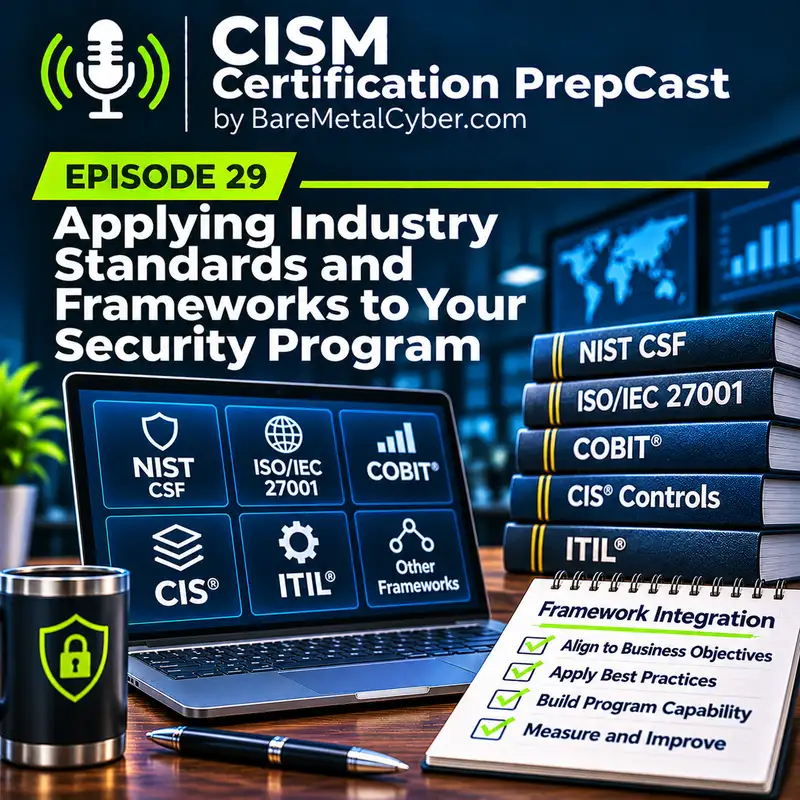
Applying Industry Standards and Frameworks to Your Security Program
In this episode, we are applying industry standards and frameworks to an information security program. Rather than memorizing framework names, we will connect them to program scope, architecture, responsibilities, evidence, governance, and the operating decisions that make a framework useful.
Imagine a fictional manufacturer called Summit Components. It has acquired two smaller companies, adopted several cloud services, and inherited different security frameworks in each business unit. One team wants to standardize everything on a single control catalog, while another wants each unit to keep its existing approach. The security manager reframes the problem. The first decision is not which framework name wins. The first decision is what program scope, business capabilities, information flows, architecture requirements, decision rights, and evidence expectations the enterprise needs. A governance framework may clarify oversight, an information security management standard may organize management-system requirements, and an outcome-based framework may support communication and improvement. Those tools can coexist when their responsibilities and evidence are mapped. They create confusion when they are treated as competing checklists detached from architecture and the operating model. This fictional scenario illustrates why framework application is a design and governance problem rather than a branding exercise.
Now apply the idea to the management decision at hand. A security framework is not a trophy and it is not a manifesto; it is a governance instrument that converts intent into repeatable decisions. When executives approve a framework choice, they are approving a way to set expectations, define accountability, and judge whether risk is being managed within tolerance. The framework becomes a shared language that links business objectives to controls, evidence, and reporting. In exam terms, the “best answer” is usually the option that makes security measurable and governable, not merely well-intentioned.
Consider a common scenario: a retail organization suffers a credential-stuffing incident and the board asks for “an industry standard so this never happens again.” The security leader proposes “implement NIST,” the legal team asks for “ISO certification,” and engineering wants “whatever the cloud provider recommends.” In that moment, the framework is functioning as a decision filter for priorities, scope, and proof, not as a catalog of controls. The correct governance move is to select an approach that can be operationalized and audited for consistency, while still fitting the organization’s risk profile and regulatory environment.
Frameworks differ in the job they help you do. Before selecting one, identify whether leadership needs better governance, a managed security system, control requirements, or a plan for enterprise change. These familiar examples make the distinction concrete.
COBIT twenty nineteen addresses the governance and management of enterprise information and technology. It helps connect objectives, responsibilities, performance and oversight. A manager can use it to clarify how technology decisions support enterprise goals.
NIST Cybersecurity Framework two point zero organizes cybersecurity outcomes under Govern, Identify, Protect, Detect, Respond and Recover. Current and Target Profiles help explain gaps and priorities. The outcomes still need to be translated into the organization’s chosen controls and operating practices.
ISO IEC twenty seven thousand one, twenty twenty two specifies requirements for an information security management system, including its continuing operation and improvement. An organization can choose certification within a defined scope. ISO IEC twenty seven thousand two, twenty twenty two provides supporting guidance on information security controls; it serves a different purpose from the management-system requirements.
NIST Special Publication eight hundred fifty-three Revision five provides a catalog of security and privacy controls. Selection and tailoring should reflect applicable requirements, risks and system context. A catalog gives control detail, but leadership must still decide priorities, ownership and acceptable exposure.
The Open Group Architecture Framework Standard, tenth edition, provides an enterprise architecture methodology and framework. It supports the enterprise change questions introduced in an earlier lesson, including how business goals and the organization’s information and technology fit together.
These approaches can work together. For the retailer in an earlier lesson, architecture explains the portal transition, a cybersecurity profile helps prioritize outcomes, and control guidance supports implementation. Select and map them to the decision you need to make, while avoiding duplicate evidence requests.
In practice, selection begins with defining scope boundaries that make governance real rather than theoretical. Scope should anchor on business services, data classes, and critical processes, not on an org chart or a list of technologies. A framework that cannot be mapped to the organization’s service ownership model will produce gaps, duplicate work, and unclear accountability. Governance also requires deciding the level of granularity needed for assurance, because the evidence burden and operational overhead scale quickly. The “right” framework is often the one that supports consistent evidence collection without collapsing the program under its own documentation weight.
A framework choice is also a contract about how risk will be expressed and managed across the enterprise. If leadership expects risk decisions to be comparable across business units, the framework must support consistent risk statements, control objectives, and assessment criteria. If leadership expects improvement to be tracked over time, the framework must support maturity, capability, or implementation measurements that are stable and repeatable. If leadership expects third-party assurance, the framework must support clear control mapping and evidence expectations that stand up to independent review. Governance fails when the framework’s built-in measurement model conflicts with how the enterprise actually makes decisions.
Most organizations end up operating with more than one framework, and governance is the discipline of making that coexistence coherent. A common pattern is to select a primary governance framework for “how we run security” and then map supplemental frameworks to specific obligations or domains. For example, a governance-oriented model can define decision rights and oversight, while a control catalog drives technical and administrative control implementation, and a management-system model drives continual improvement and auditability. This is not “doing everything,” it is layering instruments so they play different roles without contradicting one another. The governance test is whether a control, a risk decision, and an audit finding can all be traced back to a single, consistent set of objectives.
Selecting a framework as a governance instrument also means planning how it will be adopted, not just announcing it. Adoption requires translation into organizational artifacts: policies, control standards, assessment methods, and reporting rhythms that make expectations actionable. It also requires assigning ownership for interpretation, because frameworks contain flexibility that can either empower good decisions or enable endless debate. When the organization cannot answer “what does this requirement mean for us,” it will substitute opinion, and governance becomes negotiation. A sound selection includes the commitment to an interpretation authority, typically a risk or governance function partnered with security leadership.
A practical selection decision also anticipates where exceptions, compensating controls, and legacy constraints will appear. Framework-aligned governance does not pretend every control will be implemented uniformly; it sets rules for when deviation is acceptable and how it is approved, time-bounded, and monitored. If the framework selection does not integrate with the organization’s risk acceptance process, exceptions will quietly become permanent, and “alignment” will become performative. In exam logic, the best answer favors mechanisms that preserve control under real-world constraints rather than insisting on perfect compliance. A framework is valuable precisely because it provides structure for making imperfect decisions consistently.
Begin with program boundaries and the interfaces where responsibilities meet. Program scope is where strategy becomes a set of promises you can actually keep. A security program that tries to “cover everything” usually covers very little, because nothing has a clear owner, a clear budget, or a clear definition of done. The exam logic tends to reward the manager who defines scope explicitly, aligns it to business priorities, and then manages the interfaces to everything outside that scope. In practice, scope is not just what the security team will do; it is what the organization expects the program to deliver in measurable outcomes.
A useful way to think about scope is as a bounded system with inputs, outputs, and constraints. Inputs include business objectives, risk appetite, legal and regulatory obligations, and the current operating environment. Outputs include risk decisions, security requirements, control objectives, metrics, and assurance evidence that leadership can rely on. Constraints include budget, staffing, technical debt, architecture choices, and the organization’s tolerance for disruption. If you cannot name the inputs and constraints, you will not be able to defend the outputs when stakeholders ask why security is “slowing things down.”
Scope boundaries should be expressed in terms of what the program governs versus what it merely influences. Within its delegated scope, the program applies approved policy, establishes standards, and routes decisions through defined authority. Acceptance of residual business risk belongs to the designated risk owner or higher approving authority; it does not automatically belong to the security team. Influence means the program provides guidance, patterns, and expertise, but the final decision sits elsewhere, such as in product management or a business unit leadership team. Confusing these two leads to predictable failure modes: the security team is blamed for outcomes it cannot control, or it tries to control outcomes without legitimate authority. Clear boundaries make accountability possible, which is the prerequisite for maturity.
Interfaces are the structured handoffs and shared responsibilities between the security program and other parts of the enterprise. Every interface needs two things: a defined decision right and a defined communication path. For example, an interface with enterprise architecture should clarify who sets security architecture standards, who grants exceptions, and what evidence is required to justify deviation. An interface with legal should clarify when security escalates an incident for breach analysis and what facts must be documented to support notification decisions. A program without explicit interfaces will still have them, but they will be improvised under pressure, which is exactly when inconsistency becomes expensive.
A compact scenario helps lock this in: a business unit launches a new software as a service tool for customer support, and security discovers it after contracts are signed. The security manager tries to “stop the project,” but procurement says the agreement is executed and the vendor is already processing customer data. The best answer is not to argue about who should have been consulted; it is to activate the interface: define required security and privacy controls, assess gaps, establish compensating measures, and determine whether a risk acceptance is needed at the right level. That response is only possible if the program previously defined where software as a service onboarding sits in scope and how procurement, IT, and business owners engage security.
In exam terms, scope boundaries protect against both overreach and abdication. Overreach looks like security attempting to own day-to-day operational tasks that belong to IT operations or application teams, which creates bottlenecks and makes security a single point of failure. Abdication looks like security publishing policies with no adoption path, no ownership, and no enforcement mechanism, which creates paper compliance and operational risk. The practical middle ground is to define what security owns, what it co-owns, and what it audits or advises on, and then build repeatable interfaces for each category. This is how you avoid the trap of being “responsible for everything and accountable for nothing.”
Interfaces should also map cleanly to data and system boundaries, because that is where risk concentrates. When data crosses boundaries (between networks, between tenants, between vendors, or between classification levels) your program needs explicit control expectations and an escalation path for exceptions. The interface definition should answer questions like: who approves access models, who validates logging and monitoring coverage, who ensures retention and legal hold requirements are met, and who sponsors remediation when gaps are found. When those answers are fuzzy, the organization defaults to convenience, and convenience rarely aligns with risk management.
Finally, scope is not static; it must be resilient to organizational change without becoming a moving target. Mergers, cloud migrations, new product lines, and regulatory shifts all create pressure to expand scope immediately, but mature programs adjust via controlled mechanisms: reassessing risk priorities, updating control objectives, and renegotiating interfaces and decision rights. The security manager’s job is to keep scope coherent while still responsive, which means saying “yes” with conditions more often than saying “no” without authority. When scope boundaries and interfaces are explicit, the program becomes legible to the business, and legibility is what makes security operational instead of aspirational.
Next, connect architecture to the way the program actually operates. Three connected views help a manager turn strategy into working protection. Enterprise architecture describes how business capabilities, information, applications, and technology fit together, including current arrangements and the intended future state. an earlier lesson develops that business view. Information security architecture describes how protection is built into those arrangements through security requirements, control responsibilities, boundaries, and interactions. The program operating model explains how people, processes, resources, and decision rights keep that protection working. A staffing chart cannot show whether a supplier can read customer records, and a network diagram cannot identify who may approve a risk exception.
Return to the retailer integrating an acquired business into a shared customer-service portal before seasonal demand. The service owner wants customers served across both businesses while records remain accurate, access stays appropriate, and disruption remains within agreed limits. Security helps turn those needs into requirements. Which staff may see which records? Can the external support provider export customer data? How will inappropriate changes be identified? What service must remain available if an integration fails? Those answers give architects and delivery teams a business purpose for each protection decision.
Follow a customer request through the portal, identity service, customer records, external support team, and monitoring service. Describe what information moves, why it moves, and who controls each step. A trust boundary marks a point where security assumptions or authority change, such as the boundary between a supplier's environment and the retailer's records. Boundaries can also exist within a shared cloud environment. Being on the same network does not establish permission to access a record. Each crossing needs explicit expectations for identity, authorization, data handling, and evidence.
Suppose the assessed risk is that a supplier account could retrieve records unrelated to its assigned work. A useful requirement is that support staff can access only the records needed for authorized cases, with actions attributable to individual users. The architecture allocates responsibilities: the identity service establishes who is connecting, the application enforces permitted access, and monitoring supports detection and investigation of misuse. Strong authentication alone does not decide which customer record a valid user may open. The manager asks whether the combined design addresses the risk across the whole flow.
Compare feasible designs against those requirements and their lifecycle costs. Reusing the retailer's identity and monitoring services may improve consistency, but the portal then depends on their capacity, availability, and ownership. Document those dependencies and agree on acceptable behavior when they are unavailable. An approved limited service mode might preserve essential work; a sensitive function might need to stop safely. The appropriate choice depends on business impact and the risk decision. More components or more suppliers do not automatically produce a more resilient service.
The approved design creates obligations for the operating model. Someone must maintain identity rules, review supplier access, monitor the service, test recovery, and fund ongoing support. Compare those target capabilities with what the organization can demonstrate today. If no team can operate a proposed control or produce its evidence, record the capability gap and assign an owner before treating the design as ready. an earlier lesson turns those gaps into staffing, tooling, funding, and sourcing decisions.
Architecture decisions are not complete until assurance shows that intended requirements were implemented. Architecture decisions are most useful while meaningful options remain. A review after a contract is signed or a service is deployed may reveal a problem that is expensive to change. Set review points according to risk, including before major commitments and before release. Bring together the service owner, architects, security, and operations, with procurement, legal, and other specialists where the design crosses their responsibilities. The manager's contribution is to clarify requirements, expose tradeoffs, and ensure that the decision has an accountable owner.
An approved pattern is a reusable design for a defined situation. For the portal, a pattern could specify supplier access through the retailer's identity service, limited application permissions, protected data exchanges, and monitoring responsibilities. Record its permitted uses, assumptions, dependencies, version, and review owner. Teams can move faster when their implementation remains within those conditions and produces the required evidence. Reusing a pattern for different data or a broader supplier role may require another review. A previous approval is evidence of a decision in context, not permission for every future use.
Keep a short architecture decision record that a future manager can understand. Capture the business need, relevant risks and requirements, alternatives considered, chosen approach, reasons, and accountable decision-maker. Include material cost and service dependencies, the controls assigned to each party, and the evidence needed to judge success. Link the record to the implementation work and state what would trigger reconsideration. The record should make it possible to follow a requirement from the business concern through the chosen design to a control that someone operates and tests.
Separate design approval, release authorization, and risk acceptance. A team may have delegated authority to implement an approved pattern within agreed limits. An architect may confirm conformance, while an operational owner confirms readiness. Neither decision automatically accepts residual business risk. The designated risk owner or higher authority makes that decision under the organization's policy, using the security assessment and advice from other relevant functions. An exception needs an explicit scope, owner, safeguards, review or expiry date, and a route to resolution. an earlier lesson explains the full waiver lifecycle.
In the retailer scenario, suppose the acquired application cannot yet enforce the required supplier access limits. The manager presents alternatives: defer that integration, restrict the initial service to an approved subset of data, or fund the missing capability. If a limited interim design is authorized, document exactly what data and users it covers, how misuse will be detected, and when the decision expires. The business deadline does not supply approval by itself. Required safeguards remain conditions of the decision, and their owners need resources to operate them.
Assurance begins with agreement on what acceptable evidence will look like. Verification asks whether the specified requirements have been met. Validation asks whether the resulting service meets its intended business and protection needs in its operating environment. For the portal, test that permitted users can complete legitimate work, unauthorized record requests are denied, revoked access is removed as required, and useful events reach the responsible monitoring team. Exercise important dependency failures and the agreed recovery or limited service arrangements. A successful demonstration of one feature does not establish that the entire service is ready.
Before handover, review the test results, unresolved findings, approved exceptions, operating procedures, and named control owners. Once the service is live, reassess material changes to data flows, suppliers, or shared services. The control testing in an earlier lesson supplies feedback on whether the design and its operation remain effective. Findings should lead to updated requirements, patterns, funding, or risk decisions when necessary. Architecture remains useful when the evidence can change the decision.
This customer-support software as a service example addresses the risk of unauthorized customer-data export. Logical boundaries and controls are illustrative, not a vendor deployment specification. Design and test evidence informs authorization; operational logs and access reviews support continued assurance. The three decision outcomes are alternatives, not successive approvals.
Now apply the idea to the management decision at hand. Enterprise architecture is a maintained view of how the enterprise’s business capabilities, information, applications, and supporting technology work together. It helps leaders judge whether a proposed change supports the mission and what else must change with it. The security manager uses this view to connect business impact to design choices, shared dependencies, and investment. A network diagram alone cannot explain those relationships.
The enterprise view exposes decisions that a project inventory can miss. Who determines which customer record is authoritative? Which support activities require access to both businesses’ information? Can order fulfillment continue if the shared identity service is unavailable? Which existing connections must be retired after migration? A shared service can improve consistency and reduce duplicated work while concentrating failure impact. The manager should assess both effects instead of assuming that consolidation automatically reduces risk.
Enterprise architecture provides this enterprise-wide context. Information security architecture develops the protection requirements, boundaries, and control interactions within it, which an earlier program-development lesson explores. The security program’s operating model supplies the people, authority, workflows, and resources that keep those arrangements working. Distinguishing these purposes helps leaders fund a coherent change rather than treating three different needs as one architecture document.
A practical framework crosswalk should operate as a translation layer rather than a document-merging project. Start with the organization’s own objectives, architecture requirements, risk decisions, and operating responsibilities. Then map the relevant framework outcomes or requirements to those internal elements. This keeps the program understandable to employees while allowing auditors, customers, and leadership to see how recognized guidance is addressed. When two frameworks cover the same objective, use one internal control and one evidence stream where possible instead of creating parallel processes. Where the frameworks differ, record the additional obligation and identify the owner responsible for it. The crosswalk should reduce duplication, not multiply it.
Evidence mapping makes framework application durable. For every significant requirement, identify the responsible role, the approving or accountable role, the operating evidence, the assurance method, and the forum that reviews performance. A policy reference alone does not prove operation, and a tool screenshot does not prove that the control covers the required scope. The evidence map should connect the intended outcome to records such as approvals, configurations, logs, test results, exceptions, remediation, and management review. When a framework or business service changes, the map provides a controlled way to identify which internal artifacts and responsibilities require reassessment.
Return to the fictional scenario from the beginning of this lesson on applying industry standards and frameworks to your security program. The strongest management response is not a slogan or an isolated tool purchase. It is a documented decision that connects business impact, authority, evidence, operating responsibility, and follow-through. Ask what must be true before the organization can proceed, who is accountable for making or accepting the decision, and how the result will be verified over time. That reasoning pattern helps on the CISM exam because it prevents a technically plausible action from being mistaken for the best management action.
For practice, take a fictional organization and define one governance need, one architecture requirement, one operating responsibility, and one evidence expectation. Then explain how COBIT, ISO, or the NIST Cybersecurity Framework could support those needs without becoming separate competing programs. The strongest answer will name the decision owner and show how framework guidance becomes part of normal planning, implementation, assurance, and reporting.