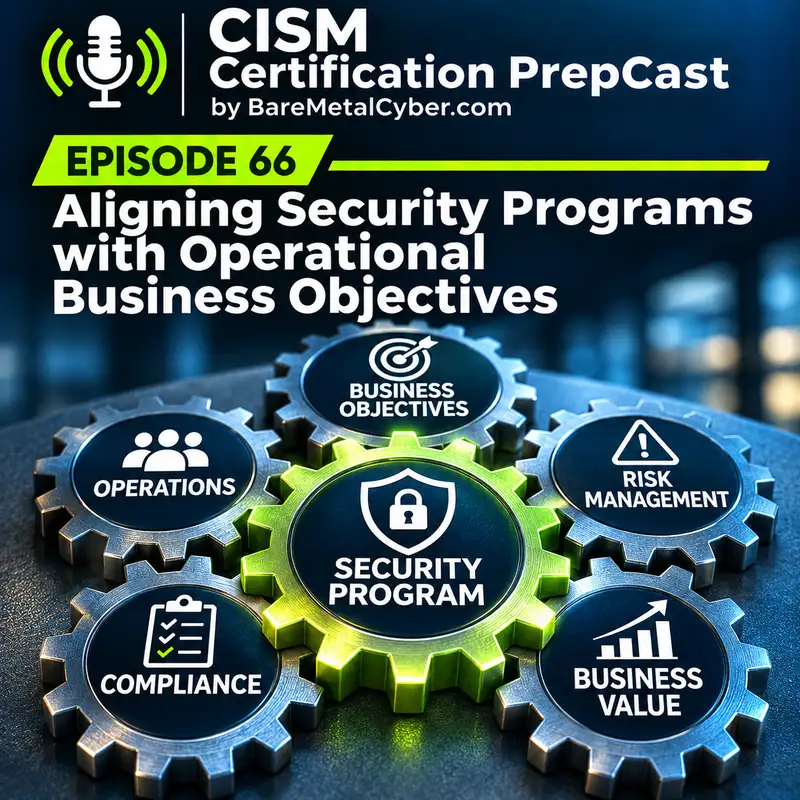
Aligning Security Programs with Operational Business Objectives
In this episode, we are aligning security programs with operational objectives, service dependencies, architectural boundaries, and sustainable capability. The objective is to connect the topic to business impact, decision authority, operating responsibility, and evidence rather than treating it as a slogan or isolated technical task.
Consider Greenfield Utilities, a fictional teaching organization. It wants to improve field maintenance while keeping customer service reliable. The new operating model depends on mobile work orders, supplier access, shared identity, and an aging outage platform. Security proposes several controls, but operations cannot tell which ones protect the service objective or how support responsibilities will work after launch. This scenario is not an official examination question. It gives us a practical setting in which to examine the management choices and the reasons behind them.
The first task is to identify the business service and measurable operating objective. The manager must then map information, applications, technology, people, and external dependencies. Next, the responsible teams should define program boundaries and protection requirements. Before the decision is closed, the organization must assign operating ownership and resource the interfaces between teams. Finally, it should verify that controls support the service under normal and disrupted conditions. These actions may occur in parallel when authority and urgency permit, but none should disappear from the management record.
Security programs cannot exist in isolation. To be truly effective, they must be deeply embedded in the operational fabric of the organization. The purpose of aligning security programs with operational business objectives is to ensure that protection efforts support, rather than obstruct, daily business activities. Security leaders must design and implement controls that are responsive to how the organization actually functions. This alignment helps prioritize security based on real business impact, not theoretical risk. It enhances collaboration between security and business teams, improves resource utilization, and increases stakeholder engagement. When alignment is achieved, security is seen as a business enabler, something that protects workflows, enhances trust, and reduces friction, rather than something that slows down innovation or burdens productivity. More than just cooperation, alignment ensures that security measures are relevant, integrated, and responsive to the pace and complexity of enterprise operations.
To begin aligning security with operations, the first step is understanding the organization’s core business objectives. This requires more than a surface-level knowledge of department names or high-level strategy statements. Security teams must review corporate and departmental strategic plans to identify key services, processes, and performance expectations. Engaging directly with operational leaders is essential to understand their specific priorities, constraints, and pain points. Key performance indicators and service-level agreements can reveal what each business function values, whether it's system uptime, customer response time, or regulatory accuracy. Regulatory obligations tied to data handling, service delivery, or financial integrity must also be considered. Security professionals must identify the systems and workflows that are critical to revenue generation, customer trust, or core service fulfillment. These business objectives must then be translated into operational security requirements, establishing a direct connection between what the business wants to achieve and what security needs to protect.
Once business needs are understood, security activities must be mapped to specific functions. This includes aligning access controls, logging standards, and monitoring practices to business service tiers. High-value functions, such as online transaction platforms, health records systems, or critical infrastructure, should receive enhanced monitoring and faster incident response prioritization. Security controls must be designed with the process owners in mind, ensuring that policies reflect the way people actually work. For instance, if a department uses cloud-based collaboration tools, policies must support secure usage rather than impose blanket restrictions. Controls must also support ongoing business initiatives, such as cloud migrations, automation projects, or software development efforts. Security must enable agility while ensuring compliance with relevant frameworks and obligations. This balance is only achieved when security teams understand the business architecture and intentionally design controls to align with business workflows.
Engaging operational stakeholders is a core part of this alignment process. Security teams must include business unit leaders in risk assessments, control design reviews, and prioritization discussions. Transparency is key, business teams must understand how proposed controls will affect their workflows. Shared responsibility models should be emphasized so that business leaders understand their role in securing systems, data, and decisions. Training and awareness efforts must be tailored to reflect the responsibilities and daily realities of each business role. For example, a logistics manager and a finance director may need very different guidance even though both support critical operations. Feedback loops must be established so that stakeholders can report friction, suggest improvements, or highlight areas of concern. This feedback should be taken seriously and used to refine controls over time. Engagement fosters buy-in, which is critical to adoption, compliance, and long-term sustainability.
Designing controls that are both effective and business-centric requires flexibility. Security outcomes must be consistent, but implementation can and should be tailored to local environments where appropriate. This means defining outcome-based requirements, such as access control or data classification, but allowing departments to choose how to meet them within approved boundaries. Exception processes should be formalized, allowing documented deviations when justified by business need and approved through governance channels. Control baselines should be tailored based on the sensitivity and risk profile of each function. One-size-fits-all controls rarely succeed in diverse operating environments. Instead, embed controls into existing processes and tools. For instance, integrate encryption into document management systems, rather than creating standalone platforms. The goal is to make secure behavior the path of least resistance. When controls support rather than disrupt business activity, adoption improves and residual risk decreases.
Measurement is essential to ensure that alignment efforts are working. Control effectiveness should be monitored continuously, but without degrading performance. Security metrics must be tied to operational key performance indicators to demonstrate relevance. For instance, if a new authentication method improves security but causes downtime, that impact must be measured and addressed. Business teams should be surveyed regularly about their experience with security controls, both usability and support responsiveness. Review incidents, outages, or audit findings to identify where misalignment between controls and operations contributed to failure. Was a required process skipped because it was too complex? Did an access delay affect service delivery? Use these insights to adjust controls so that protection is maintained without introducing unnecessary friction. A data-informed feedback loop strengthens alignment and demonstrates a commitment to continuous improvement.
Managing change is another key dimension of operational alignment. As business models evolve, systems are replaced, or processes are reengineered, security controls must adapt. Coordinate control deployment with business project lifecycles so that security is embedded early in design. Participate in change management reviews and product planning sessions. Align risk assessments with new service launches, mergers, or infrastructure changes. Integrate security into operational planning and budgeting, ensuring that protection measures are scoped and funded alongside business initiatives. Use a risk-based prioritization model to decide where to focus attention. Not all changes introduce equal risk, so align control adaptation with areas of highest potential impact. By linking security processes to business change drivers, the security program remains responsive, integrated, and respected.
Communicating the value of security to business teams is essential to maintaining alignment. Security leaders must show how controls protect operational continuity, reduce reputational risk, and maintain compliance. Use relatable scenarios to show how unpatched systems or misconfigured access controls could lead to business outages or financial loss. Highlight success stories where collaboration with security led to smoother operations, faster audits, or safer customer experiences. Provide reports that reflect operational outcomes, not just technical achievements. For example, show how changes to access controls reduced onboarding time while improving compliance. Reinforce that the goal of security is not to say no, but to say yes, safely. Emphasize shared goals like uptime, customer trust, and service quality. When business teams understand how security helps them succeed, resistance fades and support grows.
Despite best efforts, common barriers can prevent alignment. One of the most persistent is a lack of business understanding among security teams. When controls are designed without awareness of workflow realities, friction and workarounds emerge. Similarly, rigid or overly complex controls can alienate users and reduce effectiveness. Competing priorities can also cause tension, where business units focus on throughput while security teams focus on control enforcement. Misalignment in priorities or lack of collaboration in policy and tool selection can cause resistance or noncompliance. Another challenge is reporting. If security metrics are highly technical, they may fail to communicate value to business leaders. These barriers must be addressed through structured engagement, empathy, and feedback. Alignment is not just about tools and policies, it’s about relationships, understanding, and shared accountability.
Alignment must be sustained, not just achieved. Schedule periodic alignment reviews with business process owners to assess whether controls still reflect workflow realities and strategic priorities. During enterprise planning cycles, revisit security priorities to ensure they continue to serve operational needs. Expand cross-functional representation in security governance bodies to bring more business insight into control decisions. Track alignment maturity using surveys, metric correlation, or incident data to measure how well controls support business functions. Use these insights to identify where additional tuning, communication, or redesign may be needed. Most importantly, embed alignment as a core objective of the security program. Make it part of mission statements, performance reviews, and success criteria. When alignment becomes part of the security team’s identity, it evolves from an aspiration into a standard. Security becomes not only a protector, but a partner in the business.
To deepen the lesson on aligning security programs with operational business objectives, begin with the management principle behind the decision. Security embedded into change management means categorizing changes in a way that drives proportional control, not endless bureaucracy. Low-risk, repeatable changes can be pre-authorized through standard change models, with defined guardrails and automated checks that confirm they stayed within bounds. Higher-risk changes require stronger review, clearer rollback planning, and explicit verification that security controls will remain effective after the change. Emergency changes are not exempt from governance; they are governed differently, with accelerated approval and mandatory after-the-fact review to validate necessity and remove temporary exposure. For exam purposes, the “best answer” typically recognizes risk-based tailoring while still preserving accountability and evidence.
The next part of the analysis concerns the evidence and accountability behind the decision. Procurement is the other half of the same story because buying technology and services is a form of change with long-term consequences. A purchase decision commits the organization to an architecture, a vendor’s security posture, and a lifecycle of maintenance, patching, renewals, and eventual decommissioning. If security requirements show up after a contract is signed, the organization is negotiating from weakness and paying for remediation in both dollars and time. Embedding security into procurement means translating risk into requirements that vendors must meet before onboarding, not after an incident. Done well, procurement becomes a preventive control that reduces downstream operational risk and improves auditability.
Viewed through this episode’s purpose, the practical implication is important. Security requirements in procurement must be written as verifiable expectations rather than aspirational language. “Vendor will use industry-standard security” is not enforceable, testable, or meaningful, and it creates false confidence for stakeholders who assume it offers protection. Requirements should instead be tied to outcomes the organization can validate, such as identity integration capabilities, logging and audit trail availability, data handling constraints, encryption expectations, incident notification timelines, and the right to assess or receive assurance evidence. The goal is not to build a legal monument; it is to ensure the organization can operate the service securely without constant exceptions. On the exam, choices that focus on measurable requirements and enforceable accountability are typically stronger than choices that rely on goodwill.
A manager should connect this point to ownership, operating reality, and the business consequence. Deployment-stage gating should confirm that operational readiness matches the risk posture of the solution. This includes verifying that monitoring is configured, alerting routes to an accountable team, incident response procedures are workable, and rollback plans are realistic. Many organizations treat deployment as the finish line, but governance treats it as a transition into a new steady state that must be managed. The risk at deployment is often about speed and pressure, which is why the gate must be resistant to “just this once” exceptions that become permanent exposure. On the exam, the most defensible approach is one that protects the enterprise during the highest-pressure moment, when mistakes are most likely.
This distinction becomes especially useful when several plausible actions compete for attention. Operational handoff is a stage gate that is often neglected, yet it is where projects either become sustainable services or fragile liabilities. A secure build can still fail as a control if the operations team lacks documentation, access boundaries, and runbooks for routine and emergency actions. From a risk perspective, ownership must transfer clearly, with responsibilities for patching, access approvals, logging review, and incident response assigned and accepted. If ownership is unclear, problems are discovered late, and accountability becomes political rather than procedural. Exam questions that ask about “ensuring ongoing security” or “maintaining control effectiveness” often point to this handoff decision.
The governance question is not whether the idea sounds secure, but whether it is authorized, workable, and verifiable. A useful exam-style scenario is a project team that has met schedule but requests a waiver to deploy without centralized logging because “it will be added next sprint.” The risk-based response is not to debate the value of logs in the abstract; it is to evaluate whether the lack of logging breaks the risk assumptions that justified approval. If the system handles sensitive data or has privileged access paths, missing logs may eliminate detection capability and make incident response ineffective, changing the residual risk materially. The stage gate forces that reality into a decision, requiring either remediation, compensating controls, or formal acceptance by the right authority. The control lesson is that stage gates convert hidden risk into explicit choices with accountable owners.
The operational consequence also matters because a plan that cannot be sustained will not manage risk for long. Escalation is most defensible when it is criteria-based and pre-defined, not ad hoc or personality-driven. If escalation only happens when someone feels uncomfortable, the organization ends up with inconsistent decisions and political friction. Criteria should be tied to business impact, such as potential outage duration, exposure of sensitive data, compromise of privileged access, breach notification implications, or violation of contractual obligations. The decision to escalate should be as procedural as the decision to patch, deploy, or onboard a vendor, because the control objective is repeatability and evidence. A mature organization treats escalation thresholds like guardrails that keep routine teams within their authority while ensuring material risks reach senior ownership.
Use this point to challenge assumptions and to identify what must be demonstrated before the next decision. A common exam-realistic scenario is a high-urgency change request that would weaken segmentation to restore service during an outage. The operations team argues that the business cannot wait, and the security engineer sees a clear exposure that could enable lateral movement or unauthorized access. In this situation, escalation is the control because it forces the organization to weigh immediate availability impact against increased compromise risk, using the risk appetite and business priorities that senior leadership owns. The engineer’s job is to present the risk clearly, propose safer alternatives if available, and ensure the decision is made by an authorized risk owner. The “best answer” typically is not “deny the change” by default, but “escalate and document a risk-based decision” with time bounds and compensating controls.
The exam lens here is to separate the activity from the outcome that leadership actually needs. The most important feature of escalation is not the meeting it creates, but the accountability it produces. Proper escalation assigns a named risk owner, defines what is being accepted or deferred, and records the rationale in business terms. It also attaches conditions, such as compensating controls, reduced scope, monitoring requirements, and a deadline for remediation or reevaluation. When these elements are missing, escalation becomes theater: everyone “knows” there is risk, but no one owns the consequences. For exam purposes, the presence of documented ownership and time-bounded treatment is a strong indicator of a correct governance action.
A defensible approach keeps the scope, owner, evidence, and remaining uncertainty visible. Escalation is also a control for conflicting priorities, especially when security, operations, and delivery teams each optimize for different outcomes. Security tends to optimize for reduced likelihood and impact of compromise, operations optimizes for uptime and stability, and delivery optimizes for feature velocity and deadlines. None of these priorities are wrong, but unmanaged conflict leads to unsafe compromises made under pressure. Escalation provides a structured way to resolve conflicts by tying decisions back to enterprise risk appetite and business objectives. On the exam, when you see a scenario where teams disagree and the impact is material, escalation to the appropriate governance body or risk owner is often the best answer.
Apply this principle directly to the management decision in this episode. Third-party incidents are another place where escalation becomes the control because the organization may have incomplete information and limited leverage. If a critical vendor reports a security event with uncertain scope, the enterprise must quickly decide whether to suspend integrations, rotate credentials, trigger contingency plans, or notify stakeholders. Those decisions can have significant business impact, and they often require executive involvement to balance continuity, legal exposure, and reputational considerations. Escalation ensures that the response is not solely a technical reaction but a managed business decision with coordinated communications and accountability. Exam questions that mention vendor events, contractual obligations, or ambiguous impact often test whether you recognize escalation as a governance control rather than a sign of failure.
The next part of the analysis concerns the evidence and accountability behind the decision. Finally, scope is not static; it must be resilient to organizational change without becoming a moving target. Mergers, cloud migrations, new product lines, and regulatory shifts all create pressure to expand scope immediately, but mature programs adjust via controlled mechanisms: reassessing risk priorities, updating control objectives, and renegotiating interfaces and decision rights. The security manager’s job is to keep scope coherent while still responsive, which means saying “yes” with conditions more often than saying “no” without authority. When scope boundaries and interfaces are explicit, the program becomes legible to the business, and legibility is what makes security operational instead of aspirational.
Viewed through this episode’s purpose, the practical implication is important. Three connected views help a manager turn strategy into working protection. Enterprise architecture describes how business capabilities, information, applications, and technology fit together, including current arrangements and the intended future state. another lesson in this course develops that business view. Information security architecture describes how protection is built into those arrangements through security requirements, control responsibilities, boundaries, and interactions. The program operating model explains how people, processes, resources, and decision rights keep that protection working. A staffing chart cannot show whether a supplier can read customer records, and a network diagram cannot identify who may approve a risk exception.
A manager should connect this point to ownership, operating reality, and the business consequence. Return to the retailer integrating an acquired business into a shared customer-service portal before seasonal demand. The service owner wants customers served across both businesses while records remain accurate, access stays appropriate, and disruption remains within agreed limits. Security helps turn those needs into requirements. Which staff may see which records? Can the external support provider export customer data? How will inappropriate changes be identified? What service must remain available if an integration fails? Those answers give architects and delivery teams a business purpose for each protection decision.
This distinction becomes especially useful when several plausible actions compete for attention. Follow a customer request through the portal, identity service, customer records, external support team, and monitoring service. Describe what information moves, why it moves, and who controls each step. A trust boundary marks a point where security assumptions or authority change, such as the boundary between a supplier's environment and the retailer's records. Boundaries can also exist within a shared cloud environment. Being on the same network does not establish permission to access a record. Each crossing needs explicit expectations for identity, authorization, data handling, and evidence.
The governance question is not whether the idea sounds secure, but whether it is authorized, workable, and verifiable. The approved design creates obligations for the operating model. Someone must maintain identity rules, review supplier access, monitor the service, test recovery, and fund ongoing support. Compare those target capabilities with what the organization can demonstrate today. If no team can operate a proposed control or produce its evidence, record the capability gap and assign an owner before treating the design as ready. another lesson in this course turns those gaps into staffing, tooling, funding, and sourcing decisions.
The operational consequence also matters because a plan that cannot be sustained will not manage risk for long. An operating model is the bridge between what leadership wants and what the organization can reliably execute. Without an explicit model, a security program becomes a collection of good intentions and reactive work, with results depending on which individuals happen to be on call or which leaders happen to care that quarter. The exam lens tends to treat the operating model as the practical expression of governance: it clarifies who does the work, how the work flows, and what tooling and data make the work repeatable. In other words, strategy describes direction, but the operating model determines whether you arrive.
Use this point to challenge assumptions and to identify what must be demonstrated before the next decision. The “people” part is not a headcount discussion; it is a responsibility and accountability discussion. Roles should be defined by decision rights and outcomes, not by job titles that vary between organizations. A mature model separates program ownership from operational execution, so that policy and oversight do not collapse into day-to-day ticket handling. It also clarifies how security leadership engages business leadership, because risk decisions are business decisions and must be owned at the appropriate level. When those relationships are vague, security either becomes an isolated technical function or a political bottleneck, neither of which the exam rewards.
The exam lens here is to separate the activity from the outcome that leadership actually needs. A robust operating model also defines how information moves between people and processes. Metrics and reporting are part of operations, not an afterthought, and they should be tied to decision-making rather than vanity dashboards. For example, trends in recurring exceptions may indicate a control is impractical and needs redesign, while backlog growth in remediation may indicate capacity constraints or unclear prioritization. The model should specify what gets reported, to whom, how often, and what action is expected when thresholds are crossed. If reports do not drive decisions, they become ceremonial, and leadership confidence in the program erodes.
A defensible approach keeps the scope, owner, evidence, and remaining uncertainty visible. Finally, the operating model must make risk ownership explicit so that security can lead without owning everything. Security leadership typically owns the program mechanisms (standards, oversight, and assurance) but the business owns the risk decisions and the remediation sponsorship. The model should define how risk acceptance works, who can approve it, how long it lasts, and what compensating controls or monitoring are required. It should also anticipate friction: delivery teams prioritize features, operations teams prioritize stability, and security prioritizes risk reduction, so the model must provide a structured way to resolve conflicts. When people, process, and technology reinforce one another, security stops being an intermittent project and becomes an operating reality.
Apply this principle directly to the management decision in this episode. Governance is the mechanism that turns security from advice into accountable decisions. In a program context, governance is not a committee name or an org chart box; it is the repeatable process by which the organization sets direction, approves priorities, allocates resources, and accepts risk. Without governance, security becomes a sequence of isolated technical efforts, each justified by the loudest incident, the newest headline, or the strongest personality in the room. The exam perspective consistently favors governance that is business-aligned, formally defined, and capable of making timely decisions under pressure. Good governance is less about control and more about clarity: who decides, on what basis, and with what evidence.
The next part of the analysis concerns the evidence and accountability behind the decision. Finally, documentation must be usable under stress, because that is when the program is most visible. During an incident, a regulatory inquiry, or an audit, teams need quick access to current requirements, prior decisions, and evidence that controls are operating. Documentation that enables execution is searchable, structured, and aligned to how the organization actually works, not to how it wishes it worked. It provides just enough detail to guide action, route decisions, and generate evidence without stalling teams in paperwork. When documentation meets that standard, it does not feel like compliance overhead; it feels like operational leverage.
Viewed through this episode’s purpose, the practical implication is important. A security program becomes credible when its operating model enables accountable decisions and its security architecture connects protection requirements to working controls. Both need evidence that the resulting service supports its business purpose. Clear scope boundaries prevent both overreach and neglect, while defined interfaces ensure security is engaged at the right moments with the right authority. An explicit operating model aligns people, processes, and technology so that security work scales beyond individual effort, and governance provides the cadence and accountability needed to resolve tradeoffs consistently. Documentation ties these elements together by preserving intent, enabling execution, and making risk decisions durable over time. When these components are aligned, security shifts from being a reactive function to an integrated operating capability that the business can rely on.
A manager should connect this point to ownership, operating reality, and the business consequence. Define program scope boundaries in writing and tie them to business outcomes. Practice expressing scope as what the program governs versus what it influences, and make sure you can explain why that distinction changes accountability. In your day job, test this by taking one recurring security friction point and documenting where decision authority truly sits. Use that exercise to sharpen exam instincts around “best answer” choices that emphasize clarity of ownership and measurable outcomes.
Return to the fictional Greenfield Utilities scenario. Program alignment is demonstrated when security capabilities protect the way the business actually operates, including dependencies and handoffs, without losing sight of risk appetite and resilience expectations. The strongest management response makes the underlying choice visible, names the accountable owner, and states how the result will be verified. It also preserves the distinction between an authorized technical action and the governance decision that gives that action direction, limits, and follow-through.
For practice, map the Greenfield maintenance service from field worker to customer outcome. Identify the most important dependency, one security requirement, the team that operates the related control, the failure mode that could interrupt service, and the evidence that the program is supporting the operational objective. Then challenge your own answer by identifying one plausible alternative that appears reasonable but fails because of authority, timing, scope, evidence, or business impact. This exercise develops the habit of explaining not only what should happen, but why that action is the best management decision under the stated conditions.